
Life, 1896-01-30 · page 6 of 20
Life — January 30, 1896 — page 6: what you’re looking at
What you’re looking at
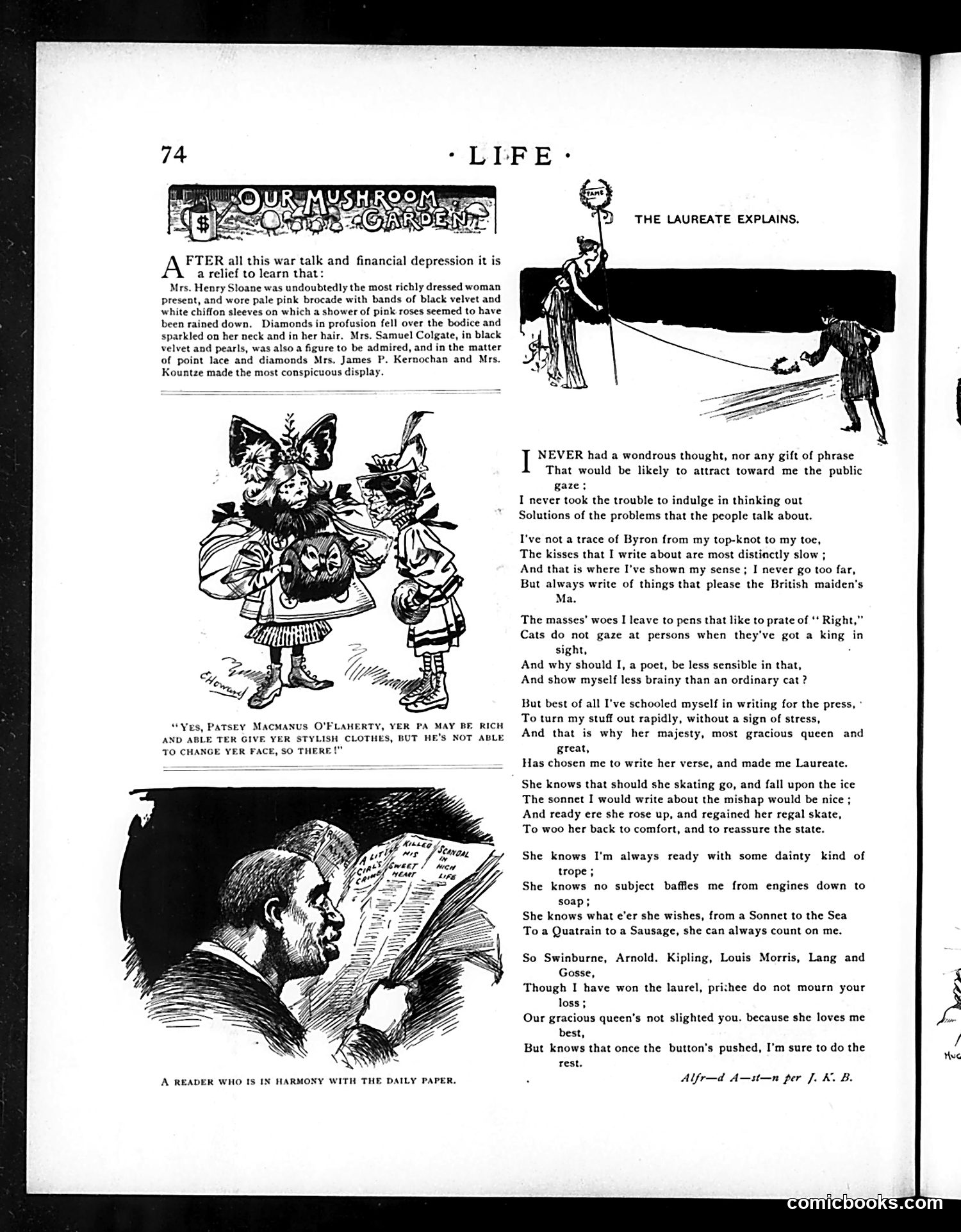
This page features a poem by a newly appointed Poet Laureate of Britain, explaining their approach to writing. The satire mocks the laureate's admission that they deliberately avoid serious subjects—wars, financial crises, social problems—preferring instead light, accessible verse about pleasant topics like ice-skating. The cartoon ridicules this evasion of weighty matters, particularly given the page opens with war and depression references. The poem names several famous male writers (Swinburne, Kipling, Morris, etc.), suggesting the laureate is proud despite writing less substantial work than their predecessors. The lower illustration shows a newspaper reader, contrasting the "harmonious" escapism of the laureate's verse with serious current events demanding attention—the central irony of the satire.
📄 Transcribed text from this page (OCR, searchable)
Machine-transcribed from the original scan — historical spelling and the odd misread are preserved.
Ars all this war talk and financial depression it is a relief to learn that: Mrs. Henry Sloane was undoubtedly the most richly dressed woman present, and wore pale pink brocade with bands of black velvet and white chiffon sleeves on which a shower of pink roses seemed to have been rained down, Diamonds in profusion fell over the bodice and sparkled on her neck and in her hair. Mrs. Samuel Colgate, in black velvet and pearls, was also a figure to be admired, and in the matter of point lace and diamonds Mrs, James P. Kernochan and Mrs. Kountze made the most conspicuous display. “Yes, PATSEY MACMANUS O'FLAHERTY, YER PA MAY BE RICH AND ABLE TER GIVE YER STYLISH CLOTHES, BUT HE'S NOT ABLE TO CHANGE YER FACE, SO THERE!” A READER WHO 1S IN HARMONY WITH THE DAILY PAPER. THE LAUREATE EXPLAINS. NEVER had a wondrous thought, nor any gift of phrase That would be likely to attract toward me the public gaze; I never took the trouble to indulge in thinking out Solutions of the problems that the people talk about. I've not a trace of Byron from my top-knot to my toe, The kisses that I write about are most distinctly slow ; And that is where I've shown my sense ; I never go too far, But always write of things that please the British maiden’s Ma. The masses’ woes I leave to pens that like to prate of ‘* Right,” Cats do not gaze at persons when they've got a king in sight, . And why should I, a poet, be less sensible in that, And show myself less brainy than an ordinary cat ? But best of all I've schooled myself in writing for the press, ° To turn my stuff out rapidly, without a sign of stress, And that is why her majesty, most gracious queen and great, Has chosen me to write her verse, and made me Laureate. She knows that should she skating go, and fall upon the ice The sonnet I would write about the mishap would be nice ; And ready ere she rose up, and regained her regal skate, To woo her back to comfort, and to reassure the state. She knows I'm always ready with some dainty kind of trope ; She knows no subject baffles me from engines down to soap; She knows what e’er she wishes, from a Sonnet to the Sea To a Quatrain to a Sausage, she can always count on me. So Swinburne, Arnold. Kipling, Louis Morris, Lang and Gosse, Though I have won the laurel, prishee do not mourn your loss ; Our gracious queen’s not slighted you. because she loves me best, But knows that once the button’s pushed, I’m sure to do the rest. Alfr—d A—st—n per JK. B.