
Life, 1896-01-30 · page 12 of 20
Life — January 30, 1896 — page 12: what you’re looking at
What you’re looking at
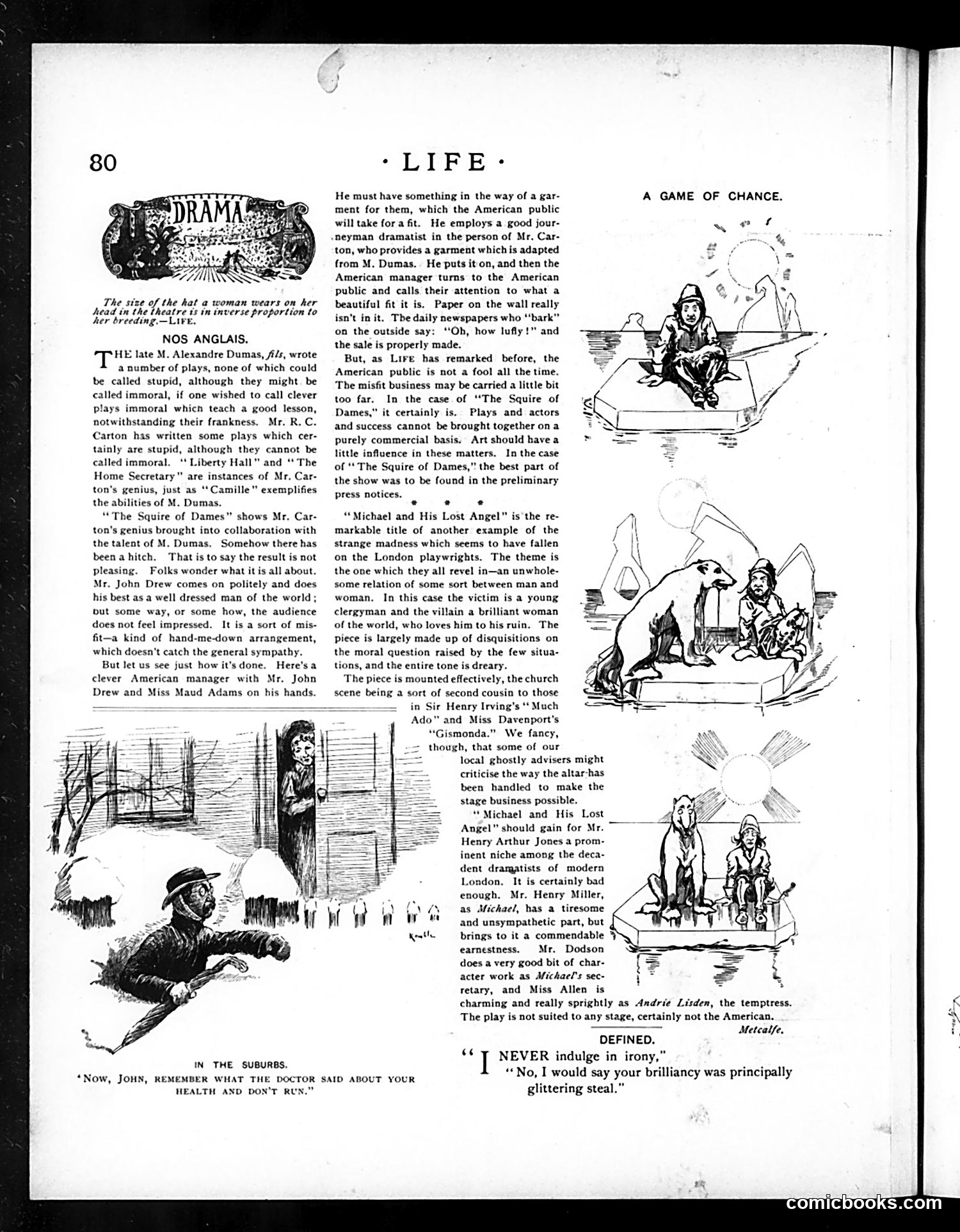
This page combines theater reviews with satirical illustrations. The main text critiques contemporary plays, particularly "The Squire of Dames" (adapted from Alexandre Dumas by R.C. Carton) and "Michael and His Lost Angel" by Henry Arthur Jones. The satire targets commercial theater practices: Life attacks the cynical formula of packaging mediocre American adaptations with star actors (John Drew, Maud Adams) and relying on preliminary press hype rather than artistic merit to fool audiences. The reviewer argues the American public isn't entirely foolish and resents being sold "misfits." The sidebar joke about women's hat sizes in theaters reflects contemporary complaints about obstructed sightlines caused by fashionable, oversized millinery. The right-side illustrations labeled "A Game of Chance" appear to be unrelated satirical drawings, likely commenting on luck or social situations.
📄 Transcribed text from this page (OCR, searchable)
Machine-transcribed from the original scan — historical spelling and the odd misread are preserved.
The size of the hat a woman wears on her Acad in the theatre ts in inverse proportion to her breeding.—LIFE. NOS ANGLAIS, HE late M. Alexandre Dumas, /i/s, wrote a number of plays, none of which could be called stupid, although they might. be called immoral, if one wished to call clever plays immoral which teach a good lesson, notwithstanding their frankness. Mr. R. C. Carton has written some plays which cer- tainly are stupid, although they cannot be called immoral. ‘* Liberty Hall" and ** The Home Secretary” are instances of Mr. Car- ton's genius, just as Camille" exemplifies the abilities of M. Dumas. “The Squire of Dames” shows Mr. Car- ton’s genius brought into collaboration with the talent of M. Dumas, Somehow there has been a hitch. That is to say the result is not pleasing. Folks wonder what itis all about. Mr. John Drew comes on politely and does his best as a well dressed man of the world; but some way, or some how, the audience does not feel impressed. It is a sort of mis- fit—a kind of hand-me-down arrangement, which doesn’t catch the general sympathy. But let us see just how it's done. Here's a clever American manager with Mr. John Drew and Miss Maud Adams on his hands. - LIFE: He must have something in the way of a gar- ment for them, which the American public will take fora fit. He employs a good jour- neyman dramatist in the person of Mr. Car- ton, who provides a garment which is adapted from M. Dumas. He puts it on, and then the American manager turns to the American public and calls their attention to what a beautiful fit it is. Paper on the wall really isn't in it, The daily newspapers who “bark” on the outside say: ‘Ob, how lufly!” and the sale is properly made. But, as Lire has remarked before, the American public is not a fool all the time. ‘The misfit business may be carried a little bit too far. In the case of ‘‘The Squire of Dames,” it certainly is. Plays and actors and success cannot be brought together on a purely commercial basis. Art should have a little influence in these matters. In the case of “* The Squire of Dames," the best part of the show was to be found in the preliminary press notices. * * “Michael and His Lost Angel” is the re- markable title of another example of the strange madness which seems to have fallen on the London playwrights. The theme is the one which they all revel in—an unwhole- some relation of some sort between man and woman. In this case the victim is a young clergyman and the villain a brilliant woman of the world, who loves him to his ruin, The piece is largely made up of disquisitions on the moral question raised by the few situa- tions, and the entire tone is dreary. The piece is mounted effectively, the church scene being a sort of second cousin to those A GAME OF CHANCE. — in Sir Henry Irving's “Much Ado” and Miss Davenport's “Gismonda.” We fancy, = though, that some of our local ghostly advisers might criticise the way the altar-has been handled to make the stage business possible. “Michael and His Lost Angel” should gain for Mr. Henry Arthur Jones a prom- inent niche among the deca- dent dramatists of modern London. It is certainly bad enough. Mr. Henry Miller, as Michael, has a tiresome and unsympathetic part, but J brings to it a commendable earnestness. Mr. Dodson does a very good bit of char- acter work as Michael's sec- retary, and Miss Allen is charming and really sprightly as Andrie Lisden, the temptress. The play is not suited to any stage, certainly not the American. —— Metcalfe. DEFINED. ‘67 NEVER indulge in irony,” “*No, I would say your brilliancy was principally glittering steal.” IN THE SUBURBS. “Now, JOHN, REMEMBER WHAT THE DOCTOR SAID ABOUT YOUR HEALTH AND DON’T RUN.”