
A complete issue · 18 pages · 1895
Life — December 5, 1895
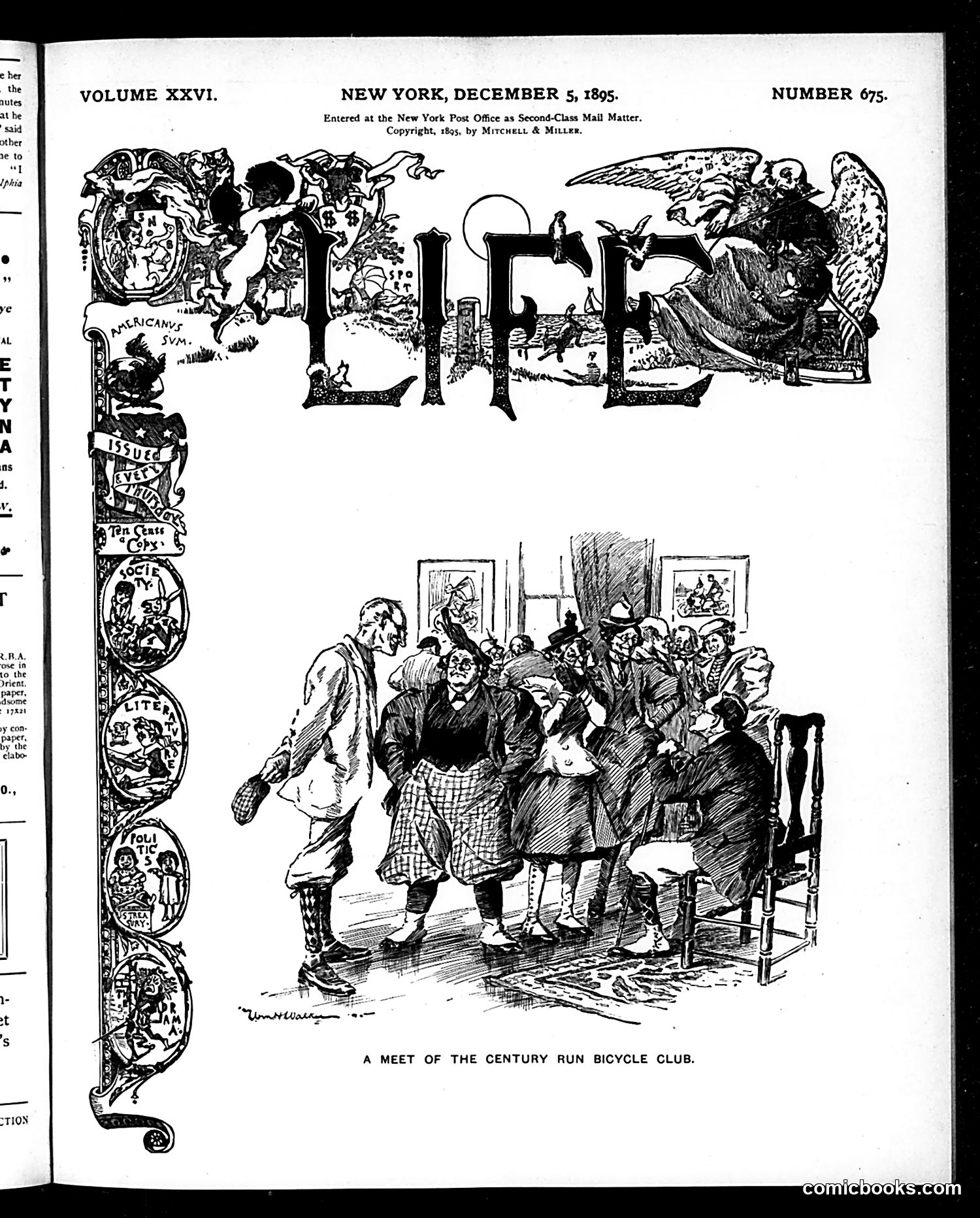
The main cartoon, captioned "A Meet of the Century Run Bicycle Club," depicts what appears to be a social gathering of bicycle club members, shown as a humorous domestic scene. The figure on the left (appearing to be male) addresses a group of women in period dress. The satire likely concerns the bicycle craze of the 1890s and changing social norms—bicycling gave women unprecedented independence and mobility, causing social commentary. The "Century Run" refers to long-distance cycling events popular in that era. The ornamental left border contains decorative medallions with classical references and the Life magazine masthead, typical of the publication's aesthetic. The cartoon's humor appears directed at the social awkwardness or novelty of women's active participation in athletic clubs during the Victorian period.
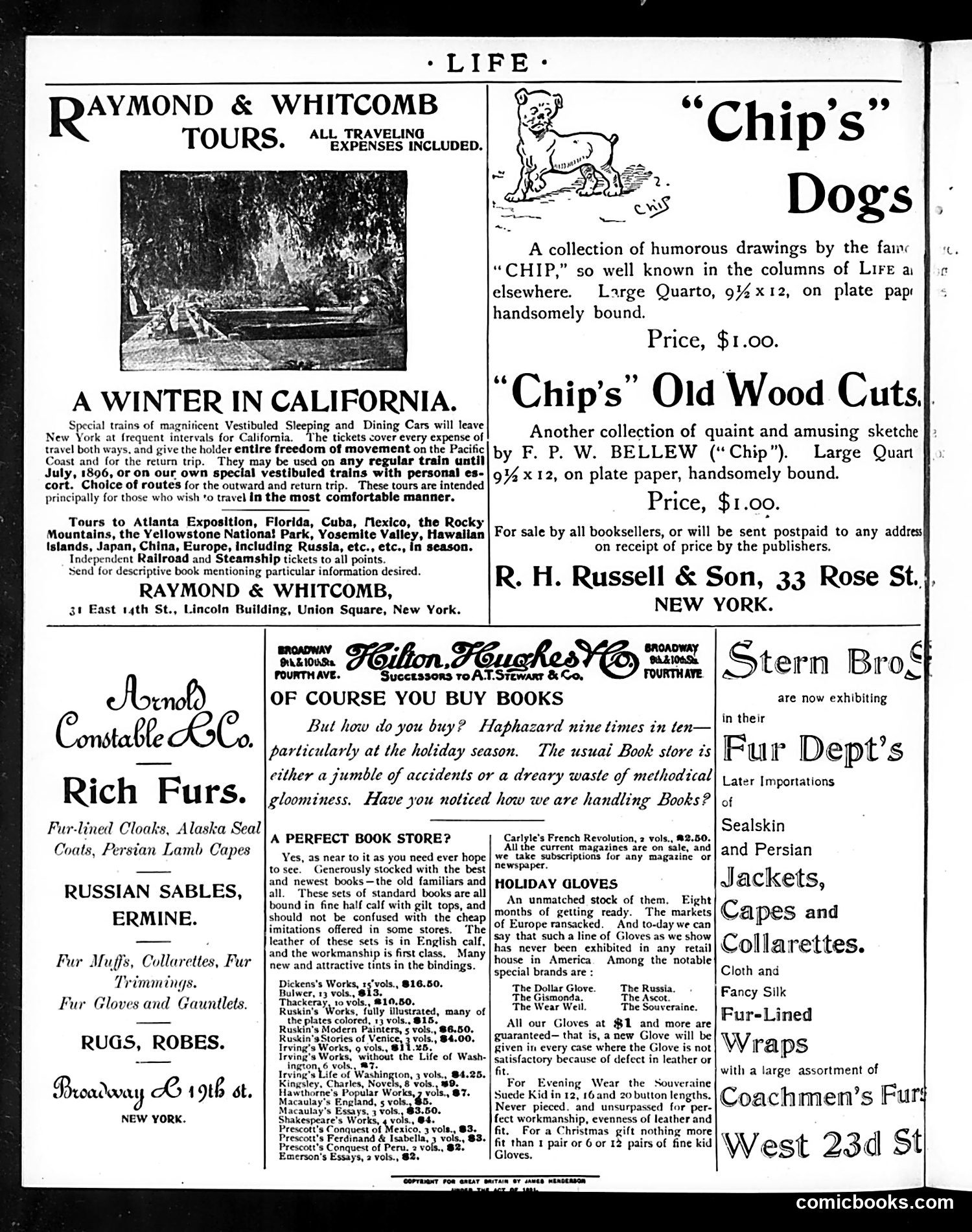
This page is primarily **advertising**, not political satire or comics. It contains several distinct advertisements: 1. **Raymond & Whitcomb Tours** - promoting travel to California and various destinations (Atlanta Exposition, Florida, Cuba, Mexico, Rocky Mountains, Yellowstone, Hawaiian Islands, etc.) 2. **"Chip's" Dogs and Old Wood Cuts** - book collections by an artist known as "Chip," priced at $1.00 each 3. **Halton Hawkes & Co.** - a bookstore discussing how to purchase books, with recommendations for various titles 4. **Arnold Constable & Co.** - selling luxury furs (Russian sables, ermine, fur-lined cloaks) 5. **Stern Bros.** - advertising fur department imports (sealskin, Persian jackets, capes, collars, wraps) The page reflects early 20th-century consumer culture and luxury goods marketing rather than political commentary or humor.
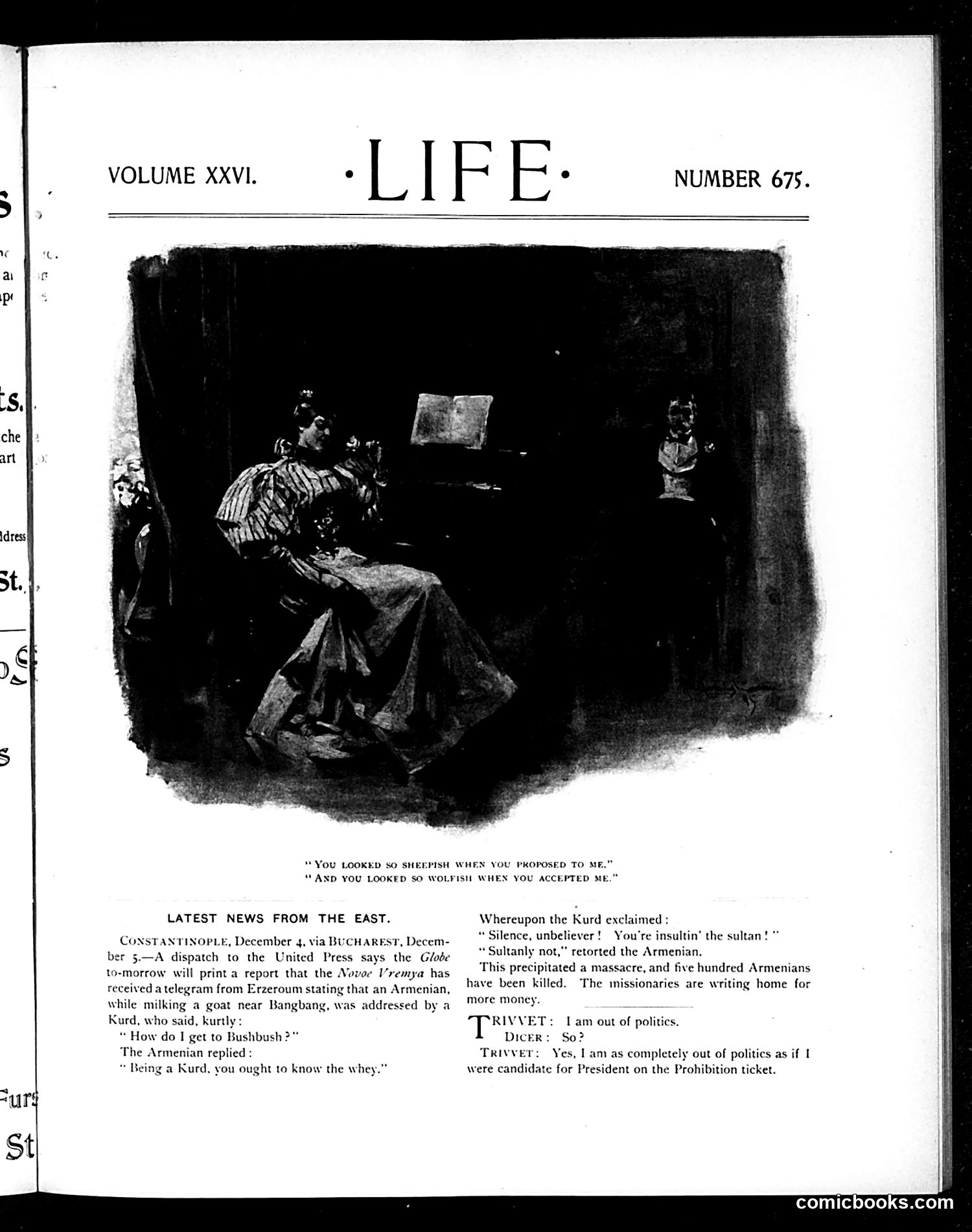
The main cartoon illustrates a dialogue between two figures in an ornate interior. The caption quotes: "You looked so sheepish when you proposed to me" and "And you looked so wolfish when you accepted me." This is a satirical commentary on courtship and marriage dynamics, suggesting that romantic partners present false personas during courtship—one appearing innocent ("sheepish"), the other predatory ("wolfish")—only to reveal their true natures after engagement. Below, "Latest News from the East" contains a joke about an Armenian milking a goat near Bianybang who is addressed by a Kurdish man asking directions to Bushbush. The humor relies on the absurdity of the place names and the ethnic/cultural misunderstanding between characters, typical of period satire.
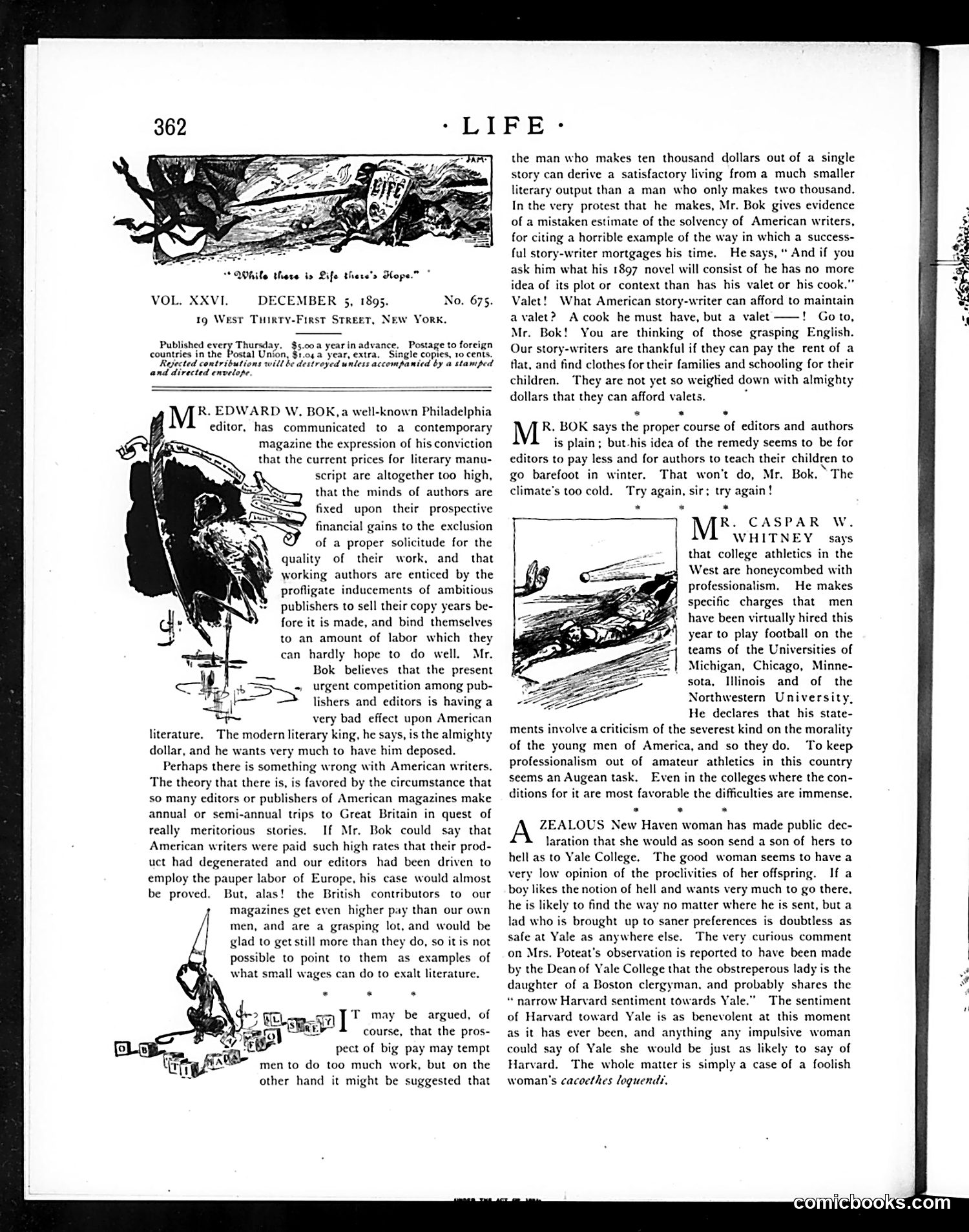
This page contains editorial commentary rather than political cartoons. The illustrations are decorative vignettes accompanying text. **Main content:** Editor Edward W. Bok argues that American literary magazines pay writers too little, forcing them into poverty. He suggests this practice harms American literature's quality, while British magazines pay better rates and thus attract superior contributors. **Secondary items:** - Caspar W. Whitney criticizes college football teams for hiring professional players, compromising amateur athletics - A brief note mocks a New Haven woman who declared she'd send her son to hell rather than Yale, with sarcastic commentary on regional college rivalries The decorative illustrations—including what appears to be a jester figure and scattered objects—serve as visual interest rather than conveying specific satirical meaning about identified individuals.
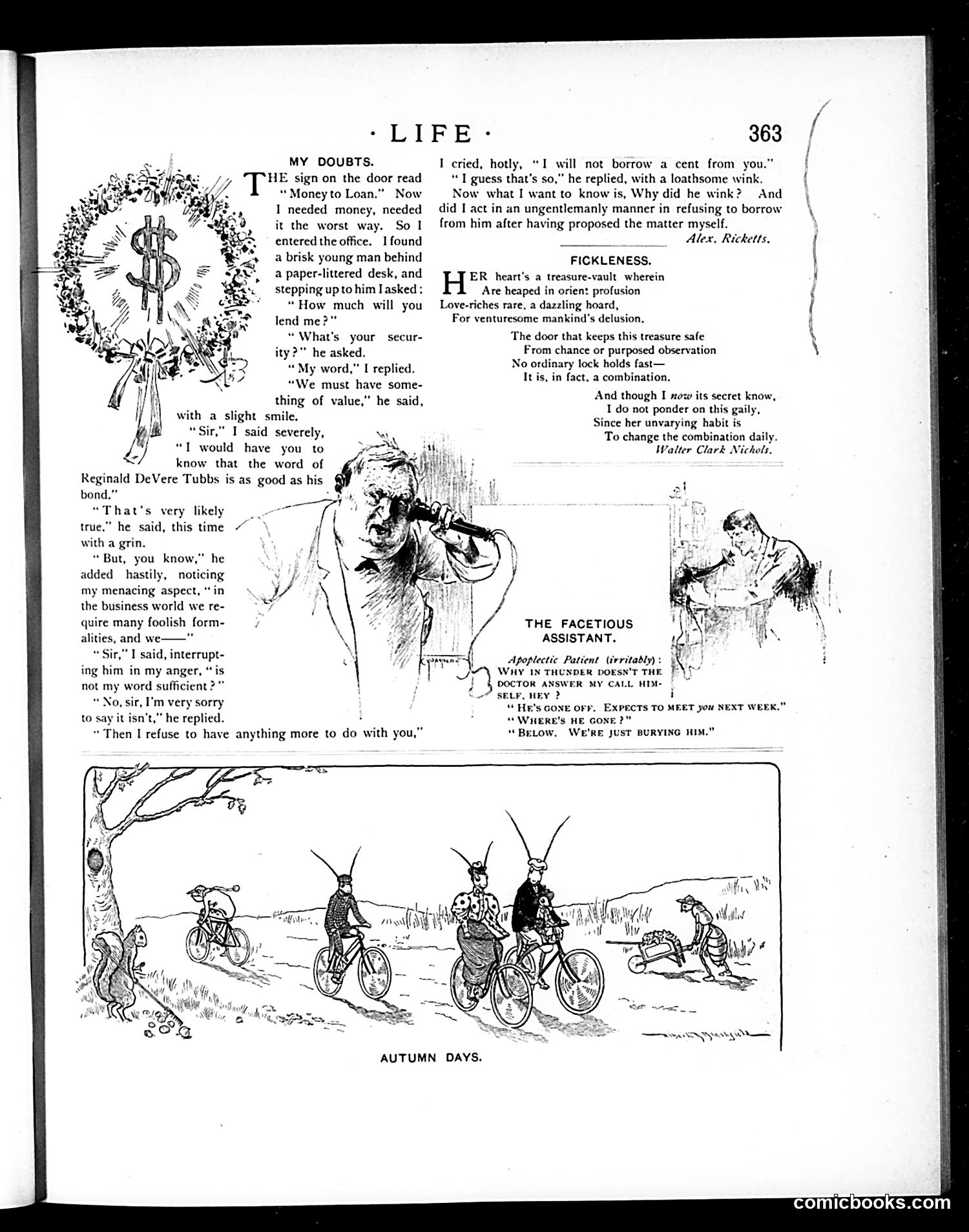
**"My Doubts" (Top Left):** A satirical anecdote about borrowing money. A man seeks a loan from a young banker, offering his "word" as security. The banker dismissively responds that Reginald DeVere Tubbs's endorsement would be worthless—a joke about someone apparently known for unreliability. The punchline mocks the narrator's angry response to being called an insufficient guarantee, suggesting his reputation is equally questionable. **"Fickleness" (Poetry):** A poem about a woman with a changeable combination lock, satirizing female inconsistency—a period stereotype. **"The Facetious Assistant":** A brief joke about a doctor's absence, playing on miscommunication: the patient believes the doctor is dead rather than unavailable. **"Autumn Days" (Bottom):** A whimsical illustration of cyclists with antenna-like protrusions, likely representing eccentric autumn recreation or contemporary cycling culture.
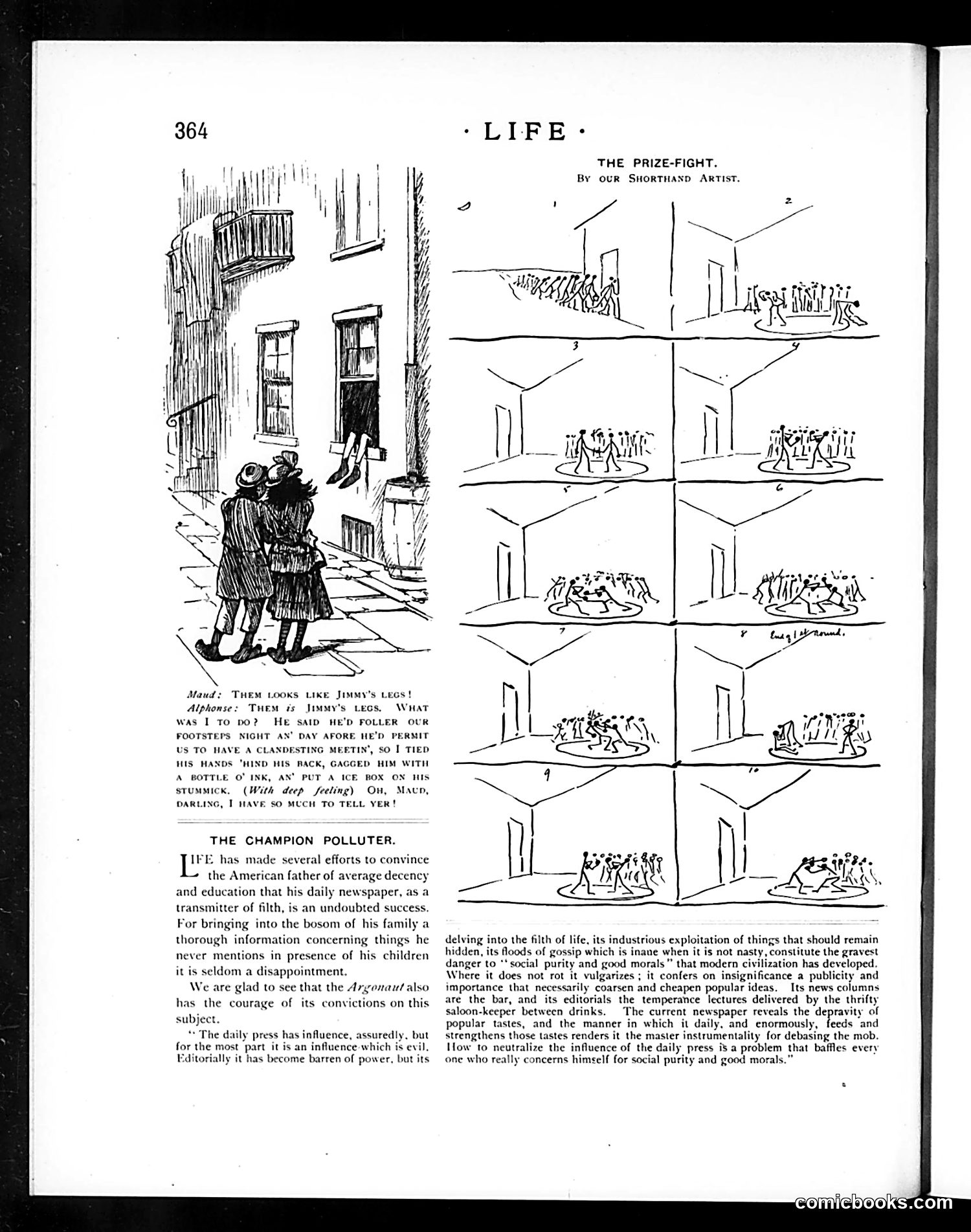
**"The Prize-Fight"** (top right): A shorthand artist's sequential comic depicting a boxing match, showing the fight's progression through 12 numbered panels with increasing action and apparent chaos. **"The Champion Polluter"** (bottom): An editorial criticizing an unnamed American newspaper of "average decency and education" that spreads "filth" and gossip. The piece condemns the paper's influence on family morality, calling it a transmitter of indecency. The text attacks yellow journalism's exploitation of scandal and sensationalism, arguing that newspapers function as a corrupting force in society—specifically targeting their role in degrading "social purity and good morals" among the population. This reflects Progressive Era concerns about media ethics and tabloid sensationalism.
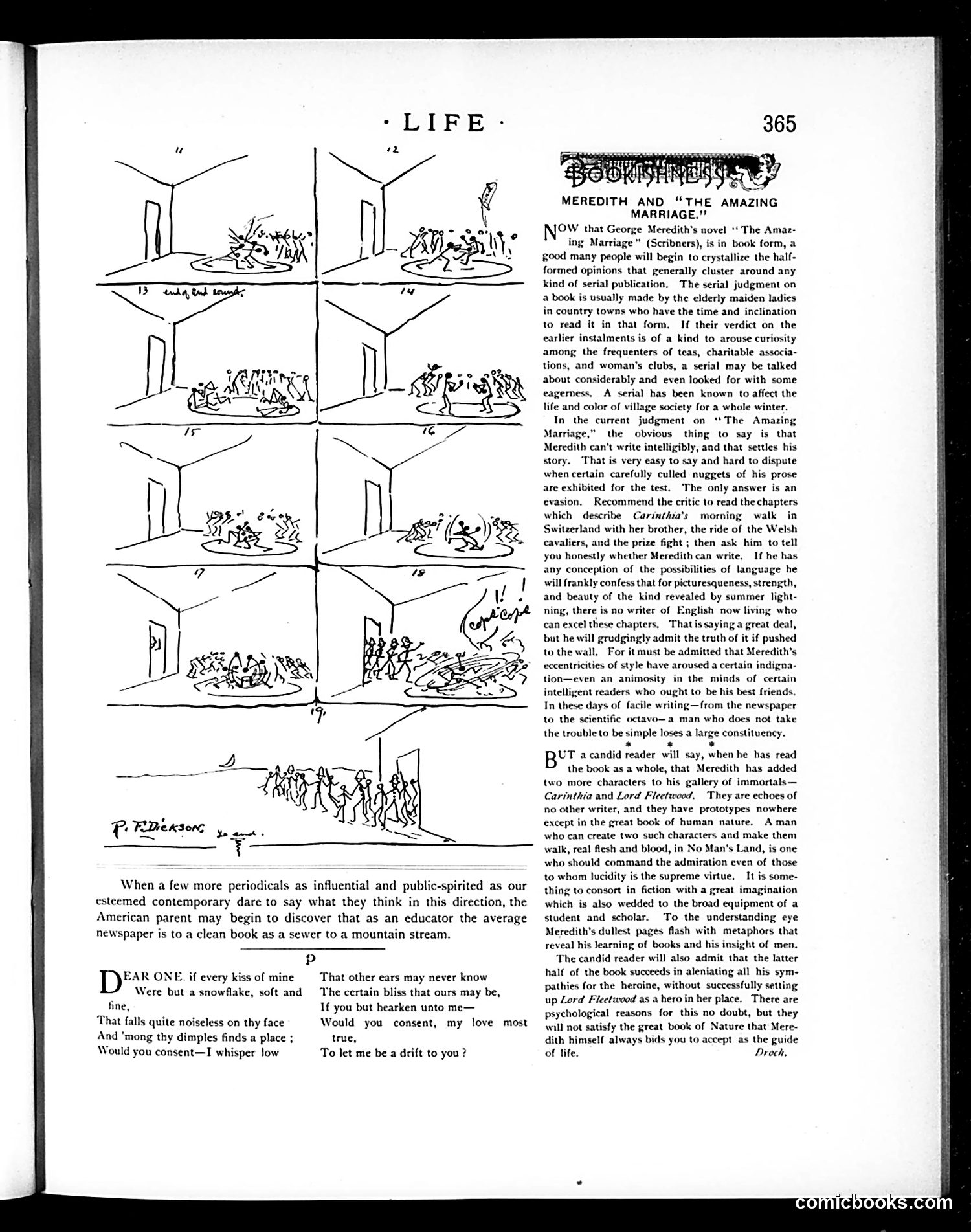
This page contains a multi-panel cartoon (credited to F. Ridgerson) showing nine sequential scenes of what appears to be a building interior, with simplified figures engaged in various activities. The panels seem to depict escalating chaos or disorder within the space—figures become more numerous and animated as the sequence progresses downward. Below the cartoon is a poem beginning "Dear one, if every kiss of mine / Were but a snowflake, soft and fine..." The right column contains a book review of George Meredith's novel "The Amazing Marriage," discussing its serialization in publications and Meredith's literary style and character development. **The cartoon's specific satirical meaning is unclear without additional context.** It may comment on social disorder or institutional dysfunction, but the exact subject cannot be definitively determined from the image alone.
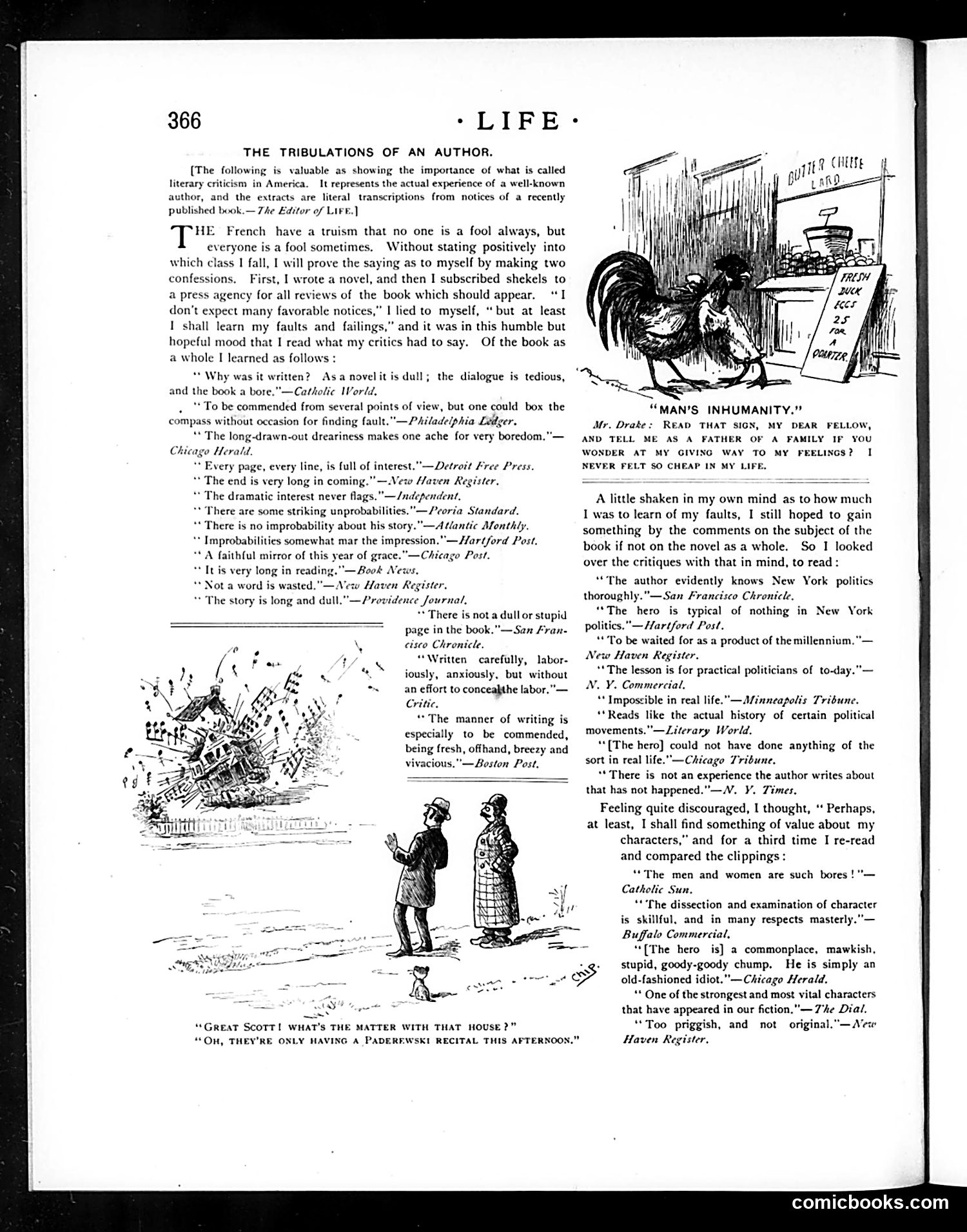
This page satirizes literary criticism and publishing. The main cartoon shows a rooster reading a sign labeled "BUTTER AND LARD" in what appears to be a shop—captioned "Man's Inhumanity," depicting an author's humiliation at harsh reviews. The lengthy text consists of real critical quotes (attributed to publications like *Catholic World*, *Philadelphia Ledger*, *Chicago Herald*) about an unnamed novel—mixing genuine praise with cutting dismissal. The author confesses subscribing to a press clipping service, hoping critics would find merit despite poor sales. The lower cartoon shows two well-dressed men discussing a "Paderewski recital," suggesting contrast between musical and literary reception. The satire targets the disparity between critical reception and commercial success, and the author's anxious dependence on critical validation during the publishing process.
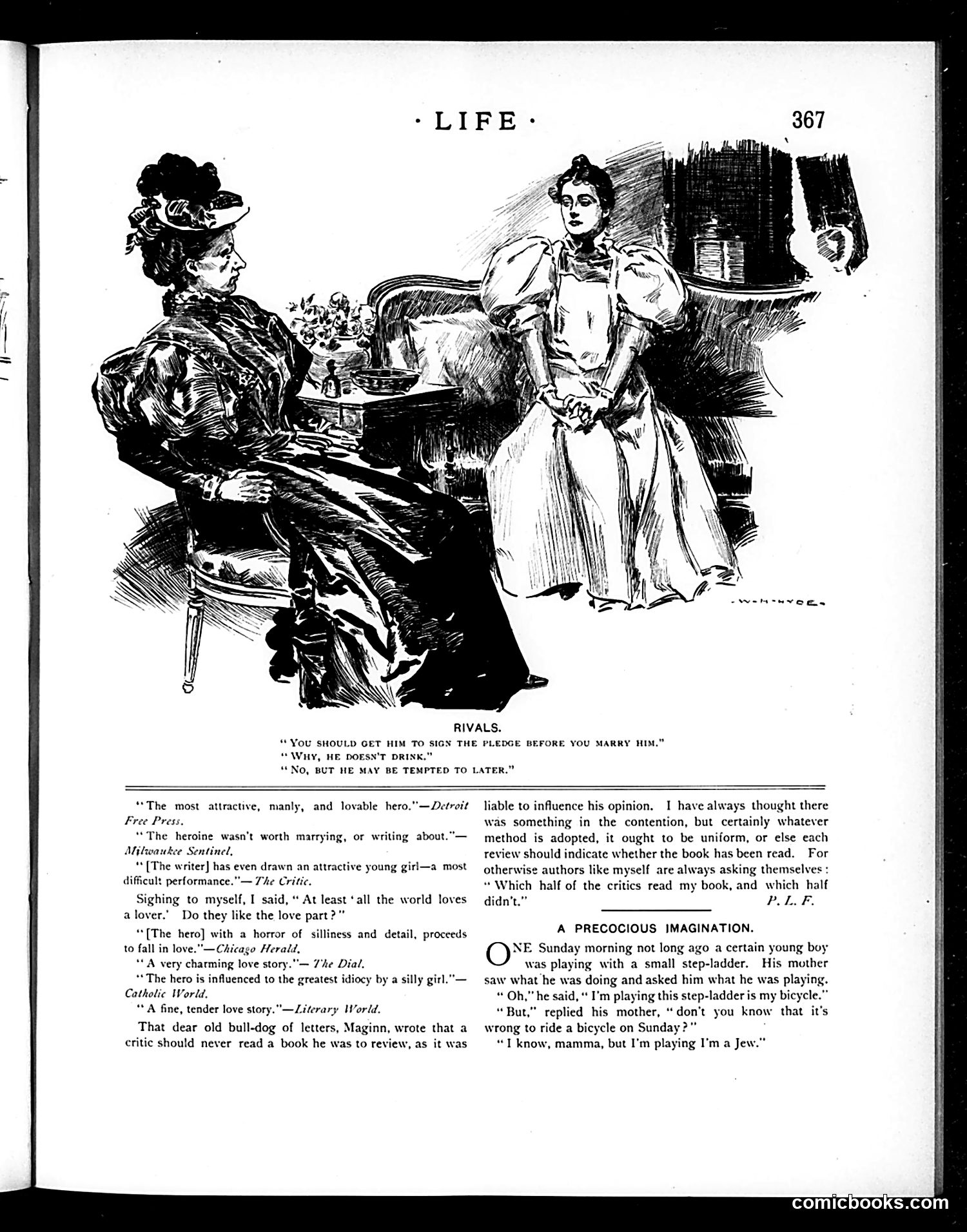
This page contains a satirical cartoon titled "RIVALS" depicting two women in Victorian-era dress in what appears to be a domestic interior. The caption reads: "You should get him to sign the pledge before you marry him" / "Why, he doesn't drink" / "No, but he may be tempted to later." The cartoon satirizes anxieties about male temperance and marriage, playing on contemporary concerns about alcohol and men's susceptibility to drinking. The "pledge" refers to temperance movement pledges abstaining from alcohol—a major social issue of the era. The page also includes various literary reviews and quotes praising a romantic hero character, suggesting this excerpt discusses courtship and marriage ideals in contemporary literature.
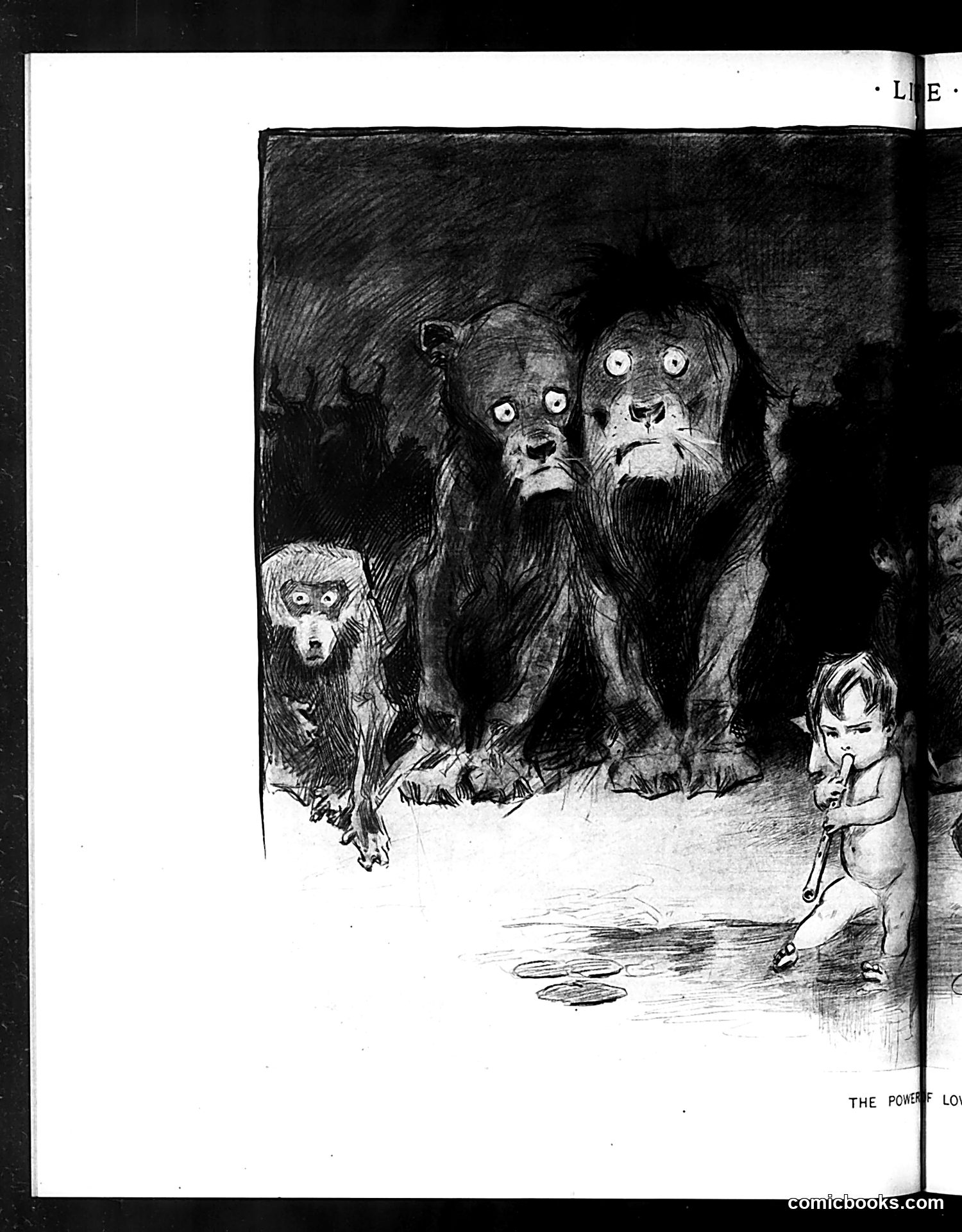
This appears to be a satirical illustration depicting a child confronting large, menacing ape-like creatures in a dark setting. The style and composition suggest it's critiquing something through animal allegory—a common technique in early 20th-century political cartooning. The title fragment "THE POWER OF LO[VE]" (visible at bottom right) indicates this likely uses sentimental or moral messaging ironically. The small, vulnerable human figure contrasted against the grotesque, large creatures suggests a commentary on power imbalances or humanity facing overwhelming, dehumanized forces. However, without the complete page title, date, or additional context, I cannot definitively identify which specific political figures or events this references. The crude characterization of the apes may invoke period racial stereotypes common to the era's problematic satirical conventions.
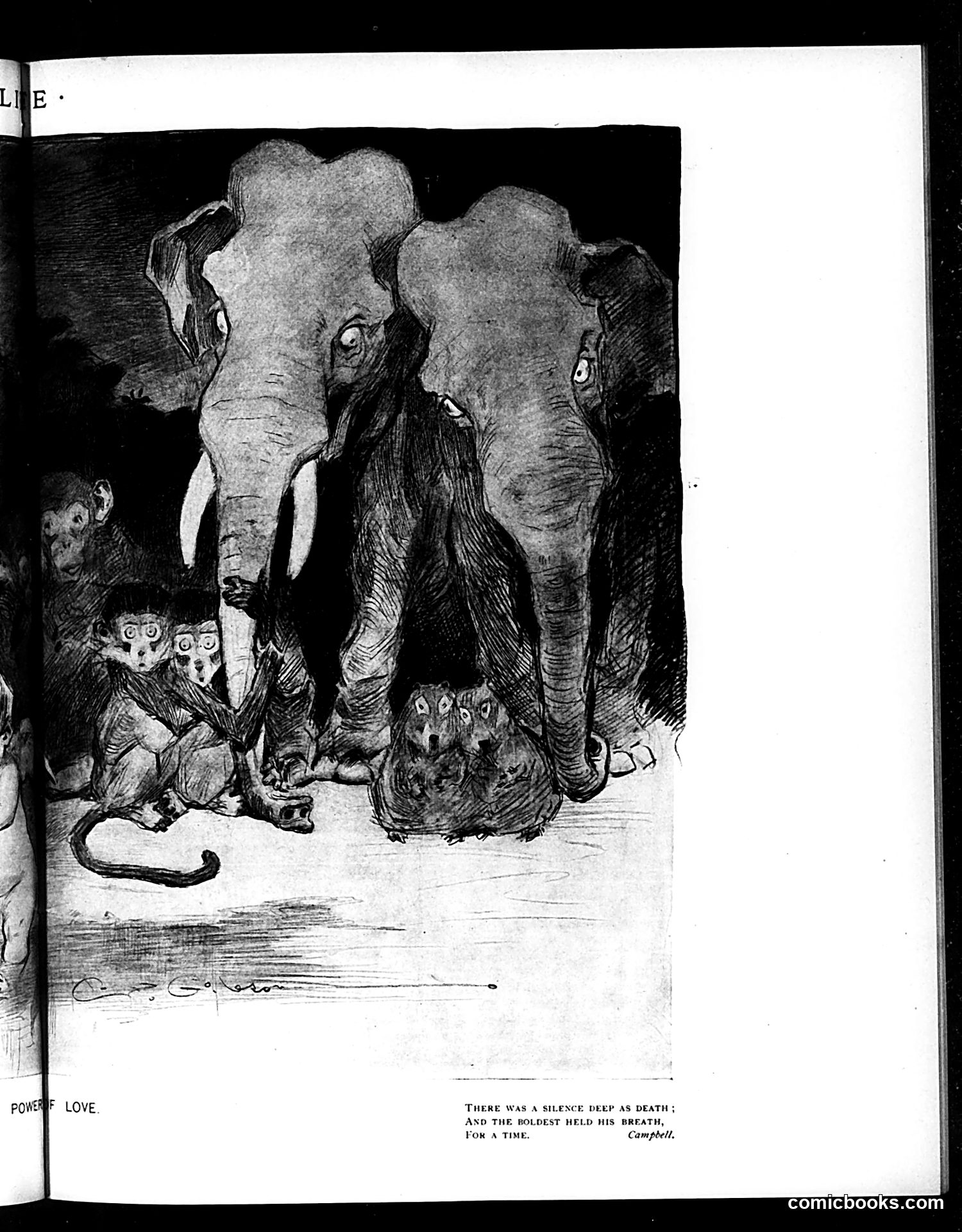
This political cartoon depicts two elephants surrounded by smaller animals (appearing to be monkeys and rats). The elephants likely represent major political powers or figures of the era. The smaller creatures gathered around them suggest lesser nations or populations under their influence or control. The caption quotes Campbell: "There was a silence deep as death; and the boldest held his breath, for a time." The "Power of Love" title appears ironic—the image suggests tension, dominance, and subordination rather than affection. This likely critiques international power dynamics or imperialism, where larger nations exert control over smaller ones. The quoted literary reference emphasizes the gravity and fear inherent in these relationships, rather than any genuine mutual regard or love.
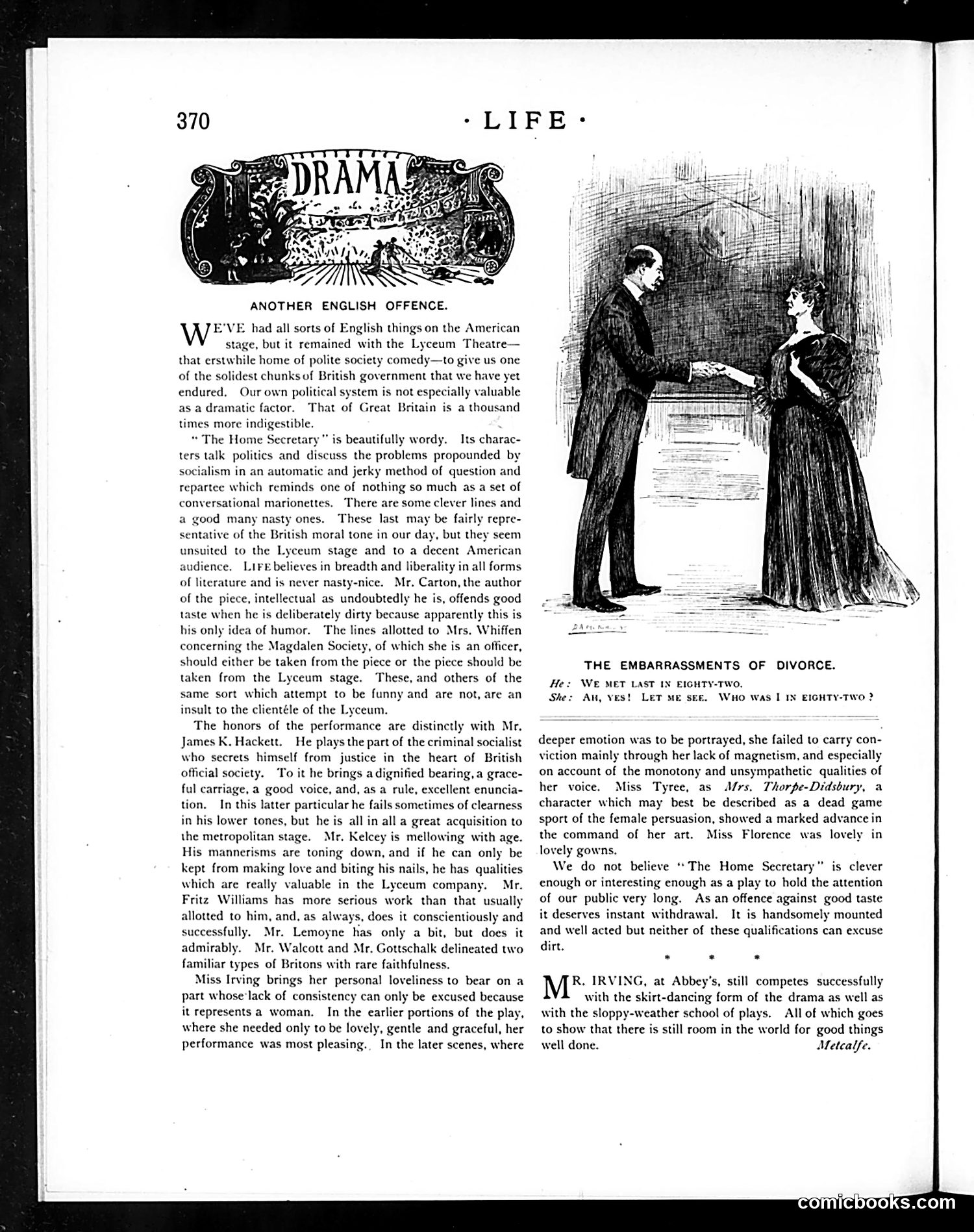
This *Life* drama review critiques a Lyceum Theatre production of "The Home Secretary," a British play the critic finds tediously political and deliberately crude. The main complaint is that the play imports British governmental debate—described as "indigestible"—to the American stage, where it doesn't belong. Author Mr. Carton apparently uses dirty humor as a substitute for wit, offending the magazine's standards. The accompanying illustration, captioned "The Embarrassments of Divorce," shows a couple who haven't seen each other since 1882 awkwardly pretending they don't remember their marriage—a visual joke about the social awkwardness surrounding divorce in that era. It's satirizing how divorced people would encounter each other in society and feign amnesia about their past relationship. Both items reflect *Life*'s concern with theatrical taste and social propriety during the Edwardian period.
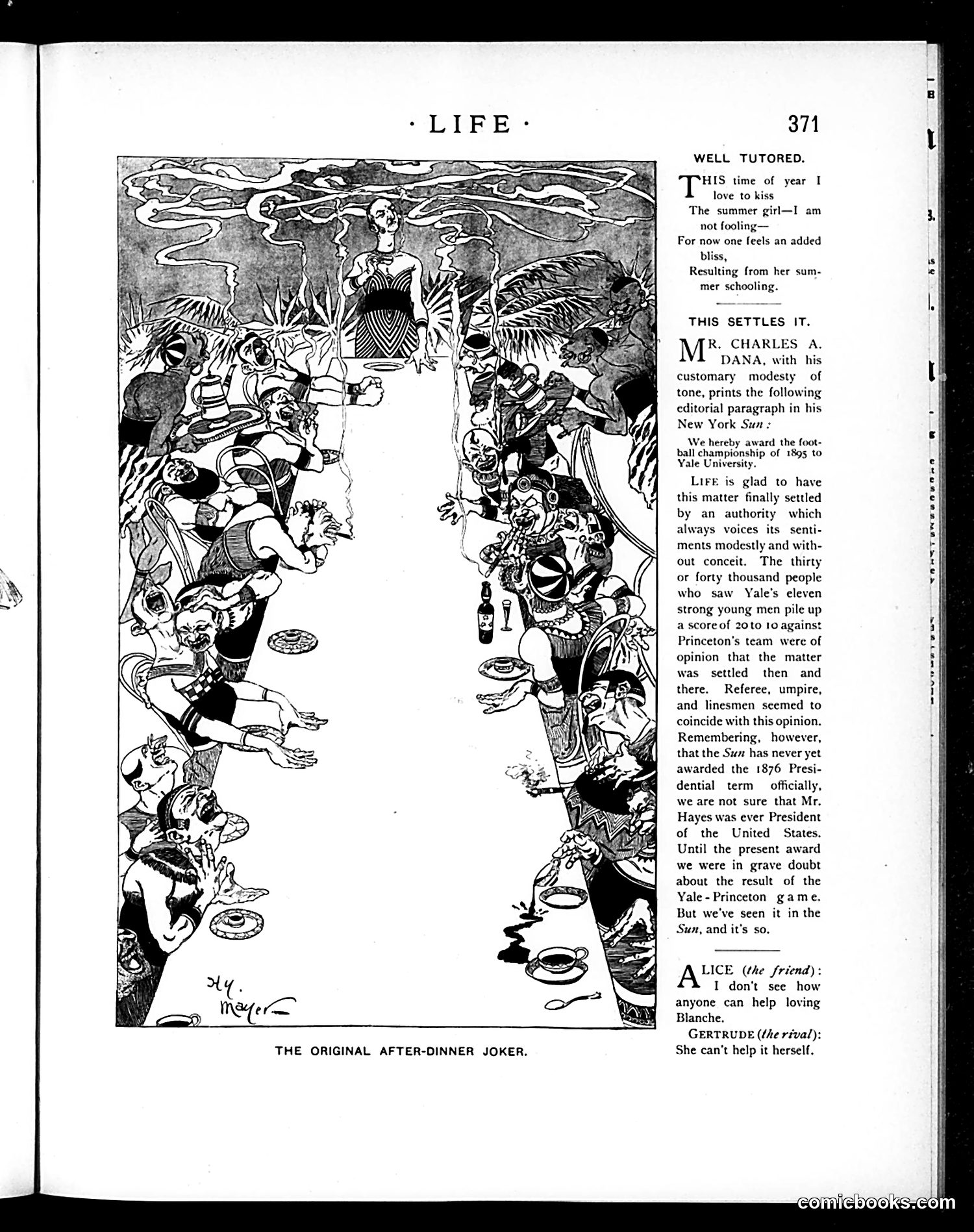
This page contains satirical commentary on two topics: **"The Original After-Dinner Joker"** (the elaborate cartoon): A chaotic dinner scene with numerous caricatured figures engaged in revelry. The satire appears to mock after-dinner entertainment and social pretension, though specific identities aren't clearly indicated in the visible text. **"This Settles It"**: Life ridicules Charles A. Dana, editor of the New York *Sun*, for pompously "awarding" the 1895 football championship to Yale in his newspaper. The joke is that 30,000-40,000 people witnessed the Yale-Princeton game and officials already determined the outcome—Dana's editorial declaration adds nothing. Life sarcastically compares this to Dana's paper never officially awarding the 1876 presidential term to Rutherford B. Hayes, suggesting the *Sun's* pronouncements carry no actual authority. The pieces below are brief romantic verse and dialogue about summer romance and a rival named Blanche.
This page from *Life* magazine contains **three humorous anecdotes** satirizing domestic life and absent-mindedness: 1. **"At Scissors at Nullus"** (top): A wife asks her cook where the pug dog disappeared. The cook replies he "missed the last boat"—a sarcastically clever response mocking her husband's habitual excuse for coming home late. 2. **The Detective Story**: A wife bursts into a detective's office demanding her husband be found, then aggressively contradicts the detective's polite demurrals, lecturing him about her tax contributions funding his salary. The satire targets both her overbearing manner and the detective's feeble response. 3. **The Doctor and Irishman**: An Irish patient claims pills made him worse because "the cover hasn't come off the box"—a joke about literal-minded incompetence. The page satirizes **marital conflict, female assertiveness, and working-class stupidity** in early-1900s domestic settings. The humor relies on exaggerated character types rather than specific political references.
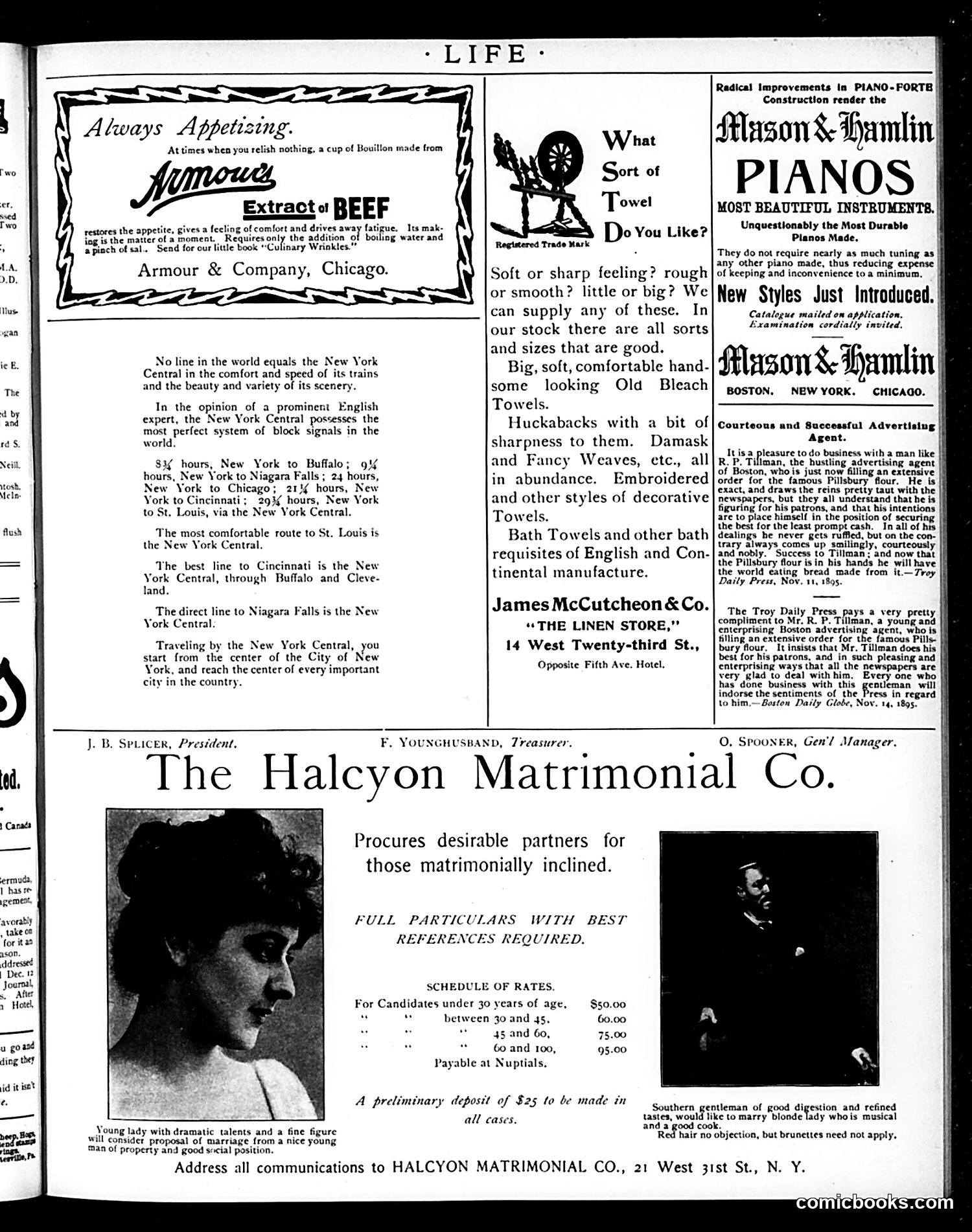
This page is primarily **advertising and promotional content**, not satirical editorial cartoons. **Main Content:** The page features ads for conventional consumer products: Armour beef extract, New York Central Railroad service (emphasizing speed and comfort), James McCutcheon linen goods, and Mason & Hamlin pianos. **The Halcyon Matrimonial Company Advertisement:** The lower half contains a striking advertisement for a **marriage-brokerage service** ("matchmaking agency"). It promises to "procure desirable partners for those matrimonially inclined," with a fee schedule based on age (ranging from $50-$95) and requirement of references and a $25 deposit. Two photographs show prospective clients—a young woman described as having "dramatic talents and a fine figure" and a "Southern gentleman of good digestion and refined tastes" who is musical and a good cook. **Historical Context:** This reflects a real (if discreet) commercial matrimonial industry of the 1890s, before internet dating. The frank commodification and bureaucratic pricing of marriage-matching is jarring to modern sensibilities, though this was apparently routine advertising in the era.
This cartoon satirizes a common turn-of-century American theme: the city man's failed attempt to intimidate rural villagers through bluffing about urban toughness. The narrator, a city dweller who moves to Hayville, boasts to locals about his Bowery adventures and encounters with a "Broadway policeman" (dating this to pre-Roosevelt era), hoping to scare them away from his rented pear trees. He claims he's set man-traps and booby-traps. **The joke:** The villagers, unimpressed by his bluster, steal his pears anyway on the first night. When confronted, the local justice of the peace appears—the same man whose pitchfork was used to pull down the pears—claiming *he* was the victim, needing the city man's help recovering his property. The satire mocks the narrator's misplaced confidence that city toughness translates to rural settings, and suggests rural folk possess a cleverer, more practical intelligence than the city man recognizes. His Bowery tales prove worthless against genuine country cunning.
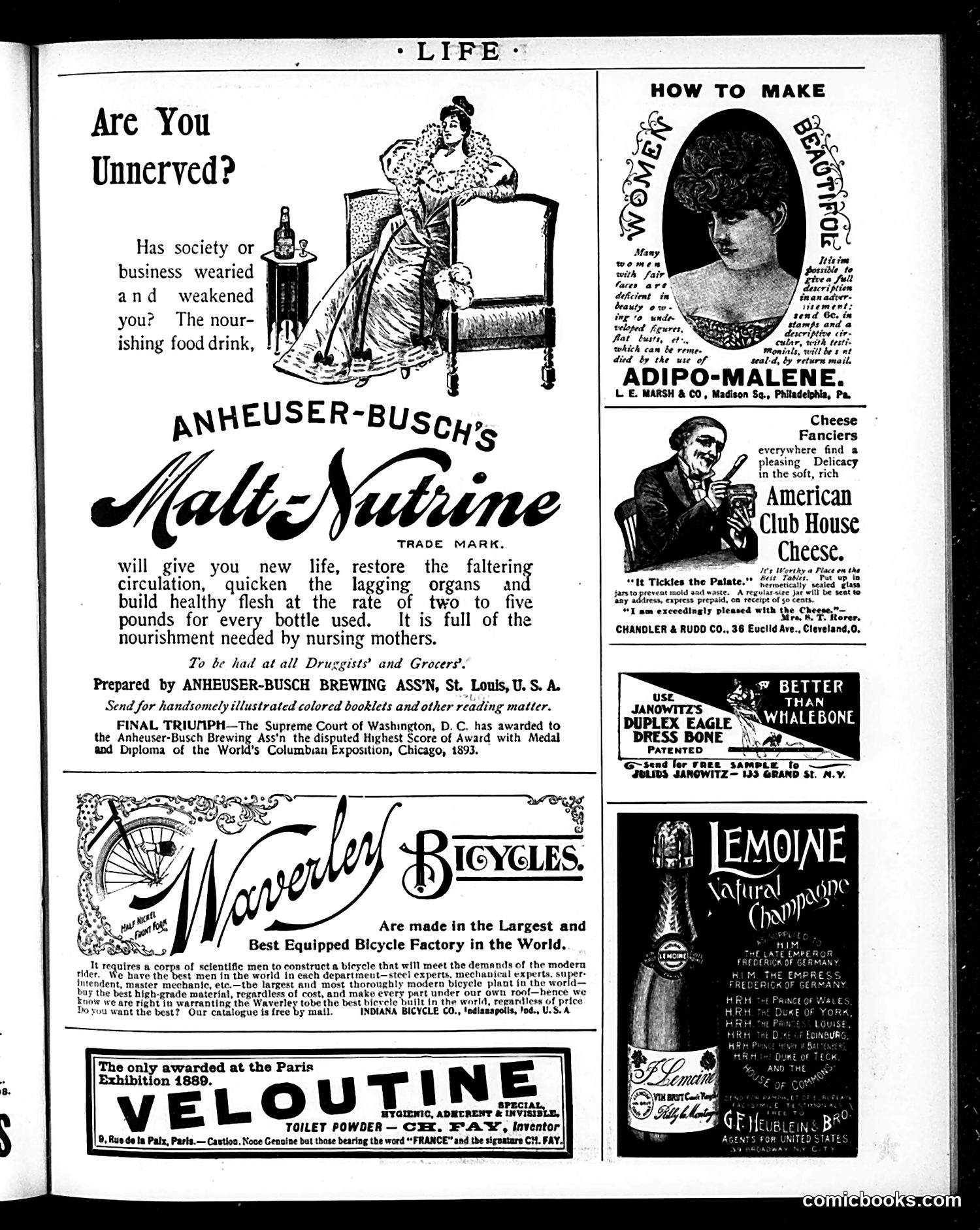
This is primarily an **advertising page** with no political cartoons or satire. It contains six commercial advertisements typical of the 1890s era: **Key advertisements include:** - **Anheuser-Busch's Malt Nutrine**: A "nourishing food drink" claimed to restore health, build flesh, and aid nursing mothers—reflecting Victorian-era patent medicine marketing - **Waverley Bicycles**: Emphasizes scientific construction and American manufacturing superiority - **Adipo-Malene**: A beauty product promising to beautify women's faces (with testimonial imagery) - **American Club House Cheese**: Marketed as a delicacy - **Veloutine**: French toilet powder, awarded at Paris Exhibition 1889 - **Janowitz's Duplex Eagle Dress Bone**: Corset stiffening product **Historical context**: These ads reveal late-19th-century consumer culture priorities: health tonics, beauty enhancement, sporting goods, and domestic/fashion products. The emphasis on scientific credentials and international awards reflects contemporary marketing strategies targeting middle-class consumers.
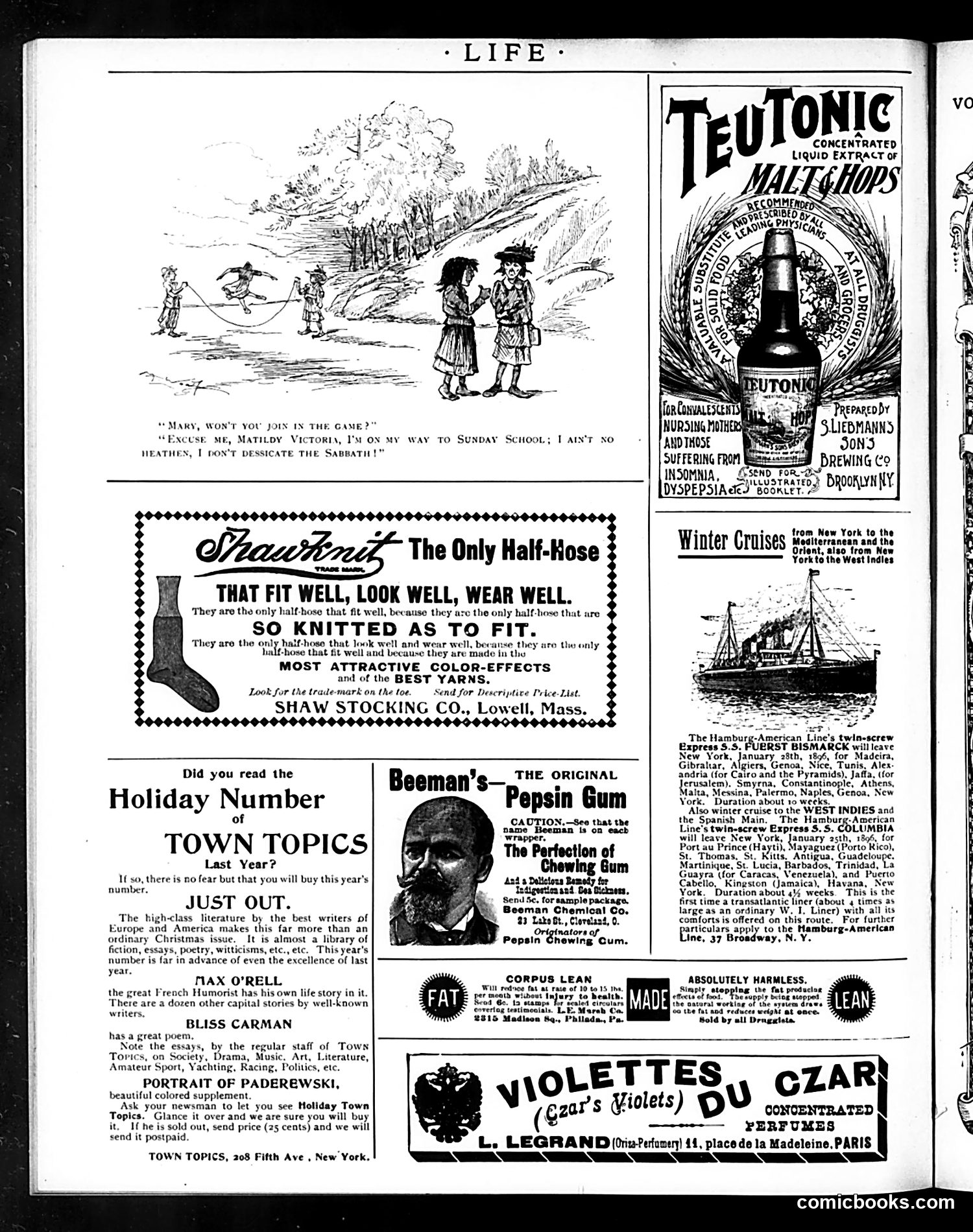
The main cartoon depicts a religious child rejecting playmates' invitation to join a game, claiming she must attend Sunday School and won't "desecrate the Sabbath." The satire targets Victorian-era religious hypocrisy—the child's ostentatious piety contrasts with the era's casual attitude toward strict Sabbath observance. By the 1890s-1900s (when this appears), such rigid religious posturing was increasingly seen as outdated and amusing. The page is primarily **advertisement-heavy**, featuring: - Shaw stockings (half-hose) - Teutonic malt extract tonic - Beeman's Pepsin gum - Hamburg-American Line cruise ships - Violettes Du Czar perfume A sidebar promotes Life's "Holiday Number" featuring Max O'Rell (French humorist) and poet Bliss Carman, marketing the literary quality of this special issue. The cartoon's humor relies on readers finding excessive religiosity quaint or hypocritical—a social attitude that has substantially shifted in modern times.