
Life, 1895-12-05 · page 7 of 18
Life — December 5, 1895 — page 7: what you’re looking at
What you’re looking at
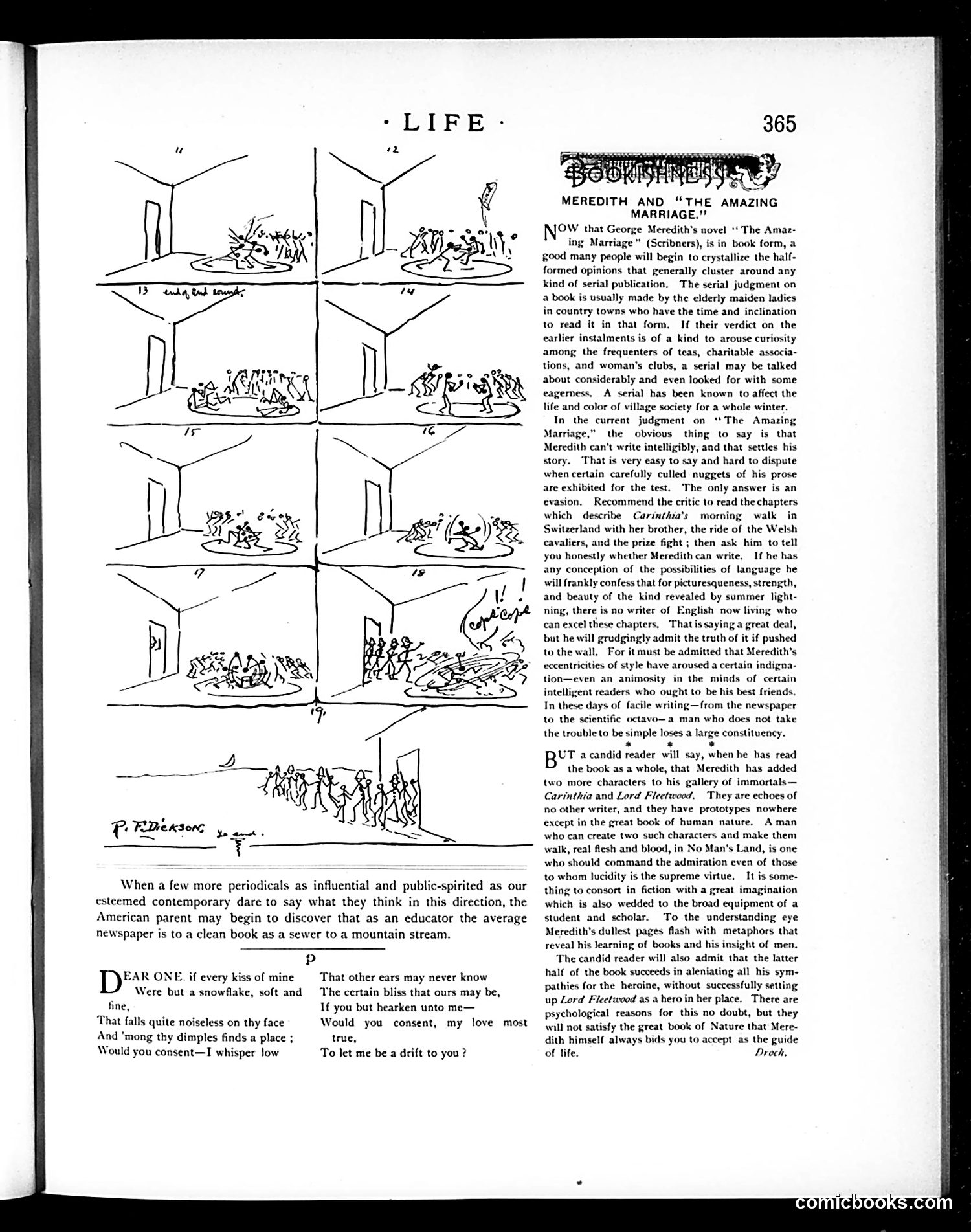
This page contains a multi-panel cartoon (credited to F. Ridgerson) showing nine sequential scenes of what appears to be a building interior, with simplified figures engaged in various activities. The panels seem to depict escalating chaos or disorder within the space—figures become more numerous and animated as the sequence progresses downward. Below the cartoon is a poem beginning "Dear one, if every kiss of mine / Were but a snowflake, soft and fine..." The right column contains a book review of George Meredith's novel "The Amazing Marriage," discussing its serialization in publications and Meredith's literary style and character development. **The cartoon's specific satirical meaning is unclear without additional context.** It may comment on social disorder or institutional dysfunction, but the exact subject cannot be definitively determined from the image alone.
📄 Transcribed text from this page (OCR, searchable)
Machine-transcribed from the original scan — historical spelling and the odd misread are preserved.
When a few more periodicals as influential and public-spirited as our esteemed contemporary dare to say what they think in this direction, the American parent may begin to discover that as an educator the average newspaper is to a clean book as a sewer to a mountain stream. p AR ONE. if every kiss of mine That other ears may never know Were but a snowflake, soft and The certain bliss that ours may be, fine, If you but hearken unto me— That falls quite noiseless on thy face Would you consent, my love most And ‘mong thy dimples finds a place ; true, Would you consent—I whisper low To let me be a drift to you? MEREDITH AND “THE AMAZING MARRIAGE." NOW that George Meredith's novel “The Amaz- ing Marriage” (Scribners), is in book form, a good many people will begin to crystallize the half- formed opinions that generally cluster around any kind of serial publication. The serial judgment on a book is usually made by the elderly maiden ladies in country towns who have the time and inclination to read it in that form. If their verdict on the earlier instalments is of a kind to arouse curiosity among the frequenters of teas, charitable associa- tions, and woman's clubs, a serial may be talked about considerably and even looked for with some eagerness. A serial has been known to affect the life and color of village society for a whole winter. In the current judgment on ‘The Amazing Marriage,” the obvious thing to say is that Meredith can’t write intelligibly, and that settles his story. ‘That is very easy to say and hard to dispute when certain carefully culled nuggets of his prose are exhibited for the test. The only answer is an evasion. Recommend the critic to read the chapters which describe Carinthia's morning walk in Switzerland with her brother, the ride of the Welsh cavaliers, and the prize fight ; then ask him to tell you honestly whether Meredith can write. If he has any conception of the possibilities of language he ill frankly confess that for picturesqueness, strength, and beauty of the kind revealed by summer light- ning, there is no writer of English now living who can excel these chapters. ‘That is saying a great deal, but he will grudgingly admit the truth of it if pushed to the wall. For it must be admitted that Meredith's eccentricities of style have aroused a certain indigna- tion—even an animosity in the minds of certain intelligent readers who ought to be his best friends. In these days of facile writing—from the newspaper to the scientific octavo—_a man who does not take the troubleto be simple loses a lange constituency. * BUT a candid feaderwill say, when hn’ bas'read the book asa whole, that Meredith has added two more characters to his gallery of immortals— Carinthia and Lord Fleetwood, They are echoes of no other writer, and they have prototypes nowhere except in the great book of human nature, A man who can create two such characters and make them walk, real flesh and blood, in No Man’s Land, is one who should command the admiration even of those to whom lucidity is the supreme virtue, It is some- thing to consort in fiction with a great imagination which is also wedded to the broad equipment of a student and scholar. To the understanding eye Meredith's dullest pages flash with metaphors that reveal his learning of books and his insight of men. ‘The candid reader will also admit that the latter half of the book succeeds in aleniating all his sym- pathies for the heroine, without successfully setting up Lord Fleetwood as a heroin her place. There are psychological reasons for this no doubt, but they will not satisfy the great book of Nature that Mere- dith himself always bids you to accept as the guide of life. Droch.