
Life, 1895-12-05 · page 4 of 18
Life — December 5, 1895 — page 4: what you’re looking at
What you’re looking at
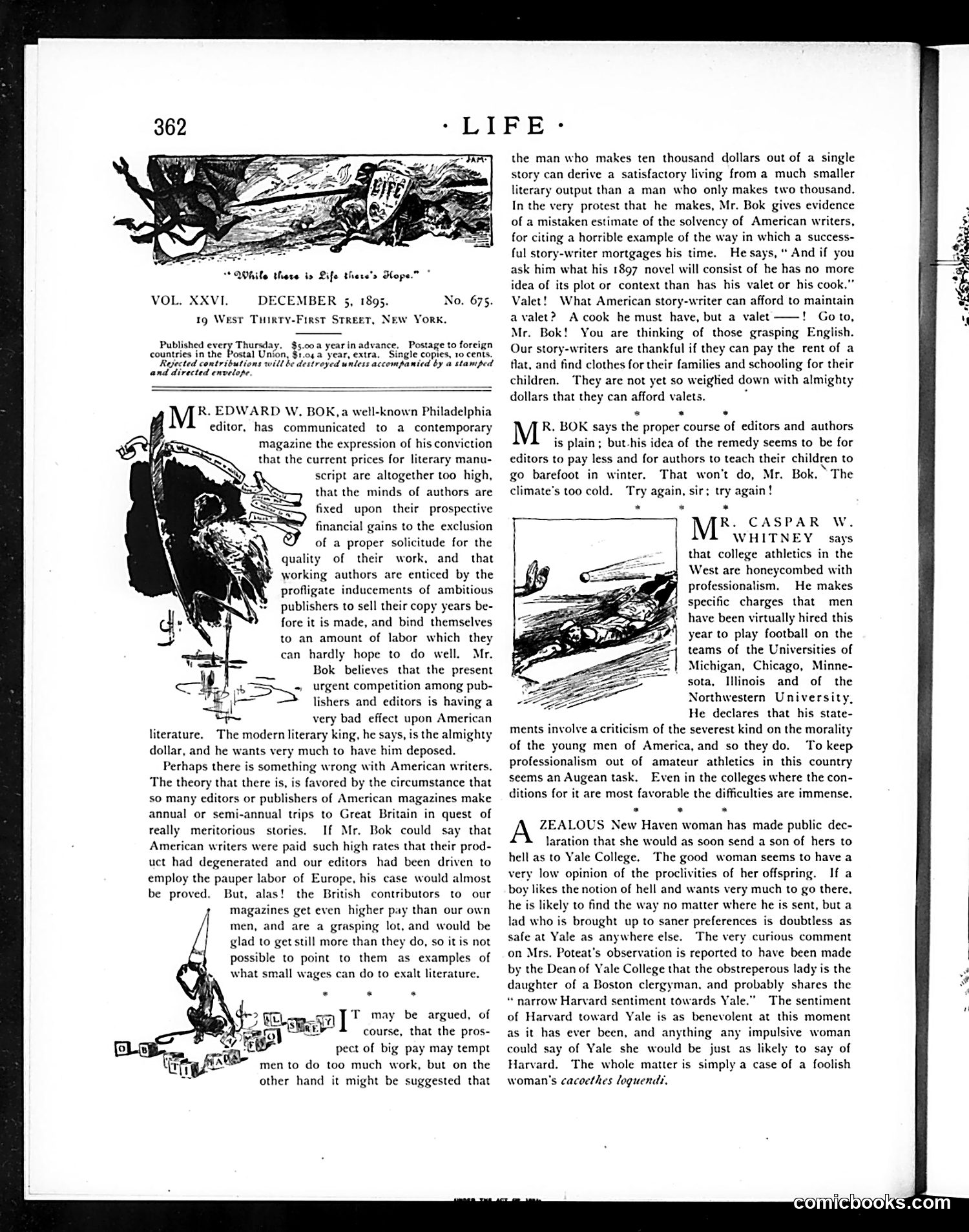
This page contains editorial commentary rather than political cartoons. The illustrations are decorative vignettes accompanying text. **Main content:** Editor Edward W. Bok argues that American literary magazines pay writers too little, forcing them into poverty. He suggests this practice harms American literature's quality, while British magazines pay better rates and thus attract superior contributors. **Secondary items:** - Caspar W. Whitney criticizes college football teams for hiring professional players, compromising amateur athletics - A brief note mocks a New Haven woman who declared she'd send her son to hell rather than Yale, with sarcastic commentary on regional college rivalries The decorative illustrations—including what appears to be a jester figure and scattered objects—serve as visual interest rather than conveying specific satirical meaning about identified individuals.
📄 Transcribed text from this page (OCR, searchable)
Machine-transcribed from the original scan — historical spelling and the odd misread are preserved.
- LIFE: “While there is Life there's Hope.” © VOL. XXVI. DECEMBER 5, 1895. No. 675. 1g West Tuirty-First STREET, New York. Published every Thursday, $5.00a year in advance, Postage to foreign countries in the Postal Union, $1.04 year, extra. Single copies, 10 cents. Rejected contributions will be destroyed untess accompanied by a stamped and directed envelope. R. EDWARD W. BOK,a well-known Philadelphia editor, has communicated to a contemporary magazine the expression of his conviction that the current prices for literary manu- script are altogether too high, that the minds of authors are fixed upon their prospective financial gains to the exclusion of a proper solicitude for the quality of their work, and that working authors are enticed by the profligate inducements of ambitious publishers to sell their copy years be- fore it is made, and bind themselves to an amount of labor which they can hardly hope to do well. Mr. Bok believes that the present urgent competition among pub- lishers and editors is having a very bad effect upon American literature. The modern literary king, he says, is the almighty dollar, and he wants very much to have him deposed. Perhaps there is something wrong with American writers. The theory that there i: favored by the circumstance that so many editors or publishers of American magazines make annual or semi-annual trips to Great Britain in quest of really meritorious stories. If Mr. Bok could say that American writers were paid such high rates that their prod- uct had degenerated and our editors had been driven to employ the pauper labor of Europe, his case would almost be proved. But, alas! the British contributors to our magazines get even higher pay than our own men, and are a grasping lot, and would be glad to get still more than they do, so it is not possible to point to them as examples of what small wages can do to exalt literature. (bit | Fe course, that the pros- ror pect of big pay may tempt men to do too much work, but on the other hand it might be suggested that T may be argued, of the man who makes ten thousand dollars out of a single story can derive a satisfactory living froma much smaller literary output than a man who only makes two thousand. In the very protest that he makes, Mr. Bok gives evidence of a mistaken estimate of the solvency of American writers, for citing a horrible example of the way in which a success- ful story-writer mortgages his time. He says, “ And if you ask him what his 1897 novel will consist of he has no more idea of its plot or context than has his valet or his cook.” Valet! What American story-writer can afford to maintain avalet? A cook he must have, but a valet ! Goto, Mr. Bok! You are thinking of those grasping English. Our story-writers are thankful if they can pay the rent of a flat, and find clothes for their families and schooling for their children. They are not yet so weigtied down with almighty dollars that they can afford valets. . * . . M*: BOK says the proper course of editors and authors is plain; but-his idea of the remedy seems to be for editors to pay less and for authors to teach their children to go barefoot in winter. That won't do, Mr. Bok. “The climate’s too cold. Try again, sir; try again! * * Tr R. CASPAR W. WHITNEY - says that college athletics in the West are honeycombed with professionalism. He makes specific charges that men have been virtually hired this year to play football on the teams of the Universities of Michigan, Chicago, Minne- sota, Illinois and of the Northwestern University, He declares that his state- ments involve a criticism of the severest kind on the morality of the young men of America, and so they do. To keep professionalism out of amateur athletics in this country seems an Augean task. Even in the colleges where the con- ditions for it are most favorable the difficulties are immense. . . . ZEALOUS New Haven woman has made public dec- laration that she would as soon send a son of hers to hell as to Yale College. The good woman seems to have a very low opinion of the proclivities of her offspring. If a boy likes the notion of hell and wants very much to go there, he is likely to find the way no matter where he is sent, but a lad who is brought up to saner preferences is doubtless as safe at Yale as anywhere else. The very curious comment on Mrs. Poteat's observation is reported to have been made by the Dean of Yale College that the obstreperous lady is the daughter of a Boston clergyman, and probably shares the “ narrow Harvard sentiment towards Yale.” The sentiment of Harvard toward Yale is as benevolent at this moment as it has ever been, and anything any impulsive woman could say of Yale she would be just as likely to say of Harvard. The whole matter is simply a case of a foolish woman's cacoethes loguendt.