
Life, 1895-12-05 · page 8 of 18
Life — December 5, 1895 — page 8: what you’re looking at
What you’re looking at
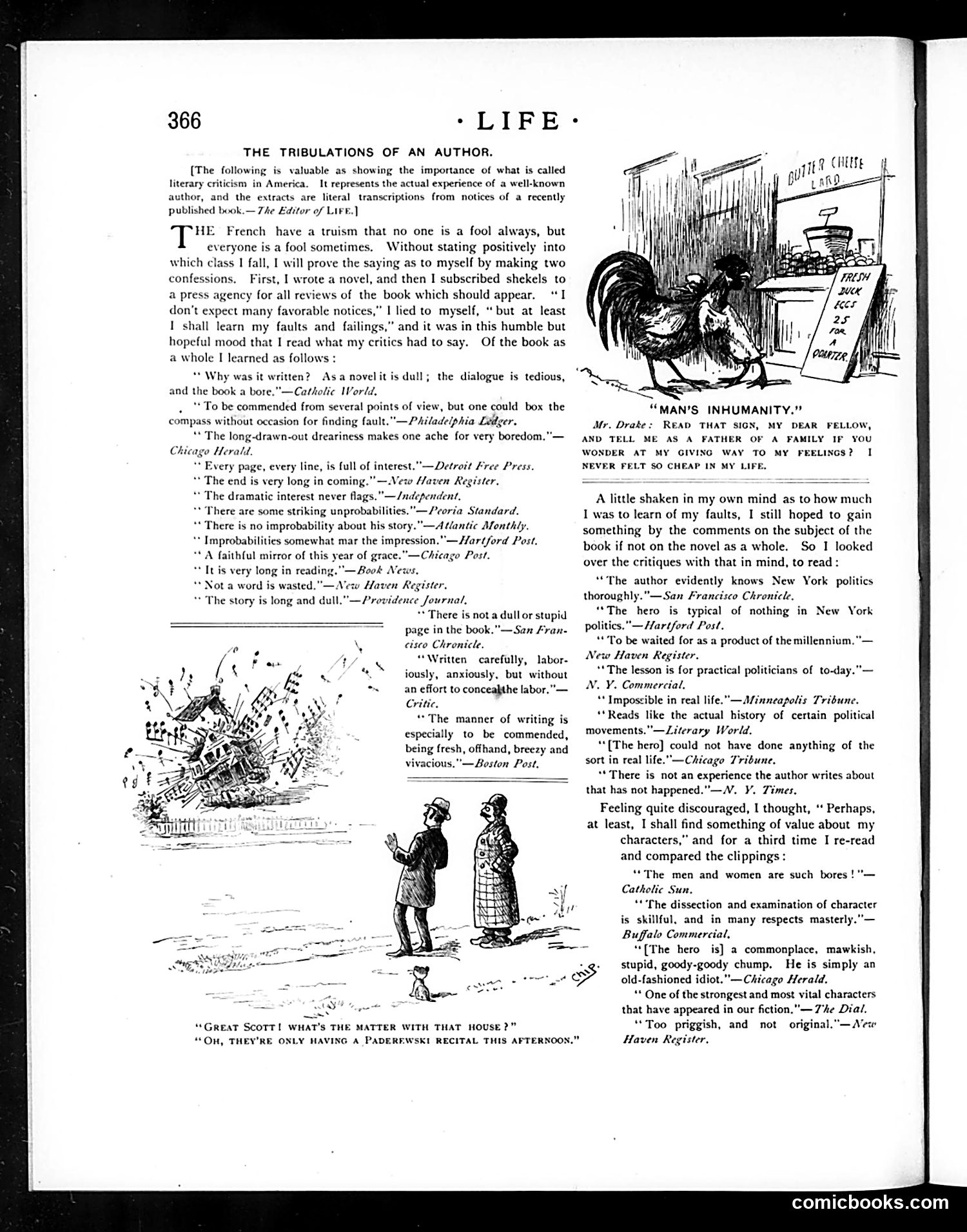
This page satirizes literary criticism and publishing. The main cartoon shows a rooster reading a sign labeled "BUTTER AND LARD" in what appears to be a shop—captioned "Man's Inhumanity," depicting an author's humiliation at harsh reviews. The lengthy text consists of real critical quotes (attributed to publications like *Catholic World*, *Philadelphia Ledger*, *Chicago Herald*) about an unnamed novel—mixing genuine praise with cutting dismissal. The author confesses subscribing to a press clipping service, hoping critics would find merit despite poor sales. The lower cartoon shows two well-dressed men discussing a "Paderewski recital," suggesting contrast between musical and literary reception. The satire targets the disparity between critical reception and commercial success, and the author's anxious dependence on critical validation during the publishing process.
📄 Transcribed text from this page (OCR, searchable)
Machine-transcribed from the original scan — historical spelling and the odd misread are preserved.
366 * LIFE: THE TRIBULATIONS OF AN AUTHOR. {The following is valuable as showing the importance of what is called literary criticism in America. It represents the actual experience of a well-known author, and the extracts are literal transcriptions from notices of a recently published book.— Zhe Editor of LiFe] HE French have a truism that no one is a fool always, but everyone is a fool sometimes. Without stating positively into which class I fall, I will prove the saying as to myself by making two confessions. First, I wrote a novel, and then I subscribed shekels to a pre: “] agency for all reviews of the book which should appear. don’t expect many favorable notic I lied to myself, “ but at least I shall learn my faults and failings,” and it was in this humble but hopeful mood that I read what my critics had to say. Of the book as a whole I learned as follows : ** Why was it written? Asa novelitis dull; the dialogue is tedious, and the book a bore."—Catholic World, . ‘' To be commended from several points of view, but one could box the compass without occasion for finding faul Philadelphia Ledger. * The long-drawn-out dreariness makes one ache for very boredom.”— Chicago Herald. ** Every page, every line, is full of interest." —Detroit Free Press. * The end is very long in coming.” —Vew Haven Register. he dramatic interest never flags." —/ndependent, here are some striking unprobabilities."—/eoria Standard. There is no improbability about his story."—A antic Monthly. * Improbabilities somewhat mar the impression."— Hartford Post. ** A faithful mirror of this year of grace."—Chicago Post. “It is very long in reading."—Book News. ** Not a word is wasted,"—NMew Haven Register. he story is long and dull."—Providence Journal, “There is not a dull or stupid page in the book." —San Fran- cisco Chronicle, “Written carefully, labor- iously, anxiously, but without an effort to conceakthe labor,” — Critic. “The manner of writing is especially to be commended, sh, offhand, breezy and ."—Boston Post. “GREAT SCOTT! WHAT'S THE MATTER WITH THAT HOUSE?” “OH, THEY'RE ONLY HAVING A PADEREWSKI RECITAL THIS AFTERNOON.” “aap ad Clie gut ii “MAN'S INHUMANITY.” Mr. Drake: READ THAT SIGN, MY DEAR FELLOW, AND TELL ME AS A FATHER OF A FAMILY IF YOU WONDER AT MY GIVING WAY TO MY FEELINGS? I NEVER FELT SO CHEAP IN MY LIFE. A little shaken in my own mind as to how much I was to learn of my faults, I still hoped to gain something by the comments on the subject of the book if not on the novel as a whole. So I looked over the critiques with that in mind, to read: “The author evidently knows New York politics thoroughly."—San Francisco Chronicle, “The hero is typical of nothing in New York politics."— Hartford Post. “To be waited for as a product of the millennium.”"— New Haven Register. “The lesson is for practical politicians of to-day."— N.Y. Commercial. Impossible in real life."—Afinneapolis Tribune. “*Reads like the actual history of certain political movements." —Literary World. “(The hero] could not have done anything of the sort in real life."—Chicago Tribune. “* There is not an experience the author writes about that has not happened."—M. ¥. Times. Feeling quite discouraged, I thought, ‘* Perhaps, at least, I shall find something of value about my characters,” and for a third time I re-read and compared the clippings : “*The men and women are such bores !"— Catholic Sun. ‘Phe dissection and examination of character is skillful, and in many respects masterly."— Buffalo Commercial, “(The hero is) a commonplace, mawkish, stupid, goody-goody chump. He is simply an old-fashioned idiot."—Chicago Herald. “* One of the strongest and most vital characters that have appeared in our fiction."— Zhe Dial, “Too priggish, and not original."—Aew Haven Register. comicbooks.com