
Life, 1895-12-05 · page 12 of 18
Life — December 5, 1895 — page 12: what you’re looking at
What you’re looking at
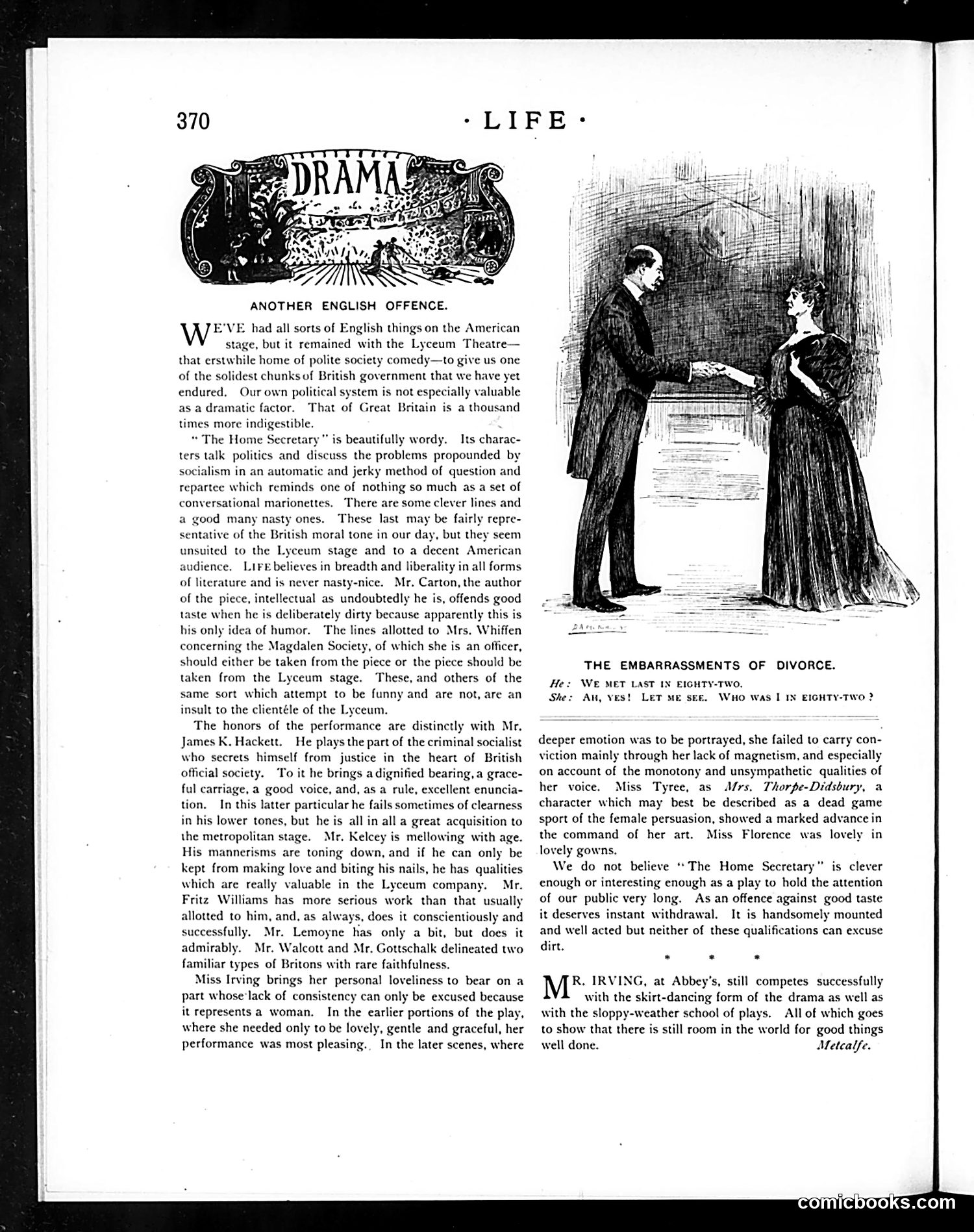
This *Life* drama review critiques a Lyceum Theatre production of "The Home Secretary," a British play the critic finds tediously political and deliberately crude. The main complaint is that the play imports British governmental debate—described as "indigestible"—to the American stage, where it doesn't belong. Author Mr. Carton apparently uses dirty humor as a substitute for wit, offending the magazine's standards. The accompanying illustration, captioned "The Embarrassments of Divorce," shows a couple who haven't seen each other since 1882 awkwardly pretending they don't remember their marriage—a visual joke about the social awkwardness surrounding divorce in that era. It's satirizing how divorced people would encounter each other in society and feign amnesia about their past relationship. Both items reflect *Life*'s concern with theatrical taste and social propriety during the Edwardian period.
📄 Transcribed text from this page (OCR, searchable)
Machine-transcribed from the original scan — historical spelling and the odd misread are preserved.
ANOTHER ENGLISH OFFENCE. E'VE had all sorts of English things on the American stage, but it remained with the Lyceum Theatre— that erstwhile home of polite society comedy—to give us one of the solidest chunks of British government that we have yet endured. Our own political system is not especially valuable as a dramatic factor. That of Great Britain is a thousand more indigestible. rhe Home Secretary” is beautifully wordy. Its charac- and discuss the problems propounded by tomatic and jerky method of question and Te; partee which reminds one of nothing so much as a set of conversational marionettes. There are some clever lines and a good many nasty ones. These last may be fairl sentative of the British moral tone in our day, but they unsuited to the 1 repre- seem cum stage and to a decent American Lire believes in breadth and liberality in all forms of literature and is never nasty-nice. audience. Mr. Carton, the author of the piece, intellectual as undoubtedly he is, offends good taste when he is deliberately dirty because apparently this is his only idea of humor. The lines allotted to Mrs, Whiffen concerning the Magdalen Society, of which she is an officer, should either be taken from the piece or the piece should be taken from the Lyceum stage. These, and others of the same sort which attempt to be funny and are not, are an insult to the clientéle of the Lyceum. The honors of the performance are distinctly with Mr, James K. Hackett. He plays the part of the criminal socialist who secrets himself from justice in the heart of British official society. To it he brings a dignified bearing, a grace- ful carriage, a good voice, and, as a rule, excellent enuncia- tion, In this latter particular he fails sometimes of clearness in his lower tones, but he is all in all a great acquisition to the metropolitan stage. Mr. Kelcey is mellowing with age. His mannerisms are toning down, and if he can only be kept from making love and biting his nails, he has qualities which are really valuable in the Lyceum company. Mr. Fritz Williams has more serious work than that usually allotted to him, and. as alway: successfully, does it conscientiously and Mr. Lemoyne has only a bit, but does it admirably. Mr. Walcott and Mr. Gottschalk delineated two familiar types of Britons with rare faithfulness. Miss Irving brings her personal loveliness to bear on a part whose'lack of consistency can only be excused because it represents a woman. In the earlier portions of the play, where she needed only to be lovely, gentle and graceful, her performance was most pleasing. In the later scenes, where THE EMBARRASSMENTS OF DIVORCE. He: WE MET LAST IN EIGHTY-TWO, She: An, ves! Let me see. Wao was | IN EIGHTY-TWo ? deeper emotion was to be portrayed, she failed to carry con- viction mainly through her lack of magnetism, and especially on account of the monotony and unsympathetic qualities of her voice. Miss Tyree, as Mrs. Thorpe-Didsbury, a character which may best be described as a dead game sport of the female persuasion, showed a marked advance in the command of her art. Miss Florence was lovely in lovely gowns. We do not believe ‘The Home Secretary” is clever enough or interesting enough as a play to hold the attention of our public very long. As an offence against good taste it deserves instant withdrawal. It is handsomely mounted and well acted but neither of these qualifications can excuse dirt. . * * R. IRVING, at Abbey's, still competes successfully with the skirt-dancing form of the drama as well as with the sloppy-weather school of plays. All of which goes to show that there is still room in the world for good things well done. Metcalfe. icbooks.com