
A complete issue · 16 pages · 1895
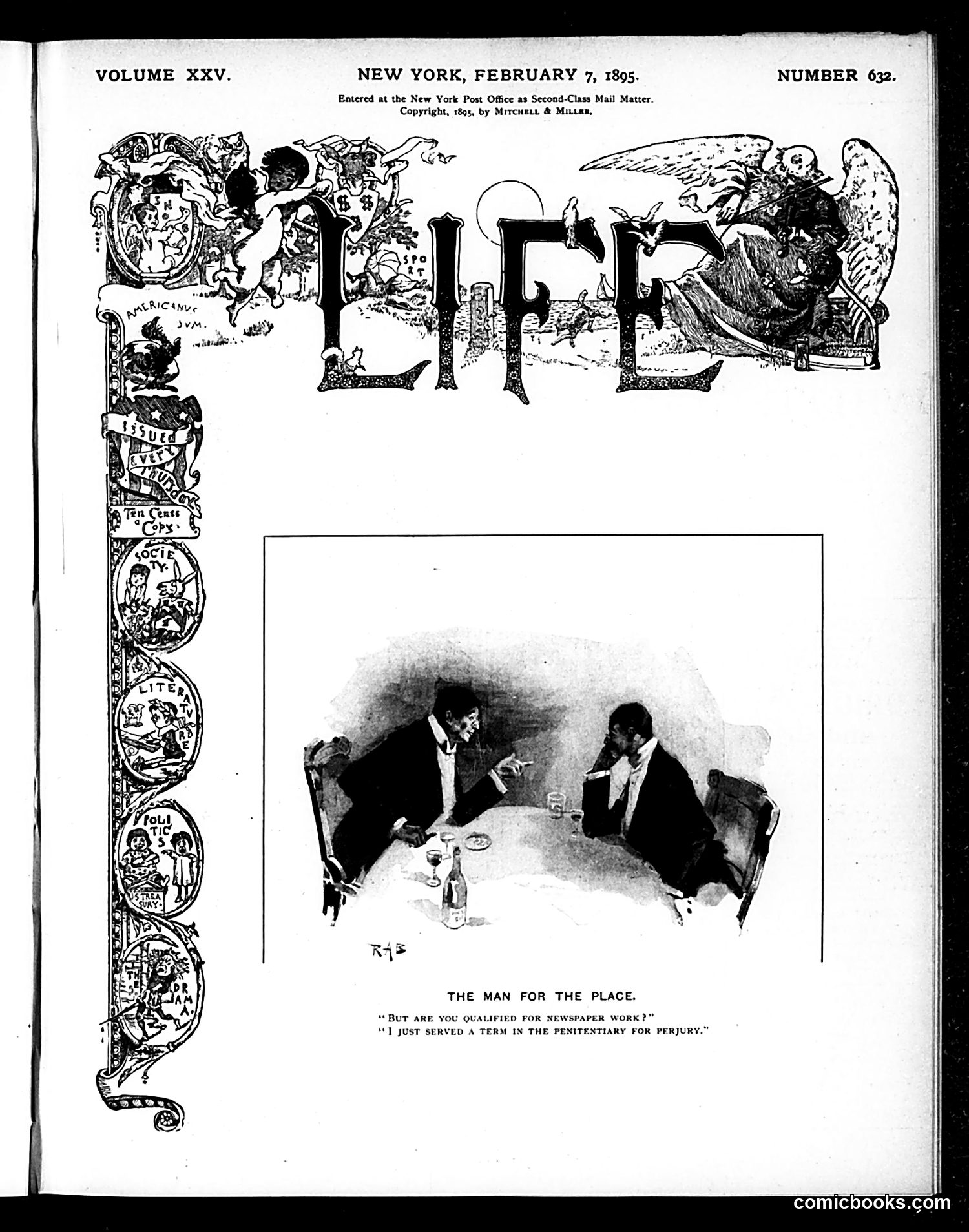
Life — February 7, 1895
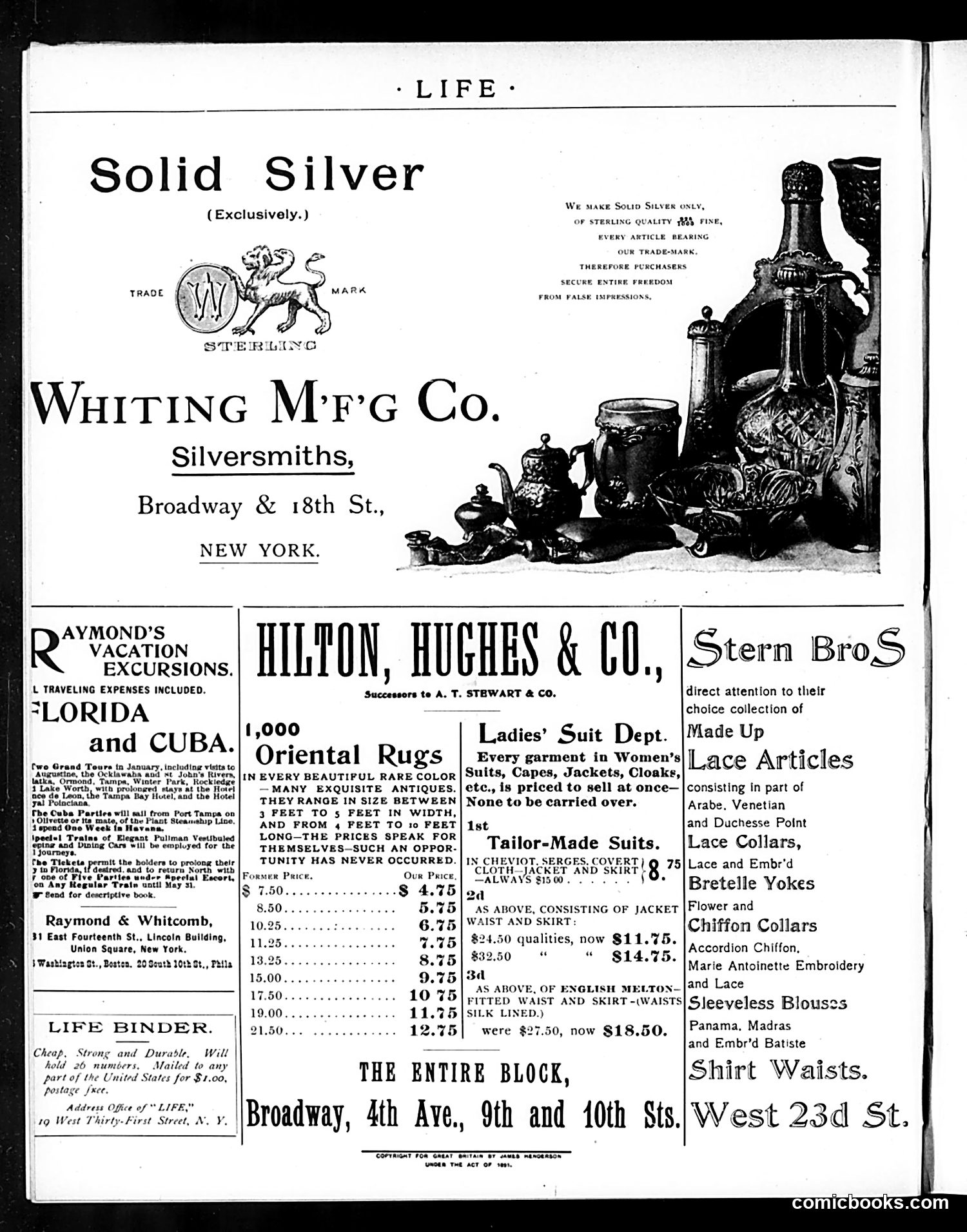
This page is primarily **advertising**, not satirical content. It features commercial advertisements for upscale goods and services circa early 1900s: - **Whiting M'fg Co.** advertises solid sterling silver flatware and serving pieces - **Hilton, Hughes & Co.** sells Oriental rugs (1,000 in stock) and women's tailored suits - **Stern Bros** promotes lace articles and embroidered blouses - **Raymond & Whitcomb** offers vacation excursions to Florida and Cuba - A **Life Binder** is advertised for holding magazine issues The page reflects the consumer culture of wealthy, urban American readers—the target audience for Life magazine during this period. There are no political cartoons or satirical commentary visible; this is a standard magazine advertising section showcasing luxury merchandise and travel services.
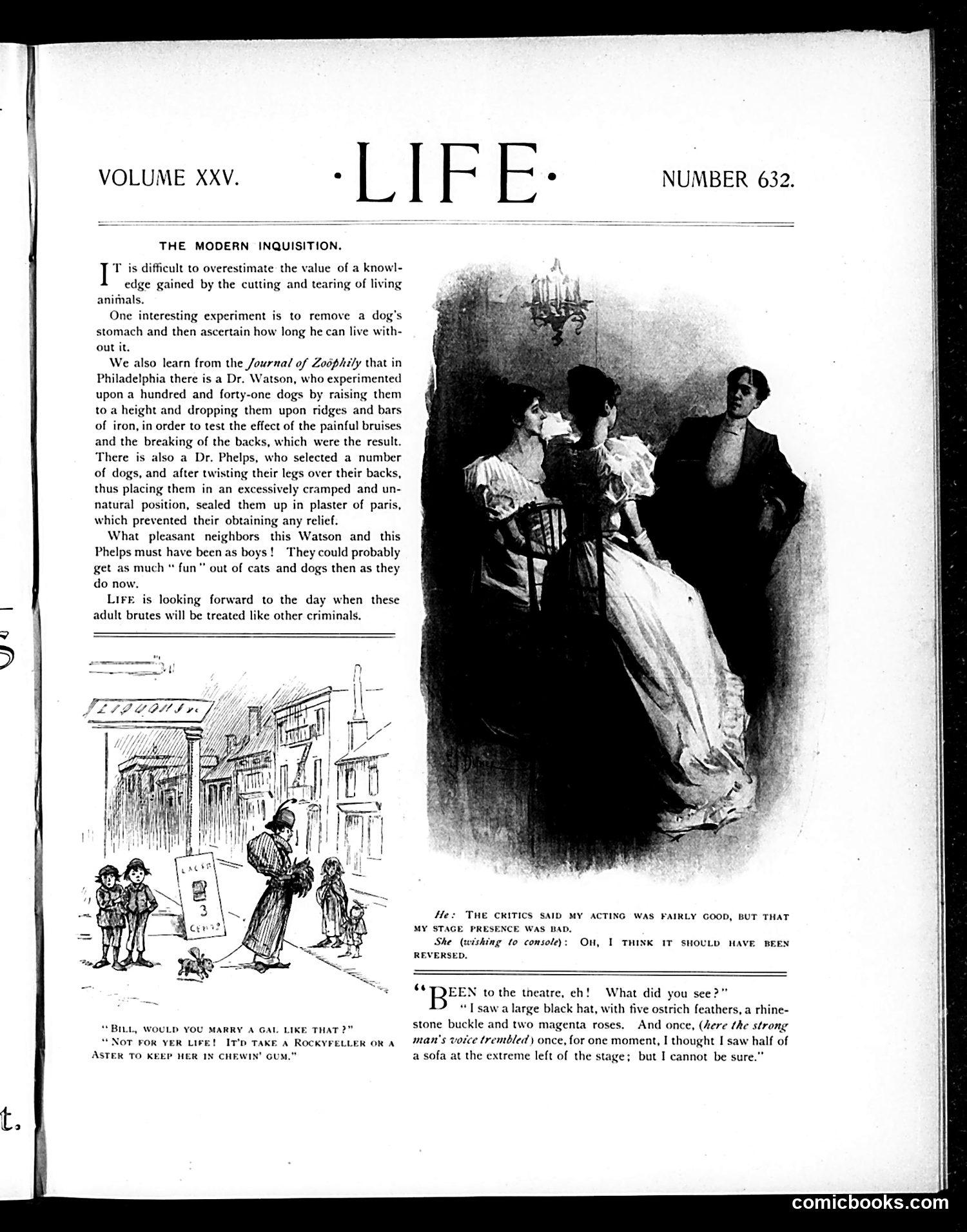
**"The Modern Inquisition"** article condemns vivivisection—animal experimentation—naming specific scientists (Dr. Watson in Philadelphia, Dr. Phelps) who conducted cruel tests on dogs. The piece sarcastically calls these practitioners "pleasant neighbors" and "adult brutes," demanding they be prosecuted as criminals. The lower cartoon depicts street poverty: a woman asks a man to marry a girl "like that," and he refuses, saying it would take a Rockefeller's wealth to support her. The caption suggests economic desperation forces difficult choices. The theatrical dialogue discusses a woman's poor stage performance—critics praised her acting but criticized her "stage presence." Overall, the page critiques cruelty (animal and economic) and theatrical pretense in early-20th-century America.
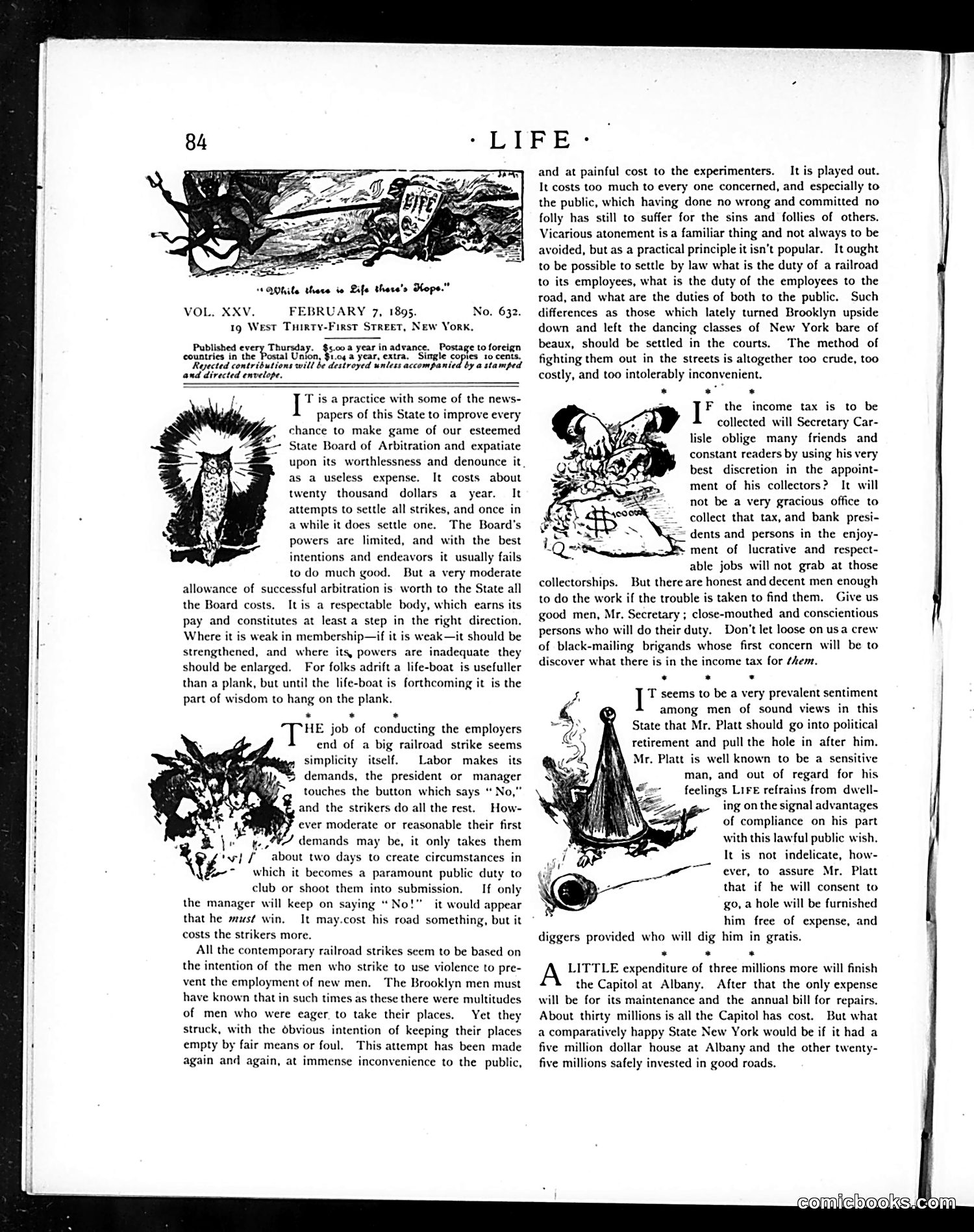
This page contains three editorial cartoons critiquing labor disputes and government inefficiency in 1890s New York. The top cartoon illustrates the State Board of Arbitration's futility in settling railroad strikes—depicted as a figure clinging to a plank, symbolizing the board's weakness against labor unrest. The middle cartoon appears to mock railroad managers' tactics during strikes, showing how they resist workers' demands and attempt to break unions through hiring replacement workers. The bottom cartoon likely references a New York State Capitol building project in Albany, satirizing government waste—millions spent on construction while workers and public suffer from labor conflicts and inadequate infrastructure. The overall message: 1890s labor relations were poorly managed through both industrial obstruction and governmental incompetence.
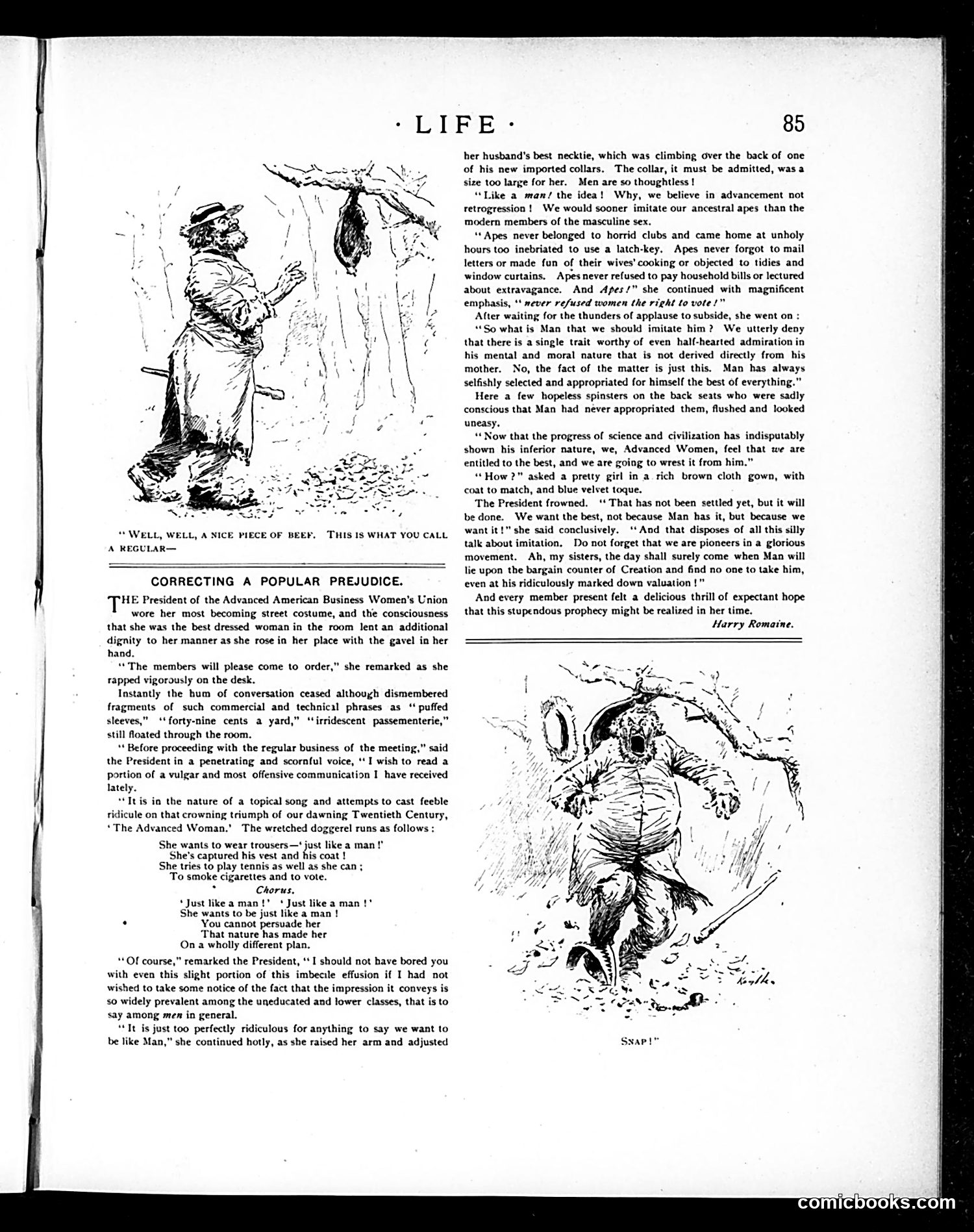
This page satirizes the "Advanced American Business Women's Union" and their push for gender equality. The top cartoon shows a man climbing a tree, captioned "Well, well, a nice piece of beef. This is what you call a 'Necktie'"—mocking women's adoption of masculine fashion (neckties). The article "Correcting a Popular Prejudice" presents the Union President defending women wearing trousers and smoking, countering the claim that such behavior imitates men. She argues women possess inherent qualities men lack. The accompanying poem ridicules feminist aspirations by repeating "Just like a man!" sarcastically, suggesting women's imitation of male behavior is both unnatural and absurd. The lower cartoon shows a man being chased, captioned "Snap!"—likely depicting social chaos from gender role disruption. The satire reflects early 20th-century anxieties about women's liberation movements.
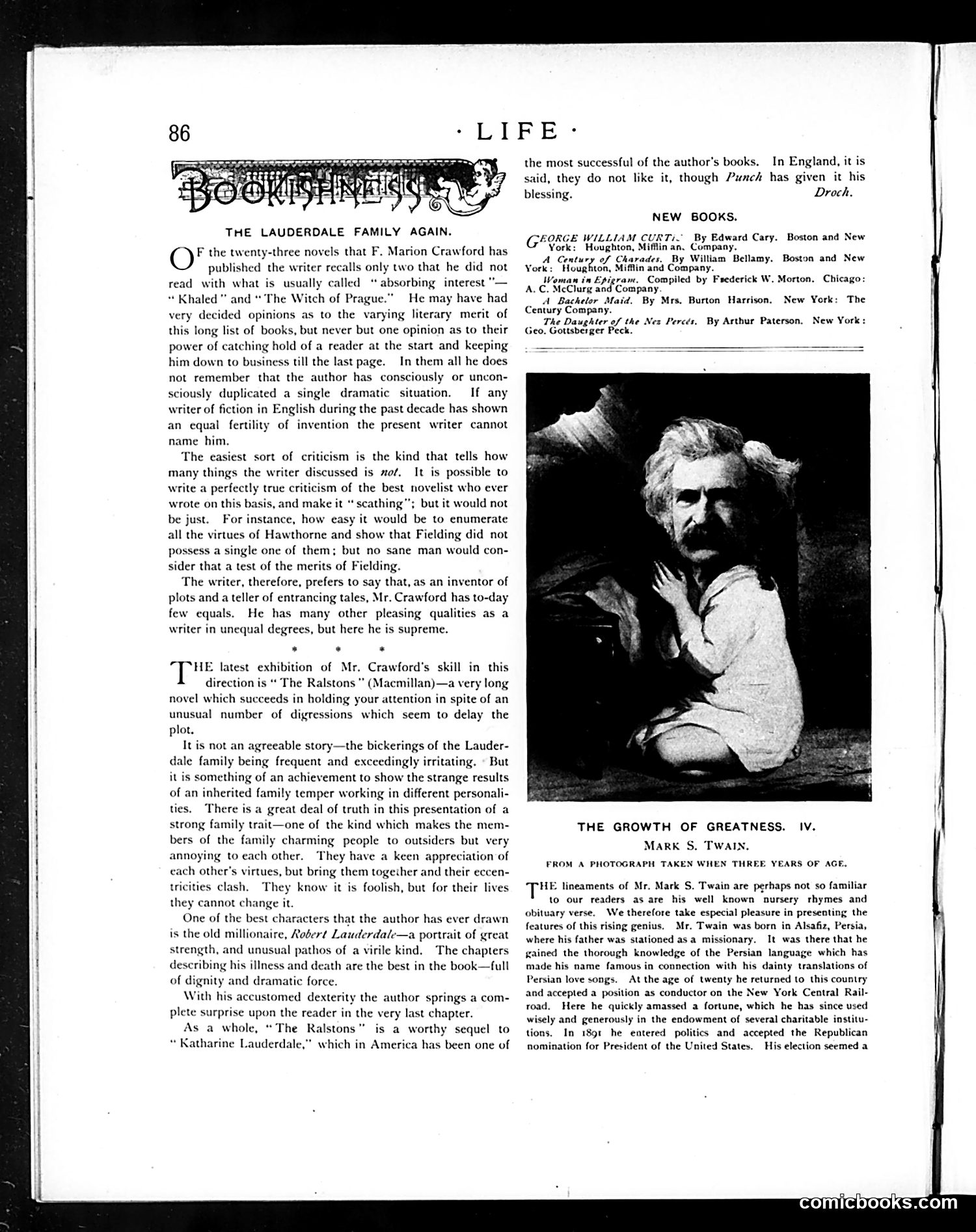
This page is primarily **literary criticism and book review**, not political satire. The left column discusses F. Marion Crawford's novels, particularly praising "The Ralstons" as an achievement in plot invention and character development. The critic argues Crawford excels at creating dramatic situations and compelling narratives. The right side features a **photograph of Mark Twain** (labeled "THE GROWTH OF GREATNESS. IV.") as part of an apparent biographical series. The accompanying text describes Twain's early life—born in Hannibal, his father's diplomatic service in Persia, his knowledge of Persian language, and his early political involvement, including Republican nomination for U.S. President. This is a **cultural/literary magazine page**, not political commentary. The content celebrates American literary figures rather than satirizing them.
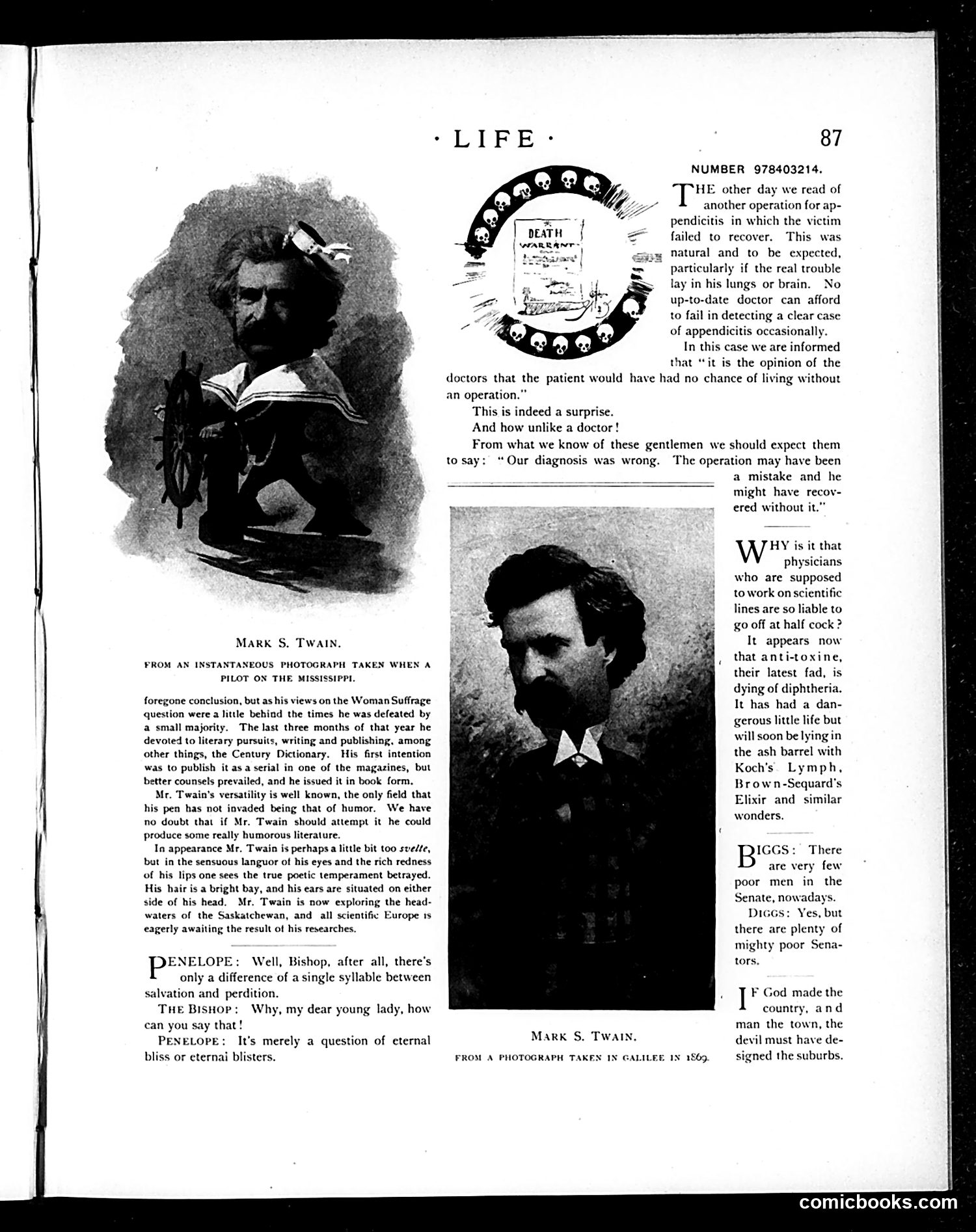
This page features two photographs of **Mark S. Twain** (1862-1910), the famous American writer and humorist. The accompanying article discusses Twain's appearance and current activities, noting he's "exploring the headwaters of the Saskatchewan" and that "all scientific Europe is eagerly awaiting the result of his researches." The text also includes a satirical dialogue between characters named Penelope and The Bishop, debating whether the difference between "salvation and perdition" is merely "a single syllable"—a play on words mocking religious doctrine. The page satirizes both Twain's celebrity status and contemporary medical science (referencing a failed appendicitis operation case), while the dialogue mocks theological hair-splitting, typical of Life magazine's irreverent social commentary.
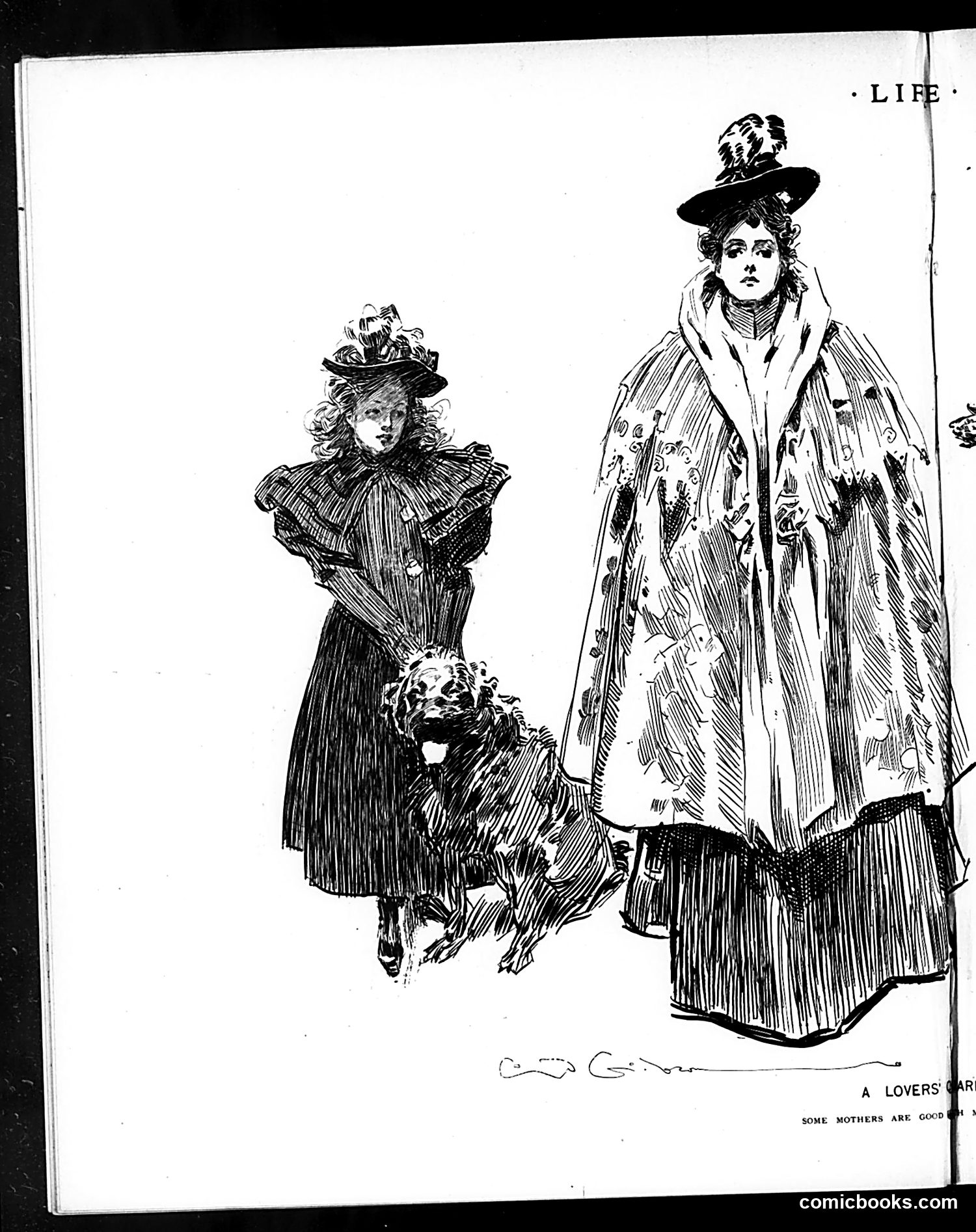
This is a satirical illustration from *Life* magazine titled "A Lovers' Quarrel" (with the subtitle "Some Mothers Are Good at..."). The cartoon depicts two fashionably dressed women of the early 1900s—one wearing an elaborate coat with a large collar and plumed hat, the other in an ornate cloak with fur trim. Between them stands a small dog on a leash. The satire appears to target upper-class women's social pretensions and their romantic entanglements. The title "A Lovers' Quarrel" suggests these women are rivals, likely competing for attention (perhaps from a man, or humorously, the dog serves as the object of their dispute). The elaborate, exaggerated fashion details—the oversized hats, luxurious fabrics, and ornate styling—mock the vanity and materialism of wealthy society women during this era.
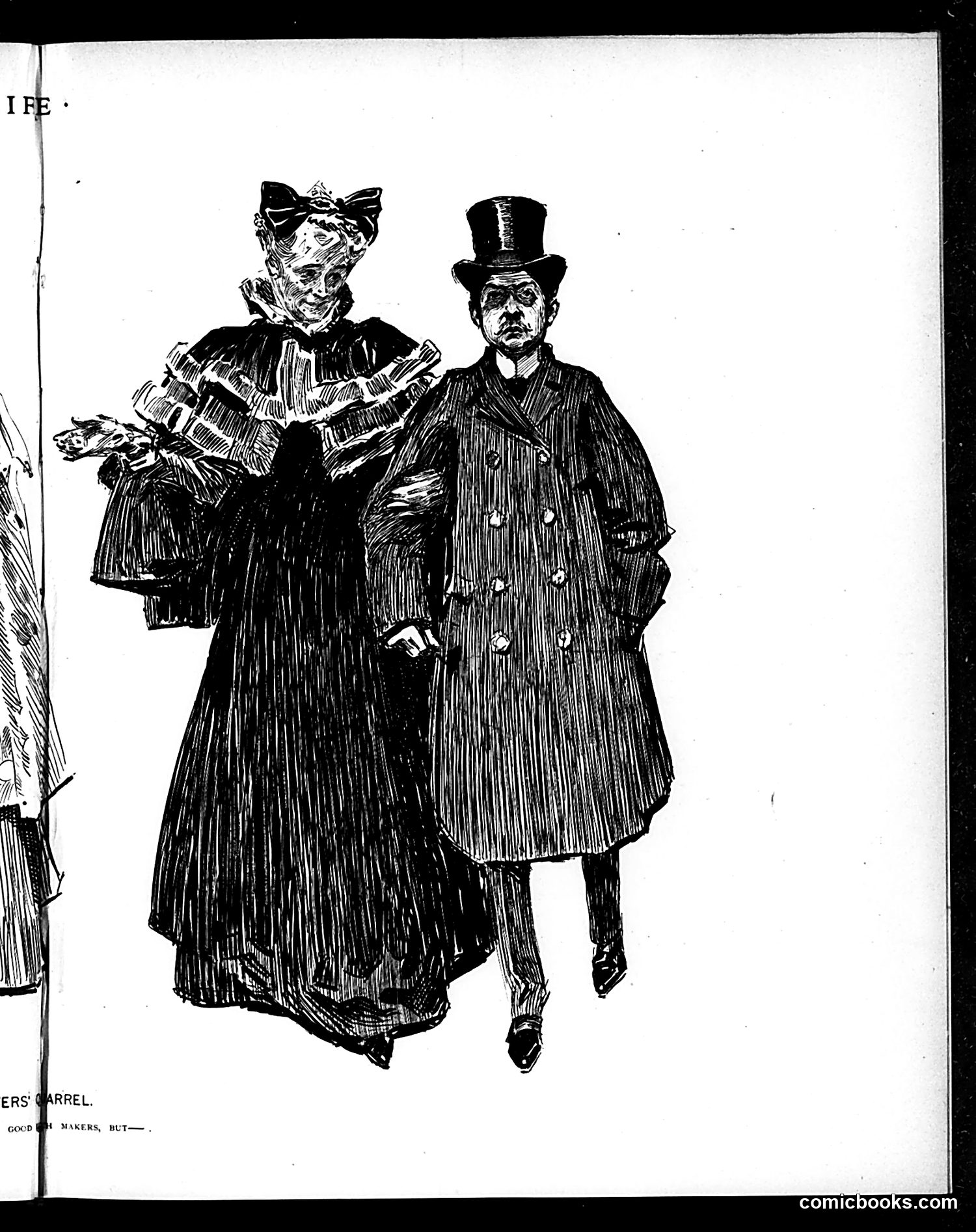
This is a black and white sketch showing two figures in late 19th or early 20th-century dress. The woman on the left wears an elaborate outfit with a large bow and ruffled collar, while the man on the right wears a top hat and double-breasted coat. The visible text at bottom reads "ERS' CARREL" and "GOOD MAKERS, BUT——" (partially cut off), suggesting this is a fashion or consumer goods commentary. Without the complete caption or surrounding context, the exact satirical point is unclear, but the contrasting clothing styles and the incomplete text "but——" suggest the joke concerns quality or standards in fashion manufacturing. The figures appear to represent types or social commentary rather than specific identifiable individuals. More page context would be needed to determine the precise satire.
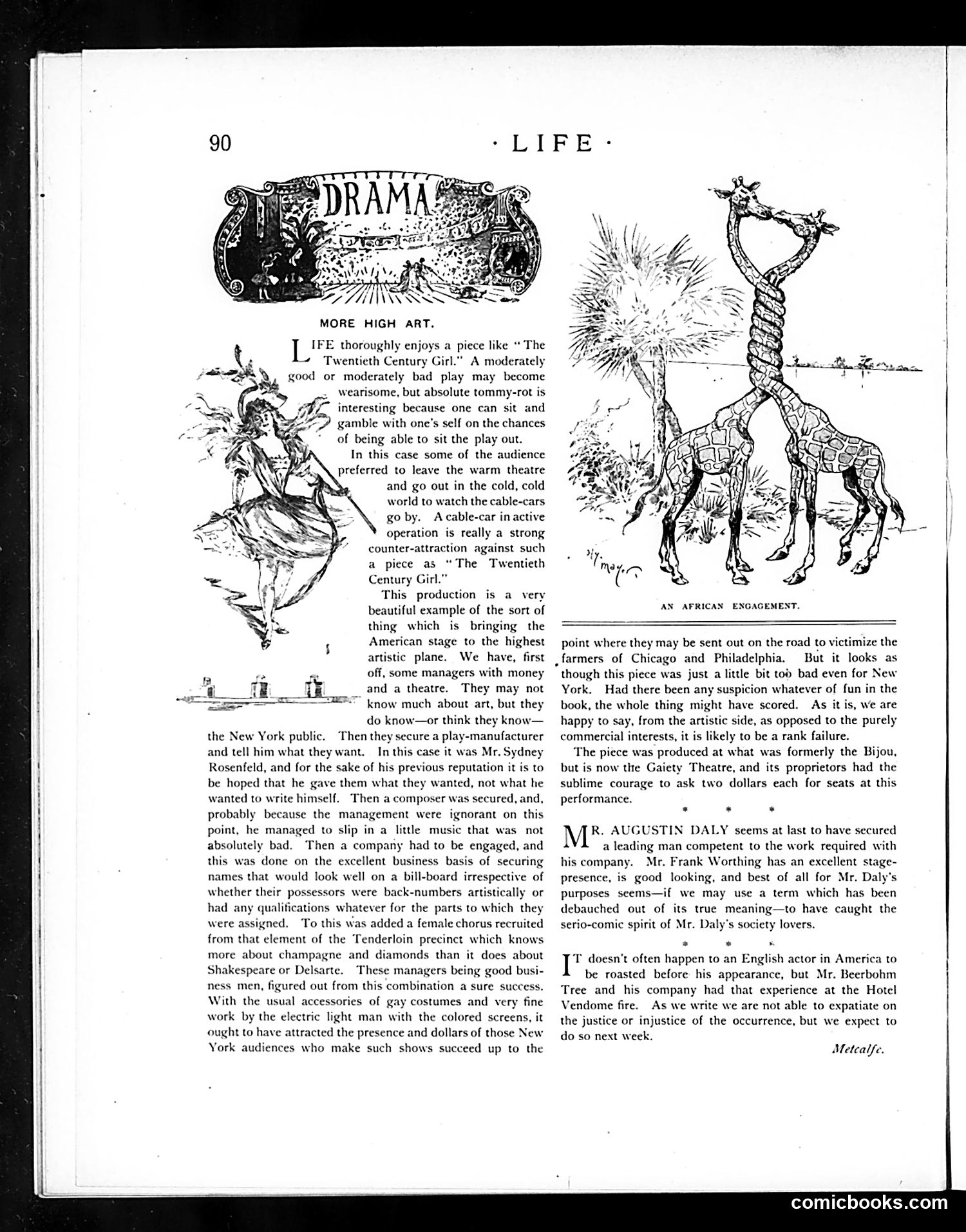
This page critiques theatrical production quality circa early 1900s. The "Drama" header and "More High Art" section discuss "The Twentieth Century Girl," a theatrical piece that attracted audiences despite mediocre quality. The article argues that theater managers prioritized commercial appeal over artistic merit—they secured famous names (specifically mentioning Sydney Rosenfeld as composer) and attractive performers rather than genuine talent. The left illustration depicts a theatrical performer. The right illustration shows "An African Engagement"—a giraffe and attendant, likely referencing exotic animal imagery popular in period entertainment spectacles. The text criticizes how American theater pursued financial success through sensationalism and star power at the Gaiety Theatre, while lamenting this approach's triumph over genuine artistry. The unsigned "Metcalfe" byline concludes with commentary on an English actor's negative experience.
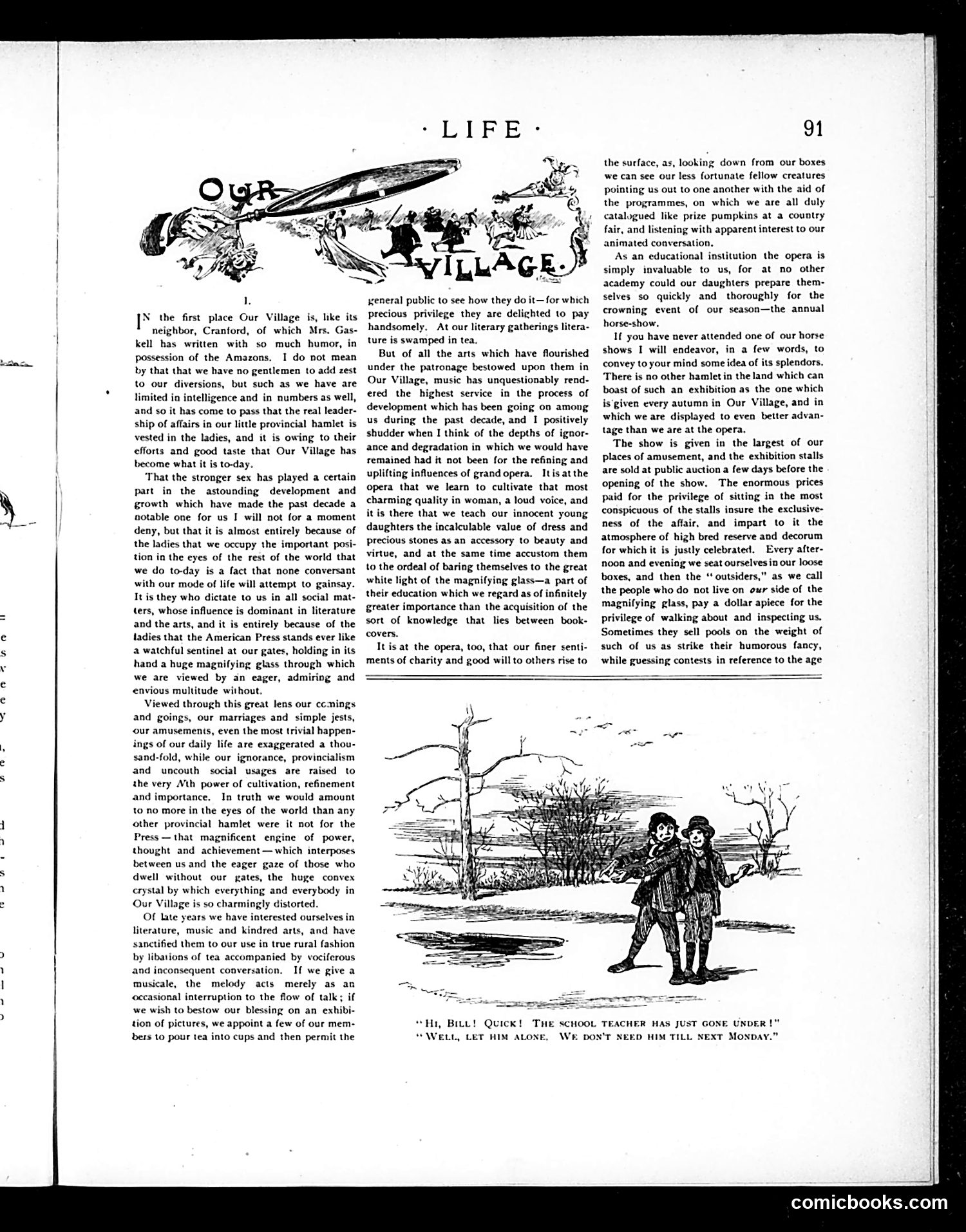
This page contains an essay titled "Our Village" praising the institution's cultural role, alongside a single illustration at the bottom. The cartoon depicts two figures (appearing to be children or young people) in a rural landscape. One says to the other: "Hi, Bill! Quick! The school teacher has just gone under!" The second responds: "Well, let him alone. We don't need him till next Monday." The joke satirizes rural indifference toward education and the schoolteacher's social position. The "gone under" likely refers to the teacher drowning or disappearing into water (a pond or stream visible in the sketch). The children's callous, dismissive response mocks both rural communities' perceived lack of educational investment and the schoolteacher's low social status in small towns—a common target of Life's satirical commentary on American provincial life.
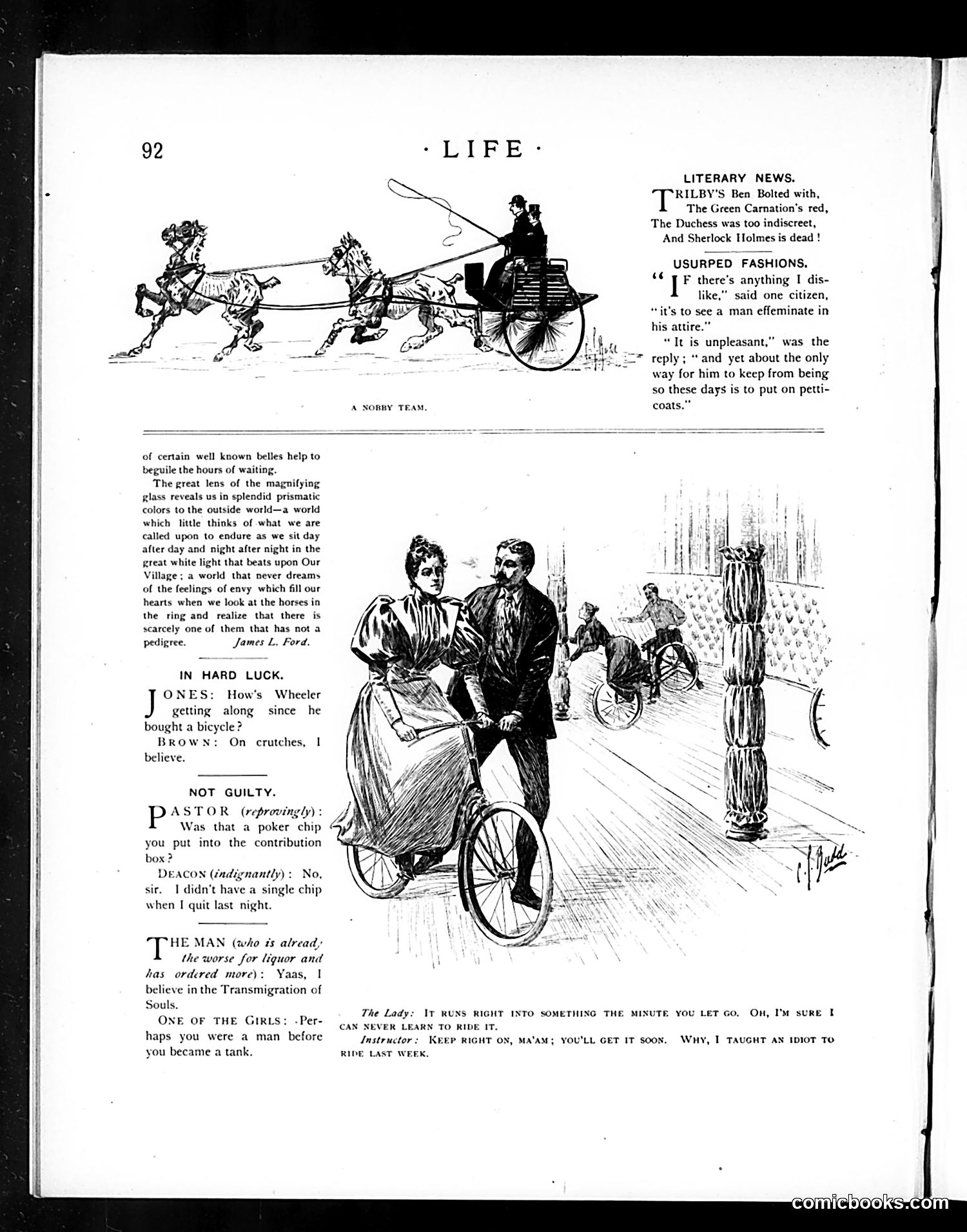
This page contains several short humorous pieces satirizing late-19th-century American life and fashion: **"Usurped Fashions"** mocks men adopting traditionally feminine clothing styles—a concern about blurred gender boundaries in dress. The joke suggests wearing petticoats is the only way to avoid appearing "effeminate," a paradoxical critique of changing fashion norms. **"In Hard Luck"** jokes about the bicycle craze: Wheeler bought one and is now on crutches, implying accidents were common among novice riders. **"Not Guilty"** plays on church propriety: a deacon denies putting a poker chip in the collection box, claiming he lost all his chips gambling the previous night—the humor lies in admitting the vice while technically denying the specific accusation. **The bicycle instruction cartoon** depicts a woman learning to ride while a confident (possibly inept) instructor boasts he even taught "an idiot." The humor targets both uncertain female cyclists and overconfident male instructors during the bicycle's novelty period.
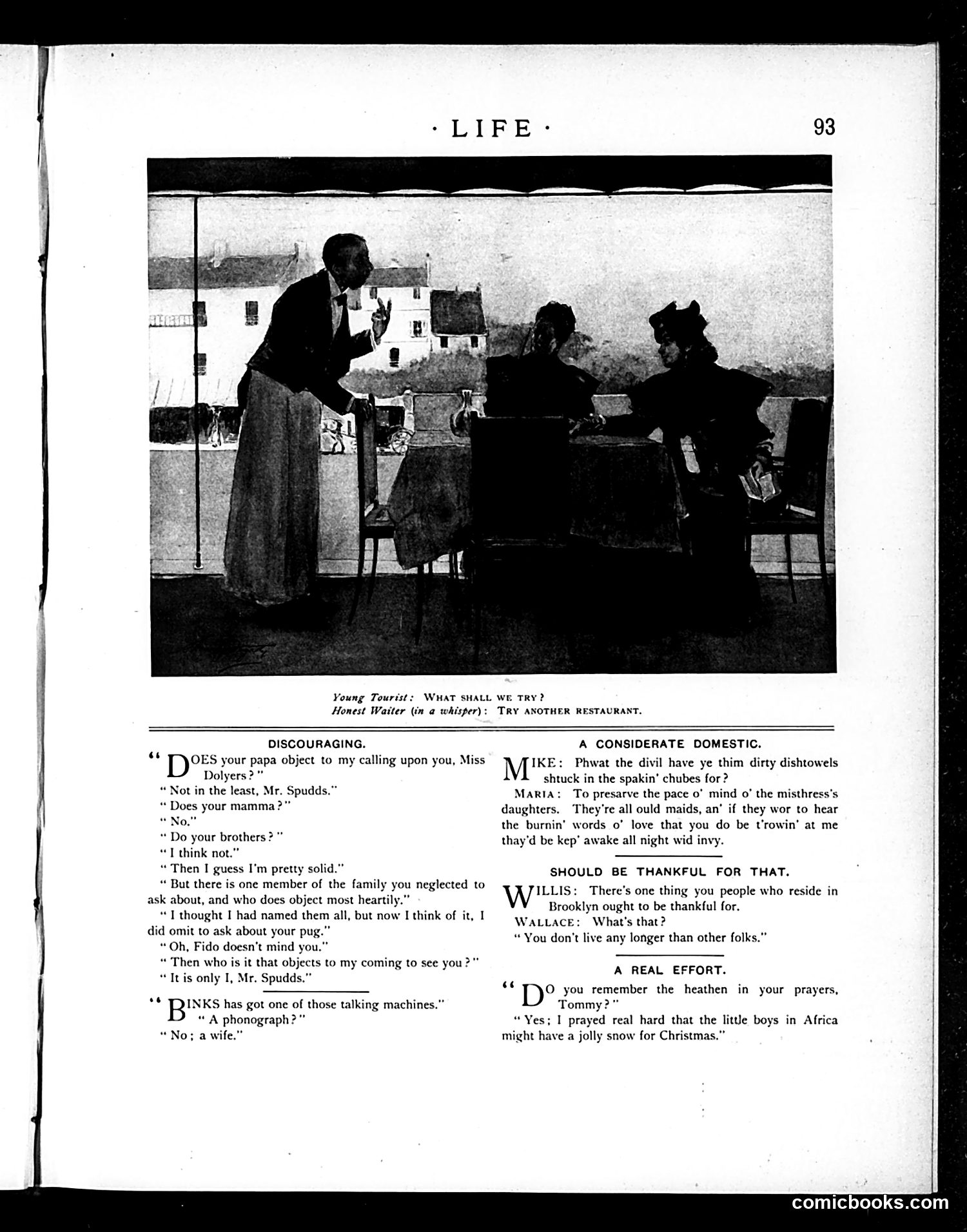
This page contains four separate humor sketches typical of early 20th-century American satire: 1. **"Young Tourist"**: A waiter warns tourists to eat elsewhere—satirizing poor restaurant quality. 2. **"Discouraging"**: A suitor confidently believes he's accepted by a young woman's entire family, only to learn she herself objects to him. The joke mocks male presumption and vanity. 3. **"A Considerate Domestic"**: Two servants discuss hiding dirty dishcloths in speaker tubes to prevent the unmarried daughters from hearing romantic declarations that would make them envious. This satirizes both servants' gossip culture and the "spinster problem"—anxiety about unmarried women. 4. **"A Real Effort"**: A child prays for African children to experience snow at Christmas, misunderstanding missionary rhetoric about "heathen" populations. The humor derives from innocent literalism and the period's paternalistic missionary attitudes. The sketches collectively mock courtship rituals, class hierarchies, and contemporary attitudes toward religion and colonialism.
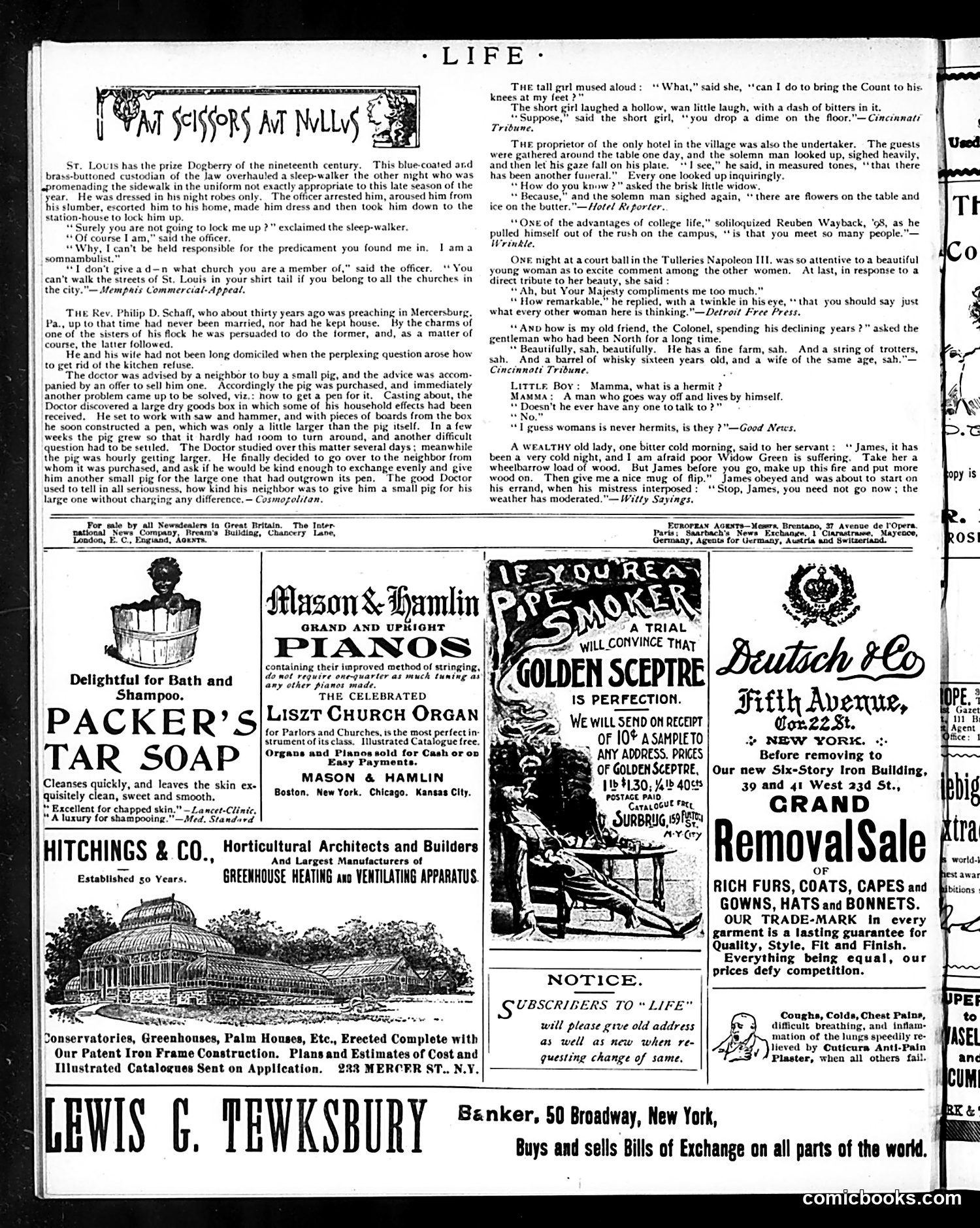
This page is primarily **advertisements and humorous anecdotes** rather than political cartoons. The main content consists of short satirical stories: 1. **"I'm Scissors at Nullus"** (header): A St. Louis police officer arrests a sleepwalker in nightclothes, dismissing the man's claim that somnambulism isn't his fault. The satire mocks overzealous law enforcement unable to distinguish between criminal intent and medical conditions. 2. **Reverend Schaff story**: A clergy member buys a pig in a box-pen that becomes too small. He naively asks the neighbor to exchange it for a smaller pig—the neighbor agrees without charge. This mocks rural simplicity and lack of business acumen. 3. **Brief quips** about a tall girl seeking a count's attention and hotel proprietor confusing funerals with decoration choices. The satire targets **bureaucratic rigidity, rural naiveté, and social pretension**—common Life magazine themes. The advertisements (pianos, soap, fur removal) fill remaining space.
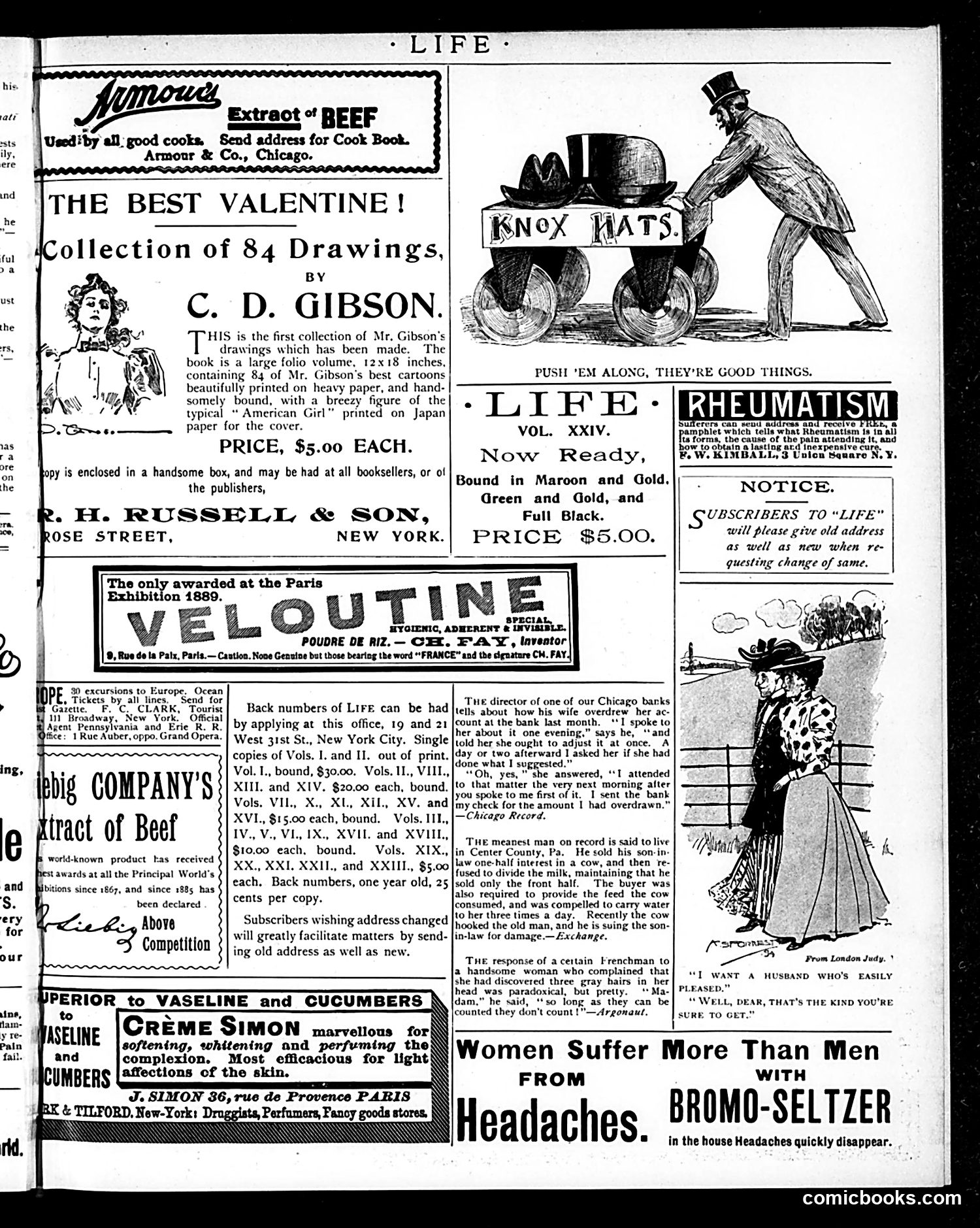
This page is primarily **advertisements and filler content** rather than political satire. The main cartoon is minimal. The notable visual element is a **Knox Hats advertisement** featuring a gentleman in a top hat pushing a baby carriage labeled "Knox Hats" with the caption "Push 'em along, they're good things." This is straightforward product advertising using humor. The page also includes: - A C.D. Gibson drawing collection advertisement (Gibson was famous for his "Gibson Girl" illustrations) - Three brief humorous anecdotes about gender relations: a wife overdrawing her bank account, a miserly man's property dispute, and a Frenchman's quip about a woman's gray hairs - Various product advertisements (Armour's Beef Extract, Bromo-Seltzer, Crème Simon cosmetics) The gender-focused humor reflects period attitudes about women's finances and appearance, but lacks pointed political commentary. This appears to be a routine issue mixing advertisements with light domestic humor.
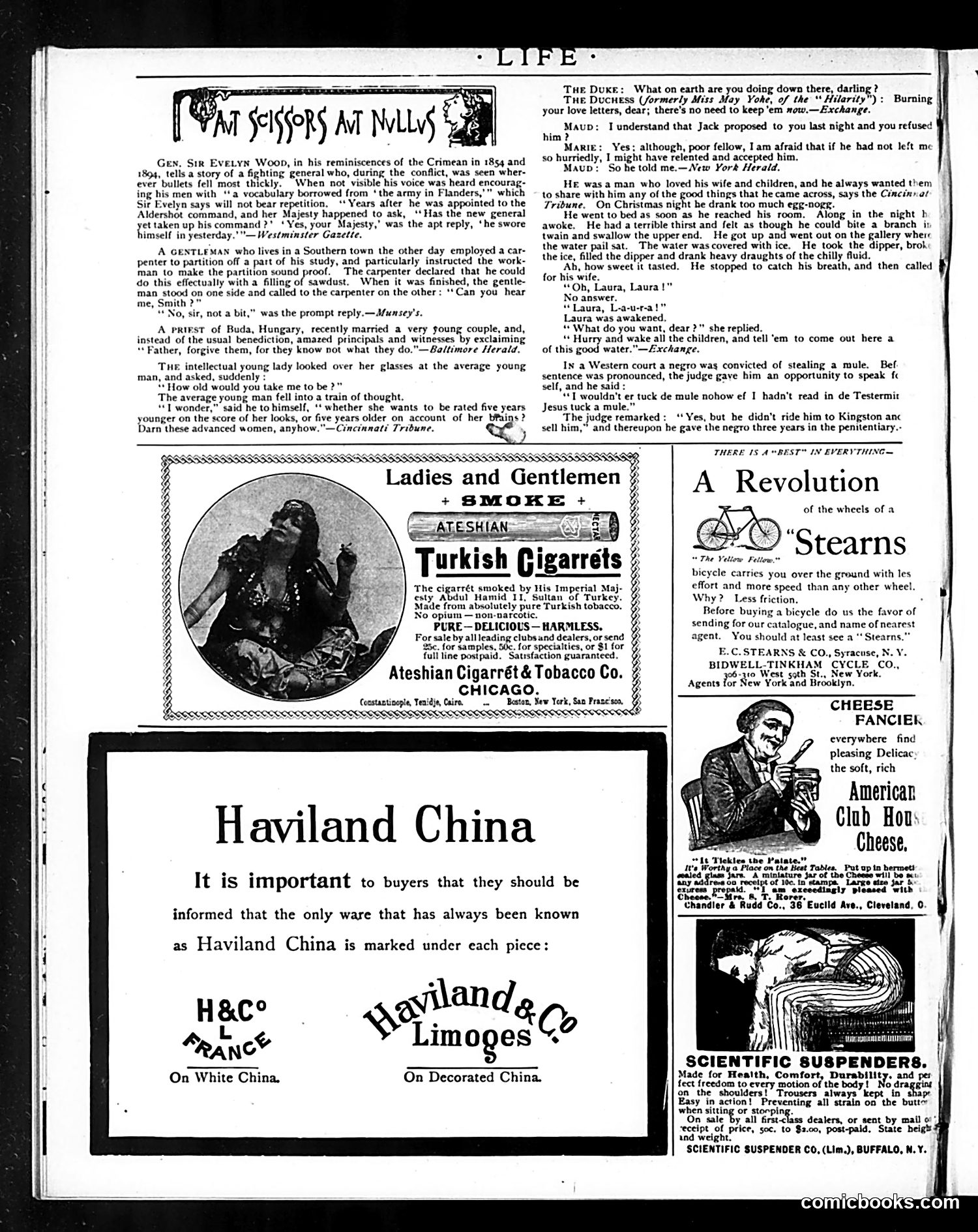
This page consists primarily of **humorous anecdotes** rather than political cartoons. The short stories mock various social situations: 1. **Military discipline**: A general's colorful language at war becomes awkward when he's appointed to a peacetime command. 2. **Soundproofing failure**: A carpenter claims to have built a soundproof partition but hasn't—obvious comedic irony. 3. **Marriage mishap**: A priest accidentally gives a secular blessing instead of a traditional one. 4. **"Intellectual" women**: Satirizes educated women's vanity about age. 5. **A drunk man's generosity**: A man, intoxicated on Christmas eggnog, wakes his family to share melted ice water he mistakes for something special. 6. **Racial stereotype humor**: A Black defendant's biblical defense ("Jesus took a mule") is mocked by the judge, who sentences him. The advertisements (Turkish cigarettes, Haviland China, Stearns bicycles) are period-typical. The humor relies on physical comedy, timing, and—disturbingly—racial mockery typical of early 20th-century publications.