
Life, 1895-02-07 · page 11 of 16
Life — February 7, 1895 — page 11: what you’re looking at
What you’re looking at
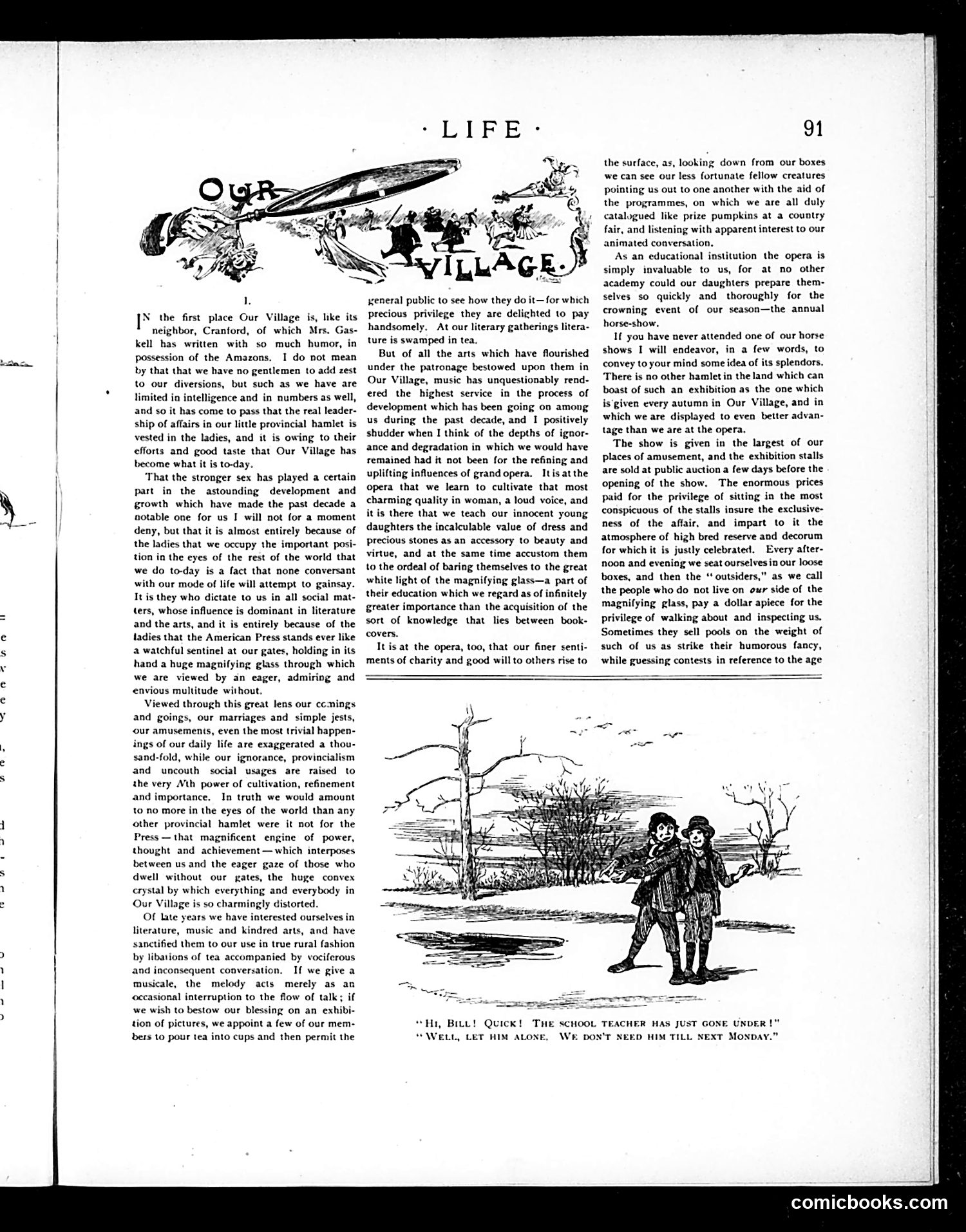
This page contains an essay titled "Our Village" praising the institution's cultural role, alongside a single illustration at the bottom. The cartoon depicts two figures (appearing to be children or young people) in a rural landscape. One says to the other: "Hi, Bill! Quick! The school teacher has just gone under!" The second responds: "Well, let him alone. We don't need him till next Monday." The joke satirizes rural indifference toward education and the schoolteacher's social position. The "gone under" likely refers to the teacher drowning or disappearing into water (a pond or stream visible in the sketch). The children's callous, dismissive response mocks both rural communities' perceived lack of educational investment and the schoolteacher's low social status in small towns—a common target of Life's satirical commentary on American provincial life.
📄 Transcribed text from this page (OCR, searchable)
Machine-transcribed from the original scan — historical spelling and the odd misread are preserved.
aan an — I the first place Our Village is, like its neighbor, Cranford, of which Mrs. Gas- kell bas written with so much humor, in possession of the Amazons. I do not mean by that that we have no gentlemen to add zest to our diversions, but such as we have are limited in intelligence and in numbers as well, and so it has come to pass that the real leader- ship of affairs in our little provincial hamlet is vested in the ladies, and it is owing to their efforts and good taste that Our Village has become what it is to-day. ‘That the stronger sex has played a certain part in the astounding development and growth which have made the past decade a notable one for us I will not for a moment deny, but that it is almost entirely because of the ladies that we occupy the important posi- tion in the eyes of the rest of the world that we do to-day is a fact that none conversant with our mode of life will attempt to gainsay. It is they who dictate to us in all social mat- ters, whose influence is dominant in literature and the arts, and it is entirely because of the ladies that the American Press stands ever like a watchful sentinel at our gates, holding in its hand a huge magnifying glass through which we are viewed by an eager, admiring and envious multitude without. Viewed through this great lens our comings and goings, our marriages and simple jests, ‘our amusements, even the most trivial happen- ings of our daily life are exaggerated a thou- sand-fold, while our ignorance, provincialism and uncouth social usages are raised to the very Vth power of cultivation, refinement and importance. In truth we would amount to no more in the eyes of the world than any other provincial hamlet were it not for the Press —that magnificent engine of power, thought and achievement — which interposes between us and the eager gaze of those who dwell without our gates, the huge convex crystal by which everything and everybody in Our Village is so charmingly distorted. OF late years we have interested ourselves in literature, music and kindred arts, and have sanctified them to our use in true rural fashion by libations of tea accompanied by vo and inconsequent conversation. If we give a musicale, the melody acts merely as an occasional interruption to the flow of talk; if we wish to bestow our blessing on an exhibi- tion of pictures, we appoint a few of our mem- bers to pour tea into cups and then permit the Keneral public to see how they do it—for which precious privilege they are delighted to pay handsomely. At our literary gatherings litera- ture is swamped in tea. But of all the arts which have flourished under the patronage bestowed upon them in Our Village, music has unquestionably rend- ered the highest service in the process of development which has been going on among. us during the past decade, and I positively shudder when I think of the depths of ignor- ance and degradation in which we would have remained had it not been for the refining and uplifting influences of grand opera. Itis atthe opera that we learn to cultivate that most charming quality in woman, a loud voice, and it is there that we teach our innocent young daughters the incalculable value of dress and precious stones as an accessory to beauty and virtue, and at the same time accustom them to the ordeal of baring themselves to the great white light of the magnifying glass—a part of their education which we regard as of infinitely greater importance than the acquisition of the sort of knowledge that lies between book- covers. It is at the opera, too, that our finer senti- ments of charity and good will to others rise to 91 the surface, as, looking down from our boxes we can see our less fortunate fellow creatures pointing us out to one another with the aid of the programmes, on which we are all duly catalogued like prize pumpkins at a country fair, and listening with apparent interest to our animated conversation. As an educational institution the opera is simply invaluable to us, for at no other academy could our daughters prepare them- selves so quickly and thoroughly for the crowning event of our season—the annual horse-show. If you have never attended one of our horse shows I will endeavor, in a few words, to convey to your mind some idea of its splendors. ‘There is no other hamlet in the land which can boast of such an exhibition as the one which is'given every autumn in Our Village, and in which we are displayed to even better advan- tage than we are at the opera. The show is given in the largest of our places of amusement, and the exhibition stalls are sold at public auction a few days before the opening of the show. The enormous prices paid for the privilege of sitting in the most conspicuous of the stalls insure the exclusive- ness of the affair, and impart to it the atmosphere of high bred reserve and decorum for which it is justly celebrated. Every after- noon and evening we seat ourselves in our loose boxes, and then the “outsiders,” as we call the people who do not live on our side of the magnifying glass, pay a dollar apiece for the privilege of walking about and inspecting us. Sometimes they sell pools on the weight of such of us as strike their humorous fancy, while guessing contests in reference to the age “Hi, BILL! Quick! THe SCHOOL TEACHER HAS JUST GONE UNI WELL, LET HIM ALONE, WE DON'T NEED HIM TILL, XT Monpay comicbooks.com