
Life, 1895-02-07 · page 6 of 16
Life — February 7, 1895 — page 6: what you’re looking at
What you’re looking at
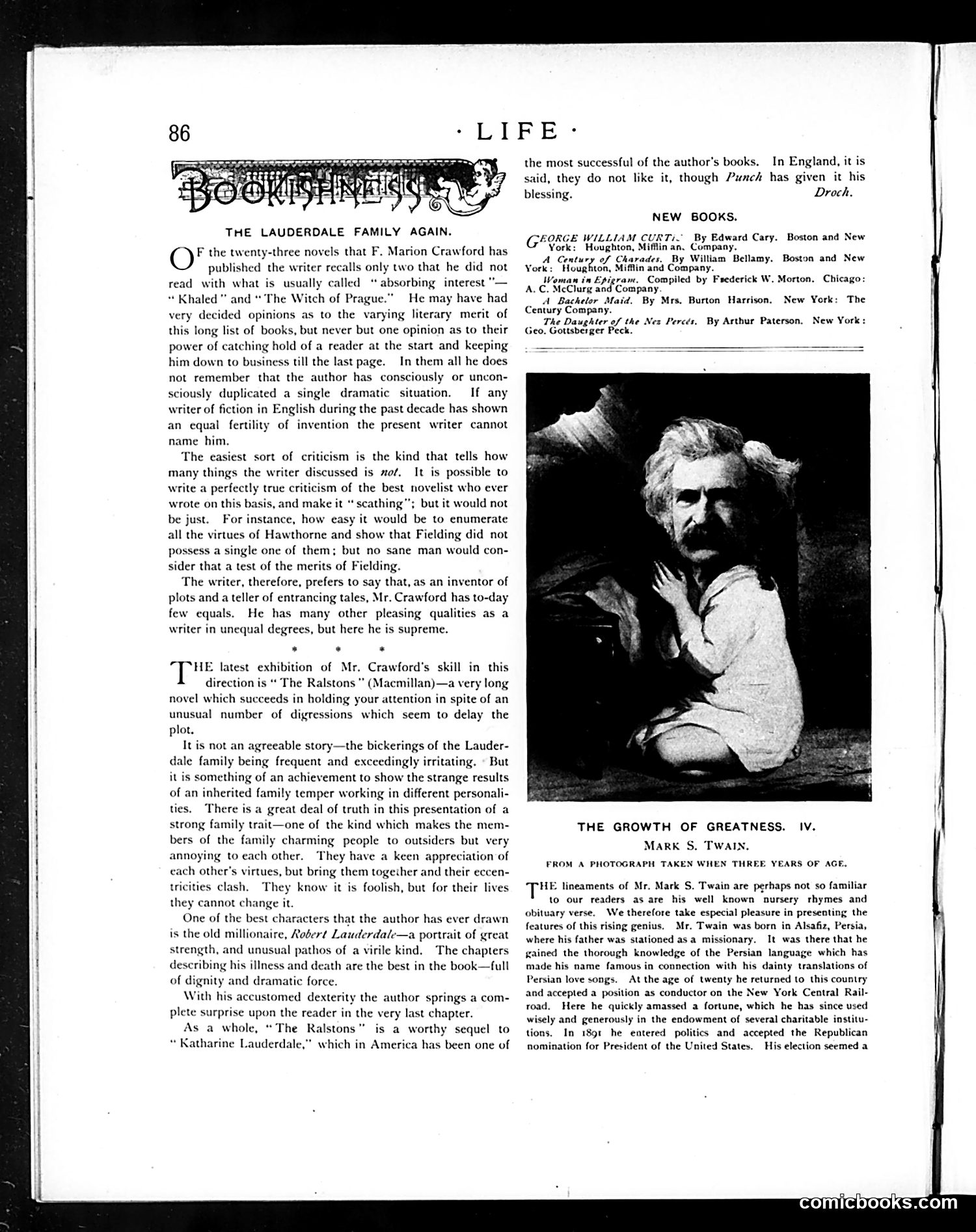
This page is primarily **literary criticism and book review**, not political satire. The left column discusses F. Marion Crawford's novels, particularly praising "The Ralstons" as an achievement in plot invention and character development. The critic argues Crawford excels at creating dramatic situations and compelling narratives. The right side features a **photograph of Mark Twain** (labeled "THE GROWTH OF GREATNESS. IV.") as part of an apparent biographical series. The accompanying text describes Twain's early life—born in Hannibal, his father's diplomatic service in Persia, his knowledge of Persian language, and his early political involvement, including Republican nomination for U.S. President. This is a **cultural/literary magazine page**, not political commentary. The content celebrates American literary figures rather than satirizing them.
📄 Transcribed text from this page (OCR, searchable)
Machine-transcribed from the original scan — historical spelling and the odd misread are preserved.
- LIFE: THE LAUDERDALE FAMILY AGAIN. F the twenty-three novels that F, Marion Crawford has published the writer recalls only two that he did not read with what is usually called“ absorbing interest "— “ Khaled" and * The Witch of Prague. He may have had very decided opinions as to the varying literary merit of this long list of books, but never but one opinion as to their power of catching hold of a reader at the start and keeping him down to business till the last page. In them all he does not remember that the author has consciously or uncon- sciously duplicated a single dramatic situation. If any writer of fiction in English during the past decade has shown an equal fertility of invention the present writer cannot name him. The easiest sort of criticism is the kind that tells how many things the writer discussed is of, It is possible to write a perfectly true criticism of the best novelist who ever wrote on this basis, and make it “ scathing”; but it would not be just. For instance, how easy it would be to enumerate all the virtues of Hawthorne and show that Fielding did not possess a single one of them; but no sane man would con- sider that a test of the merits of Fielding. The writer, therefore, prefers to say that, as an inventor of plots and a teller of entrancing tales, Mr. Crawford has to-day He has many other pleasing qualities as a writer in unequal degrees, but here he is supreme. few equals. * . * “TCHE latest exhibition of Mr. Crawford's skill in this direction is “ The Ralstons ” (Macmii novel which succeeds in holding y unus| plot. It is not an agreeable story—the bickerings of the Lauder- dale family being frequent and exceedingly irritating. » But it is something of an achievement to show the strange results of an inherited family temper working in different personali- There is a great deal of truth in this presentation of a strong family trait—one of the kind which makes the mem- bers of the family charming people to outsiders but very annoying to each other. They have a keen appreciation of each other's virtues, but bring them together and their eccen- tricities clash. They know it is foolish, but for their lives they cannot change it. One of the best characters that the author has ever drawn is the old millionaire, Nobert Lauderdal portrait of great strength, and unusual pathos of a virile kind, The chapters describing his illness and death are the best in the book—full of dignity and dramatic force. With his accustomed dexterity the author springs a com- plete surprise upon the reader in the very last chapter. As a whole, “The Ralstons “ Katharine Lauderdale,” n)—a very long ur attention in spite of an al number of digressions which seem to delay the ties, is a worthy sequel to which in America has been one of the most successful of the author's books. In England, it is said, they do not like it, though Purch has given it his blessing. Droch. NEW BOOKS. EORGE WILLI. Ti” By Edward Cary. Boston and New York: Houg! jin an. Company. A Century of Charades. By William Bellamy. Boston and New York: Houghton, Mifflin and Company. Woman in Epigram, Compiled by Frederick W. Morton, Chicago: A.C. McClurg and Company A Bachelor Maid. By Mrs. Burton Harrison. Century Company. The Daughter of the Nex Pereés. Geo. Gottsberger Peck. New York: The By Arthur Paterson, New York : THE GROWTH OF GREATNESS. IV. MARK S. Twat FROM A PHOTOGRAPH TAKEN WHEN THREE YEARS OF AGE. THE lineaments of Mr. Mark S. Twain are perhaps not so familiar to our readers as are his well known nursery rhymes and obituary verse. We therefore take especial pleasure in presenting the features of this rising genius. Mr. Twain was born in Alsafiz, Persia, where his father was stationed asa missionary. It was there that he gained the thorough knowledge of the Persian language which has made his name famous in connection with his dainty translations of At the age of twenty he returned to this country and accepted a position as conductor on the New York Central Rail- road, Here he quickly amassed a fortune, which he has since used wisely and generously in the endowment of several charitable institu- In 185 he entered politics and accepted the Republican nomination for President of the United States. His election seemed a Persian love songs. tions,