
Life, 1895-02-07 · page 4 of 16
Life — February 7, 1895 — page 4: what you’re looking at
What you’re looking at
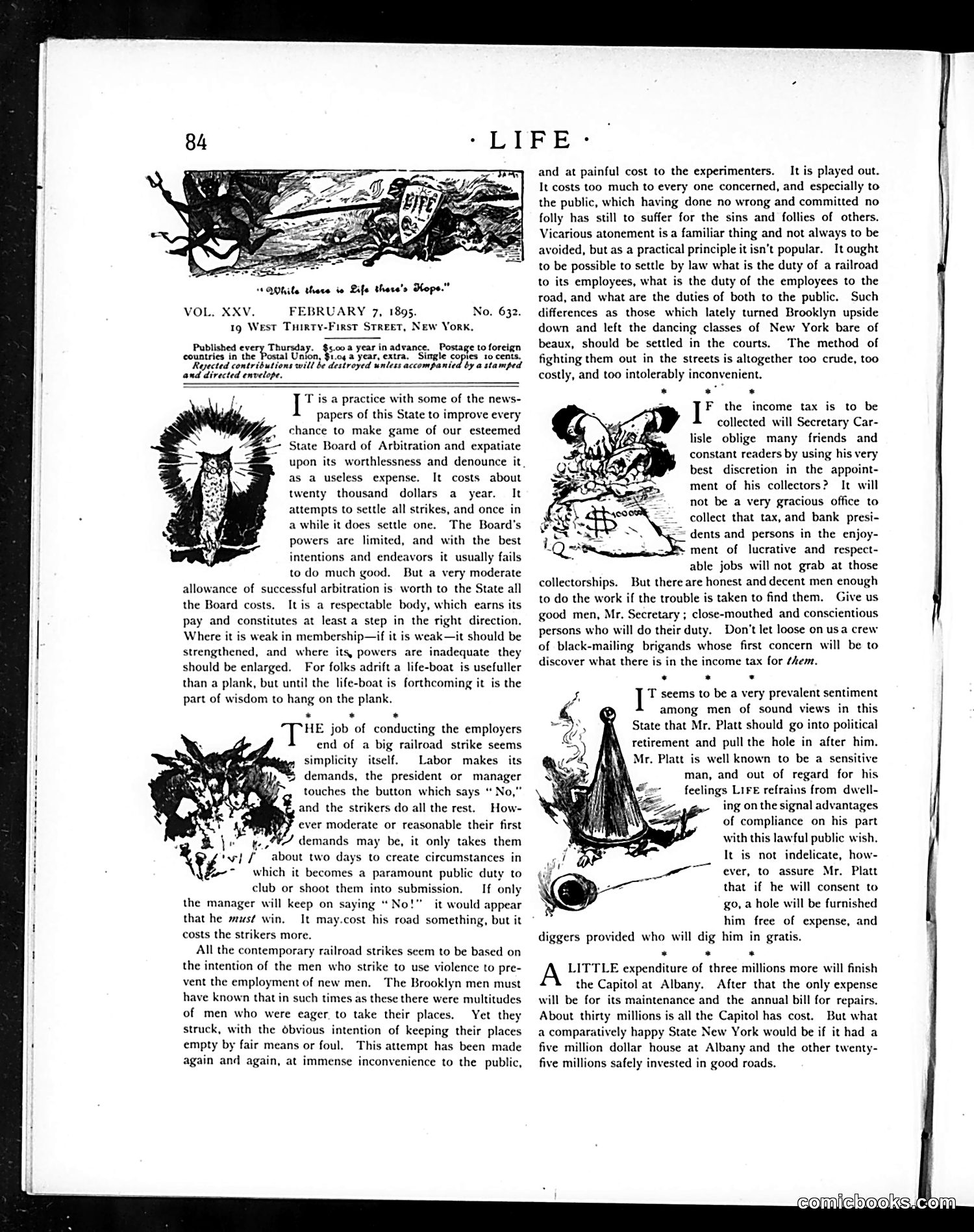
This page contains three editorial cartoons critiquing labor disputes and government inefficiency in 1890s New York. The top cartoon illustrates the State Board of Arbitration's futility in settling railroad strikes—depicted as a figure clinging to a plank, symbolizing the board's weakness against labor unrest. The middle cartoon appears to mock railroad managers' tactics during strikes, showing how they resist workers' demands and attempt to break unions through hiring replacement workers. The bottom cartoon likely references a New York State Capitol building project in Albany, satirizing government waste—millions spent on construction while workers and public suffer from labor conflicts and inadequate infrastructure. The overall message: 1890s labor relations were poorly managed through both industrial obstruction and governmental incompetence.
📄 Transcribed text from this page (OCR, searchable)
Machine-transcribed from the original scan — historical spelling and the odd misread are preserved.
‘LIFE: ‘SOMhibe there ie Life there's Hope.” FEBRUARY 7, 1895. 1g West Tuirty-First STREET, New York, VOL, Published every Thursday. countries in the Postal Union, Ryected contributions will be destroyed unless accompanie. and directed envelope. soo a year in advange. Postage to foreign 1.04 a year, extra, Single oF le$ 10 Cents. by a stamped I is a practice with some of the news- papers of this State to improve every chance to make game of our esteemed State Board of Arbitration and expatiate upon its worthlessness and denounce it, as a useless expense. It costs about twenty thousand dollars a year. It attempts to settle all strikes, and once in awhile it does settle one. The Board's powers are limited, and with the best intentions and endeavors it usually fails todo much good. But a very moderate allowance of successful arbitration is worth to the State all the Board costs. Itis a respectable body, which earns its pay and constitutes at least a step in the right direction, Where it is weak in membership—if it is weak—it should be strengthened, and where its, powers are inadequate they should be enlarged. For folks adrift a life-boat is usefuller than a plank, but until the life-boat is forthcoming it is the part of wisdom to hang on the plank. Te job of conducting the employers end of a big railroad strike seems , simplicity itself. Labor makes its SS demands, the president or mana touches the button which says ‘ No and the strikers do all the rest. How- By cver moderate or reasonable their first ju ¢,4#7 demands may be, it only takes them tw} {about two days to create circumstances in - which it becomes a paramount public duty to club or shoot them into submission. — If only the manager will keep on saying “No!” it would appear that he must win. It may.cost his road something, but it costs the strikers more. All the contemporary railroad strikes seem to be based on the intention of the men who strike to use violence to pre- vent the employment of new men. The Brooklyn men must have known that in such times as these there were multitudes of men who were eager to take their places. Yet they struck, with the obvious intention of keeping their places empty by fair means or foul. This attempt has been made again and again, at immense inconvenience to the public, and at painful cost to the experimenters. It is played out. It costs too much to every one concerned, and especially to the public, which having done no wrong and committed no folly has still to suffer for the sins and follies of others. Vicarious atonement is a familiar thing and not always to be avoided, but as a practical principle it isn’t popular. It ought to be possible to settle by law what is the duty of a railroad to its employees, what is the duty of the employees to the road, and what are the duties of both to the public. Such differences as those which lately turned Brooklyn upside down and left the dancing classes of New York bare of beaux, should be settled in the courts. The method of fighting them out in the streets is altogether too crude, too costly, and too intolerably inconvenient. . * J* the income tax is to be collected will Secretary Car- lisle oblige many friends and constant readers by using his very best discretion in the appoint- ment of his collectors? It will not be a very gracious office to collect that tax, and bank presi- ~ dents and persons in the enjoy- + ment of lucrative and respect- able jobs will not grab at those collectorships. But there are honest and decent men enough to do the work if the trouble is taken to find them. Give us good men, Mr. Secretary ; close-mouthed and conscientious persons who will do their duty. Don’t let loose on usa crew of black-mailing brigands whose first concern will be to discover what there is in the income tax for ¢hem. . . . T seems to be a very prevalent sentiment among men of sound views in this State that Mr. Platt should go into political retirement and pull the hole in after him. \ Mr. Platt is well known to be a sensitive man, and out of regard for his LiFe refrains from dwell- ing on the signal advantages of compliance on his part with this lawful public wish. It is not indelicate, how- ever, to assure Mr. Platt that if he will consent to go, a hole will be furnished him free of expense, and diggers provided who will dig him in gratis. . . * A LITTLE expenditure of three millions more will finish the Capitol at Albany. After that the only expense will be for its maintenance and the annual bill for repairs. About thirty millions is all the Capitol has cost. But what a comparatively happy State New York would be if it had a five million dollar house at Albany and the other twenty- five millions safely invested in good roads.