
A complete issue · 18 pages · 1891
Life — January 15, 1891
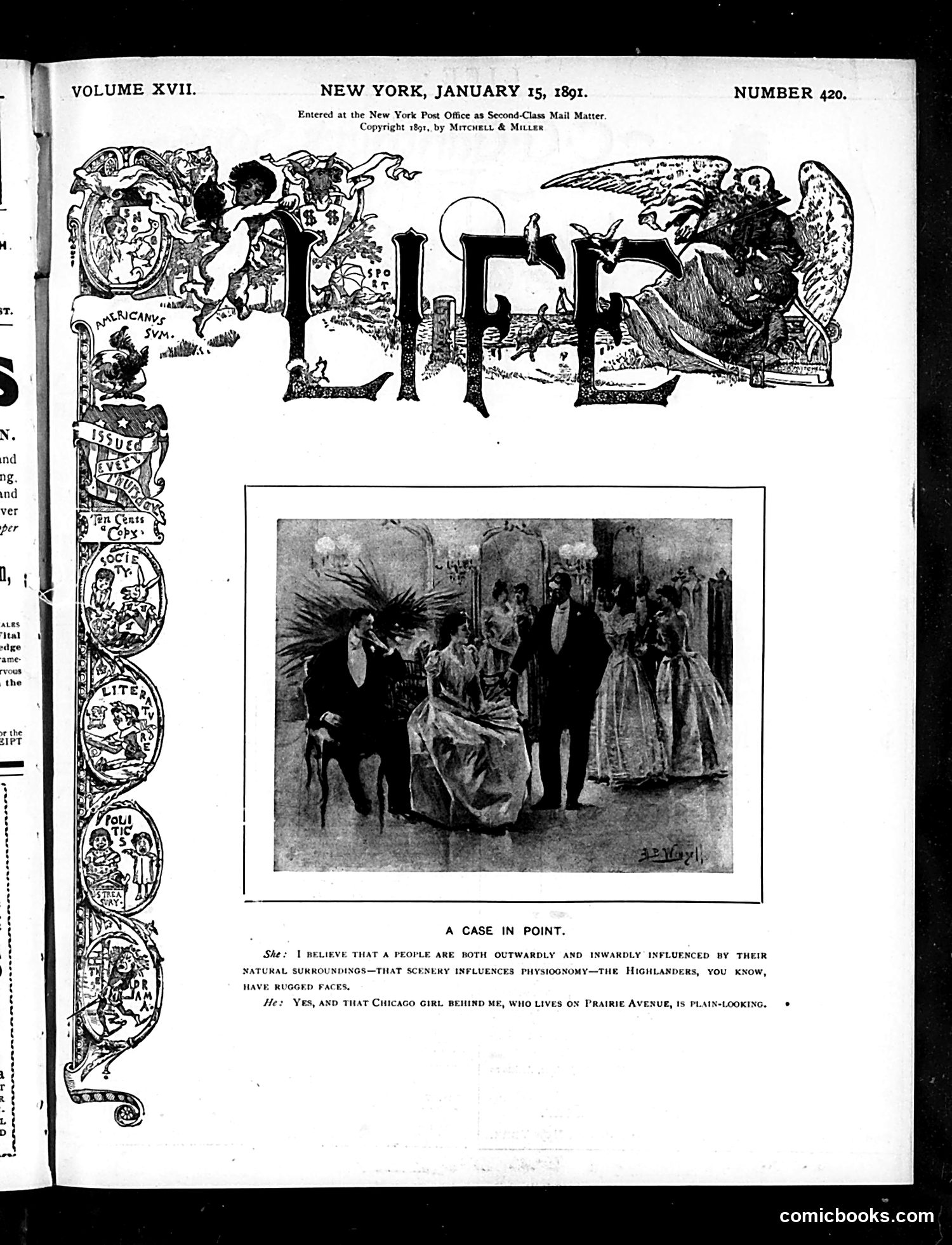
This satirical piece critiques physiognomy—the pseudoscientific belief that facial features reveal character. The dialogue mocks this notion: **She** argues that people are shaped by their surroundings; natural scenery influences character, citing "Highlanders" as examples of how landscape produces "rugged faces." **He** responds that a plain-looking Chicago girl he knows disproves this theory—she lives on Prairie Avenue (a wealthy Chicago neighborhood with fine scenery) yet remains "plain-looking." The satire ridicules the era's widespread belief in physiognomy while also gently mocking assumptions about how environment determines appearance or character. The illustration shows what appears to be a social gathering where such pretentious discussion might occur.
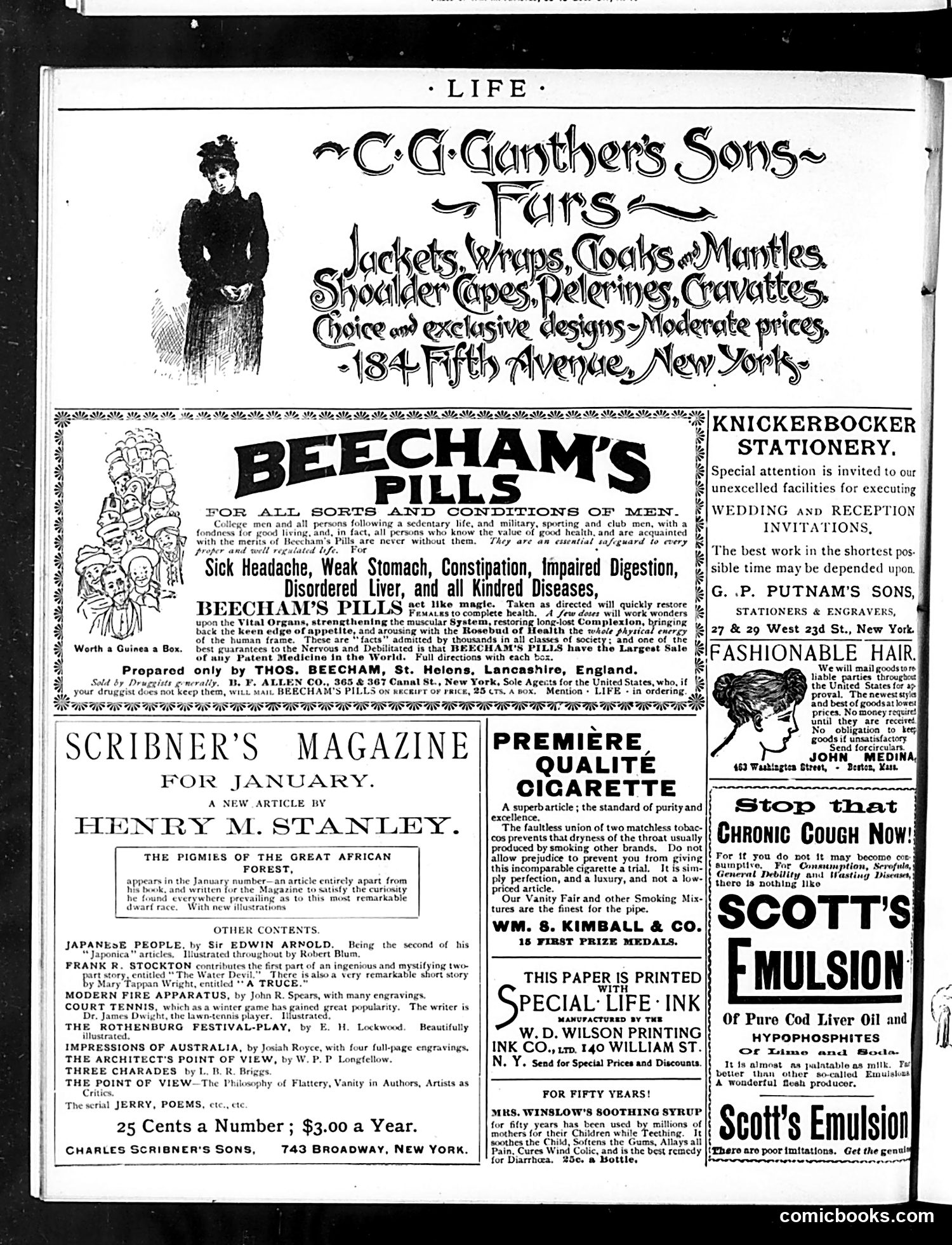
This page is **primarily advertising**, not editorial content or cartoons. The dominant features are: 1. **C.G. Ganthers Sons** - A fur fashion advertisement showing a woman in Victorian dress, promoting jackets, wraps, and cloaks at 184 Fifth Avenue, New York. 2. **Beecham's Pills** - A patent medicine advertisement claiming to treat various ailments (headache, weak stomach, constipation, liver disease) with an ornate illustrated border. 3. **Scribner's Magazine announcement** - Promoting January content by Henry M. Stanley about African forests. 4. **Scott's Emulsion** and other product ads (cigarettes, hair products, cough remedy). The page contains **no political cartoons or satire**—it's a typical turn-of-the-century magazine layout mixing editorial promotion with commercial advertising, reflecting the era's patent medicine industry and women's fashion marketing.
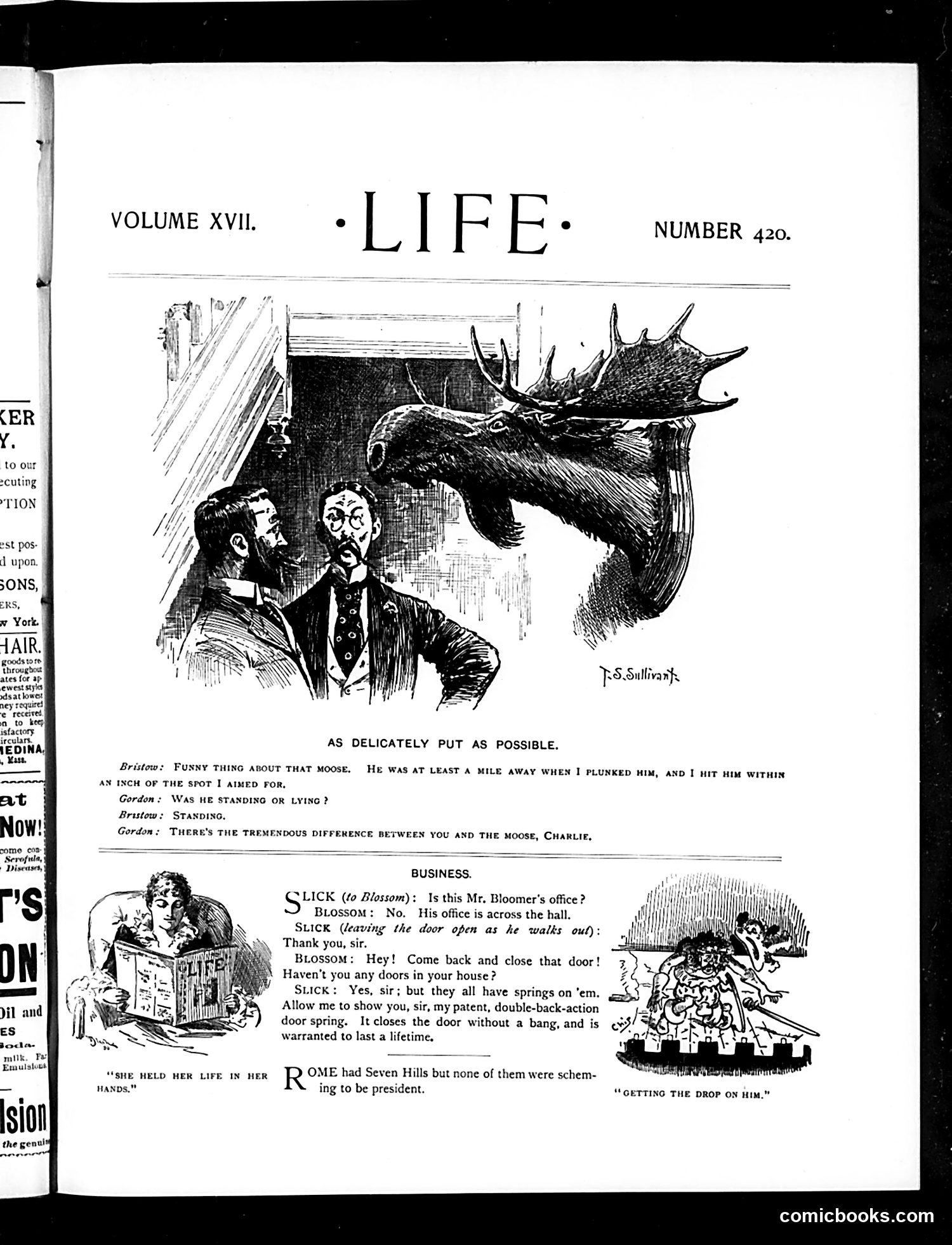
**Top Cartoon:** "As Delicately Put as Possible" shows two men observing a mounted moose head. The dialogue reveals one man shot a moose from a mile away but claimed precision—hitting his exact target. The joke satirizes the difference between reality and boastful claims: the shooter was far enough away that accuracy was essentially luck, yet he presents it as skilled marksmanship. The exaggerated moose emphasizes the absurdity. **Bottom Section:** "Business" depicts a door-to-door salesman (Slick) pitching a "double-back-action door spring" to a homeowner (Blossom). The satire mocks aggressive sales tactics and patent medicines/gadgets marketed with dubious claims about durability and innovation. Both segments reflect early 20th-century American consumer culture skepticism.
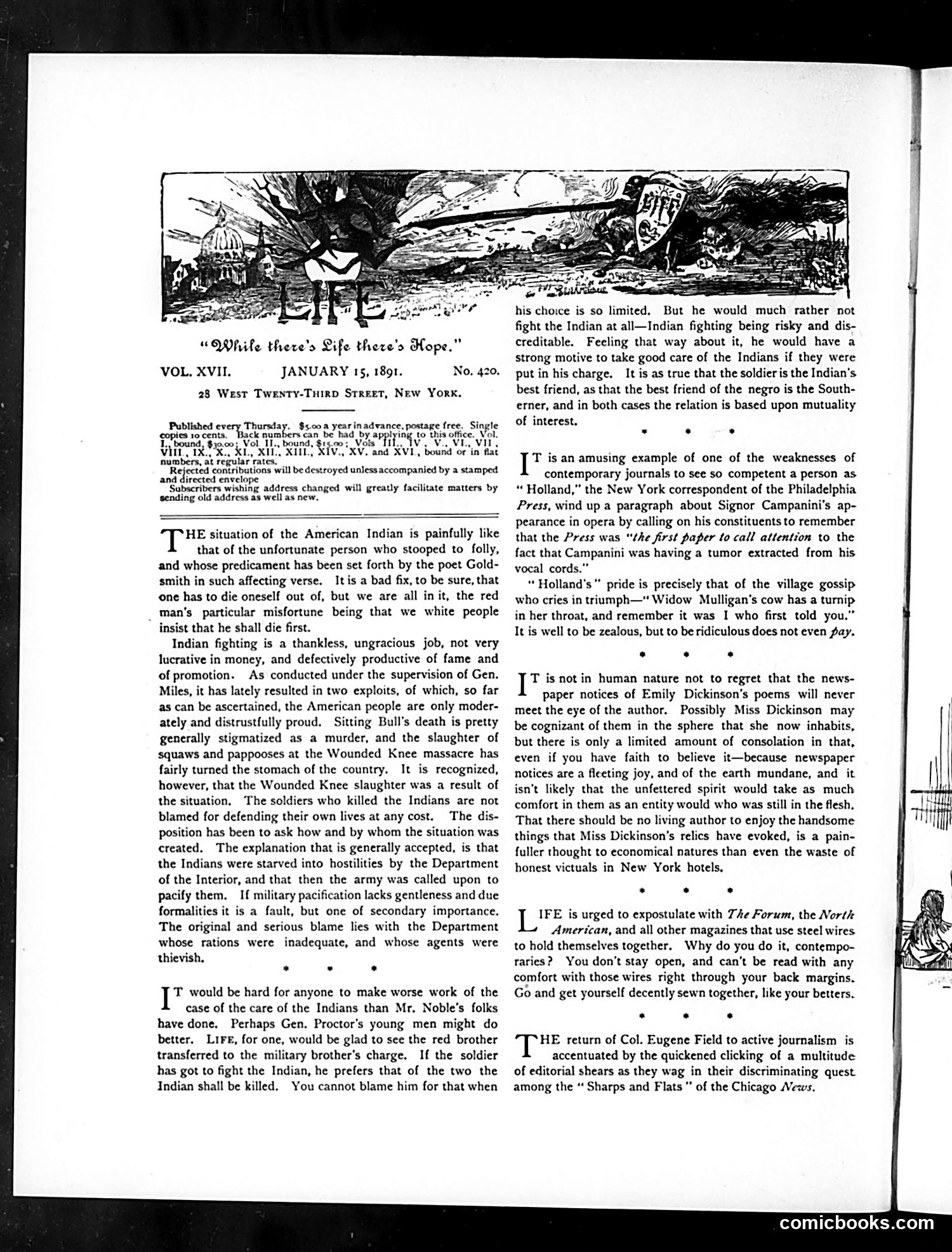
The masthead cartoon titled "While there's Life there's Hope" depicts a Native American figure amid a devastated landscape with buildings burning—likely referencing the Wounded Knee Massacre (December 1890), where U.S. Army troops killed approximately 150 Lakota Sioux. The editorial criticizes how American newspapers and the Department of Interior have mishandled Indian policy. It defends military pacification efforts while arguing that responsibility for deaths lies with poor government administration, not soldiers following orders. The piece notably expresses paternalistic sympathy for Native Americans while simultaneously supporting military action against them—a contradictory stance typical of 1891 American liberal discourse on Indian affairs.
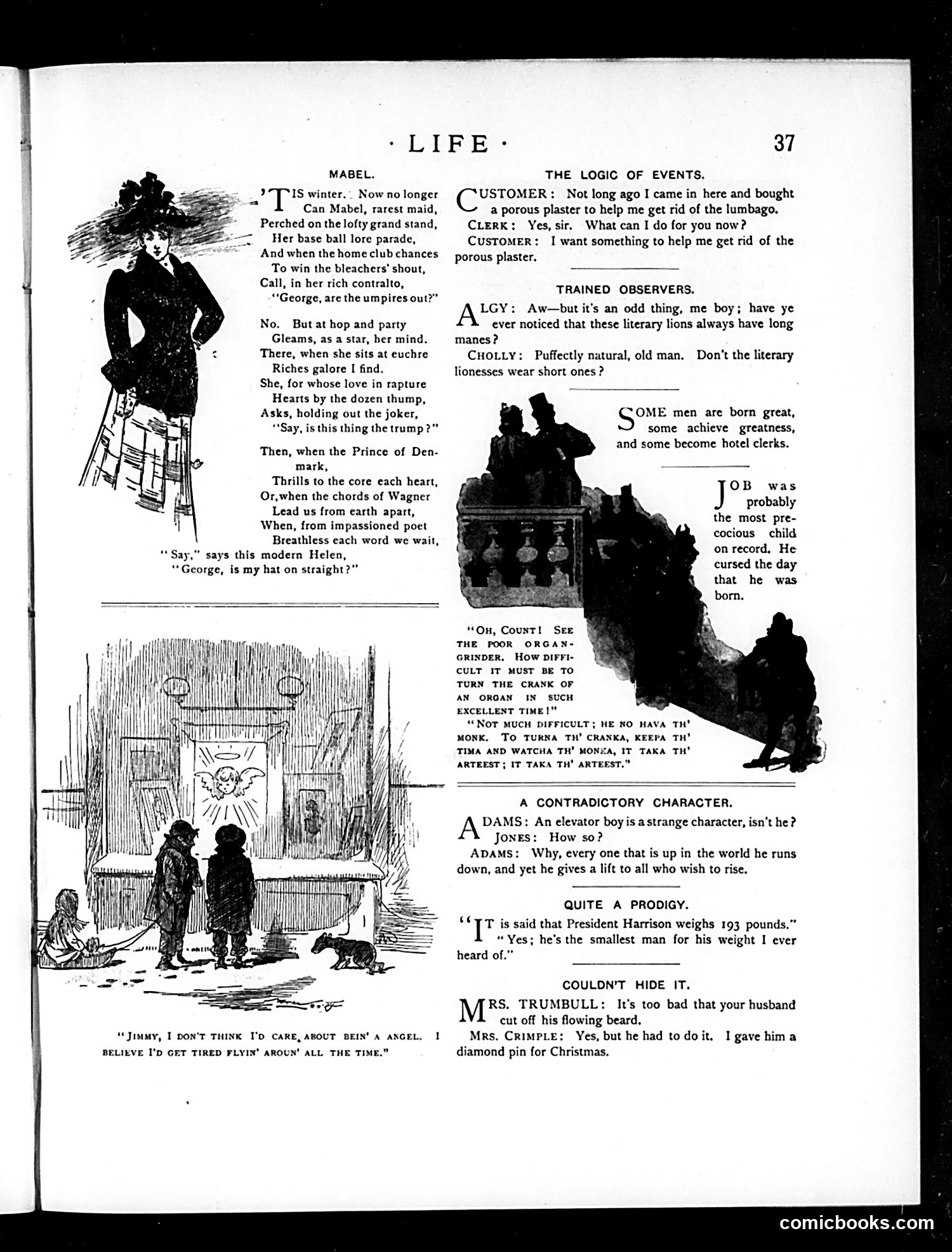
This page contains several unrelated satirical vignettes typical of Life's humor format: 1. **"Mabel"** (top left): A poem mocking a woman at a winter sporting event, with illustration showing an elegantly dressed figure. The satire targets her pretentiousness and romantic fantasies. 2. **"The Logic of Events"** and other brief joke sections feature workplace and social humor—a customer complaining about plaster, observations about "literary lionesses," and wordplay about hotel clerks achieving "greatness." 3. **"A Contradictory Character"**: A joke about an elevator boy who simultaneously runs down while lifting others up—a paradox joke. 4. **"Quite a Prodigy"**: References President Harrison weighing 193 pounds, mocking his diminutive stature. 5. **"Couldn't Hide It"**: A domestic humor piece about a husband cutting his beard. The page is typical early-20th-century American magazine humor—light satire on social manners, gender roles, and current figures.
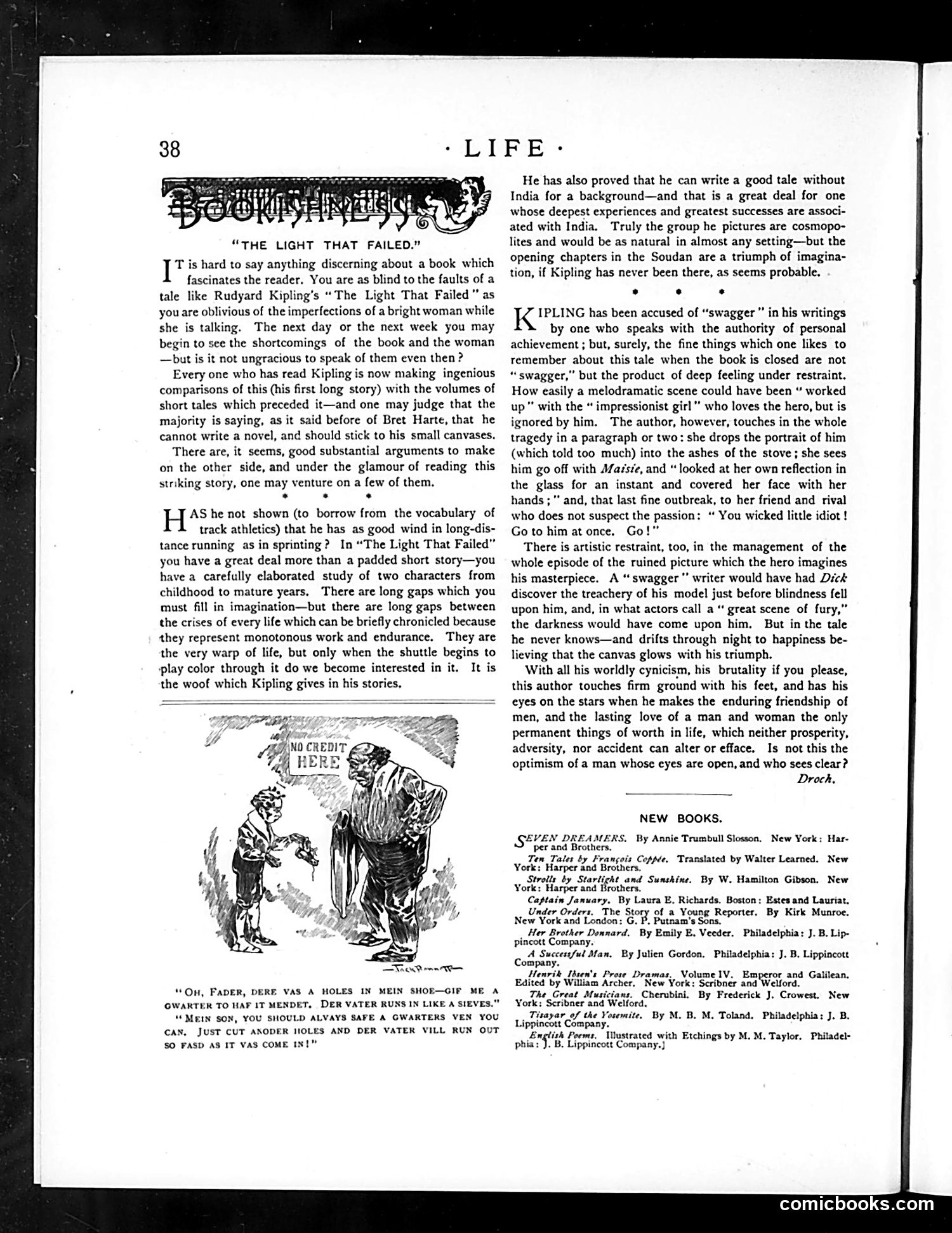
This page is primarily a **literary review** of Rudyard Kipling's story "The Light That Failed," not a political cartoon. The text discusses Kipling's narrative techniques, character development, and his ability to write compellingly about India without relying on exotic settings. The **single illustration** depicts a scene from the story itself: an adult figure ("Fader") speaking to a child about holes in shoes, rendered in a sketchy style typical of period book illustrations. The German dialogue quoted below translates roughly to advice about preventing shoe holes through darning. The page concludes with a **"New Books" section** listing recent publications. This is primarily a cultural/literary feature, not satirical commentary on contemporary politics or society.
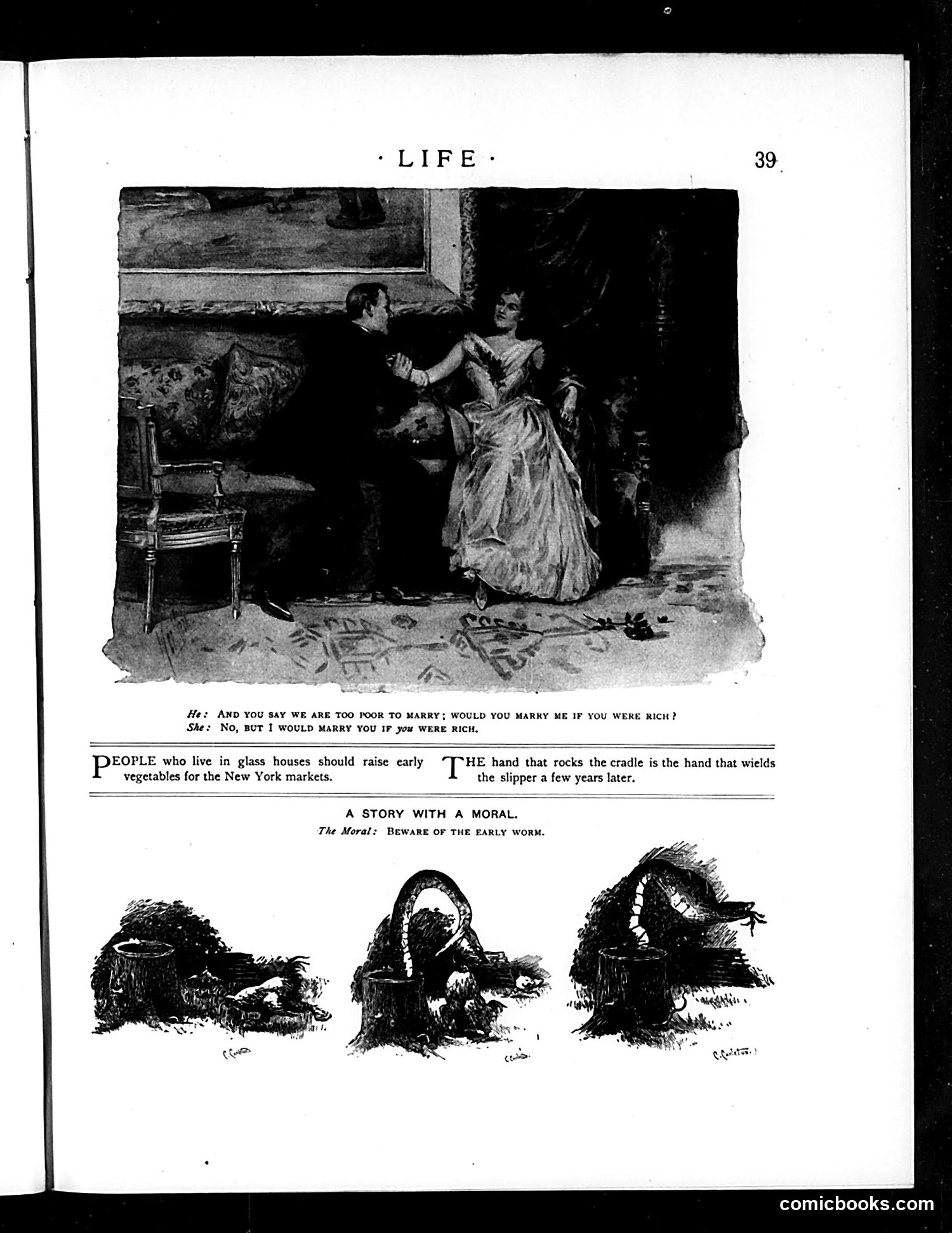
**Top photograph/scene:** Shows a couple in formal dress having a conversation. The caption presents a dialogue about marriage and poverty: "He: AND YOU SAY WE ARE TOO POOR TO MARRY; WOULD YOU MARRY ME IF YOU WERE RICH? / She: NO, BUT I WOULD MARRY YOU IF YOU WERE RICH." This is satirical commentary on materialism and courtship—the woman's contradictory response exposes the absurdity of valuing wealth over the man himself. It mocks both romantic pretense and mercenary attitudes in marriage. **Bottom section:** Three illustrated panels showing worms emerging from a tree stump, titled "A STORY WITH A MORAL: BEWARE OF THE EARLY WORM." This is a play on the proverb "the early bird catches the worm," humorously reversing it to warn worms instead—satirizing overconfidence or miscalculated risks. The page combines social satire about courtship with wordplay humor.
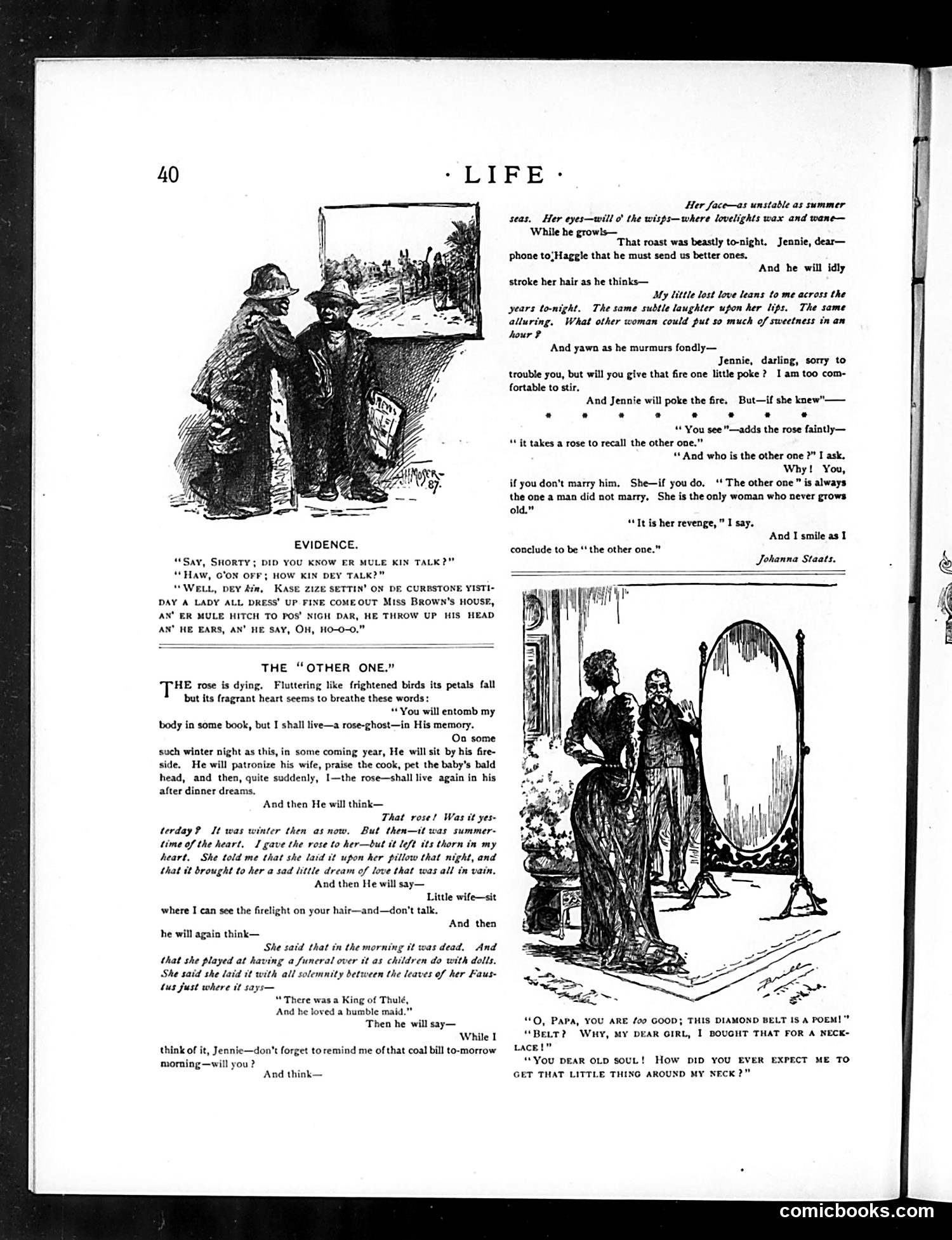
This page presents two satirical pieces. The top cartoon titled "Evidence" depicts what appears to be a dialogue between characters discussing an African American man's supposed actions—the humor relies on racist dialect and stereotypes common to period satire. The larger piece, "The Other One," is a romantic poem about a dying rose and memory, attributed to Johanna Staats. The accompanying illustration shows a woman at a mirror, likely exploring themes of vanity or reflection on lost love. The bottom cartoon mocks a wealthy man giving his daughter an expensive diamond necklace, with her complaining the gift doesn't include the item she truly wants—satirizing both conspicuous consumption and spoiled privilege among the wealthy. These pieces reflect early 20th-century satirical conventions and attitudes.
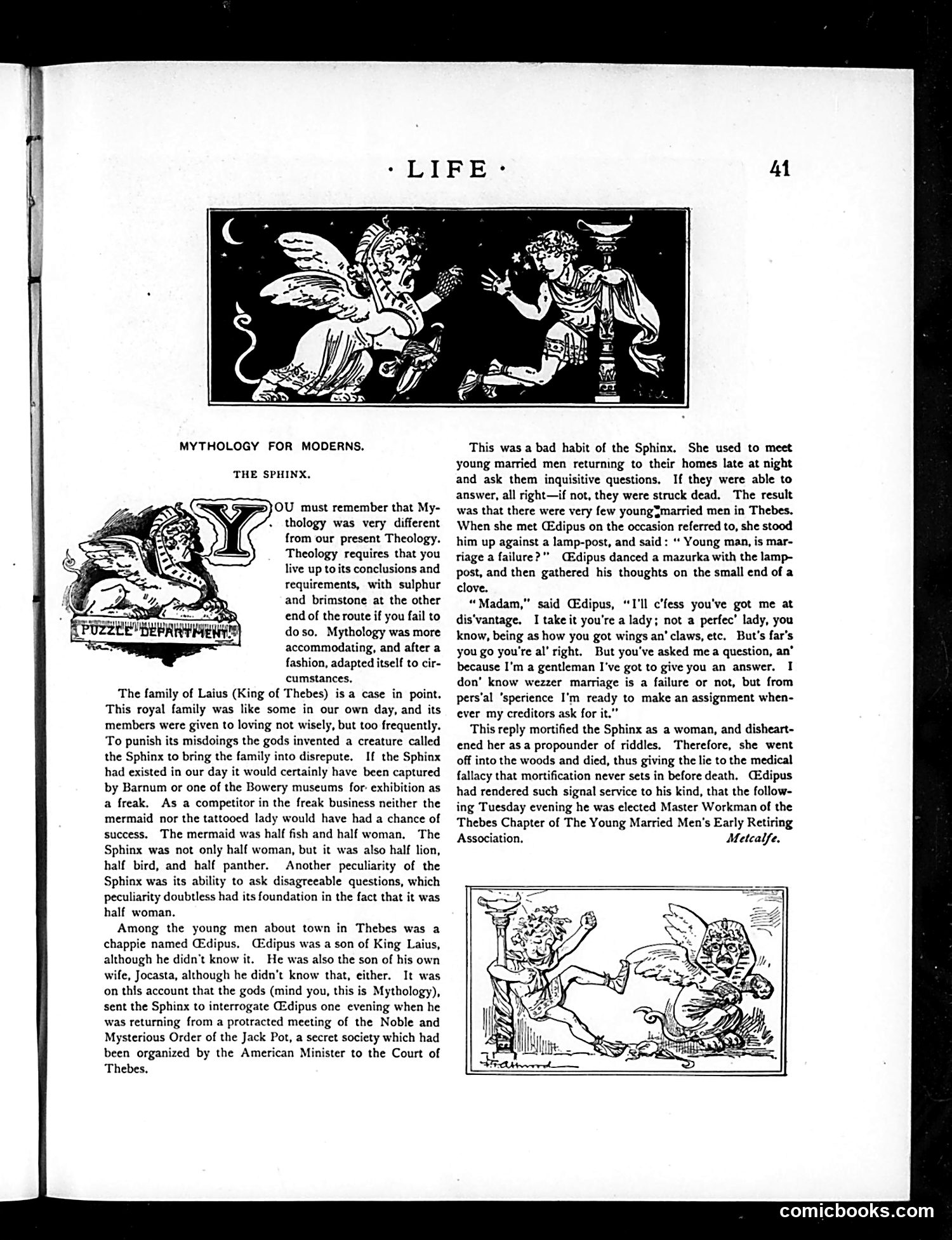
This is satirical commentary on marriage using classical mythology. The piece mocks the Sphinx's legendary riddling behavior by reframing it as a nagging wife who interrogates young husbands returning home. The joke plays on the Sphinx being "half woman"—suggesting women's tendency toward relentless questioning. The cartoon depicts Oedipus confronted by the Sphinx. The text humorously presents their exchange about whether marriage constitutes "failure," with Oedipus deflecting the woman's pointed questions. The satire targets women's inquisitiveness and marital discord, presenting it through classical mythology to mock contemporary domestic life. The piece concludes by attributing the column to "Metcalfe," suggesting authorial credit, likely for this recurring satirical feature updating ancient myths with modern social commentary.
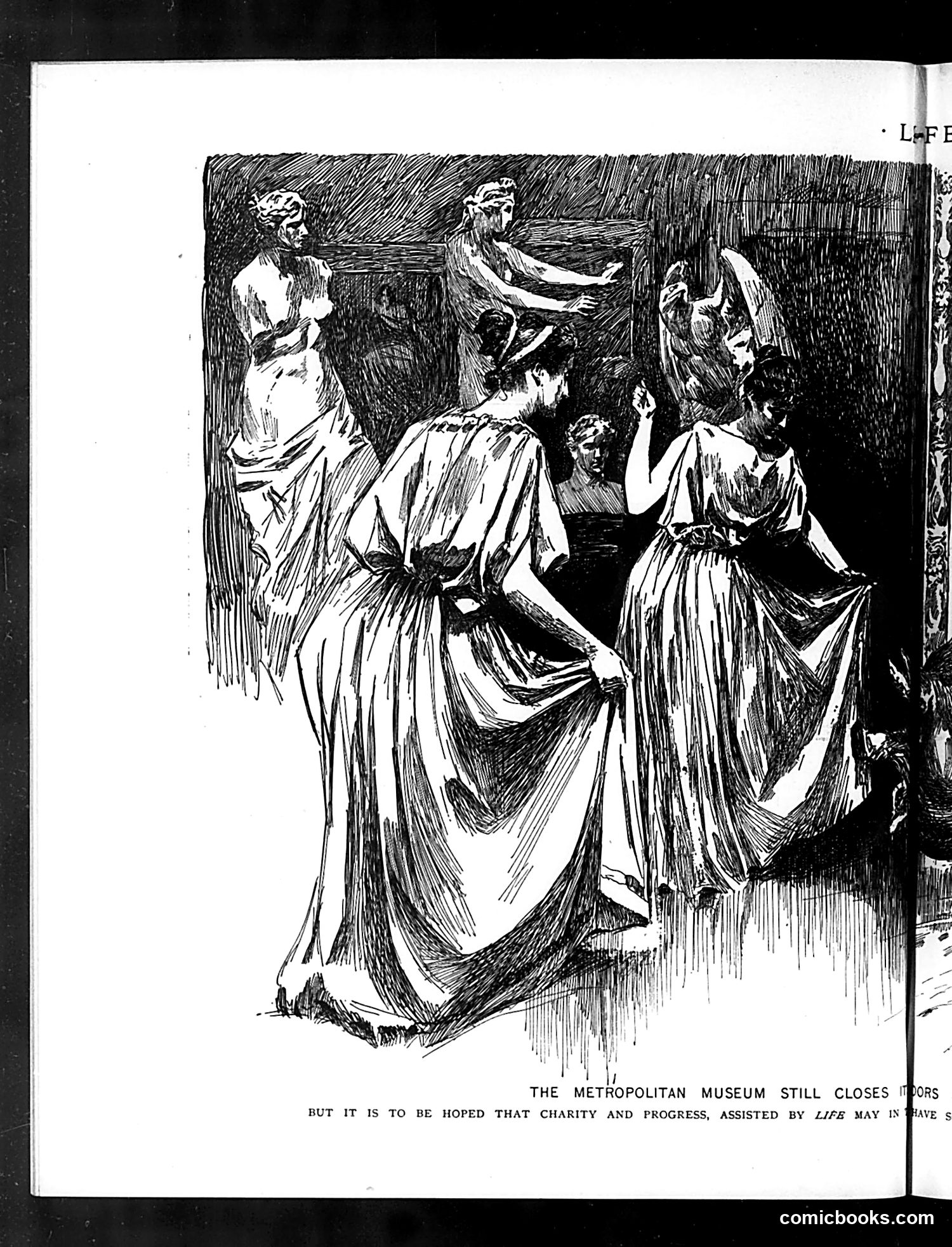
This illustration depicts several elegantly dressed women in classical Greek or Roman-style robes gathered in what appears to be a museum interior. The caption indicates the Metropolitan Museum of Art's doors remain closed, with hope expressed that "charity and progress, assisted by *Life* may in have s[ucceed]." The satire critiques the museum's closure during a period when the public expected cultural institutions to remain accessible. The classical drapery worn by the figures—suggesting ideals of civilization and enlightenment—contrasts ironically with the institution's actual unavailability to the public. The image sarcastically presents the museum's exclusivity as embodying high culture while *Life* magazine positions itself as an advocate for democratic access to arts and education.
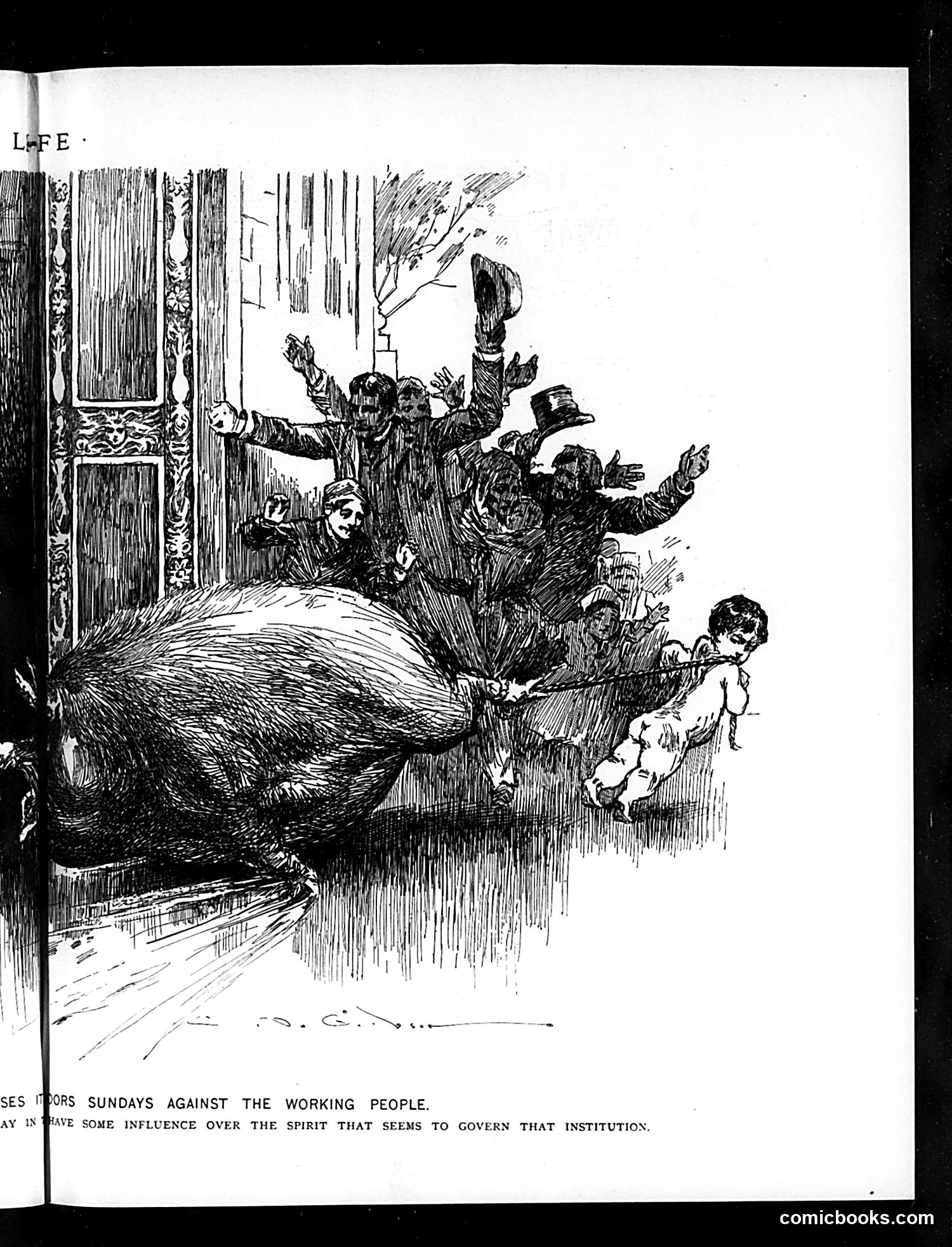
This satirical cartoon depicts a large pig being led by a child toward a group of formally dressed men with their arms raised in apparent celebration or alarm. The partial text references "SUNDAYS AGAINST THE WORKING PEOPLE" and mentions influencing "the spirit that seems to govern that institution." The image appears to be social commentary critiquing wealthy or institutional interests (represented by the formally dressed figures) exploiting or manipulating working-class concerns. The pig likely symbolizes either corruption, greed, or excess. The child leading it suggests either innocence being corrupted or the vulnerability of ordinary people being misled by powerful interests. Without the complete caption and publication date, the specific institutional or political target remains unclear, though the anti-establishment sentiment is evident.
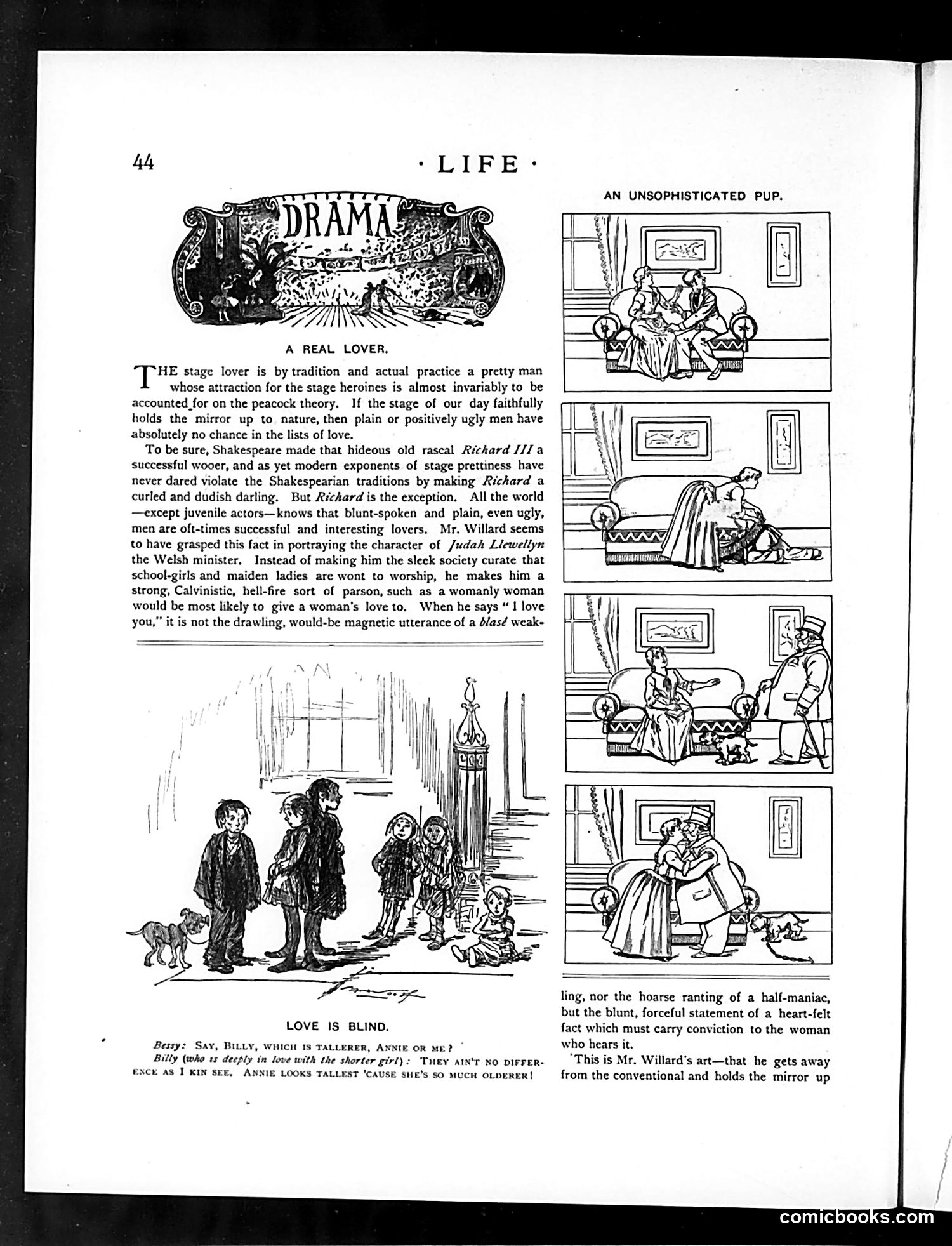
This page contains two distinct pieces of theatrical and social satire: **"A Real Lover"** (left): A drama critique praising actor Mr. Willard's portrayal of Judah Llewellyn, a Welsh minister. The article argues that unlike stage tradition—which demands conventionally handsome male leads—Willard's character is deliberately plain and religiously stern. The satire suggests stage conventions ignore reality: truly compelling men succeed through authentic conviction and strength of character, not physical beauty or affected magnetism. Shakespeare's Richard III is cited as the historical exception proving the rule. **"An Unsophisticated Pup"** (right): A four-panel comic strip showing a young boy (Billy) in love with a girl. The humor lies in his biased perception: when asked which girl is taller, he claims there's no difference, then illogically insists the shorter girl "looks tallest 'cause she's so much olderer." The title and caption ("Love is Blind") satirize how romantic infatuation distorts objective judgment—even children exhibit this universal human folly. Both pieces explore love's irrationality versus authentic character.
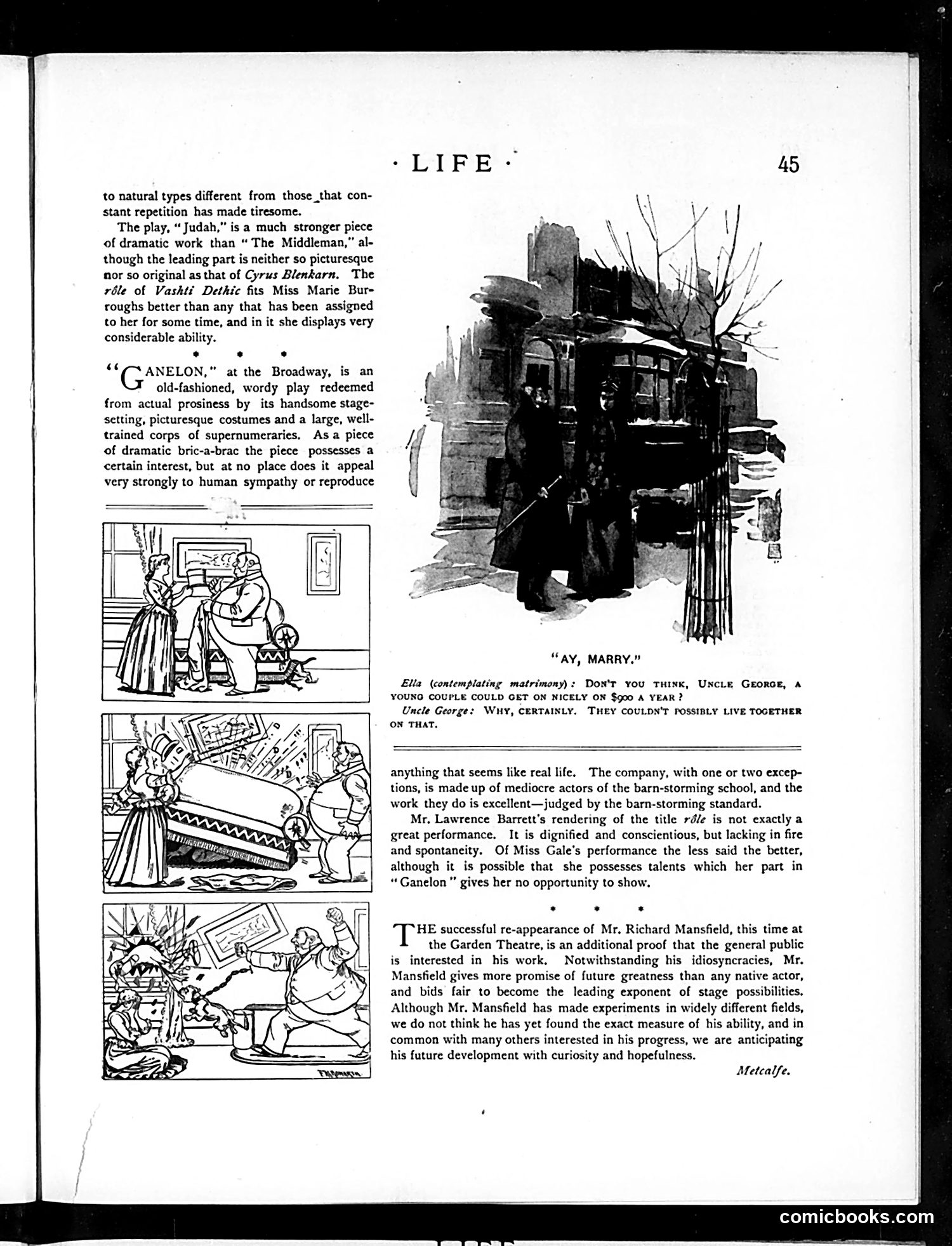
This page reviews theatrical productions, featuring three cartoons illustrating a joke about marriage finances. The main cartoon "Ay, Marry" depicts a young woman (Ella) asking her Uncle George whether a young couple could live on $900 annually. Uncle George's reply—that they "couldn't possibly live together on that"—is a witty non sequitur: he interprets her question as asking whether they could coexist as a couple at all on such meager funds, rather than answering whether survival was feasible. The three panels above show increasingly chaotic domestic scenes, humorously visualizing marital discord. The text reviews several Broadway plays: "Judah" and "The Middleman," praised for strong dramatic work; "Ganelon," deemed old-fashioned but visually appealing; and notes Richard Mansfield's promising theatrical career. The reviews critique acting quality and production values typical of period theater criticism.
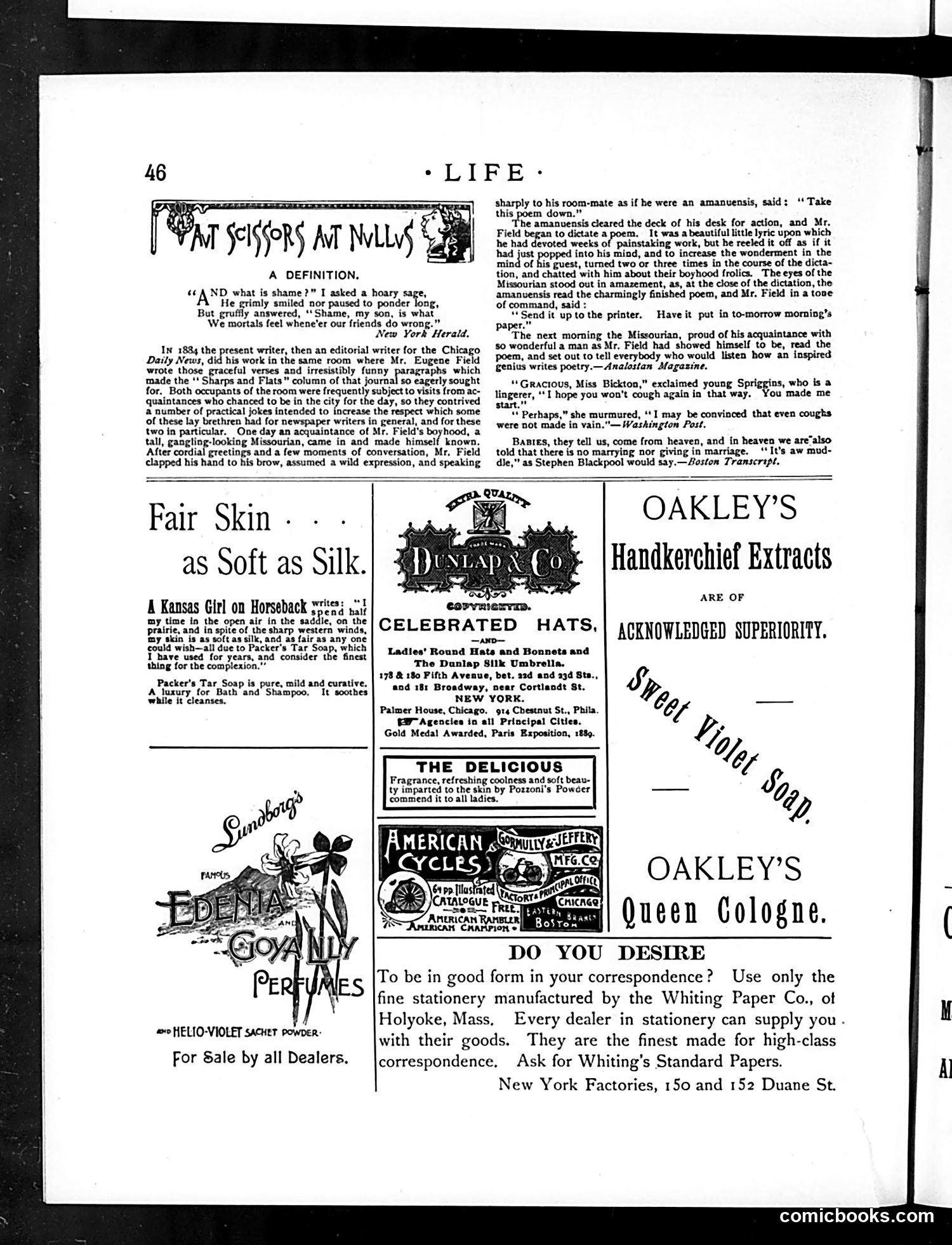
This page contains satirical anecdotes and advertisements typical of Life magazine's format. **"A Definition"** opens with a philosophical joke about shame, attributing the quote to the New York Herald. **The Eugene Field anecdote** is the main content: it describes how the famous Chicago Daily News humorist Field pranked a visiting Missourian acquaintance by dramatically "dictating" a carefully-crafted poem as if composing it spontaneously. Field's room-mate served as a fake amanuensis (secretary), and the visitor was thoroughly fooled, later boasting about Field's genius. The satire mocks both Field's theatrical deception and the visitor's gullibility—poking fun at how easily people are impressed by performance rather than substance. The remaining brief anecdotes offer gentle social humor about coughing and romance. **The bottom half** contains period advertisements for soap, hats, perfume, bicycles, stationery, and cologne—standard commercial content subsidizing the magazine's publication.
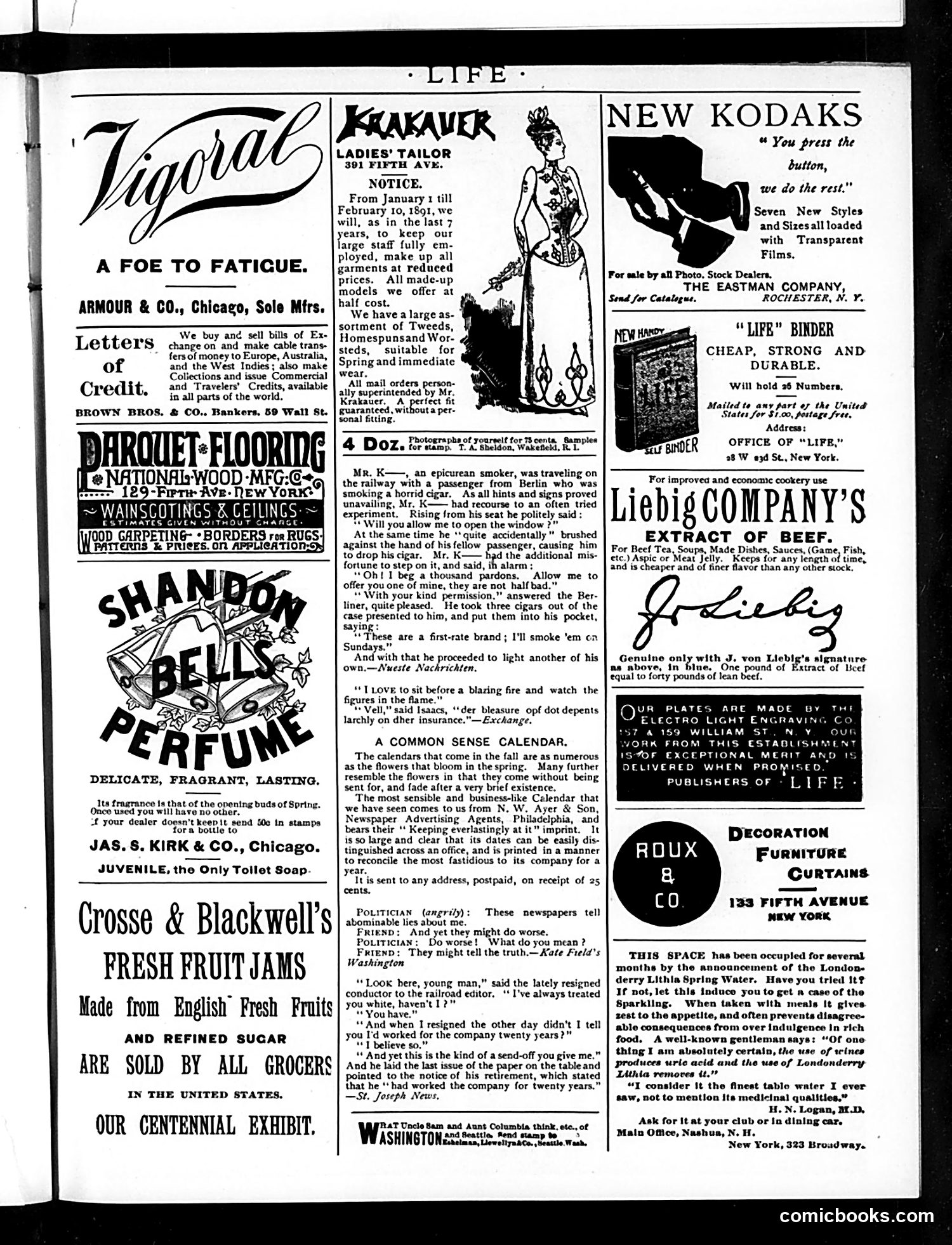
This page is primarily **advertising**, not political cartoons. The main editorial content is a brief humorous anecdote about "Mr. K—," a fastidious smoker on a train who passive-aggressively "accidentally" drops his cigar on a Berlin passenger's bad cigar, then offers superior cigars as compensation. The joke mocks pretentious smoking etiquette and German tourists. A secondary joke features a **politician complaining** to a friend that newspapers tell "abominable lies" about him. The friend suggests they "might do worse"—implying they could tell the *truth* instead. This satirizes politicians' typical complaint that press coverage is unfair, suggesting the real problem would be honest reporting. The page otherwise consists of period advertisements for furniture, banking services, jams, perfume, and cameras—typical 1890s Life magazine content mixing commercial ads with light satirical humor.
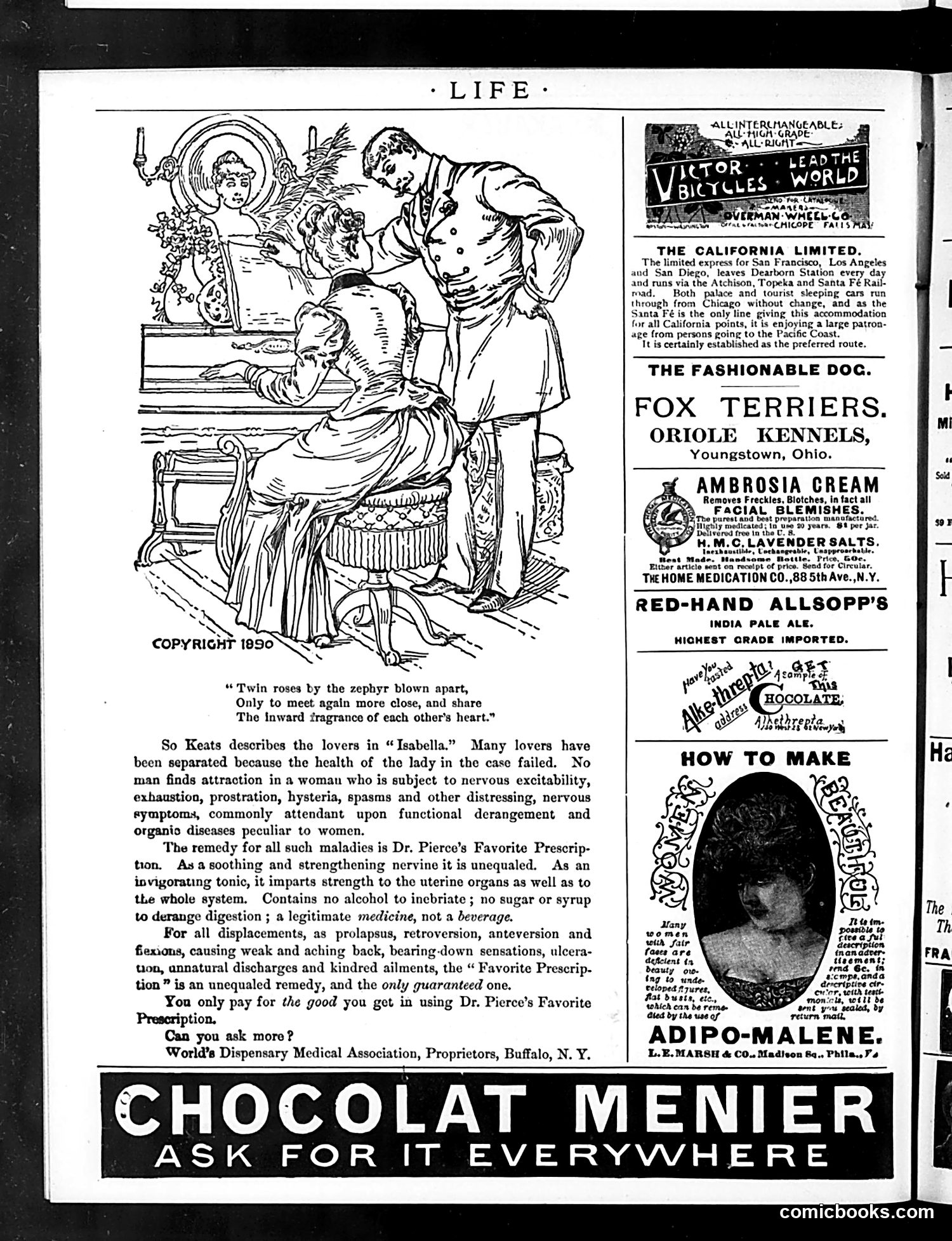
This page is primarily **advertising**, not political satire. The main illustration depicts a romantic scene from Keats's poem "Isabella"—a man and woman in classical dress with cherubs—but it serves as decoration for Dr. Pierce's "Favorite Prescription," a patent medicine. The ad promises to cure women's "nervous" ailments (hysteria, weakness, reproductive issues) to restore them as attractive partners. This reflects late-19th/early-20th-century medical pseudoscience that pathologized female physiology and marketed dubious "cures." The surrounding ads pitch other period remedies: facial creams, weight-gain products (Adipo-Malene), imported ale, and dog kennels. **The unstated message:** Women's health problems damage romantic relationships; purchase these products to "fix" yourself for male approval. This reflects era-specific attitudes about women's bodies and commercialized anxieties, now recognized as exploitative.
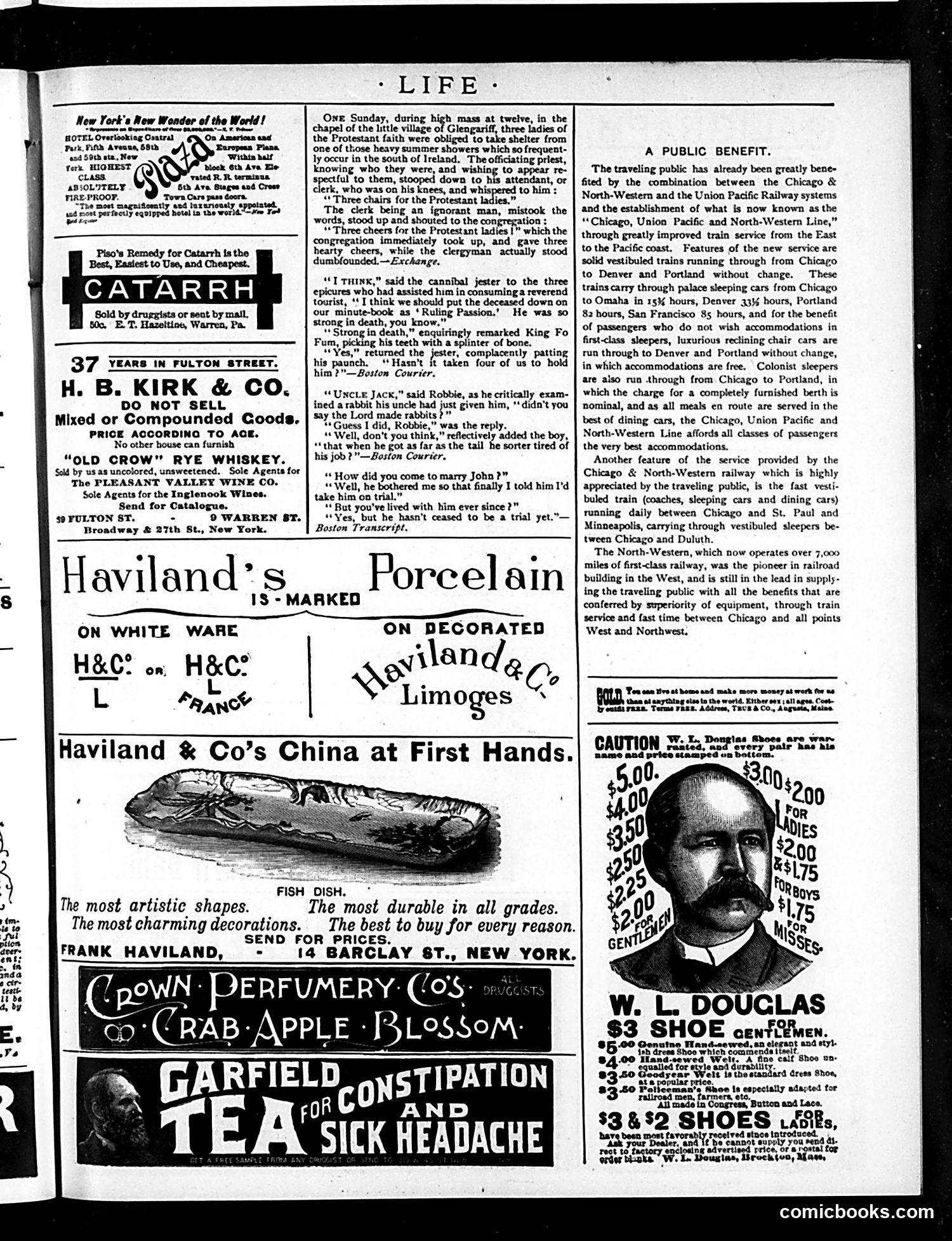
This page is primarily **advertisements and humor pieces**, not political cartoons. The main content consists of: 1. **Comic anecdotes** (text-based jokes): Irish priest's mistranslation, cannibal jester wordplay, uncle's rabbit creation, marriage trial—all typical Victorian-era humor relying on misunderstandings and puns. 2. **Advertisements**: Haviland porcelain, H.B. Kirk whiskey and wines, W.L. Douglas shoes, Crown Perfumery, Garfield Tea, Piso's Remedy for catarrh, and a luxury NYC hotel. These reflect late 19th/early 20th-century consumer products and services. 3. **"A Public Benefit"** article praising the Chicago & North-Western/Union Pacific railroad merger and improved train service with sleeping cars—corporate boosterism disguised as public service journalism. **No significant political satire or caricature** is present. This represents Life magazine's mixed-content format: light humor, advertising, and subtle promotional content for business interests.
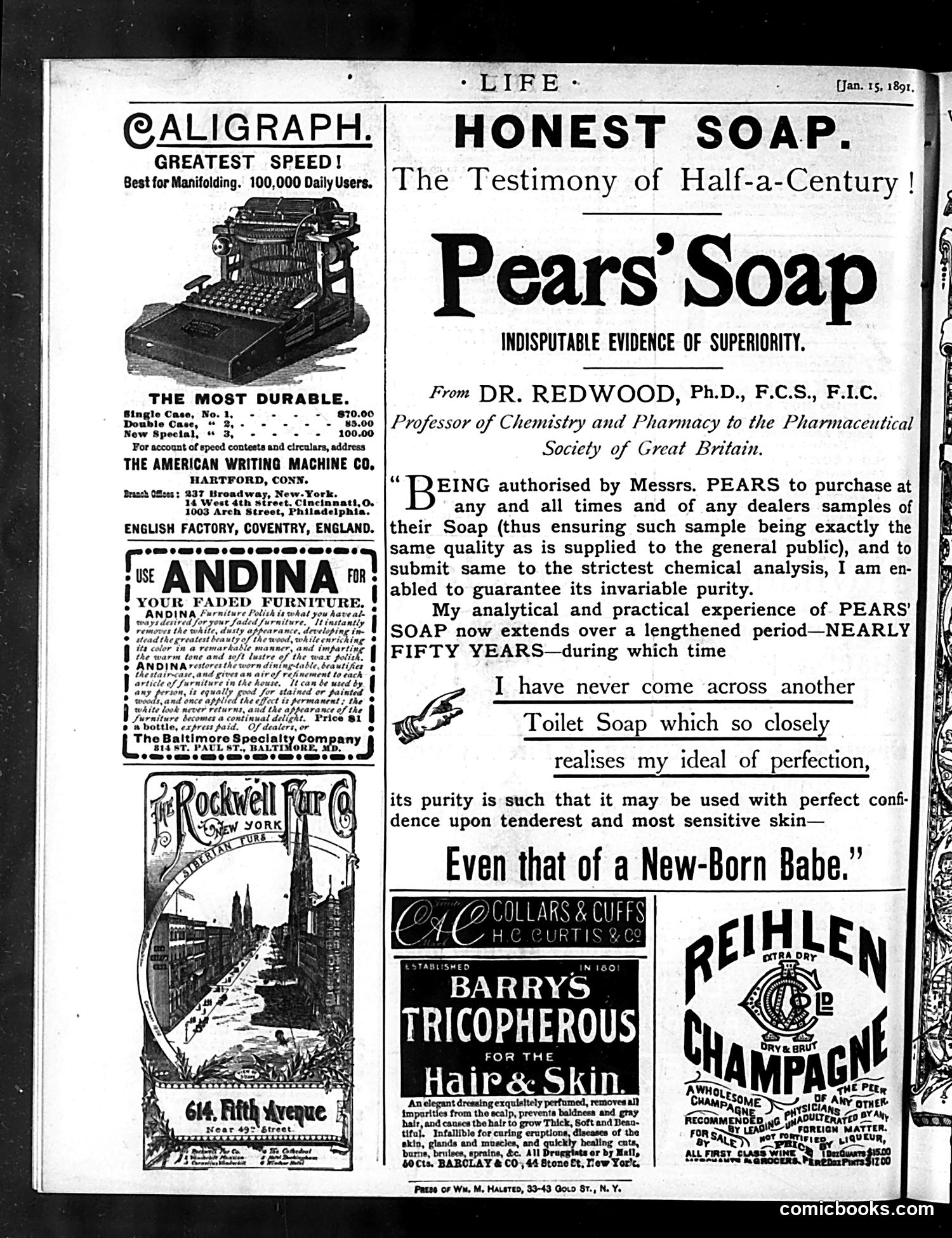
This page is primarily **advertising, not satire or political cartoon**. It contains multiple Victorian-era product advertisements with no cartoon content. The dominant feature is a full-page endorsement for **Pears' Soap** featuring a testimonial from Dr. Redwood, a respected British chemistry professor. The advertisement emphasizes the soap's purity and safety for sensitive skin, notably claiming it's suitable "Even that of a New-Born Babe"—a key selling point in an era of genuine health concerns about product safety. Side advertisements include a Caligraph typewriter, Andina furniture polish, Rockwell & Co. products, Barry's Tricopherous hair treatment, and Reihlen champagne. The page reflects late-Victorian commercial culture where expert testimonials and pseudo-scientific claims were standard marketing tactics. The emphasis on chemical "analysis" and "purity guarantees" indicates consumers' growing concerns about product quality and safety during industrialization. No satire or political content is evident.