
Life, 1891-01-15 · page 4 of 18
Life — January 15, 1891 — page 4: what you’re looking at
What you’re looking at
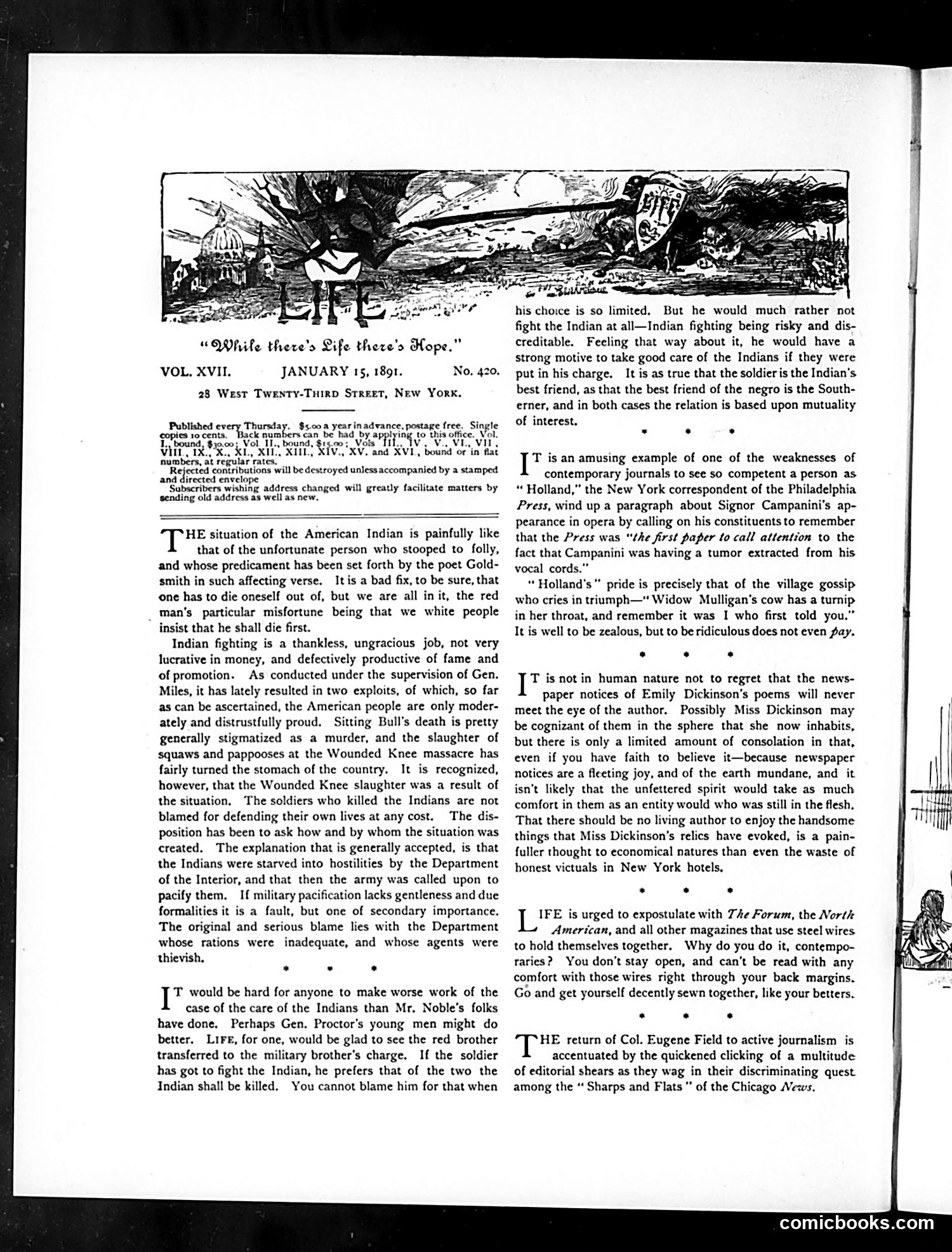
The masthead cartoon titled "While there's Life there's Hope" depicts a Native American figure amid a devastated landscape with buildings burning—likely referencing the Wounded Knee Massacre (December 1890), where U.S. Army troops killed approximately 150 Lakota Sioux. The editorial criticizes how American newspapers and the Department of Interior have mishandled Indian policy. It defends military pacification efforts while arguing that responsibility for deaths lies with poor government administration, not soldiers following orders. The piece notably expresses paternalistic sympathy for Native Americans while simultaneously supporting military action against them—a contradictory stance typical of 1891 American liberal discourse on Indian affairs.
📄 Transcribed text from this page (OCR, searchable)
Machine-transcribed from the original scan — historical spelling and the odd misread are preserved.
“Mile there's Life there's Hope.” VOL. XVII. JANUARY 15, 1891. 28 West Twenty-THirD Street, New York. No, 420. Published ev $s.00 a year in advance, postage free. Single ‘Thursday. copies ro cents, Back numbers can be had by applying 10 this office. Vol 1, bound, $30.00; Vol I1., bound, $15.00; Vols VV. Vi, VIL, VHT, IX XR KL, XID, XIIL, X1V., XV, and XVI, bound of in flat numbers, at regular rates, Rejected contributions will be destroyed unless accompanied by a stamped and directed envelope : Subscribers wishing address changed will greatly facilitate matters by sending old address as well as new, “THE situation of the American Indian is painfully like that of the unfortunate person who stooped to folly, and whose predicament has been set forth by the poet Gold- smith in such affecting verse. It is a bad fix, to be sure, that one has to die oneself out of, but we are all init, the red man’s particular misfortune being that we white people insist that he shall die first. Indian fighting is a thankless, ungracious job, not very lucrative in money, and defectively productive of fame and of promotion. As conducted under the supervision of Gen. Miles, it has lately resulted in two exploits, of which, so far as can be ascertained, the American people are only moder- ately and distrustfully proud, Sitting Bull's death is pretty generally stigmatized as a murder, and the slaughter of squaws and pappooses at the Wounded Knee massacre has fairly turned the stomach of the country, It is recognized, however, that the Wounded Knee slaughter was a result of the situation. The soldiers who killed the Indians are not blamed for defending their own lives at any cost. The dis- position has been to ask how and by whom the situation was created. The explanation that is generally accepted, is that the Indians were starved into hostilities by the Department of the Interior, and that then the army was called upon to pacify them. If military pacification lacks gentleness and due formalities it is a fault, but one of secondary importance. The original and serious blame lies with the Department whose rations were inadequate, and whose agents were thievish, . . . T would be hard for anyone to make worse work of the case of the care of the Indians than Mr. Noble's folks have done. Perhaps Gen. Proctor’s young men might do better. LiFe, for one, would be glad to see the red brother transferred to the military brother's charge. If the soldier has got to fight the Indian, he prefers that of the two the Indian shall be killed. You cannot blame him for that when his choice is so limited. But he would much rather not fight the Indian at all—Indian fighting being risky and dis- creditable. Feeling that way about it, he would have a strong motive to take good care of the Indians if they were put in his charge. It is as true that the soldier is the Indian's best friend, as that the best friend of the negro is the South- erner, and in both cases the relation is based upon mutuality of interest. . . . T’ is an amusing example of one of the weaknesses of contemporary journals to see so competent a person as “ Holland,” the New York correspondent of the Philadelphia Press, wind up a paragraph about Signor Campanini’s ap- pearance in opera by calling on his constituents to remember that the Press was “the first paper to call attention to the fact that Campanini was having a tumor extracted from his vocal cords.” “ Holland's” pride is precisely that of the village gossip who cries in triumph—" Widow Mulligan’s cow has a turnip in her throat, and remember it was I who first told you.” It is well to be zealous, but to be ridiculous does not even pay. . ° . T is not in human nature not to regret that the news- Paper notices of Emily Dickinson's poems will never meet the eye of the author. Possibly Miss Dickinson may be cognizant of them in the sphere that she now inhabits, but there is only a limited amount of consolation in that, even if you have faith to believe it—because newspaper notices are a fleeting joy, and of the earth mundane, and it isn't likely that the unfettered spirit would take as much comfort in them as an entity would who was still in the flesh, That there should be no living author to enjoy the handsome things that Miss Dickinson's relics have evoked, is a pain- fuller thought to economical natures than even the waste of honest victuals in New York hotels. . * * IFE is urged to expostulate with The Forum, the North American, and all other magazines that use steel wires to hold themselves together. Why do you do it, contempo- raries? You don’t stay open, and can’t be read with any comfort with those wires right through your back margins. Go and get yourself decently sewn together, like your betters. HE return of Col. Eugene Field to active journalism is accentuated by the quickened clicking of a multitude of editorial shears as they wag in their discriminating quest among the “ Sharps and Flats " of the Chicago Mews. comicbooks.com