
Life, 1891-01-15 · page 8 of 18
Life — January 15, 1891 — page 8: what you’re looking at
What you’re looking at
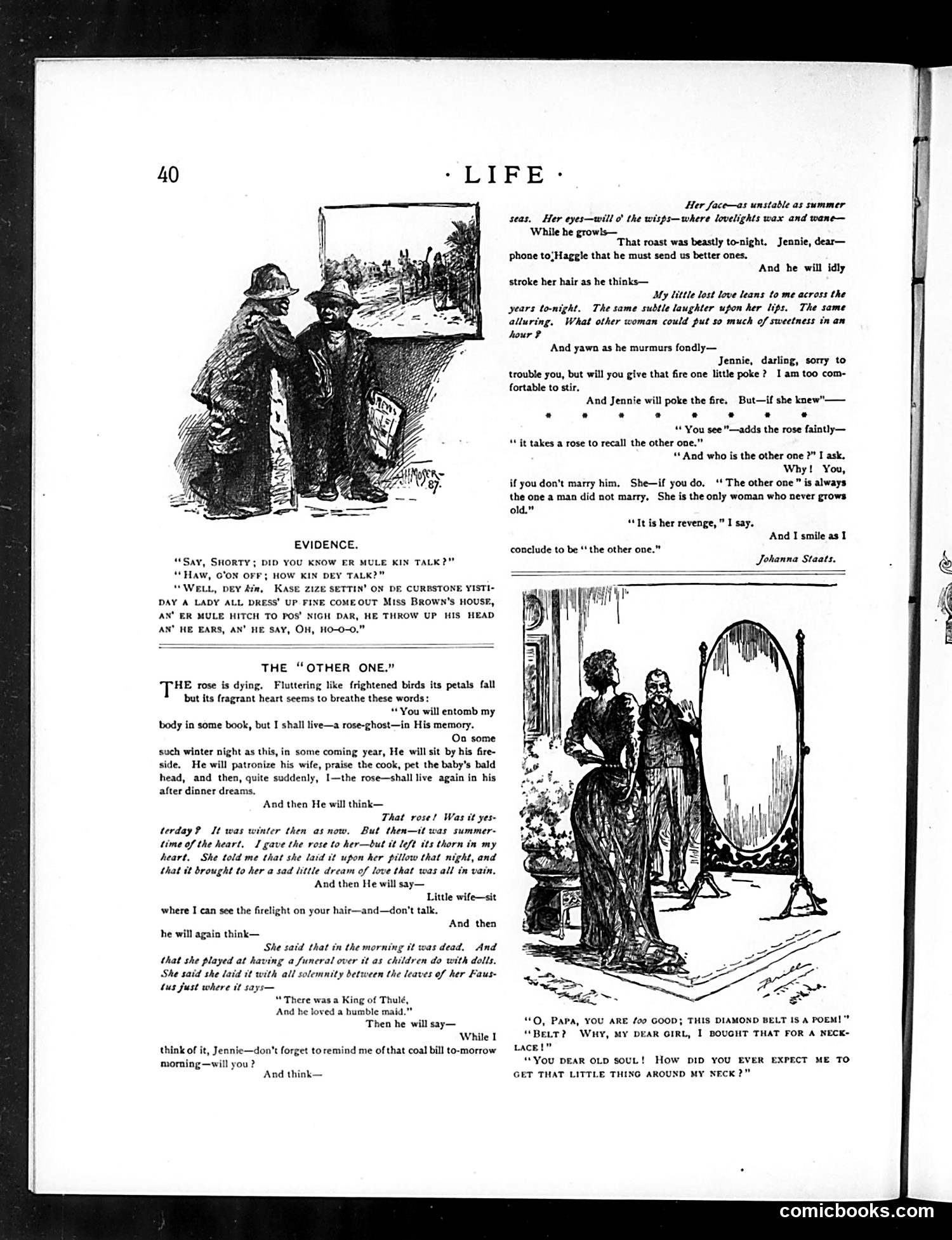
This page presents two satirical pieces. The top cartoon titled "Evidence" depicts what appears to be a dialogue between characters discussing an African American man's supposed actions—the humor relies on racist dialect and stereotypes common to period satire. The larger piece, "The Other One," is a romantic poem about a dying rose and memory, attributed to Johanna Staats. The accompanying illustration shows a woman at a mirror, likely exploring themes of vanity or reflection on lost love. The bottom cartoon mocks a wealthy man giving his daughter an expensive diamond necklace, with her complaining the gift doesn't include the item she truly wants—satirizing both conspicuous consumption and spoiled privilege among the wealthy. These pieces reflect early 20th-century satirical conventions and attitudes.
📄 Transcribed text from this page (OCR, searchable)
Machine-transcribed from the original scan — historical spelling and the odd misread are preserved.
EVIDENCE. “Say, SHORTY; DID YOU KNOW ER MULE KIN TALK?" “Haw, O'ON OF HOW KIN DEY TALK?” “WELL, DEY &: KASE ZIZE SETTIN’ ON DE CURBSTONE YISTI- DAY A LADY ALL DRESS’ UP FINE COMEOUT Miss BRoWN’'s HOUSE, AN' ER MULE HITCH TO POS’ NIGH DAR, HE THROW UP HIS HEAD AN’ HE EARS, AN’ HE SAY, OH, HO-O-©,” THE ‘OTHER ONE.” THE rose is dying. Fluttering like frightened birds its petals fall but its fragrant heart seems to breathe these words: “You will entomb my body in some book, but I shall live—a rose-ghost—in His memory. On some such winter night as this, in some coming year, He will sit by his fire- side. He will patronize his wife, praise the cook, pet the baby's bald head, and then, quite suddenly, [—the rose—shall live again in his after dinner dreams. And then He will think— That rose! Was it yes- terday? It was winter then as now. But then—it was summer- time of the heart, I gave the rose to her—but it left its thorn in my heart. She told me that she latd it upon her pillow that night, and that it brought to her a sad little dream of love that was all in vain. And then He will say— Little wife—sit where I can see the firelight on your hair—and—don't talk. And then he will again think— She said that in the morning it was dead, And that she played at having a funeral over it as children do with dolls. She said she laid it with all solemnity between the leaves of her Faus- tus just where it says— “ There was a King of Thulé, And he loved a humble maid.” Then he will say— While I think of it, Jennie—don't forget to remind me ofthat coal bill to-morrow morning—will you? And think— Her face—as unstable as summer seas, Her eyes—will o the wisps—where lovelights wax and wane— While he growls— That roast was beastly to-night. Jennie, dear— phone to;Haggle that he must send us better ones. And he will idly stroke her hair as he thinks— My little lost love leans to me across the years to-night. The same subtle laughter upon her lips, The same ‘alluring. What other woman could put so much of sweetness inan hour ? And yawn as he murmurs fondly— Jennie, darling, sorry to trouble you, but will you give that fire one little poke? Iam too com- fortable to stir, And Jennie will poke the fre, But—if she knew"—— * * ° * * * . “You see”—adds the rose faintly— ‘* it takes a rose to recall the other one.” “And who is the other one 2” I ask, Why! You, if you don't marry him, She—if you do. ‘ The other one” is always the one a man did not marry, She is the only woman who never grows old.” “It is her revenge," I say. And I smile as 1 conclude to be ‘‘ the other one.” Johanna Staats. “0, Papa, YOU ARE f00 GOOD; THIS DIAMOND BELT IS A POEM!” “Bett? WHY, MY DEAR GIRL, 1 BOUGHT THAT FOR A NECK- Lace!” “You DEAR OLD soUL! How DID YOU EVER EXPECT ME TO GET THAT LITTLE THING AROUND MY NECK?” comicbooks.com