
Life, 1891-01-15 · page 6 of 18
Life — January 15, 1891 — page 6: what you’re looking at
What you’re looking at
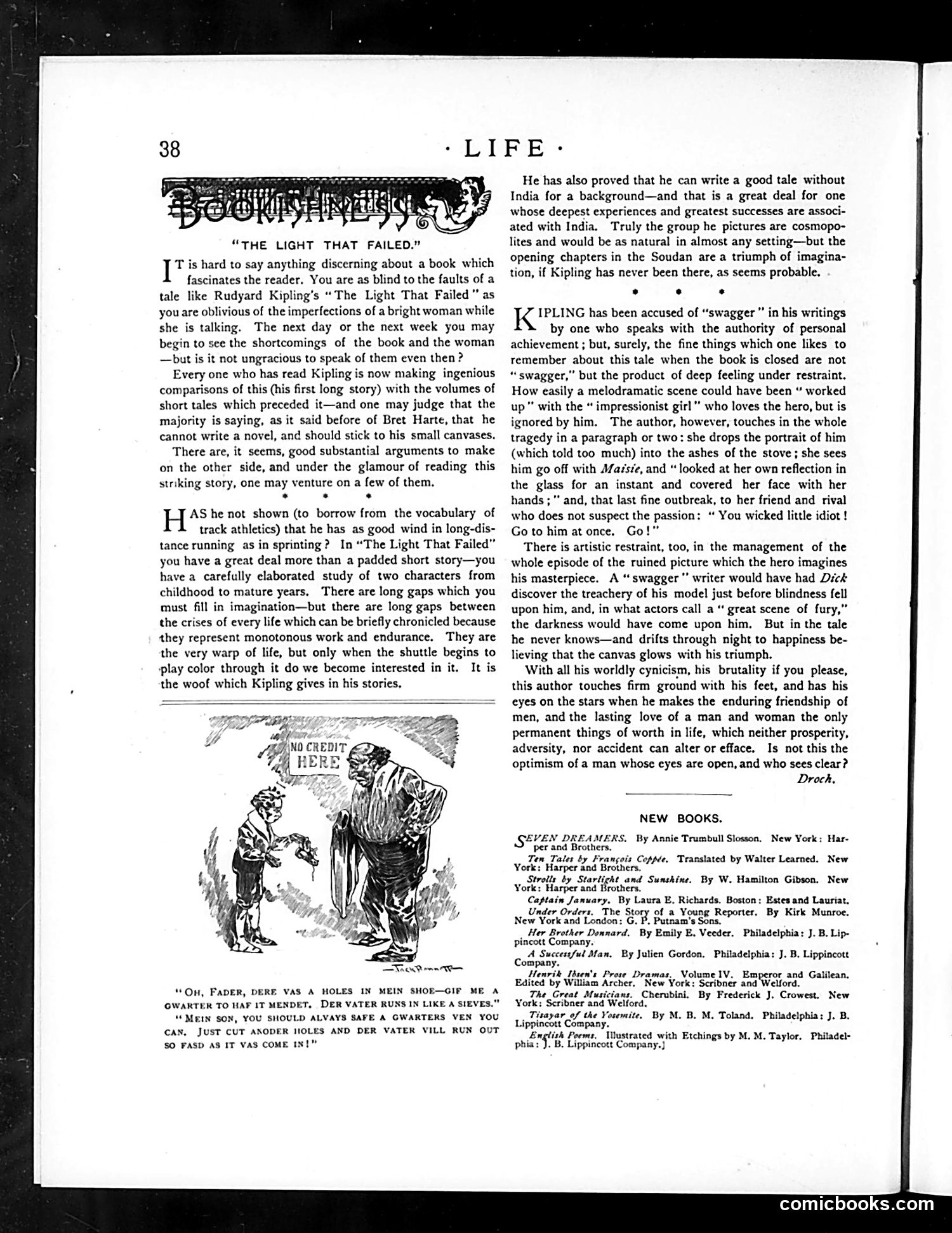
This page is primarily a **literary review** of Rudyard Kipling's story "The Light That Failed," not a political cartoon. The text discusses Kipling's narrative techniques, character development, and his ability to write compellingly about India without relying on exotic settings. The **single illustration** depicts a scene from the story itself: an adult figure ("Fader") speaking to a child about holes in shoes, rendered in a sketchy style typical of period book illustrations. The German dialogue quoted below translates roughly to advice about preventing shoe holes through darning. The page concludes with a **"New Books" section** listing recent publications. This is primarily a cultural/literary feature, not satirical commentary on contemporary politics or society.
📄 Transcribed text from this page (OCR, searchable)
Machine-transcribed from the original scan — historical spelling and the odd misread are preserved.
LIFE “THE LIGHT THAT FAILED.” T is hard to say anything discerning about a book which fascinates the reader. You are as blind to the faults of a tale like Rudyard Kipling’s “The Light That Failed” as you are oblivious of the imperfections of a bright woman while she is talking. The next day or the next week you may begin to see the shortcomings of the book and the woman —but is it not ungracious to speak of them even then? Every one who has read Kipling is now making ingenious comparisons of this (his first long story) with the volumes of short tales which preceded it—and one may judge that the majority is saying, as it said before of Bret Harte, that he cannot write a novel, and should stick to his small canvases. There are, it seems, good substantial arguments to make on the other side, and under the glamour of reading this striking story, one may venture on a few of them. . . . AS he not shown (to borrow from the vocabulary of track athletics) that he has as good wind in long-dis- tance running as in sprinting? In “The Light That Failed” you have a great deal more than a padded short story—you have a carefully elaborated study of two characters from childhood to mature years. There are long gaps which you must fill in imagination—but there are long gaps between the crises of every life which can be briefly chronicled because they represent monotonous work and endurance. They are the very warp of life, but only when the shuttle begins to play color through it do we become interested in it. It is the woof which Kipling gives in his stories. i ee CREDIT fi R LET “On, FADER, DERE VAS A HOLES IN MEIN SHOR—GIF ME A OWARTER TO HAF IT MENDET, DER VATER RUNS IN LIKE A SIEVES.” ‘MEIN SON, YOU SHOULD ALVAYS SAFE A GWARTERS VEN YOU CAN, JUST CUT ANODER HOLES AND DER VATER VILL RUN OUT SO FASD AS IT VAS COME INI” He has also proved that he can write a good tale without India for a background—and that is a great deal for one whose deepest experiences and greatest successes are associ- ated with India. Truly the group he pictures are cosmopo- lites and would be as natural in almost any setting—but the opening chapters in the Soudan are a triumph of imagina- tion, if Kipling has never been there, as seems probable. * e * IPLING has been accused of “swagger” in his writings by one who speaks with the authority of personal achievement ; but, surely, the fine things which one likes to remember about this tale when the book is closed are not “swagger,” but the product of deep feeling under restraint. How easily a melodramatic scene could have been “ worked up” with the “ impressionist girl” who loves the hero, but is ignored by him. The author, however, touches in the whole tragedy in a paragraph or two: she drops the portrait of him (which told too much) into the ashes of the stove ; she sees him go off with Aazste, and “ looked at her own reflection in the glass for an instant and covered her face with her hands ; " and, that last fine outbreak, to her friend and rival who does not suspect the passion: “ You wicked little idiot ! Go to him at once. Go!” There is artistic restraint, too, in the management of the whole episode of the ruined picture which the hero imagines his masterpiece. A “ swagger’ writer would have had Dick discover the treachery of his model just before blindness fell upon him, and, in what actors call a “‘ great scene of fury,” the darkness would have come upon him. But in the tale he never knows—and drifts through night to happiness be- lieving that the canvas glows with his triumph. With all his worldly cynicism, his brutality if you please, this author touches firm ground with his feet, and has his eyes on the stars when he makes the enduring friendship of men, and the lasting love of a man and woman the only permanent things of worth in life, which neither prosperity, adversity, nor accident can alter or efface. Is not this the optimism of a man whose eyes are open, and who sees clear? Drock. NEW BOOKS. EVEN DREAMERS, By Annie Trumbull Slosson. per and Brothers. Ten Tales by Francois Coppte, Translated by Walter Learned. New York: Harper and Brothers. vostrelte ty Starlight and Sunshine. By W. Hamilton Gibson. New ‘ork: Harper and Brothers. bbesiers January, By Laura E. Richards. Boston: Estes and Lauriat, Under Orders. The St of a Youn Reporter, By Kirk Mi New York and London: G. P, Putnam's Sons.” ee Her Brother Donnard, By Emily E. Veeder. Philadelphia: J. B. Lip- pincott Company. A Succestful Man, By Julien Gordon. Philadelphia: J. B. Lippincott Company. Henrik Ibsen's Prose Dramas. Volume 1V. Emperor and Galilean. Edited by William Archer, New York: Scribner and Welford. The Great M Cherubini. By Frederick J. C N York! seribner and Welford. Ce one ew By M.B, M, Toland, Philadelphia: J. B. Tisayar of the Yoremite, Li ippincort ‘Company. Ilustrated with Etchings by M. M. Taylor. Philadel- . B. Lippincott Company.) New York: Har- Engtith Poems. phia: comicbooks.com