
Life, 1891-01-15 · page 9 of 18
Life — January 15, 1891 — page 9: what you’re looking at
What you’re looking at
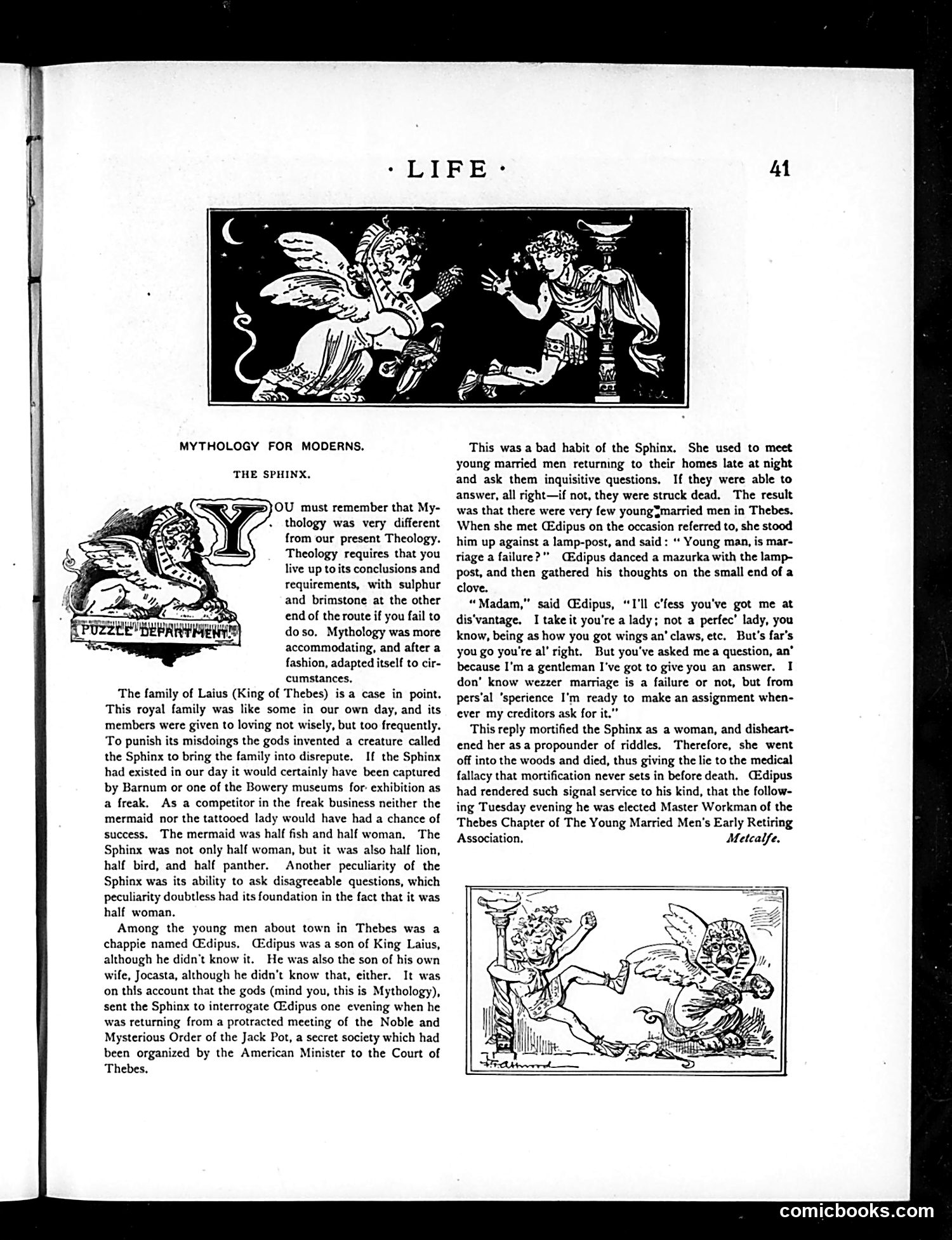
This is satirical commentary on marriage using classical mythology. The piece mocks the Sphinx's legendary riddling behavior by reframing it as a nagging wife who interrogates young husbands returning home. The joke plays on the Sphinx being "half woman"—suggesting women's tendency toward relentless questioning. The cartoon depicts Oedipus confronted by the Sphinx. The text humorously presents their exchange about whether marriage constitutes "failure," with Oedipus deflecting the woman's pointed questions. The satire targets women's inquisitiveness and marital discord, presenting it through classical mythology to mock contemporary domestic life. The piece concludes by attributing the column to "Metcalfe," suggesting authorial credit, likely for this recurring satirical feature updating ancient myths with modern social commentary.
📄 Transcribed text from this page (OCR, searchable)
Machine-transcribed from the original scan — historical spelling and the odd misread are preserved.
MYTHOLOGY FOR MODERNS. THE SPHINX, OU must remember that My- thology was very different from our present Theology. Theology requires that you live up toits conclusions and requirements, with sulphur and brimstone at the other end of the route if you fail to doso, Mythology was more accommodating, and after a fashion, adapted itself to cir- cumstances. The family of Laius (King of Thebes) is a case in point. This royal family was like some in our own day, and its members were given to loving not wisely, but too frequently. To punish its misdoings the gods invented a creature called the Sphinx to bring the family into disrepute. If the Sphinx had existed in our day it would certainly have been captured by Barnum or one of the Bowery museums for: exhibition as a freak. As a competitor in the freak business neither the mermaid nor the tattooed lady would have had a chance of success. The mermaid was half fish and half woman, The Sphinx was not only half woman, but it was also half lion, half bird, and half panther. Another peculiarity of the Sphinx was its ability to ask disagreeable questions, which peculiarity doubtless had its foundation in the fact that it was half woman. Among the young men about town in Thebes was a chappie named CEdipus. (Edipus was a son of King Laius, although he didn’t know it. He was also the son of his own wife, Jocasta, although he didn’t know that, either. It was on th{s account that the gods (mind you, this is Mythology), sent the Sphinx to interrogate CEdipus one evening when he was returning from a protracted meeting of the Noble and Mysterious Order of the Jack Pot, a secret society which had been organized by the American Minister to the Court of Thebes, This was a bad habit of the Sphinx. She used to meet young married men returning to their homes late at night and ask them inquisitive questions. If they were able to answer, all right—if not, they were struck dead. The result was that there were very few youngymarried men in Thebes. When she met (Edipus on the occasion referred to, she stood him up against a lamp-post, and said: ‘* Young man, is mar- riage a failure?" CEdipus danced a mazurka with the lamp- post, and then gathered his thoughts on the small end of a clove. “Madam,” said CEdipus, “I'll c’fess you've got me at dis‘vantage. I take it you're a lady; not a perfec’ lady, you know, being as how you got wings an’ claws, etc. But’s far’s you go you're al’ right. But you've asked me a question, an’ because I'm a gentleman I've got to give you an answer. I don’ know wezzer marriage is a failure or not, but from pers‘al ‘sperience I'm ready to make an assignment when- ever my creditors ask for it.” This reply mortified the Sphinx as a woman, and disheart- ened her as a propounder of riddles. Therefore, she went off into the woods and died, thus giving the lie to the medical fallacy that mortification never sets in before death. CEdipus had rendered such signal service to his kind, that the follow- ing Tuesday evening he was elected Master Workman of the Thebes Chapter of The Young Married Men's Early Retiring Association, Metcalfe, comicbooks.com