
Life, 1891-01-15 · page 12 of 18
Life — January 15, 1891 — page 12: what you’re looking at
What you’re looking at
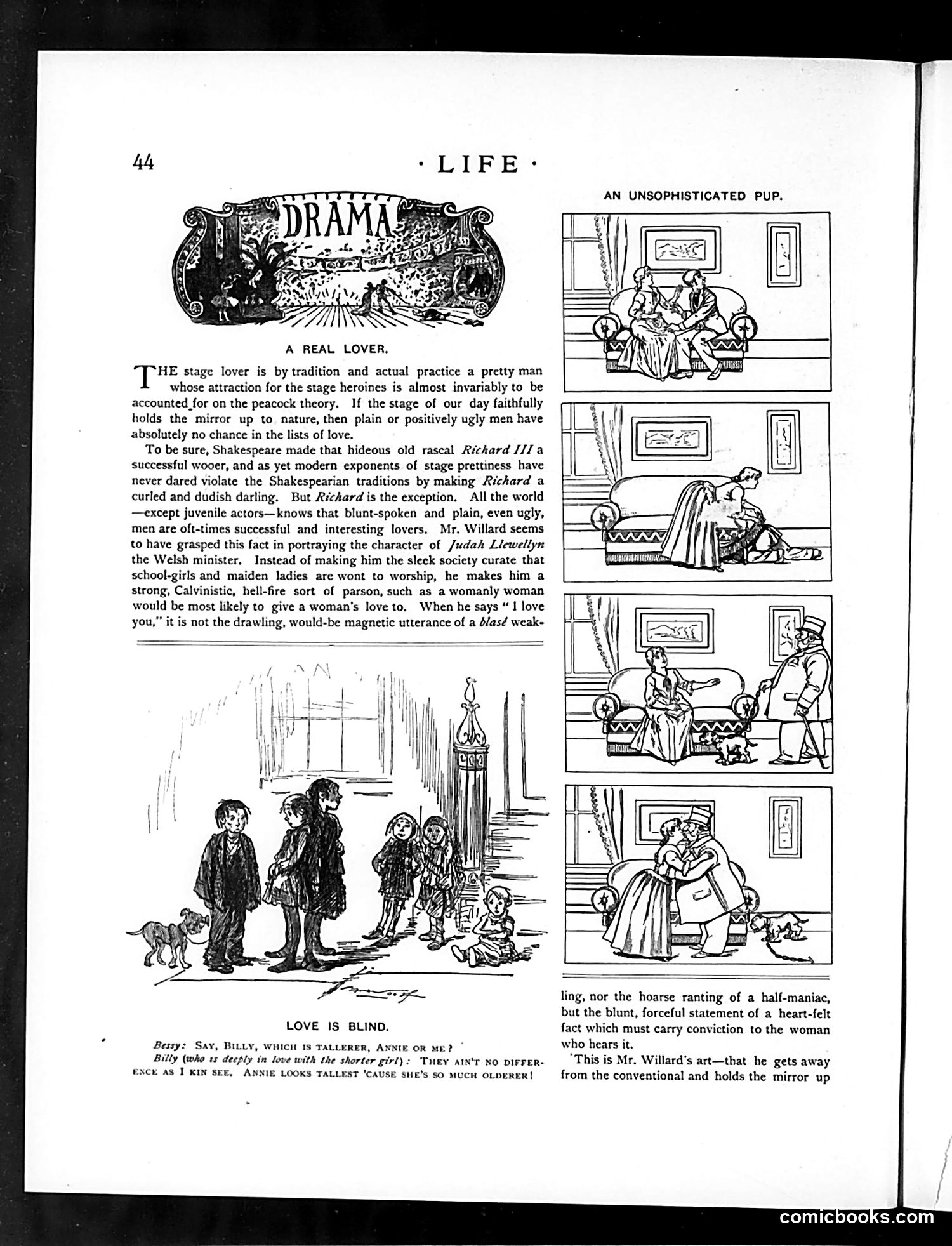
This page contains two distinct pieces of theatrical and social satire: **"A Real Lover"** (left): A drama critique praising actor Mr. Willard's portrayal of Judah Llewellyn, a Welsh minister. The article argues that unlike stage tradition—which demands conventionally handsome male leads—Willard's character is deliberately plain and religiously stern. The satire suggests stage conventions ignore reality: truly compelling men succeed through authentic conviction and strength of character, not physical beauty or affected magnetism. Shakespeare's Richard III is cited as the historical exception proving the rule. **"An Unsophisticated Pup"** (right): A four-panel comic strip showing a young boy (Billy) in love with a girl. The humor lies in his biased perception: when asked which girl is taller, he claims there's no difference, then illogically insists the shorter girl "looks tallest 'cause she's so much olderer." The title and caption ("Love is Blind") satirize how romantic infatuation distorts objective judgment—even children exhibit this universal human folly. Both pieces explore love's irrationality versus authentic character.
📄 Transcribed text from this page (OCR, searchable)
Machine-transcribed from the original scan — historical spelling and the odd misread are preserved.
A REAL LOVER. HE stage lover is by tradition and actual practice a pretty man whose attraction for the stage heroines is almost invariably to be accounted for on the peacock theory. If the stage of our day faithfully holds the mirror up to nature, then plain or positively ugly men have absolutely no chance in the lists of love. To be sure, Shakespeare made that hideous old rascal Richard /// a successful wooer, and as yet modern exponents of stage prettiness have never dared violate the Shakespearian traditions by making Richard a curled and dudish darling. But Richard is the exception. All the world —except juvenile actors—knows that blunt-spoken and plain, even ugly, men are oft-times successful and interesting lovers. Mr. Willard seems to have grasped this fact in portraying the character of /udah Llewellyn the Welsh minister. Instead of making him the sleek society curate that school-girls and maiden ladies are wont to worship, he makes him a strong, Calvinistic, hell-fire sort of parson, such as a womanly woman would be most likely to give a woman's love to, When he says “I love you,” it is not the drawling, would-be magnetic utterance of a d/as¢ weak- AN UNSOPHISTICATED PUP. LOVE IS BLIND. Bessy: Say, BILLY, WHICH 18 TALLERER, ANNIE OR ME? Billy (who 1s deeply in love with the shorter girl): "THEY AIN‘T NO DIFFER ENCE AS I KIN SEE, ANNIE LOOKS TALLEST 'CAUSE SHE'S SO MUCH OLDERER! ling, nor the hoarse ranting of a half-maniac, but the blunt, forceful statement of a heart-felt fact which must carry conviction to the woman who hears it. ‘This is Mr. Willard’s art—that he gets away from the conventional and holds the mirror up comicbooks.com