
A complete issue · 36 pages · 1886
Life — December 9, 1886
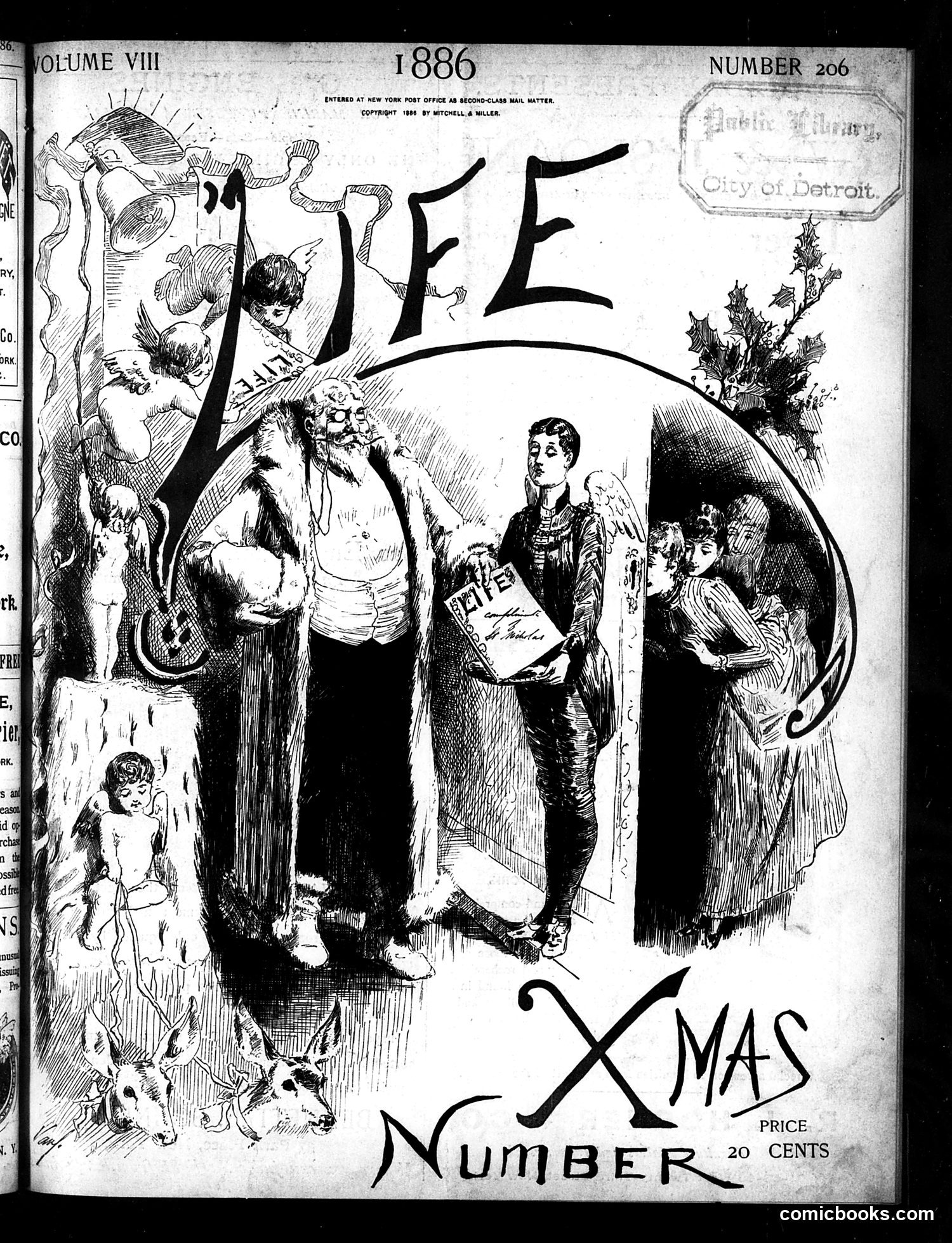
This is the cover of Life's Christmas issue (Volume VIII, Number 206, priced at 20 cents). The central illustration depicts a holiday scene with multiple figures arranged around a large numeral "5"—likely representing the fifth Christmas issue or a festive milestone. The composition includes winged angelic figures, cherubs, and what appears to be well-dressed Victorian adults and children in a celebratory arrangement. Holly and evergreen sprigs frame the scene, establishing the Christmas theme. The style is typical of 1880s satirical illustration—detailed engraving with allegorical figures common to holiday artwork of the era. Without additional context or readable text identifying specific political figures or contemporary references, the primary purpose appears to be festive seasonal cover art rather than sharp political satire.
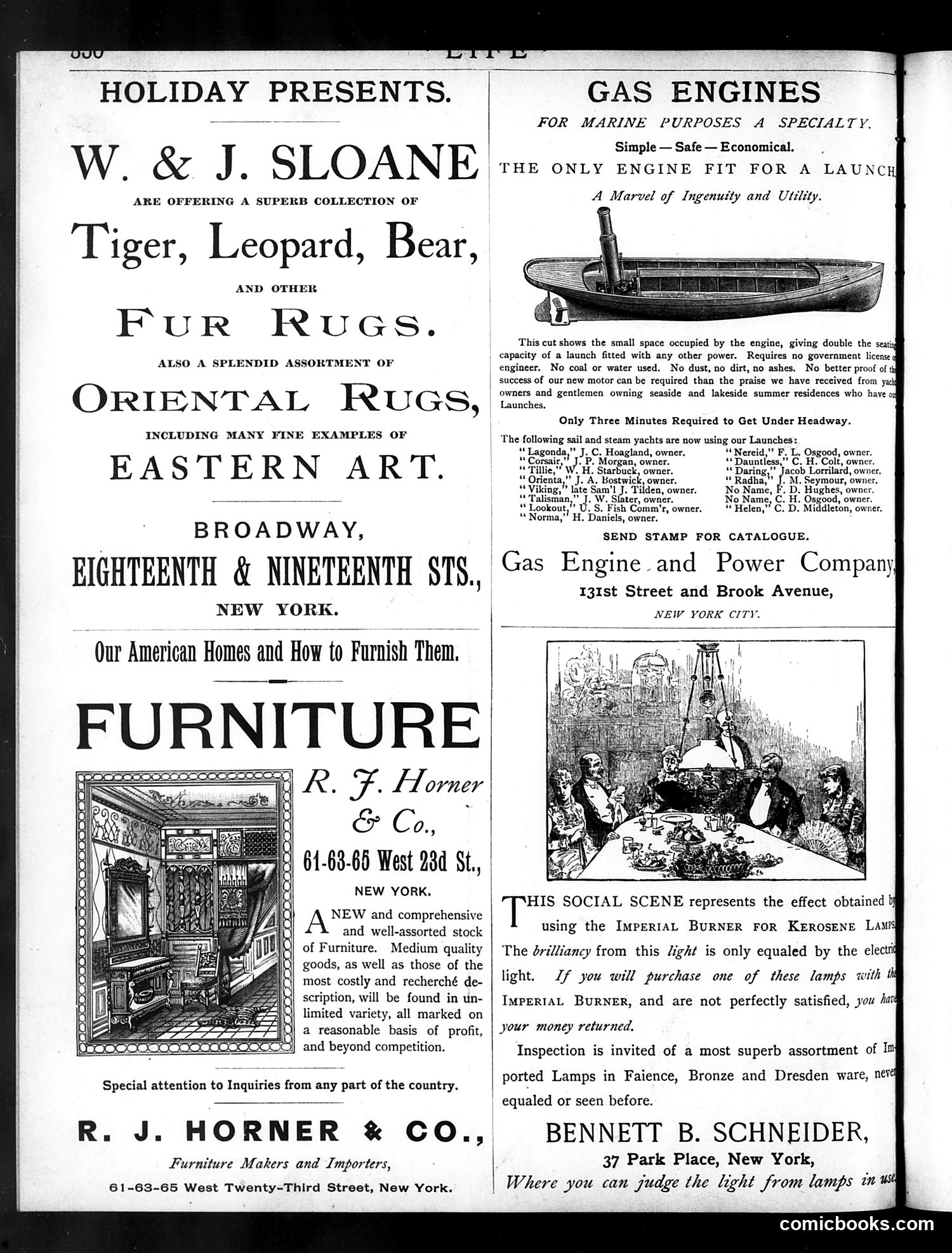
This page is **primarily advertising**, not satirical content. It contains four distinct advertisements: 1. **W. & J. Sloane** (top left): Holiday gift advertisement for fur rugs and Oriental rugs 2. **Gas Engine and Power Company** (top right): Marine engine advertisement featuring a small motorized launch 3. **R. F. Horner & Co.** (bottom left): Furniture retailer advertisement 4. **Bennett B. Schneider** (bottom right): Advertisement for imported kerosene lamps with decorative bases The only image with potential satirical content is the lamp advertisement's social scene, which appears to showcase the lamp's superior lighting quality for entertaining. However, this is promotional illustration rather than political commentary. The page reflects turn-of-the-century consumer culture and emerging technologies (gas engines, electric lighting).
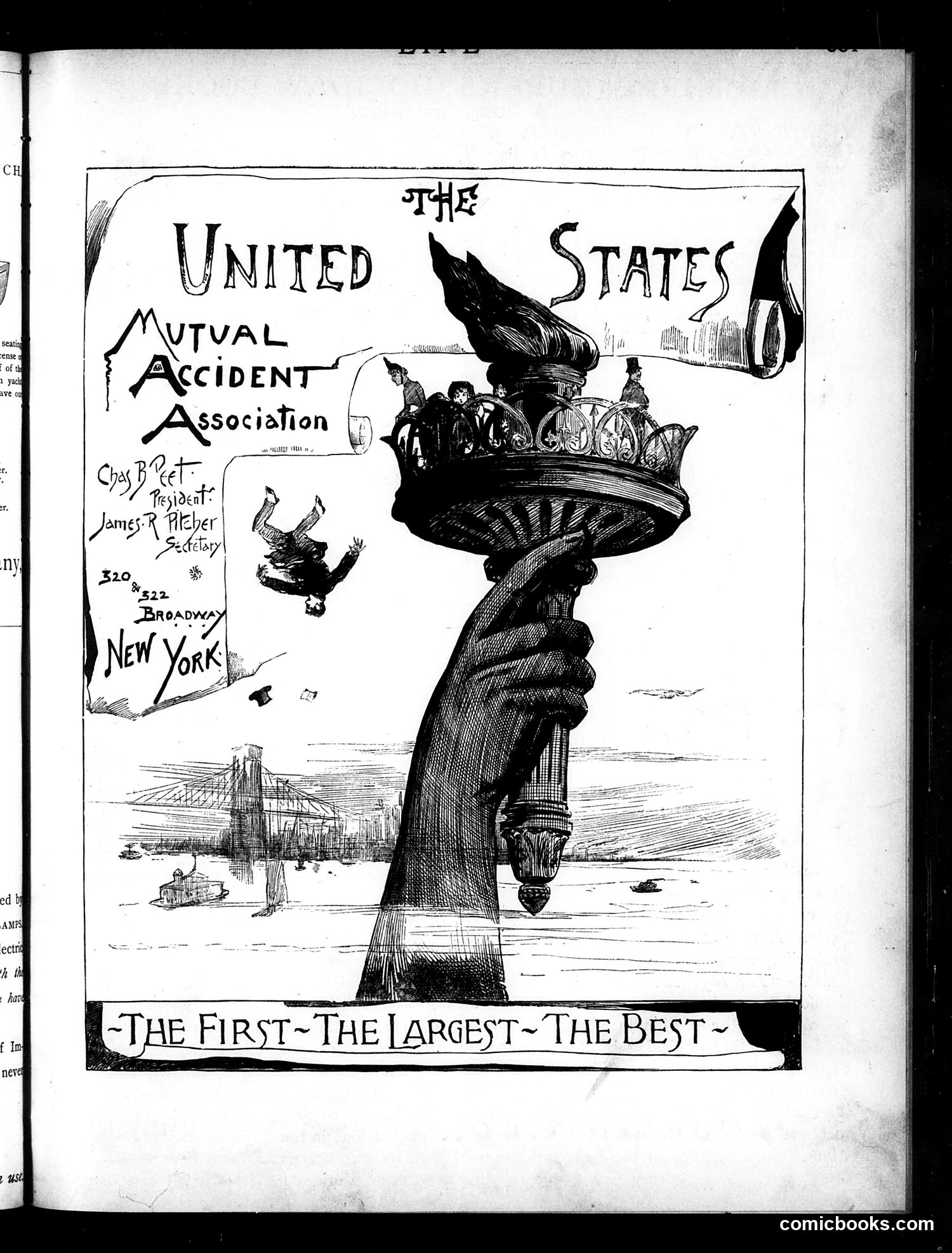
This is an advertisement for the United States Mutual Accident Association, featuring a parody of the Statue of Liberty. The statue's torch-bearing arm is inverted, with the torch pointing downward, and the crown holds what appears to be people falling or in distress, with a shoe tumbling above. The satire suggests that despite the organization's claims ("The First~The Largest~The Best"), accidents happen to people under their coverage—the reversed torch symbolizes misfortune rather than enlightenment. The figures in the crown likely represent accident victims, making a dark joke about the association's effectiveness. The contact information shows it was based in New York (320-322 Broadway). This appears to be satirical commentary on insurance company reliability circa early 20th century.
This page is **primarily advertising**, not satire or political commentary. It promotes three new books published by Harper & Brothers (holiday gift suggestions) and advertises magazine subscriptions and other books from The Century Co. The only illustration is a small decorative Christmas lantern design at the top of the advertisement section, which is purely ornamental—not a political cartoon. The text focuses on gift recommendations for the holiday season, including *St. Nicholas Magazine* and *Sport with Gun and Rod*. At the bottom right is a small illustration labeled "The Pet Cat of an Electric Light Company"—apparently a humorous drawing, though its meaning or joke is unclear from this image alone. This appears to be standard late-19th-century magazine advertising rather than editorial satire.
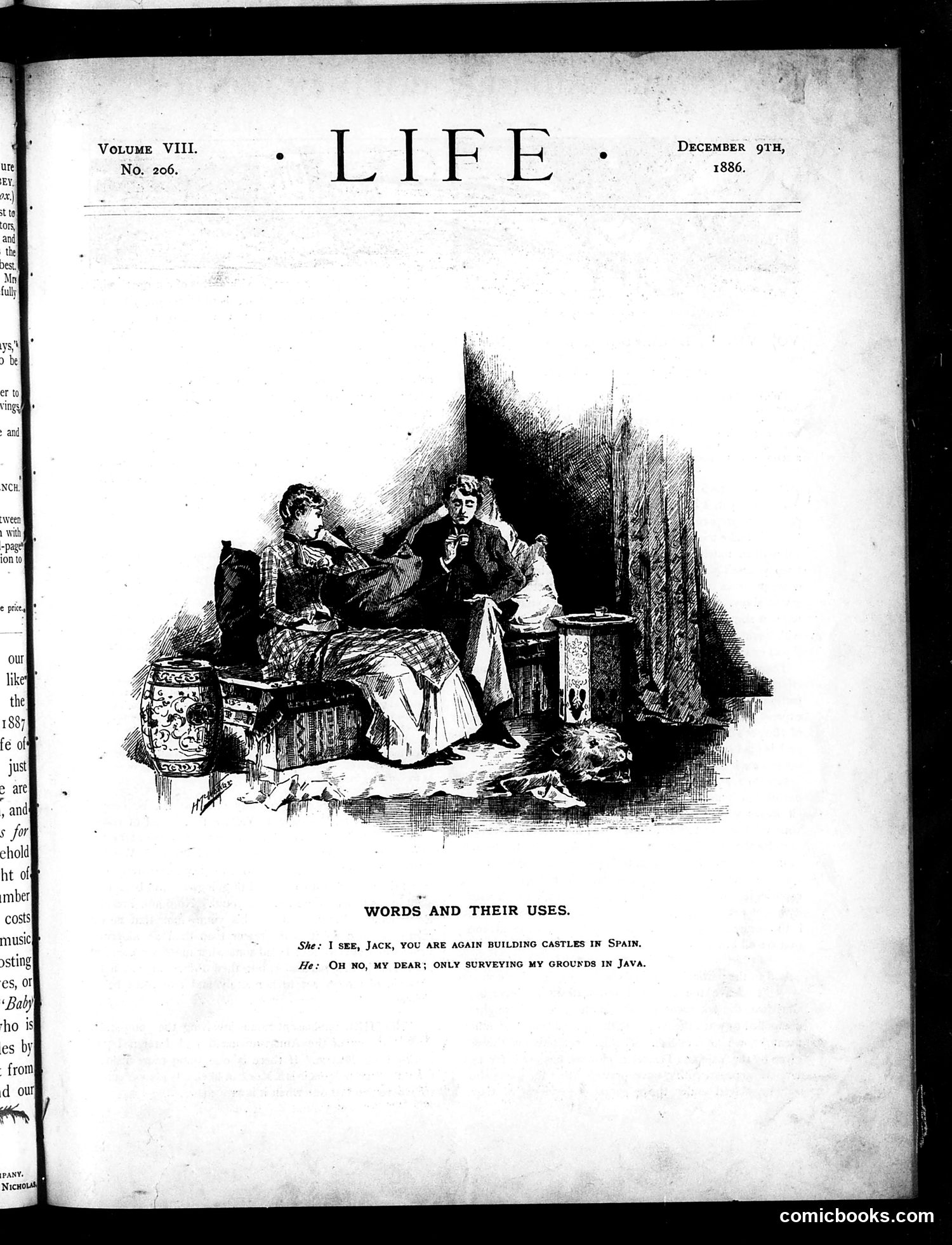
This satirical piece from *Life* magazine (December 9, 1886) depicts a domestic scene titled "Words and Their Uses." The sketch shows a woman confronting a man, with the caption revealing their exchange: **She:** "I see, Jack, you are again building castles in Spain." **He:** "Oh no, my dear; only surveying my grounds in Java." The satire mocks the man's excuse-making. When caught daydreaming or making grandiose plans ("building castles in Spain"—an idiom for unrealistic fantasizing), he deflects by claiming he's actually engaged in serious surveying work in Java. The joke exposes how people use ostensibly impressive language to disguise the same idle behavior, hence the title "Words and Their Uses"—demonstrating how vocabulary can obscure rather than clarify reality.
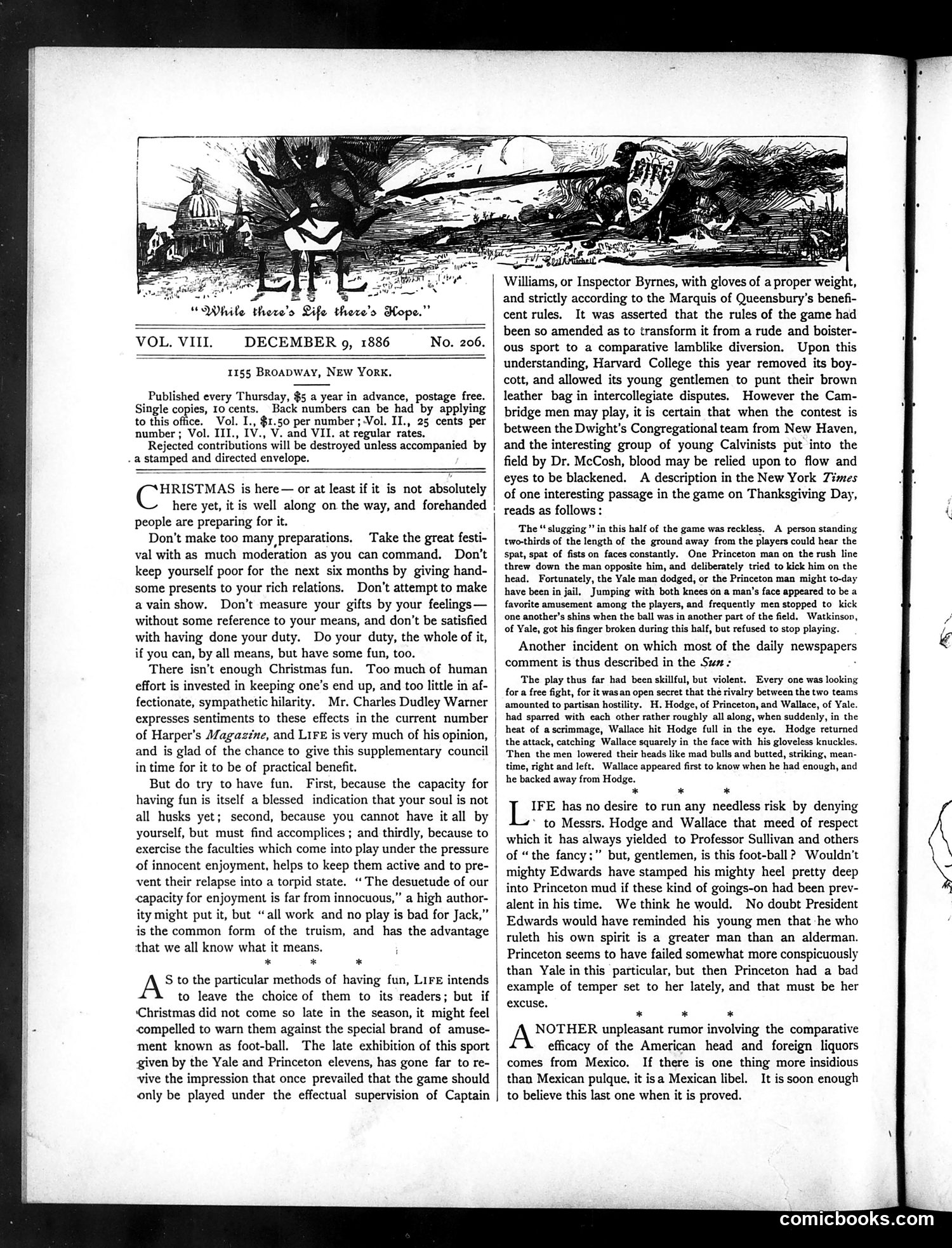
The cartoon's caption reads "While there's life there's hope," depicting a dramatic scene of what appears to be violence or chaos—possibly related to contemporary social unrest. The image shows figures in distress with dynamic, violent linework. The accompanying text discusses American football, specifically a Yale-Princeton game notable for roughness and rule violations. The article criticizes excessive violence in the sport, referencing incidents where players kicked and struck opponents. It mentions Harvard College's decision to remove football from intercollegiate competition due to safety concerns. The piece advocates for reforming football rules under proper supervision (referencing Captain Williams/Inspector Byrnes as a model authority figure) to preserve the sport while reducing injuries and brutality that were making it increasingly controversial among American institutions.
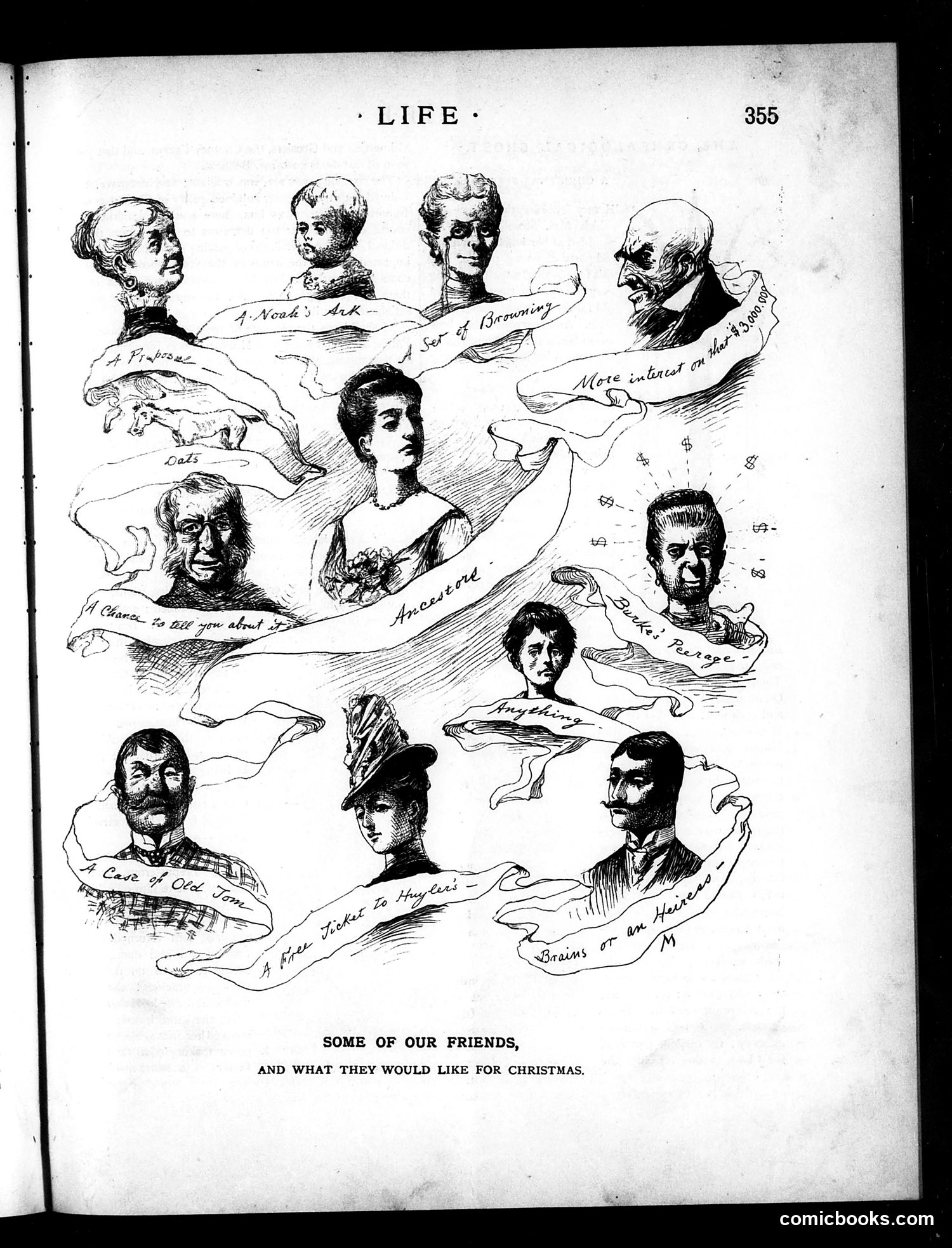
This satirical cartoon presents approximately twelve caricatured figures—prominent public figures of the era—each labeled with their supposed Christmas wishes via flowing banners. The style is typical of Life magazine's political humor. The visible text labels include references like "A Noah's Ark," "A Set of Browning," "More interest on the $," "Arrearage," and others, though specific identities are difficult to confirm from the image alone. The caricatures suggest these were recognizable contemporary personalities—likely politicians, celebrities, or society figures—whose character flaws or obsessions Life's editors mocked through their wished-for gifts. The cartoon's humor derives from matching each figure's presumed personality or financial interests to their comedic "Christmas wish."
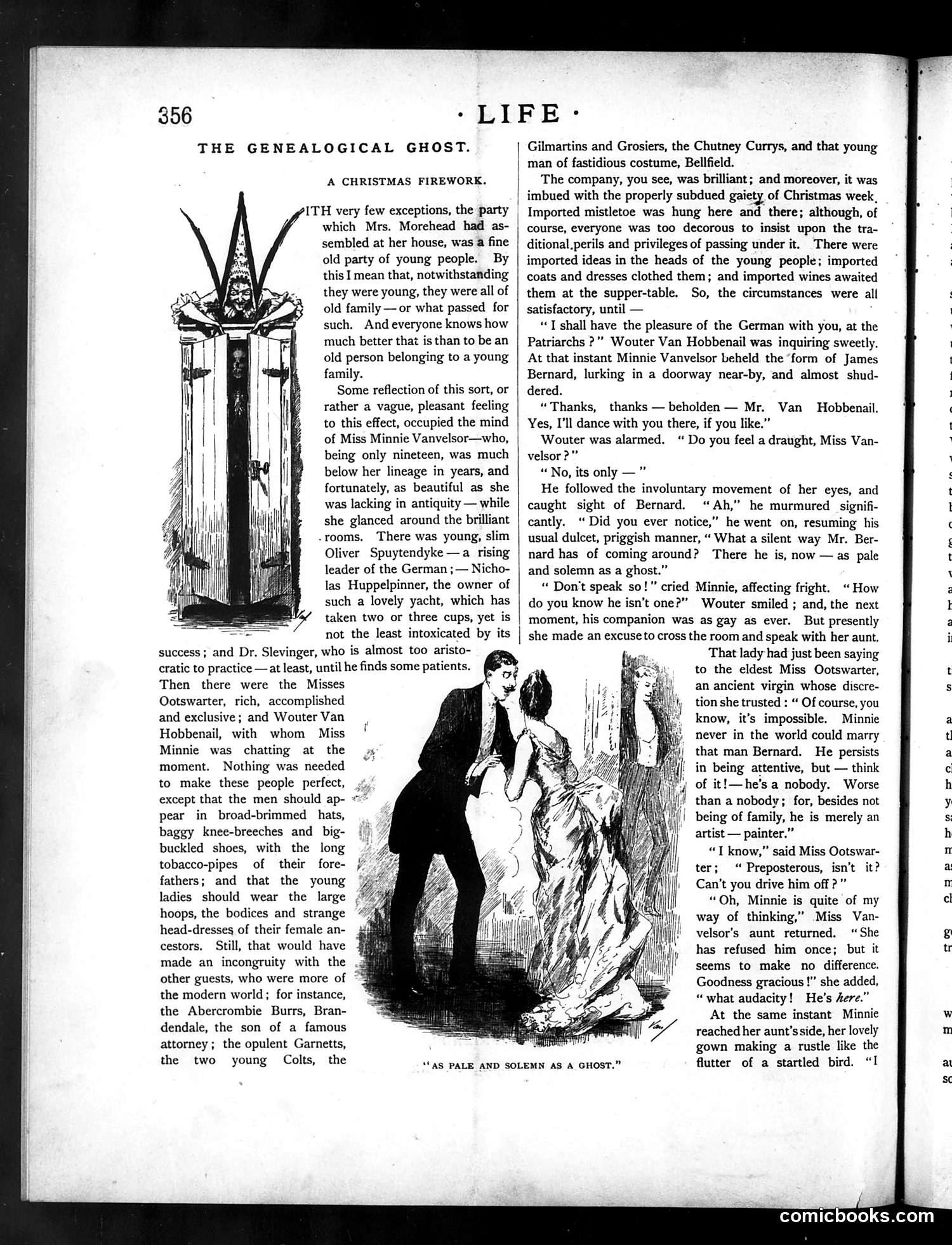
This satirical piece mocks the pretensions of newly wealthy Americans trying to claim aristocratic lineage. The story describes Mrs. Morehead's Christmas party attended by young people with "old family" pretensions—though most are actually from recently enriched families (Burrs, Garnetts, Colts, etc.). The illustration shows a man appearing "pale and solemn as a ghost," apparently Bernard, who is being scrutinized by the assembled company. The satire targets the American obsession with genealogy and old-money respectability among the nouveau riche, who anxiously performed gentility while lacking genuine historical standing. The "ghost" suggests how hollow these genealogical claims appear—spectral fictions rather than substantive heritage.
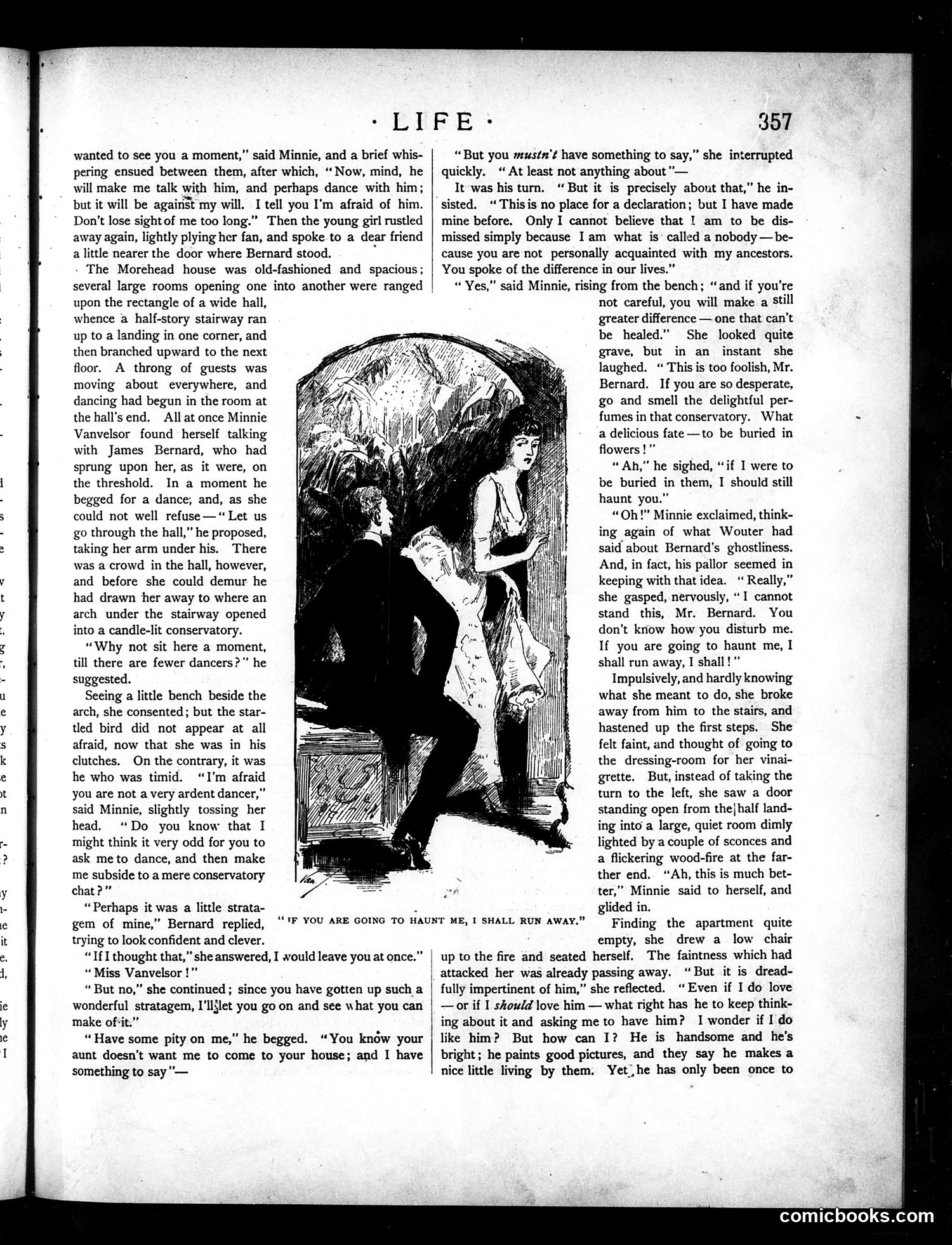
This page appears to be from a serialized fiction story in *Life* magazine, not a political cartoon. The illustrated scene shows a romantic or dramatic encounter between a man (Bernard) and a woman (Minnie) in what appears to be an elegant mansion, near a stairway and conservatory. The narrative depicts social tension around class differences and courtship propriety. Bernard, appearing to be a gentleman caller, is pressing Minnie regarding her feelings, while she expresses anxiety about their different social standings ("difference in our lives"). The scene captures a moment of romantic uncertainty typical of early 20th-century fiction serialized in such magazines. The illustration and accompanying dialogue focus on personal drama rather than political satire.
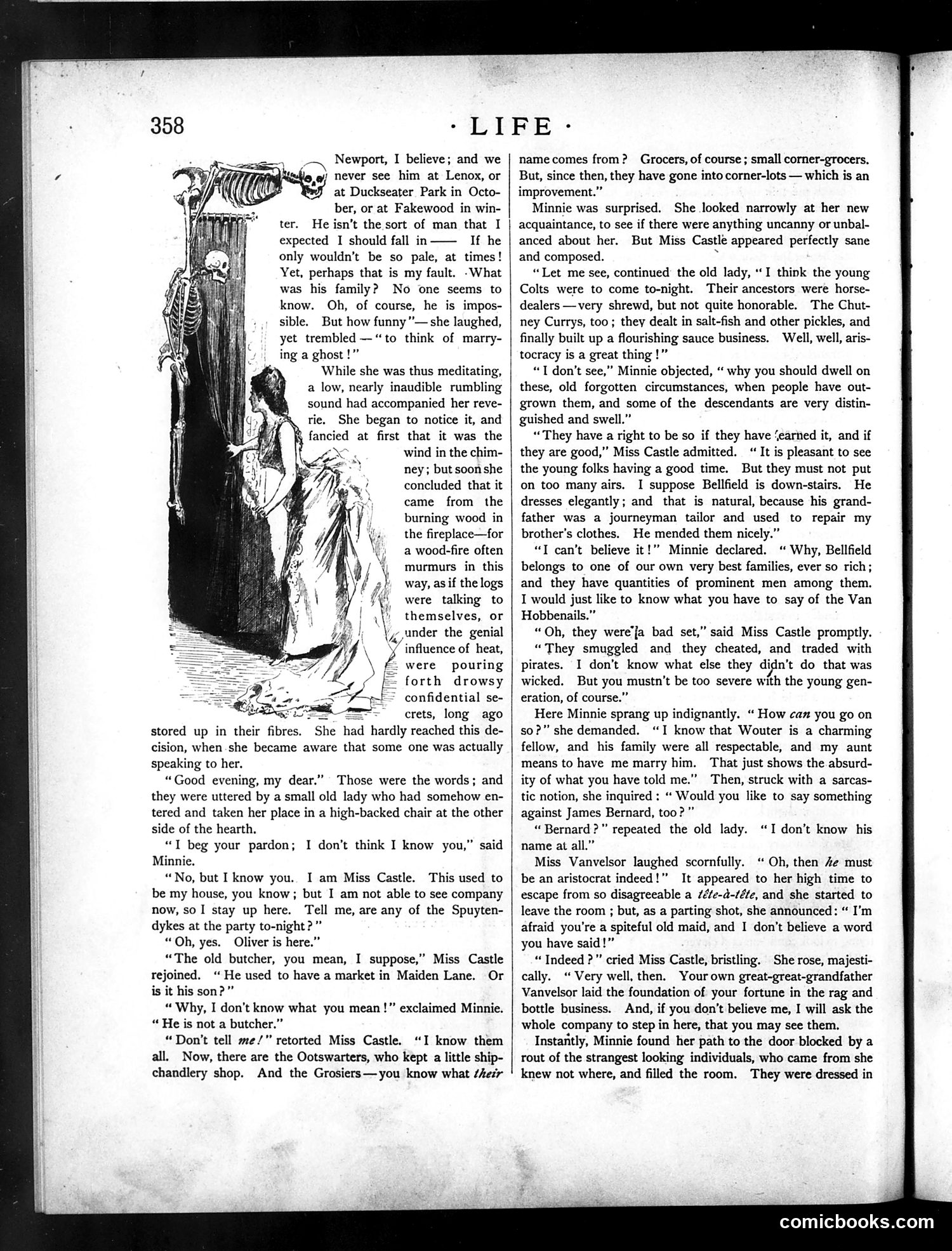
This page contains a fictional narrative dialogue rather than a political cartoon. The illustrated scene shows a woman in Victorian dress speaking with an older woman in a chair, suggesting a social encounter at a party. The text depicts a conversation about family lineage and social status. Miss Castle, apparently from an established family, questions Minnie about her acquaintances' backgrounds—specifically the "Colts," "Currys," and "Van Hobbernails." The dialogue satirizes Victorian-era class consciousness and snobbery, mocking how society obsessed over family pedigrees and respectability. Miss Castle dismisses new money and scandals in families' histories, while Minnie defends people who've "earned" respectability. The satire targets the rigid social hierarchies and arbitrary judgments based on ancestry rather than character.
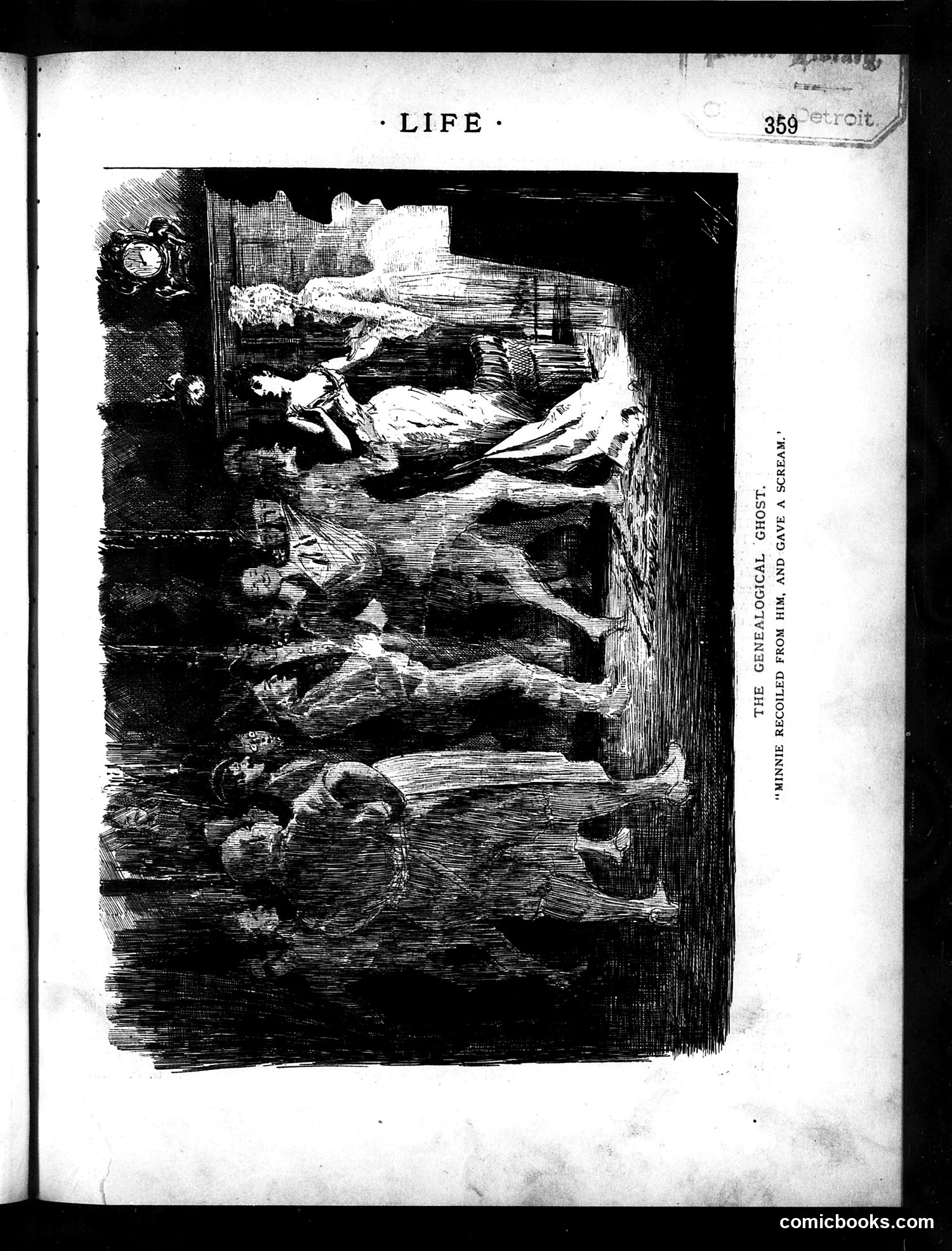
This appears to be a satirical illustration about family ancestry or lineage. The image shows multiple figures in what seems to be a domestic interior scene, oriented sideways on the page. The title "The Genealogical Ghost" and the partial text fragment "IM, AND GAVE A SCREAM" suggest someone has discovered something disturbing about their family history. The satire likely mocks the Victorian-era obsession with genealogy and "respectable" ancestry. The ghost—probably an embarrassing or scandalous ancestor—represents a skeleton in the family closet: a hidden, shameful figure that undermines claims of genteel lineage. The "scream" indicates shock upon this discovery. This would resonate with contemporary readers concerned about proving social standing through ancestral purity.
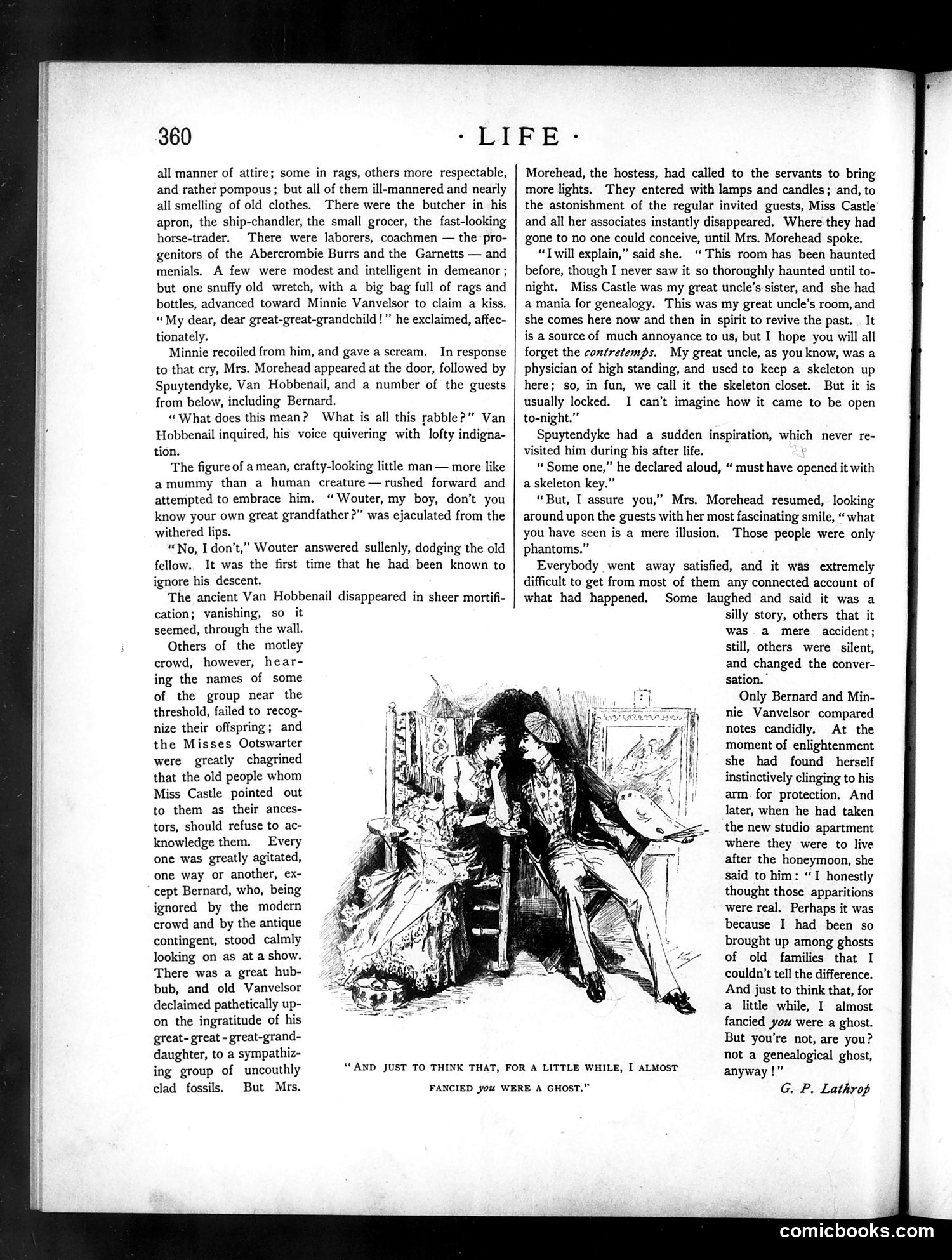
This page contains a narrative fiction piece with an embedded illustration, not a political cartoon. The story satirizes American class pretensions and genealogical snobbery. The plot involves a séance-like supernatural episode where ancestral ghosts—working-class figures (butchers, laborers, coachmen)—appear to wealthy descendants who had claimed refined ancestry. The aristocratic Van Hobbenail family recoils in mortification, refusing to acknowledge their humble forebears. **The satire's point**: The story mocks the American upper class's obsession with genealogy and respectability while their actual ancestors were common laborers and tradespeople. When confronted with their true origins, the modern "refined" descendants deny them—highlighting the hypocrisy of class-consciousness based on fabricated or forgotten ancestry. The resolution—Mrs. Morehead dismisses the apparitions as "phantoms" and an optical illusion—satirizes how the wealthy rationalize away inconvenient truths about their origins. The illustration shows an elderly ghostly figure attempting to embrace a horrified young aristocrat, dramatizing this clash between pretension and genealogical reality.
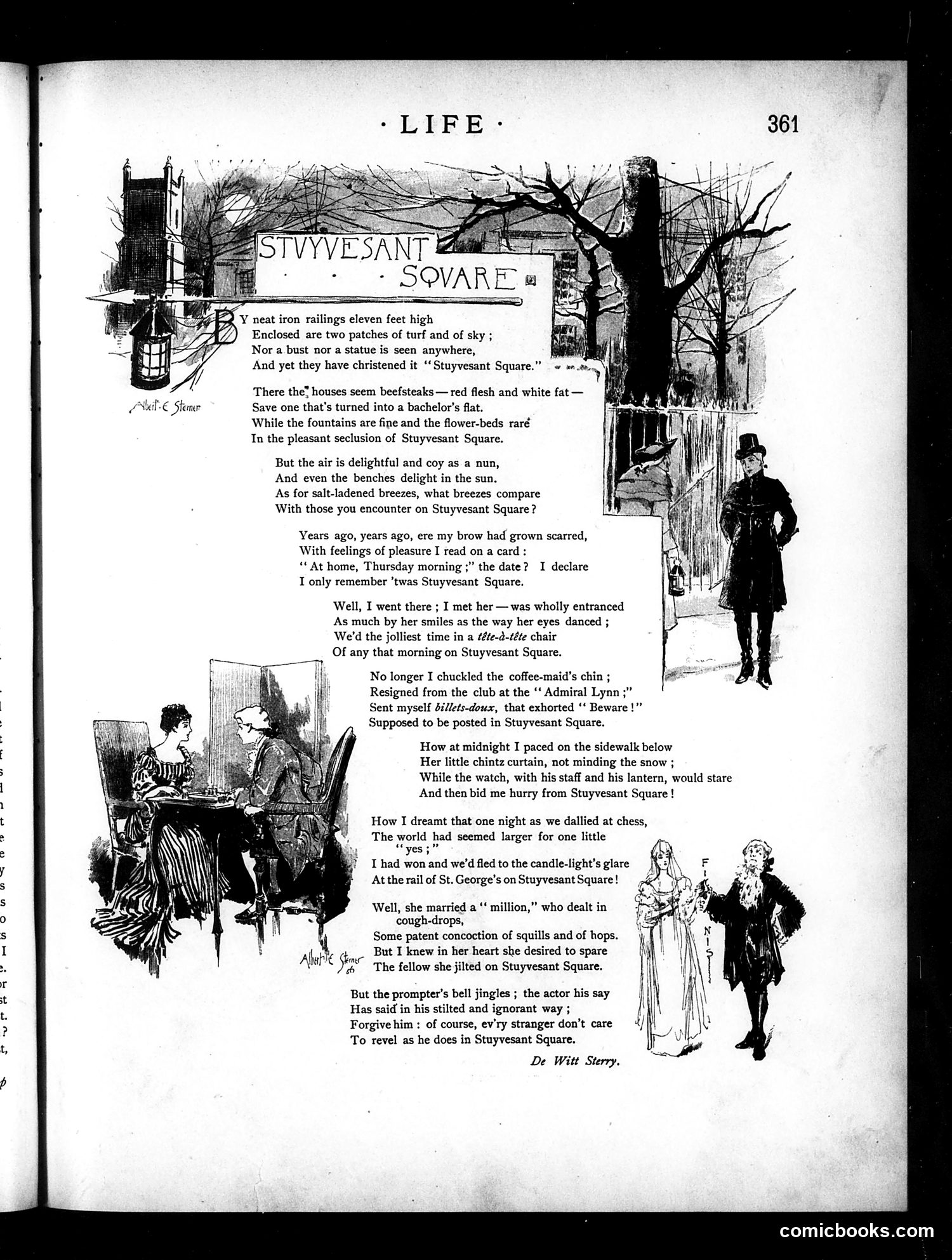
This is a nostalgic poem by De Witt Sterry about Stuyvesant Square in New York City, accompanied by period illustrations. The piece satirizes romantic sentimentality rather than political targets. The poem describes an elegant Manhattan neighborhood with iron railings and modest green space, mocking the pretensions of its residents (comparing their townhouses to "beefsteaks"). The narrative follows a bachelor's romanticized memory of meeting a woman there years ago—a brief romance that ended when she married a wealthy "million" (a millionaire) in the cough-drop business. The satire lies in the contrast between the speaker's flowery recollection of youthful passion and the banal reality: his beloved chose a rich businessman, and the speaker now inhabits this memory like an actor performing a tired script. The closing suggests even this nostalgic reverie grows tiresome. It's gentle social satire on urban romance and class aspiration rather than hard-hitting political commentary.
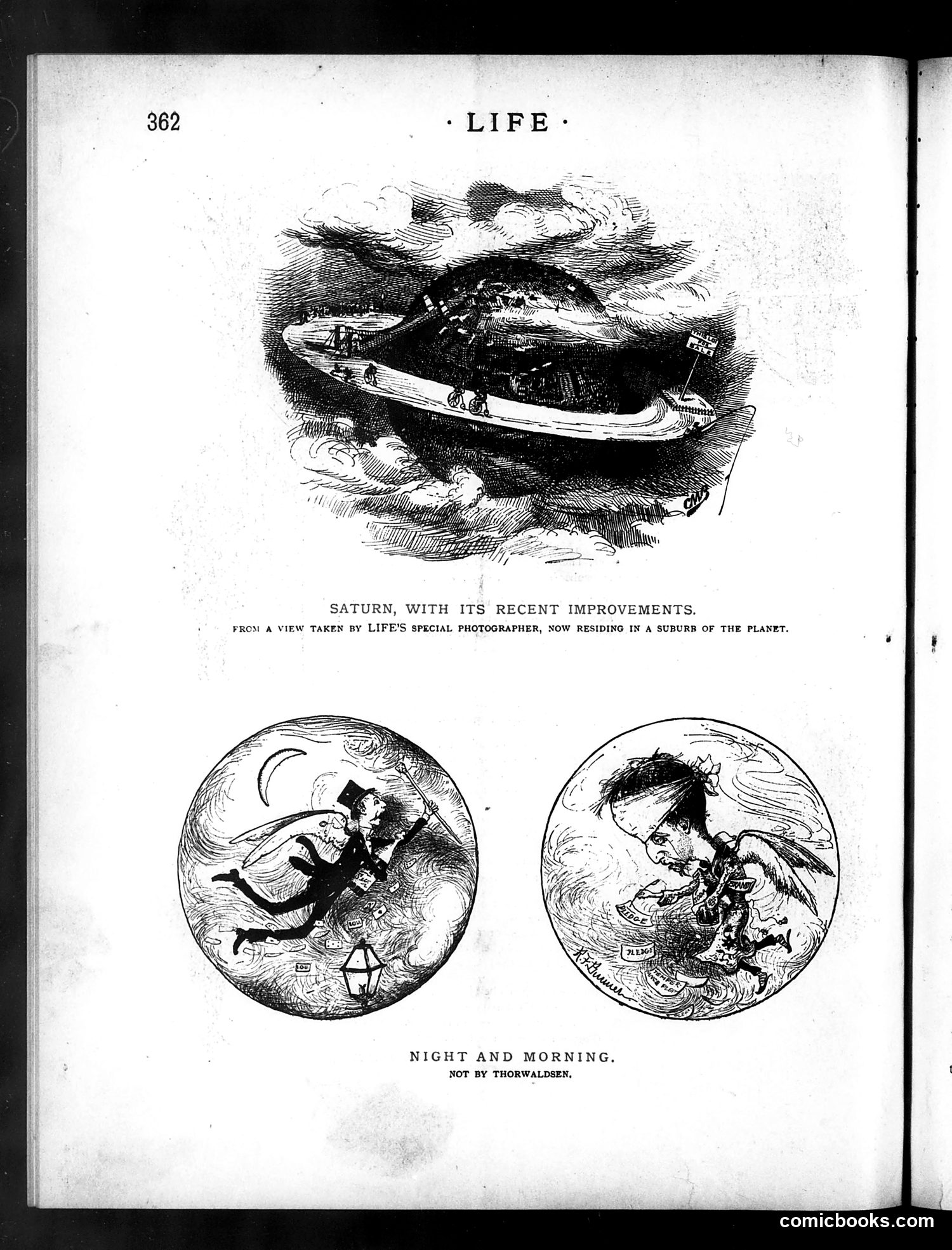
This is satirical visual humor from *Life* magazine playing on the Victorian era's fascination with space and astronomy. The top image shows Saturn with what appears to be improvements or modifications—likely mocking contemporary debates about technological progress or human ambition to literally reshape nature. The bottom two circular images labeled "Night and Morning" appear to depict fantastical lunar or planetary scenes with human figures engaged in activities. The note "NOT BY THORWALDSEN" references the famous Danish sculptor Bertel Thorwaldsen, suggesting these are parodies of serious artistic or scientific depictions. The joke seems to satirize both space speculation and pretentious artistic claims—mocking contemporary enthusiasm for scientific advancement and the notion that humans might colonize or improve other planets. The phrase about the photographer "now residing in a suburb of the planet" adds absurdist humor to the fantasy.
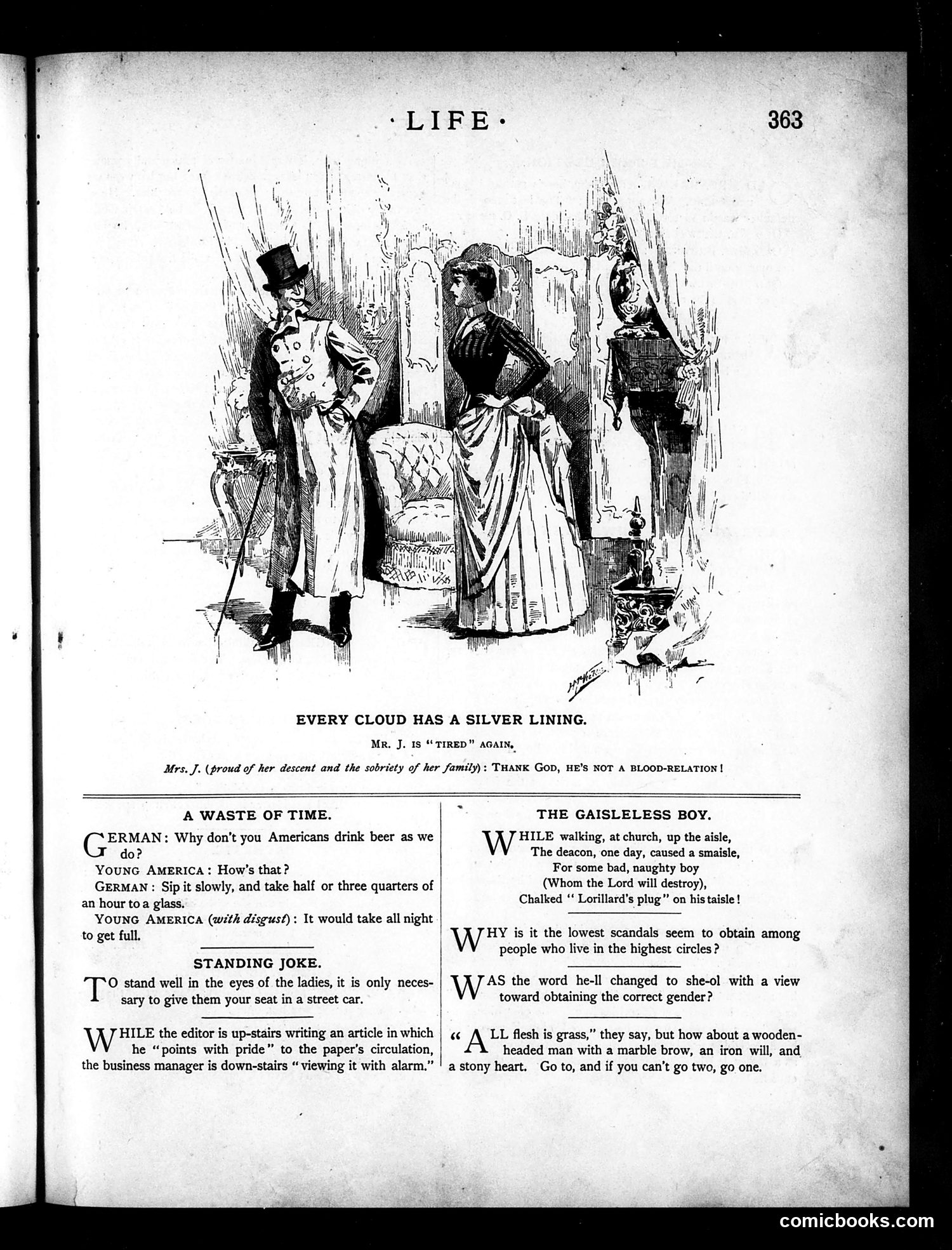
This page contains several short satirical pieces typical of *Life* magazine's humor: **Top cartoon**: "Every Cloud Has a Silver Lining" mocks a woman's relief that her husband's drinking problem isn't inherited, since he's "not a blood-relation"—suggesting she married into the trait rather than being genetically burdened. **"A Waste of Time"**: Contrasts German beer-drinking culture (slow sipping) with American impatience, satirizing American rush and materialism. **"Standing Joke"**: Observes that gentlemen gain female approval simply by offering subway seats—gentle social satire about courtship and gender dynamics. **Other items**: Include light wordplay and puns ("Gaisleless Boy," "she-ol"), editorial self-mockery (editors boasting circulation while managers worry), and philosophical quips about wooden-headed men. The overall tone is gentle, domestic satire aimed at middle-class American readers, focusing on social etiquette, drinking habits, and minor absurdities rather than political commentary.
This page collects short humorous sketches typical of Life's satirical format: **"He Met the Question"**: A joke about newspaper abbreviations. Old Mr. Brewster misinterprets "B.C." (British Columbia) as "Before Christ," creating absurdity when his wife notes the defaulter only fled recently. **"Still They Come"**: A brief social satire about courting, where a man avoids meeting a woman described as someone "who never jokes"—suggesting the period valued wit and personality in potential partners. **"A Few Pages of Unwritten History"**: The main feature, a mock-serious essay about "Adam the First" (humanity's ancestor). It satirizes both historical hagiography and phrenology (the pseudoscience of skull bumps determining personality). The piece humorously describes Adam's solitary childhood, social awkwardness, and peculiar adult behavior—all presented in inflated, pseudo-scholarly language that parodies both history-writing and 19th-century pseudo-science. The humor relies on readers recognizing overwrought historical rhetoric and the absurdity of applying modern social commentary to biblical prehistory.
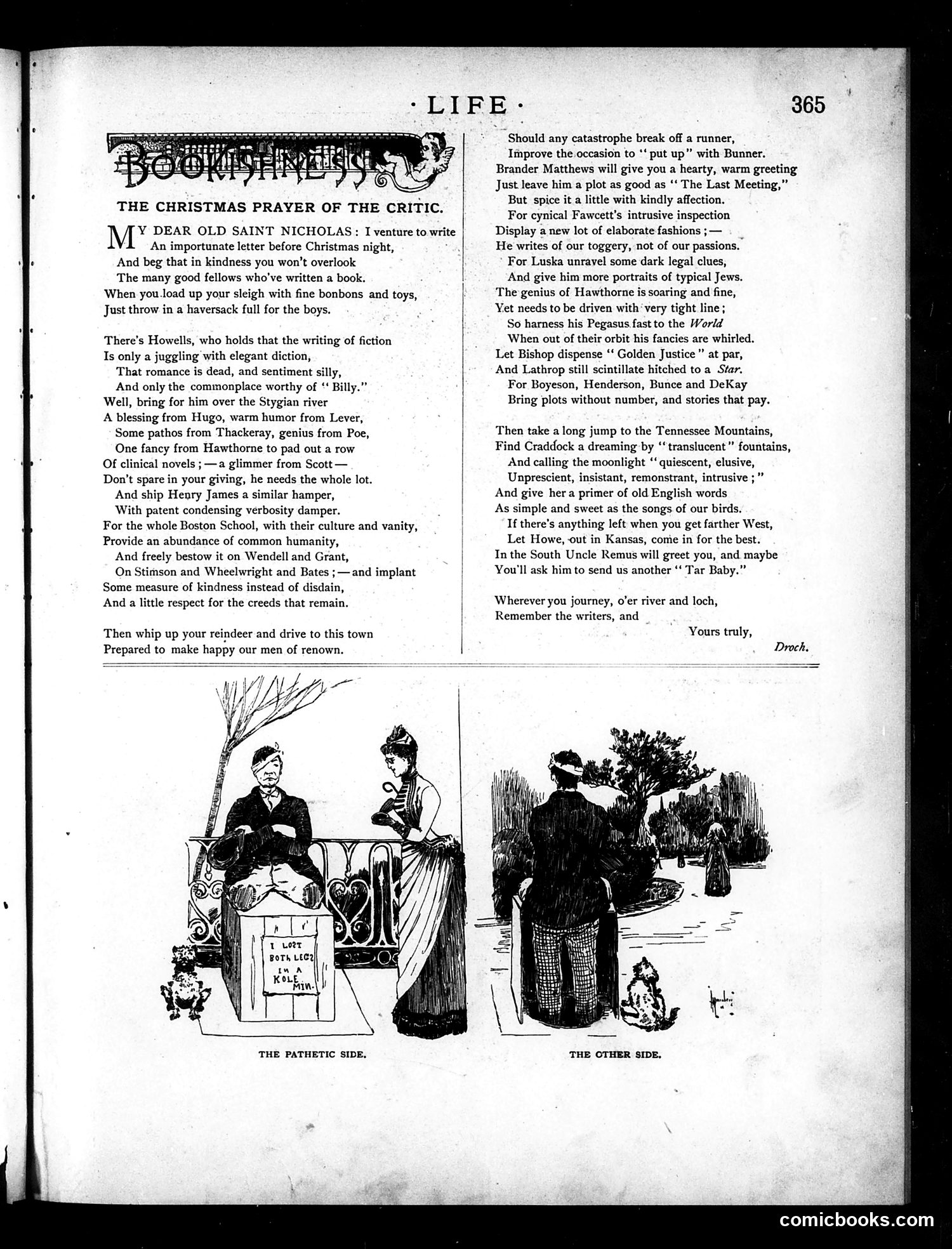
This is a satirical poem addressed to Saint Nicholas, humorously critiquing American authors of the late 19th century. The "critic" requests gifts for various writers—some genuinely talented (Hawthorne, Poe, Thackeray), others representing contemporary literary trends the critic disdains. The satire targets specific aesthetic movements: the "Boston School" for pretentious intellectualism; realist/naturalist writers like Howells for rejecting romance; Henry James for verbose verbosity; and others for various literary sins (affectation, clichéd sentimentality, overwrought language). The accompanying illustrations labeled "The Pathetic Side" and "The Other Side" appear to visualize contrasting responses to literature—likely showing sentimental versus cynical reactions, though the exact commentary is unclear from the images alone. The piece exemplifies *Life*'s function as a satirical magazine mocking contemporary intellectual and literary pretensions.
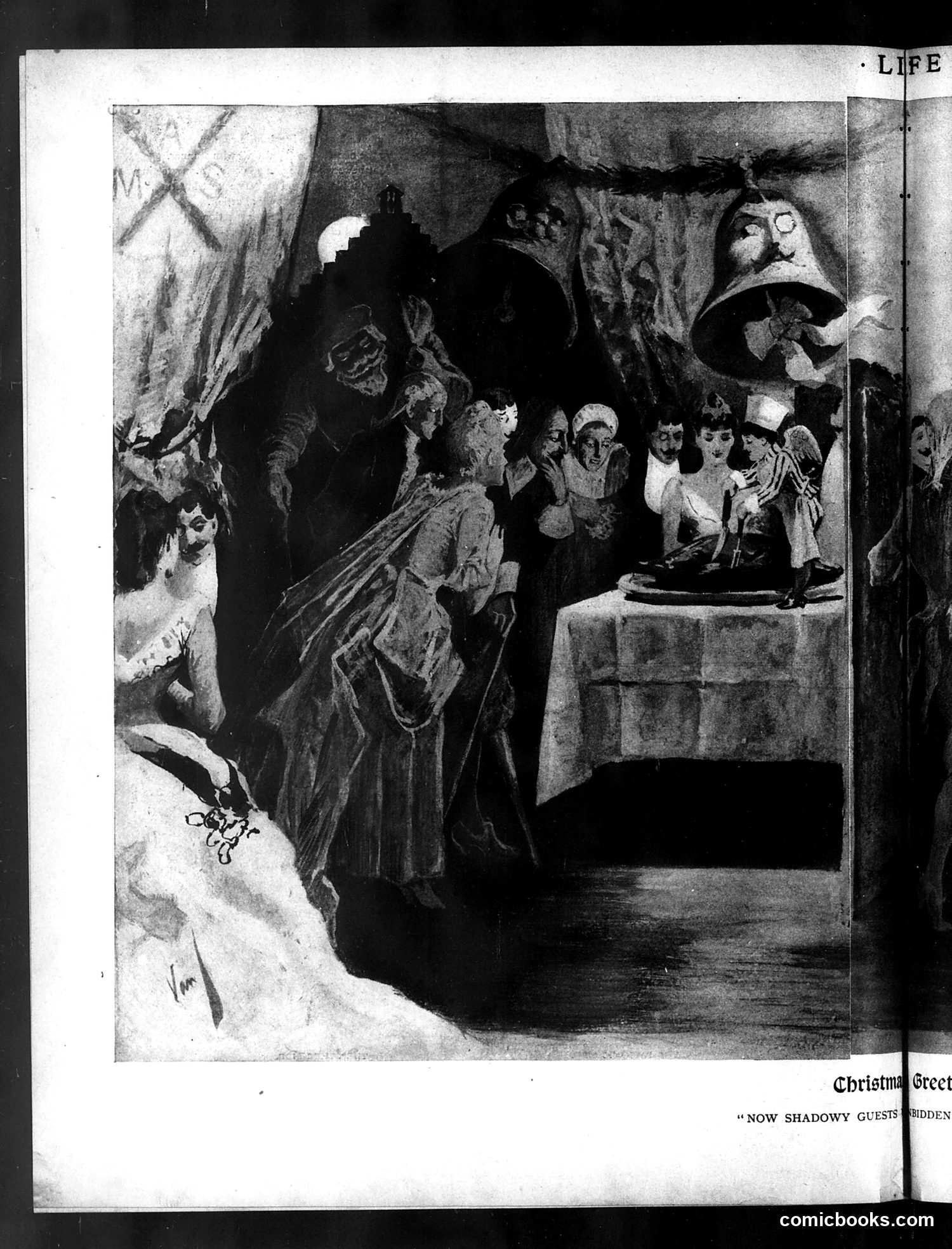
This appears to be a Christmas-themed satirical illustration from *Life* magazine. The image depicts shadowy, ghostly figures gathering in what seems to be an interior scene, with the caption "Now Shadowy Guests" suggesting an ironic or dark take on holiday visitors. The style and content suggest social satire—possibly mocking unwelcome guests, unwanted holiday obligations, or the intrusion of undesirable figures into domestic spaces during the festive season. The deliberately murky, ominous rendering of the "guests" creates comedic contrast with the cheerful Christmas greeting framework. Without the full article text or publication date visible, the specific political or social target remains unclear, though the satirical intent is evident in this darkly humorous treatment of holiday socializing.
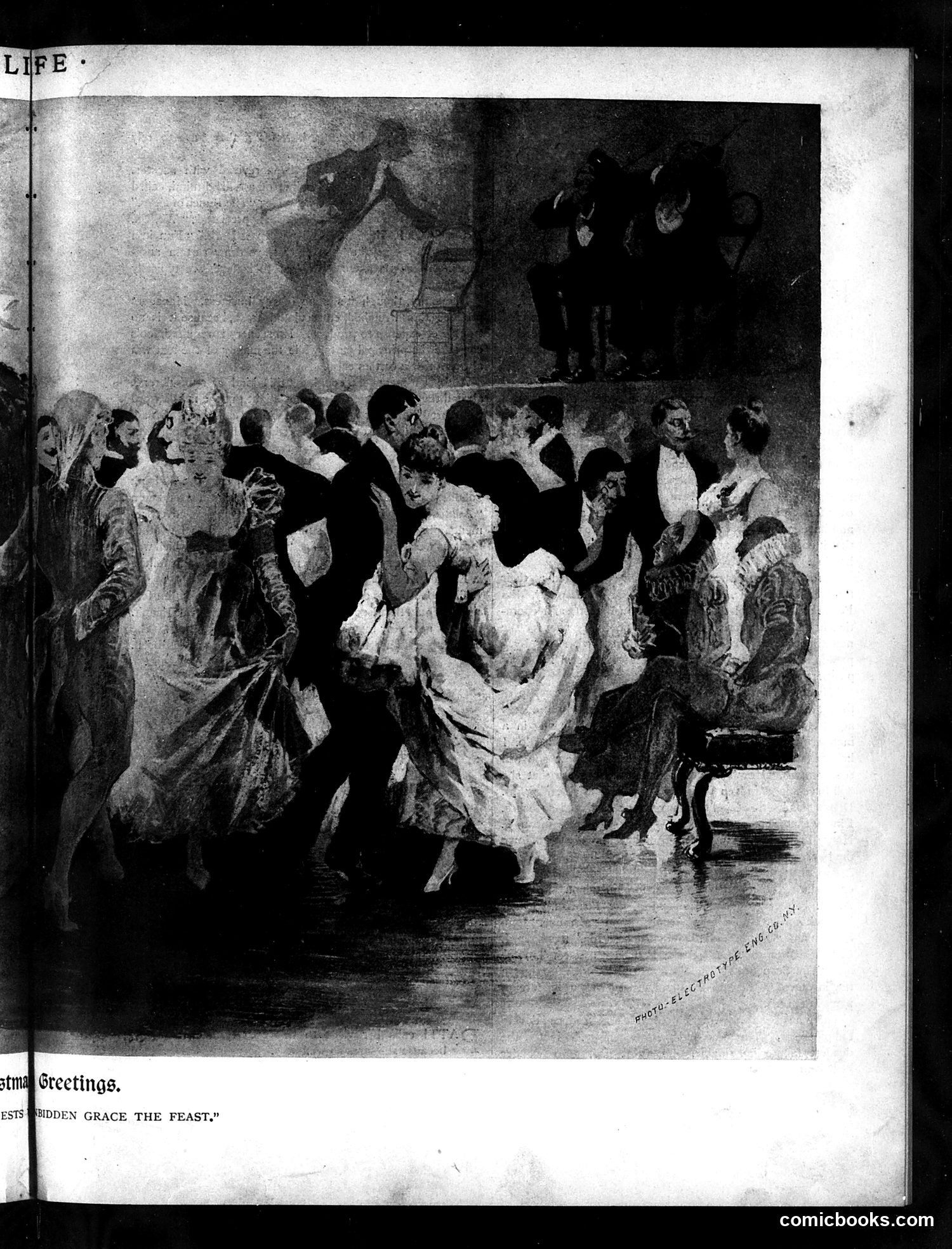
This appears to be a Christmas-themed satirical illustration from Life magazine, titled "Bidden Grace the Feast." The image depicts an elegant formal dinner party with well-dressed guests in evening wear, centered around a woman in a white gown. The scene appears to mock high society's pretension and formality during holiday celebrations. The phrase "bidden grace" likely plays on "grace before meals" — suggesting irony about whether wealthy society actually practices genuine gratitude or simply performs social rituals. The detailed period clothing and formal setting indicate this satirizes upper-class Christmas traditions and their empty ceremonialism versus authentic charitable spirit the holiday supposedly represents. The specific historical context and particular figures being caricatured remain unclear from the visible text and image alone.
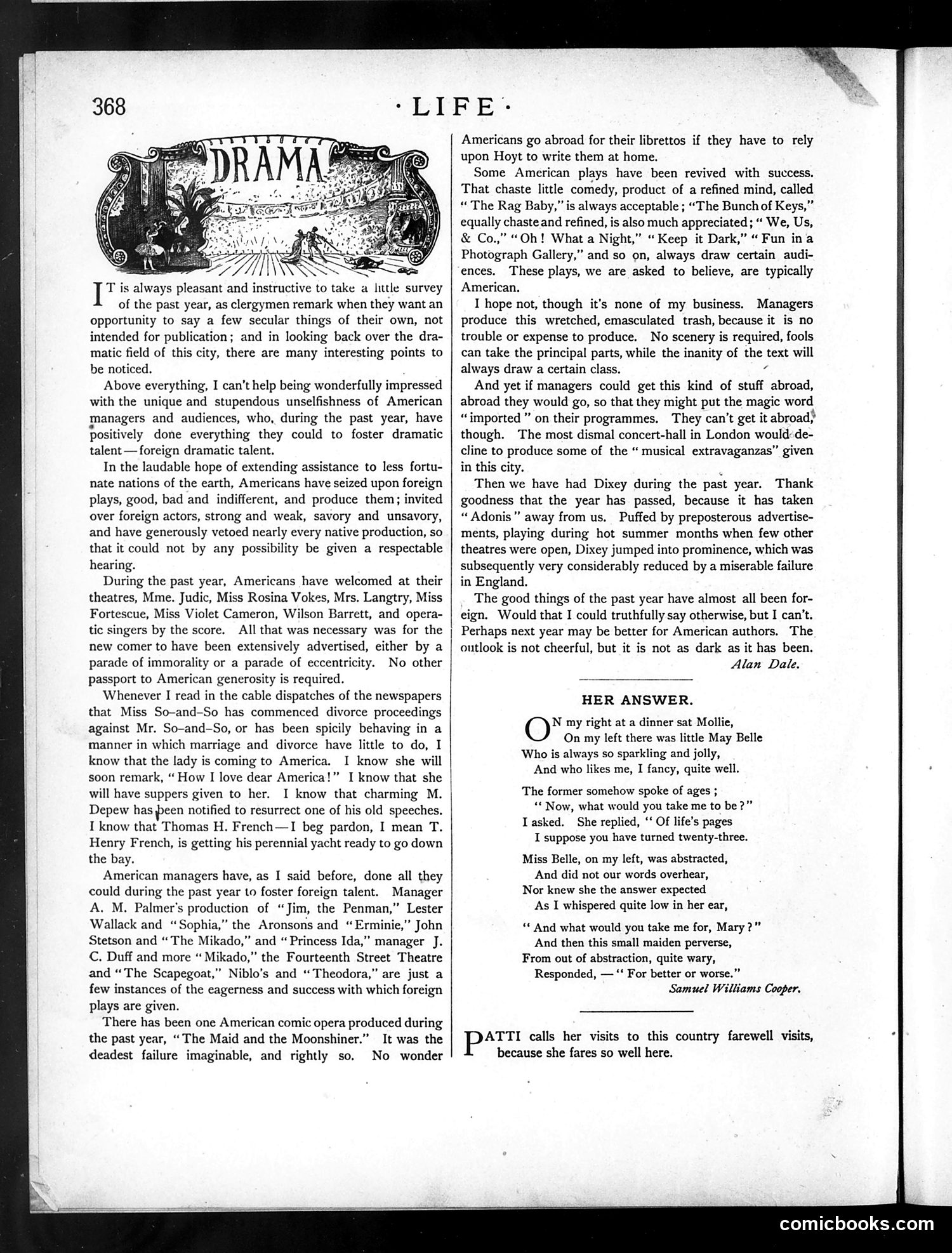
This is a drama critic's satirical column attacking American theatrical priorities in what appears to be the 1880s. The author mocks American theater managers and audiences for their obsessive preference for foreign performers and plays over domestic talent. **The Satire's Points:** The critic argues Americans will promote *any* foreign actress—no matter her quality—especially if she's controversial (divorce scandals, moral impropriety). He suggests notorious behavior is essentially a "passport" to American success. He names specific foreign performers welcomed that season (Mme. Judic, Lillie Langtry, Wilson Barrett). **The Irony:** While claiming to admire American "unselfishness," he clearly despises it. Managers produce mediocre foreign imports while rejecting native work. He notes the one American comic opera produced ("The Maid and the Moonshiner") was a "deadest failure," suggesting Americans themselves produce inferior work—yet managers still prefer labeling anything "imported." The column advocates for American dramatic talent while mockingly praising the status-seeking behavior preventing it.
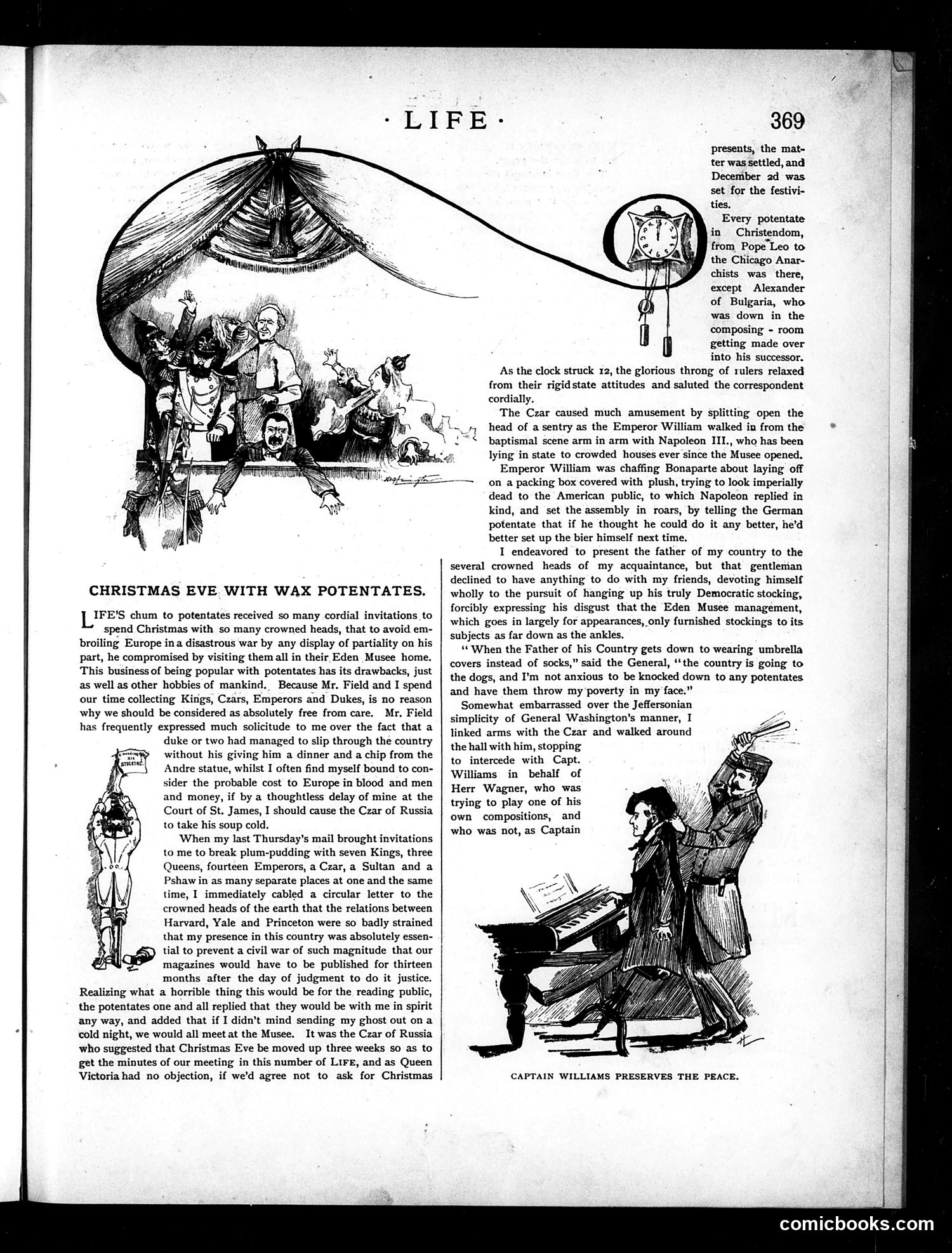
This satirical piece mocks the author's popularity with world leaders by imagining a Christmas gathering at Eden Musée—a wax museum. The joke hinges on substituting *wax figures* for actual royalty, allowing the author to entertain all crowned heads simultaneously without diplomatic offense. The text names specific figures: the Czar of Russia, Emperor William (likely Wilhelm II), Napoleon III, Pope Leo, and references to various kings, queens, and emperors. The humor derives from absurd scenarios—the Czar splitting a sentry's head open, Napoleon lying in state in the museum, George Washington complaining the wax figures only get stockings "as far down as the ankles." The satire targets both the pretensions of world leaders (portrayed as rigid and easily amused) and anxieties about international diplomacy during a period of colonial competition and rising tensions. The Edison Musée setting reduces mighty potentates to mere tourist attractions—a commentary on their diminished significance or artificial importance.
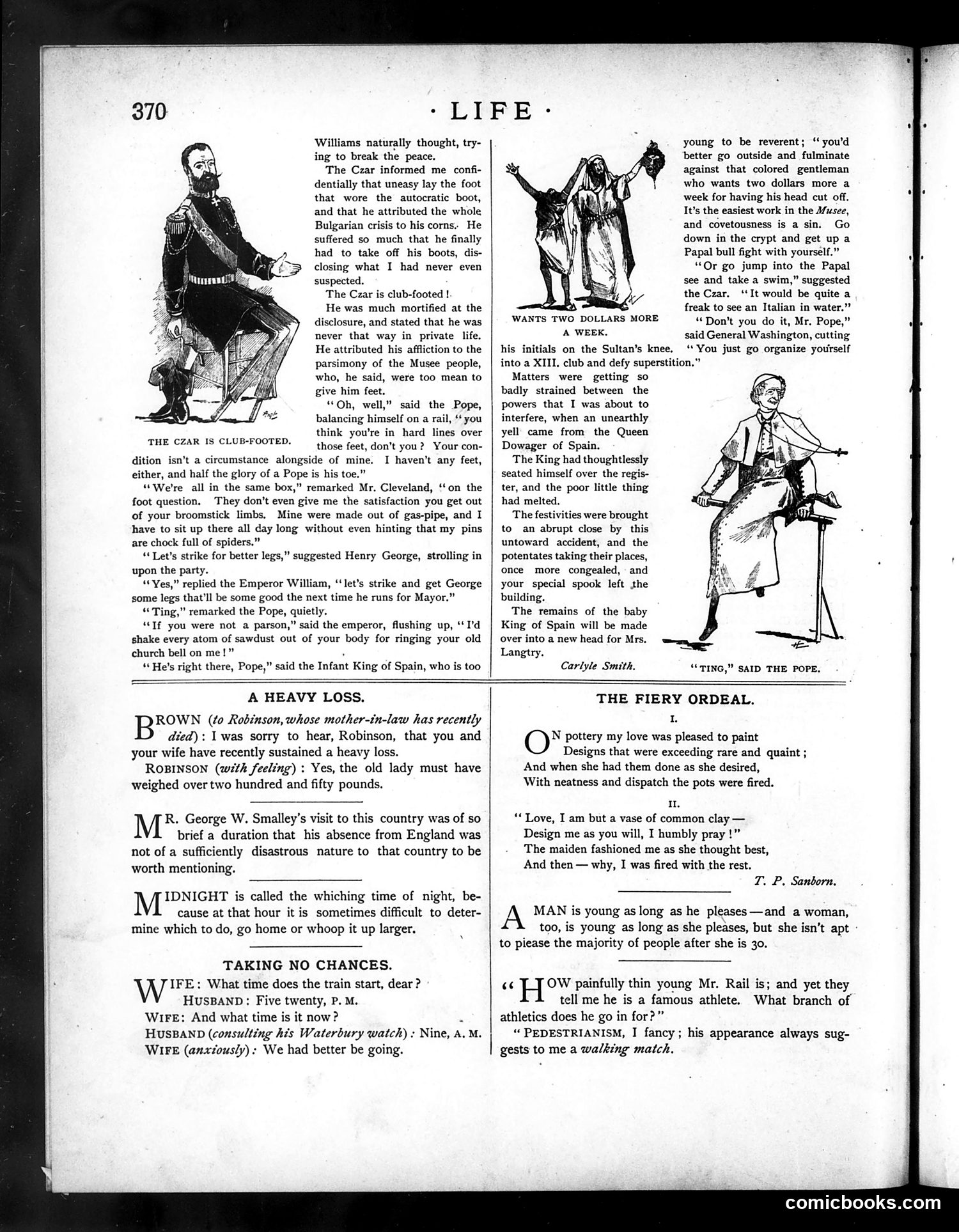
The main cartoon depicts a surreal gathering of world leaders and figures discussing their physical defects. **The Czar** (Russian Emperor) is club-footed; **the Pope** lacks feet; **Cleveland** (likely President Grover Cleveland) has artificial legs made of gas-pipe; **Henry George** (labor reformist politician) wants better legs; **Emperor William** (German Kaiser); and **the Infant King of Spain**. The satire mocks these political figures by literalizing their perceived weaknesses—the Czar's autocratic instability, the Pope's irrelevance, Cleveland's unpopularity. The joke escalates absurdly: the Queen Dowager of Spain melts near a heating register; her remains become a new head for actress **Lillie Langtry**. This is cynical political humor typical of 1880s-90s *Life* magazine, using grotesque exaggeration and crude body-humor to ridicule contemporary politicians and public figures. The accompanying brief jokes and anecdotes follow similar irreverent patterns.
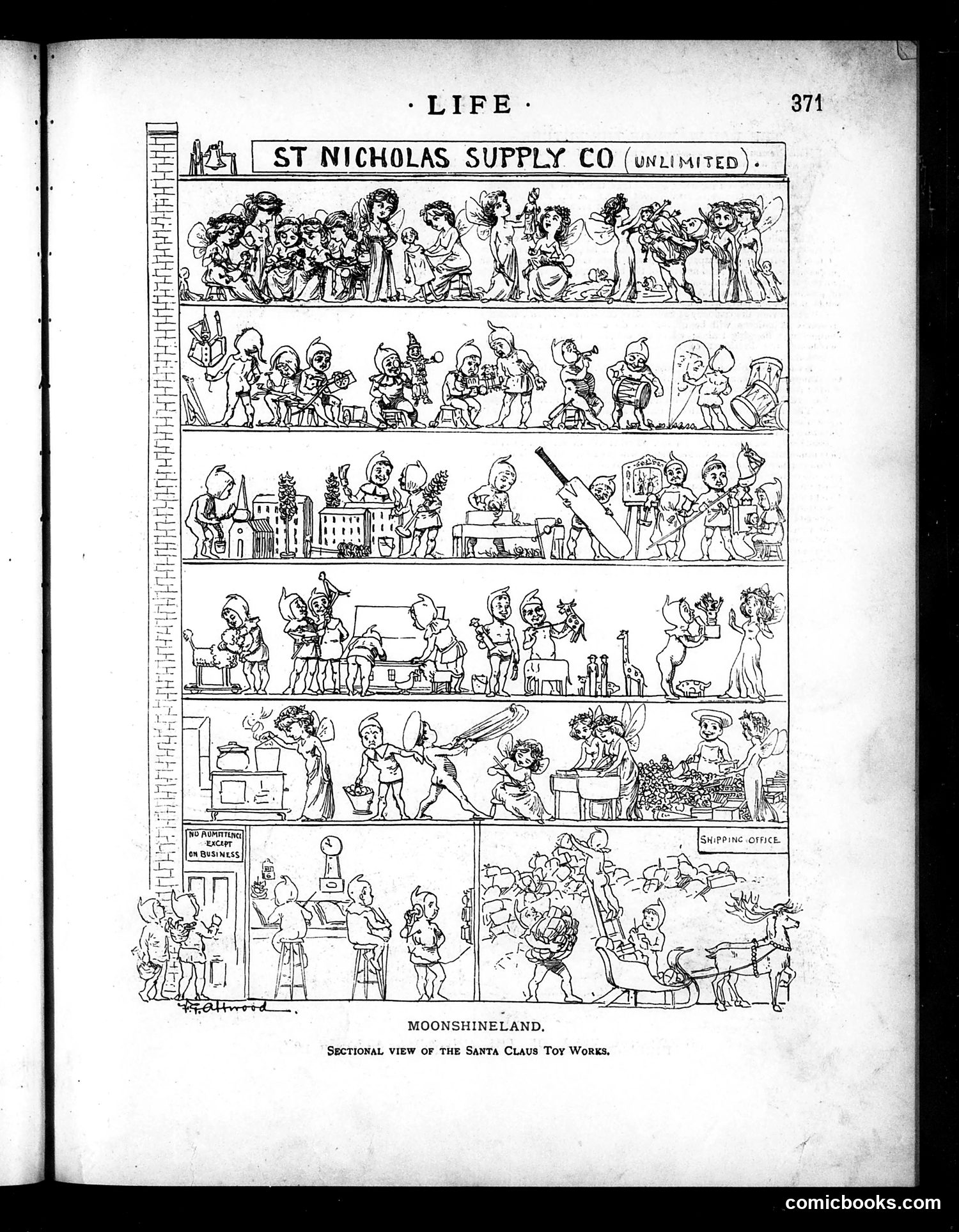
This satirical cartoon presents a multi-level cross-section depicting toy manufacturing as illicit moonshine production during Prohibition. The title puns on "Moonshineland" (illegal whiskey-making) and "Santa Claus Toy Works," conflating toy factories with bootleg operations. The sequential panels show cherub-like workers (elves) engaged in various activities across different "floors"—mixing, assembling, packaging, and shipping goods. A "Prohibition Except This Building" sign appears bottom-left, suggesting the factory operates outside legal restrictions. The joke satirizes either the toy industry's practices or perhaps uses toy-making as metaphor for prohibition-era lawbreaking. The cherubs doing industrial labor mock both idealized Christmas imagery and the reality of industrial workers. The cartoon critiques Prohibition's widespread violations and the government's apparent selective enforcement.
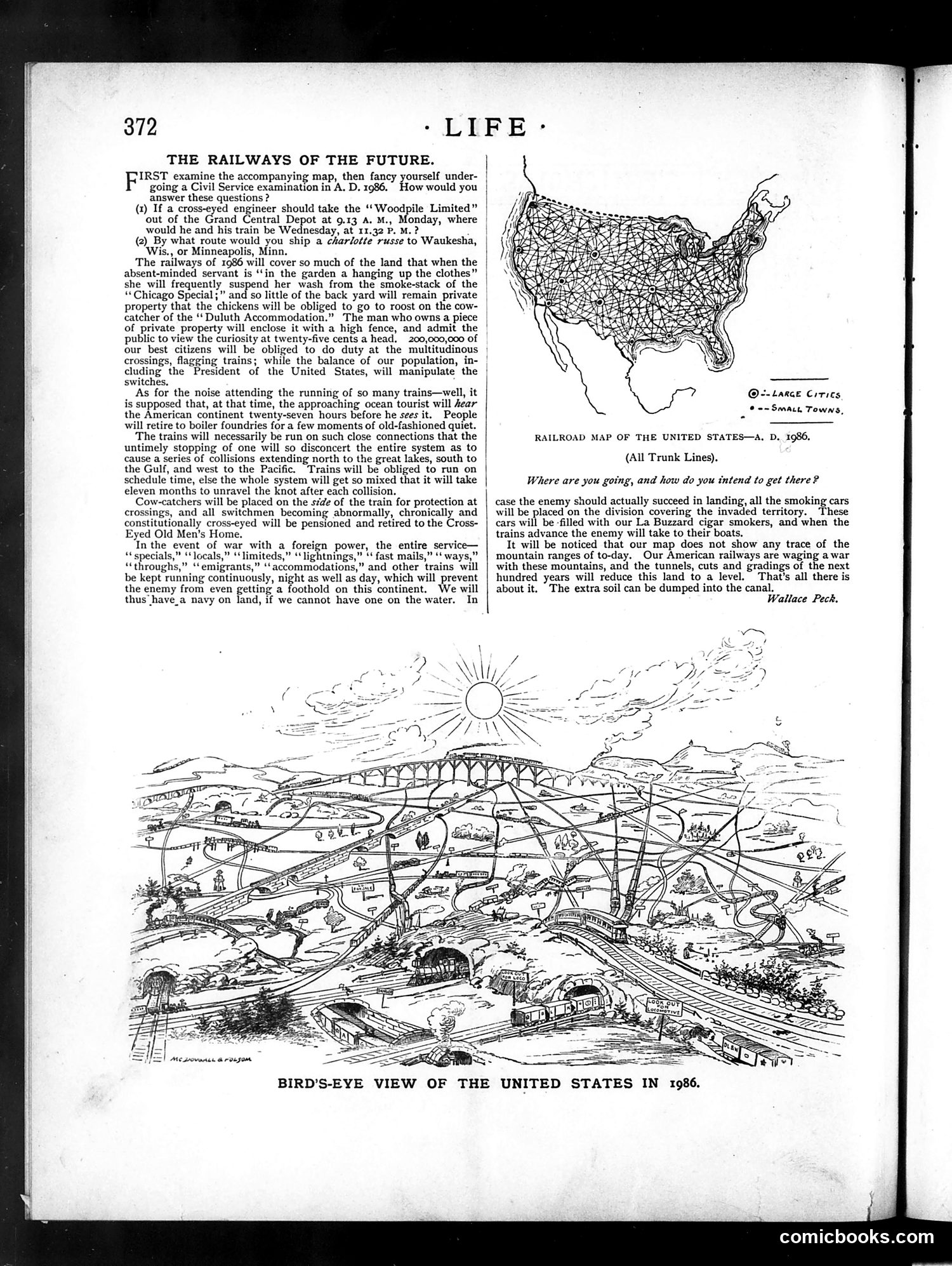
This is satirical futurism imagining an absurdly over-railroaded America a century hence. The piece mocks both railroad expansion and bureaucratic excess through exaggerated scenarios: a civil service exam asking impossible questions about train schedules; servants hanging laundry on train smokestacks; private property so rare it becomes a paid curiosity; 200 million citizens reduced to operating railway crossings; collisions cascading across the continent; cross-eyed switchmen pensioned to retirement homes; and railways so dense they could defend against invasion via cigar-smoking passengers. The accompanying map and "bird's-eye view" illustration visualize this nightmarish rail-saturation, showing the landscape completely gridded by tracks. The satire targets both technological utopianism and the railroad industry's unchecked expansion into American life—treating leveling mountains and eliminating private space as inevitable "progress." The author (Wallace Peck) implies such development would be absurd and destructive, not desirable.
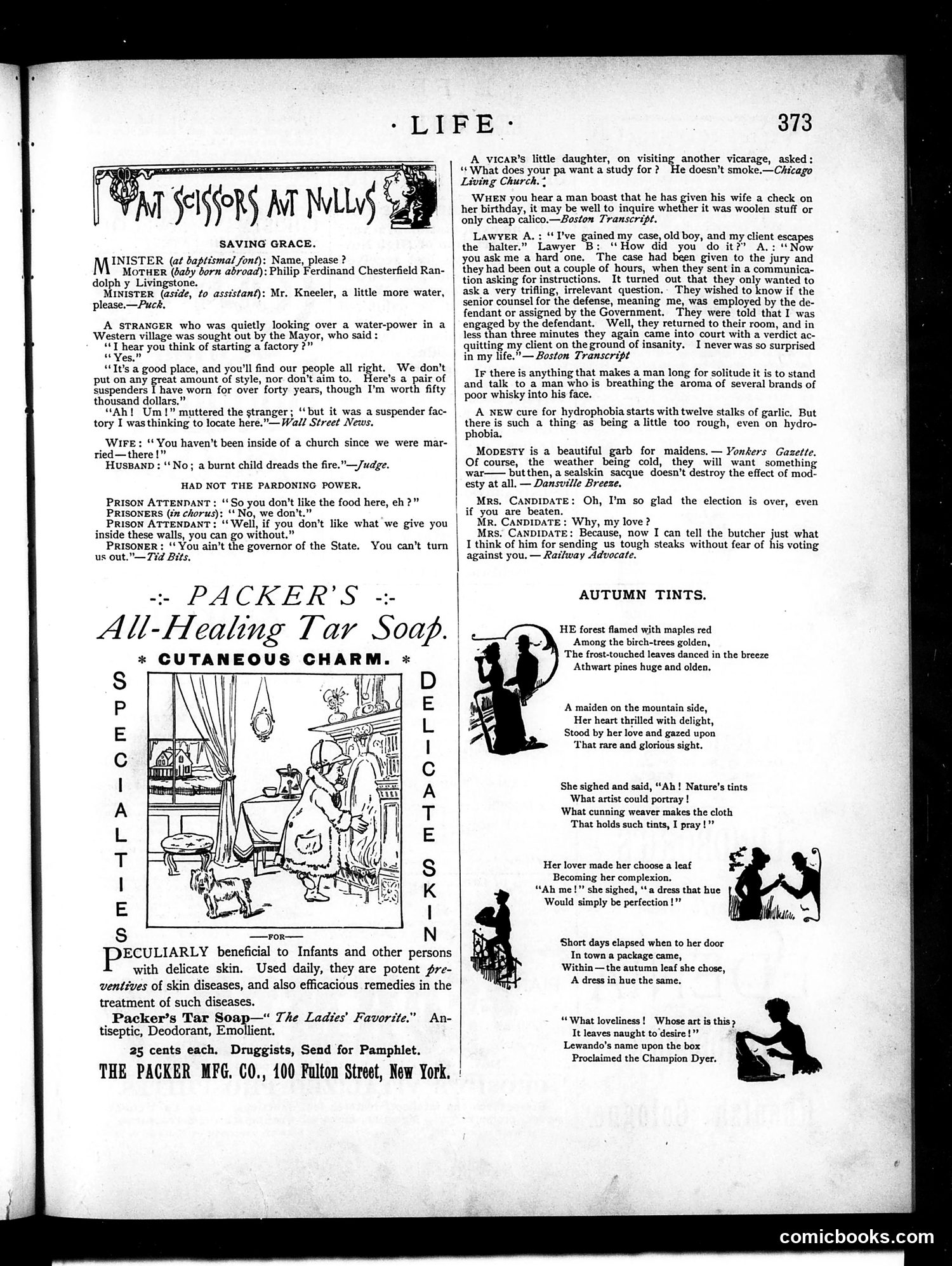
This page from *Life* magazine consists primarily of **short humor pieces and advertisements**, not political cartoons. The jokes are period-specific observations: **Key content:** - A minister baptizing a baby with an absurdly long foreign name, requiring "more water" (satirizing pretentious naming) - A factory owner mistaken for someone seeking water power, when he actually wanted a *suspender factory* (plays on frontier hospitality) - Prison inmates told they can leave if they don't like the food—but a prisoner correctly notes only the governor has that power (ironic powerlessness) - Various brief quips about spousal relationships, dishonesty in gift-giving, and legal tricks **The advertisements** (Packer's Tar Soap) are the other major element, typical of period magazine revenue. These are **gentle social satire** poking fun at vanity, rural naïveté, marital dynamics, and institutional absurdity—not partisan politics. No specific historical figures or events are referenced.
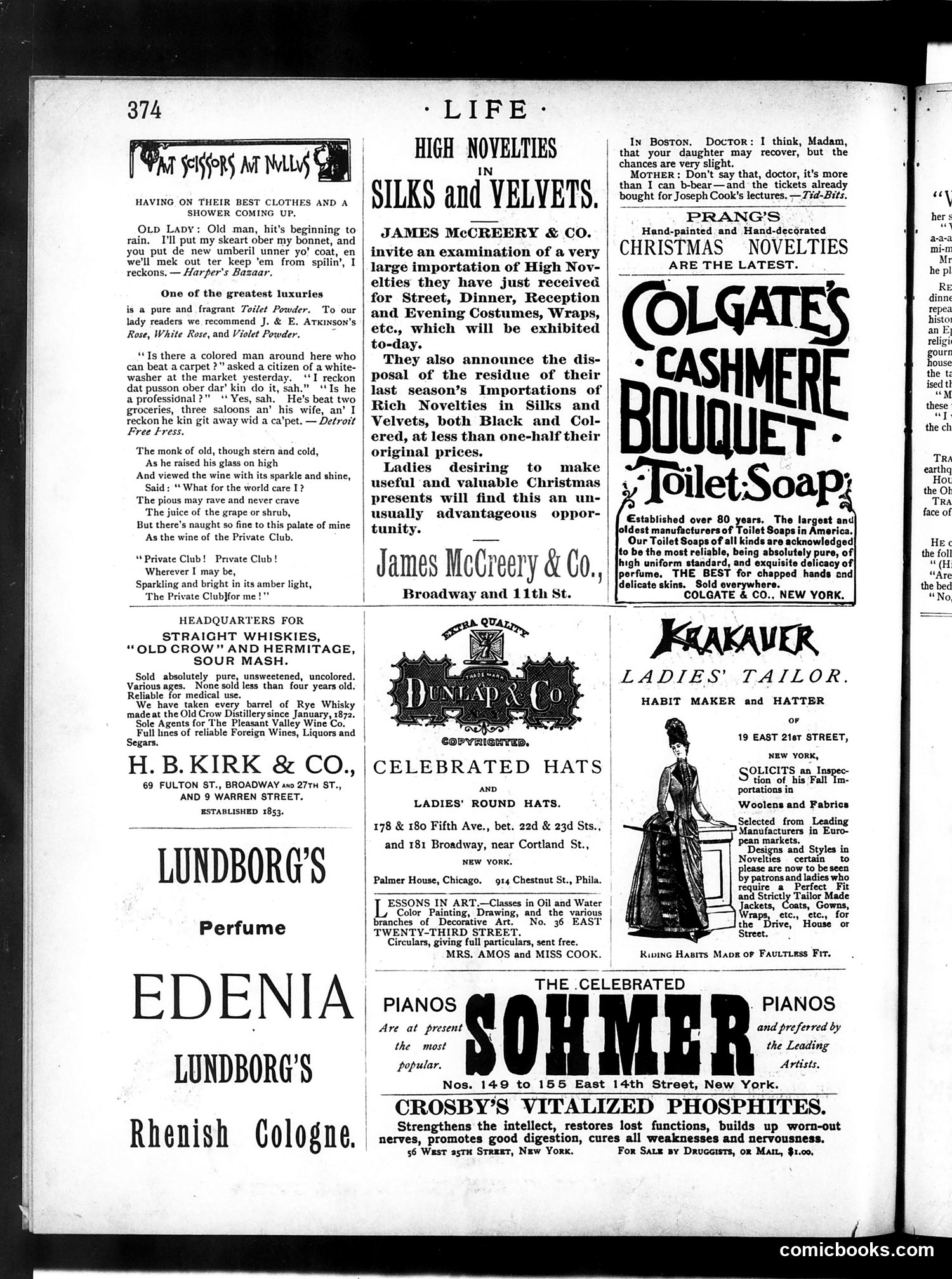
This is primarily an **advertising page** from Life magazine, with minimal cartoon content. The page is dominated by commercial advertisements for luxury goods typical of the 1880s-90s period: perfume, pianos, textiles, toilet soap, whiskey, and tailoring services. The few humor items visible are brief anecdotes rather than illustrated cartoons: 1. **"Sisters at Nall"** - A dialect joke featuring an elderly African American woman preparing for rain, using stereotypical speech patterns common to racist humor of the era. 2. **"A colored man"** - A brief joke about a Black carpet-beater, again relying on stereotypical dialect and demeaning characterization. 3. **A Boston doctor joke** - A pun about a mother's concern over theater tickets rather than her daughter's illness. These represent the casual racism and ethnic stereotyping normalized in mainstream American publications of this period. The page's primary function is advertising luxury consumer goods to affluent readers.
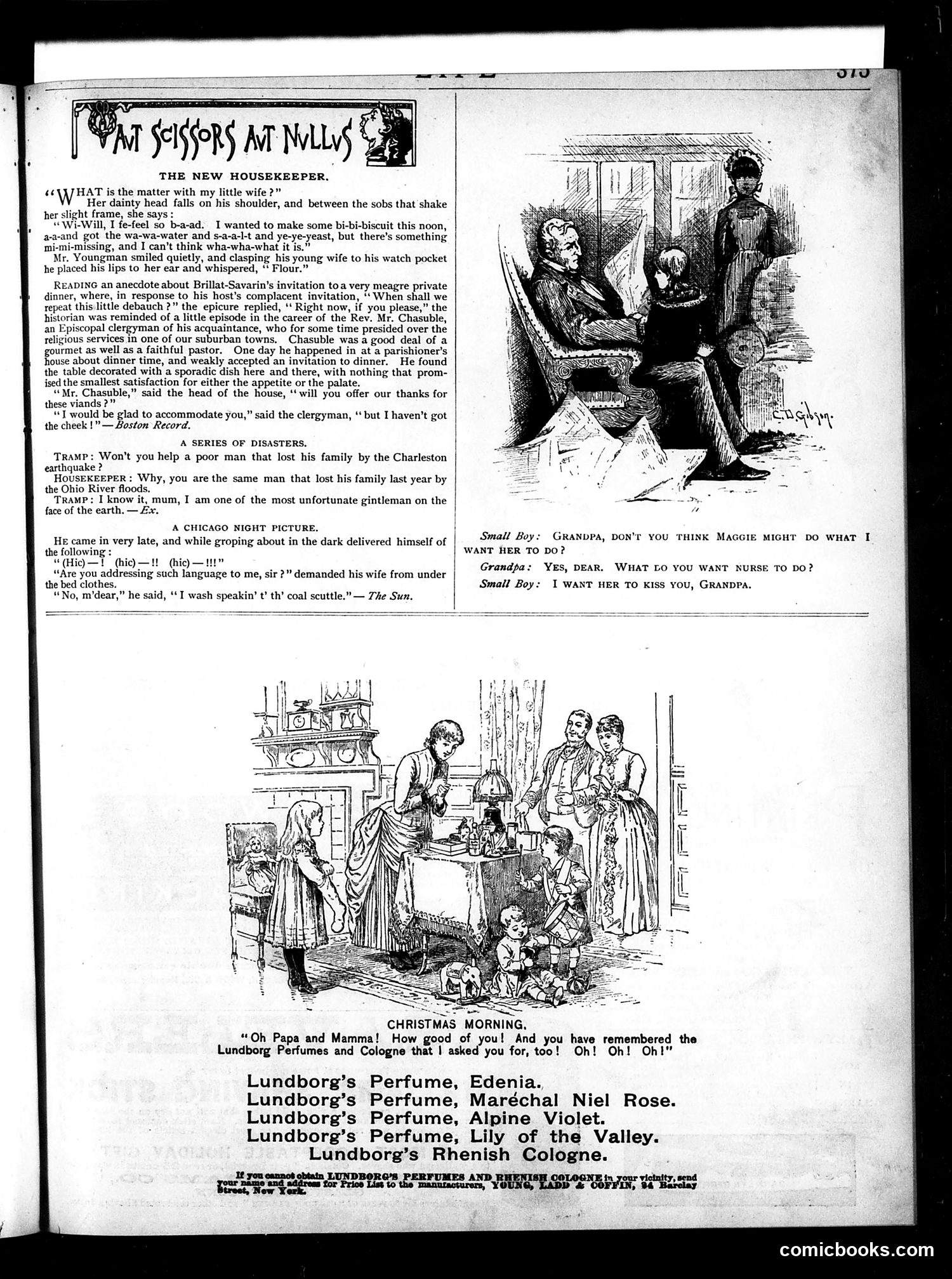
This page contains multiple short humorous sketches satirizing domestic life and human foibles: **"The New Housekeeper"** jokes about a newlywed wife's incompetence—she can't make biscuits because she's forgotten the flour, requiring her husband to whisper the answer. The satire targets both the new bride's domestic inexperience and the condescending patience of young husbands. **"A Series of Disasters"** mocks a chronic panhandler who claims successive catastrophes (Charleston earthquake, Ohio River floods) as excuses. The joke's cynicism suggests professional beggars recycled sob stories. **"A Chicago Night Picture"** depicts a drunk man hiccupping profanities, which his wife assumes are directed at her until he clarifies he's addressing the coal scuttle—humor from the absurdity of drunken confusion. The bottom section shows a child manipulating his grandfather into kissing the nurse, demonstrating childish scheming. **Lundborg's Perfume advertisement** uses a Christmas morning scene where parents present luxury toiletries, reflecting early 20th-century consumer culture and gift-giving expectations.
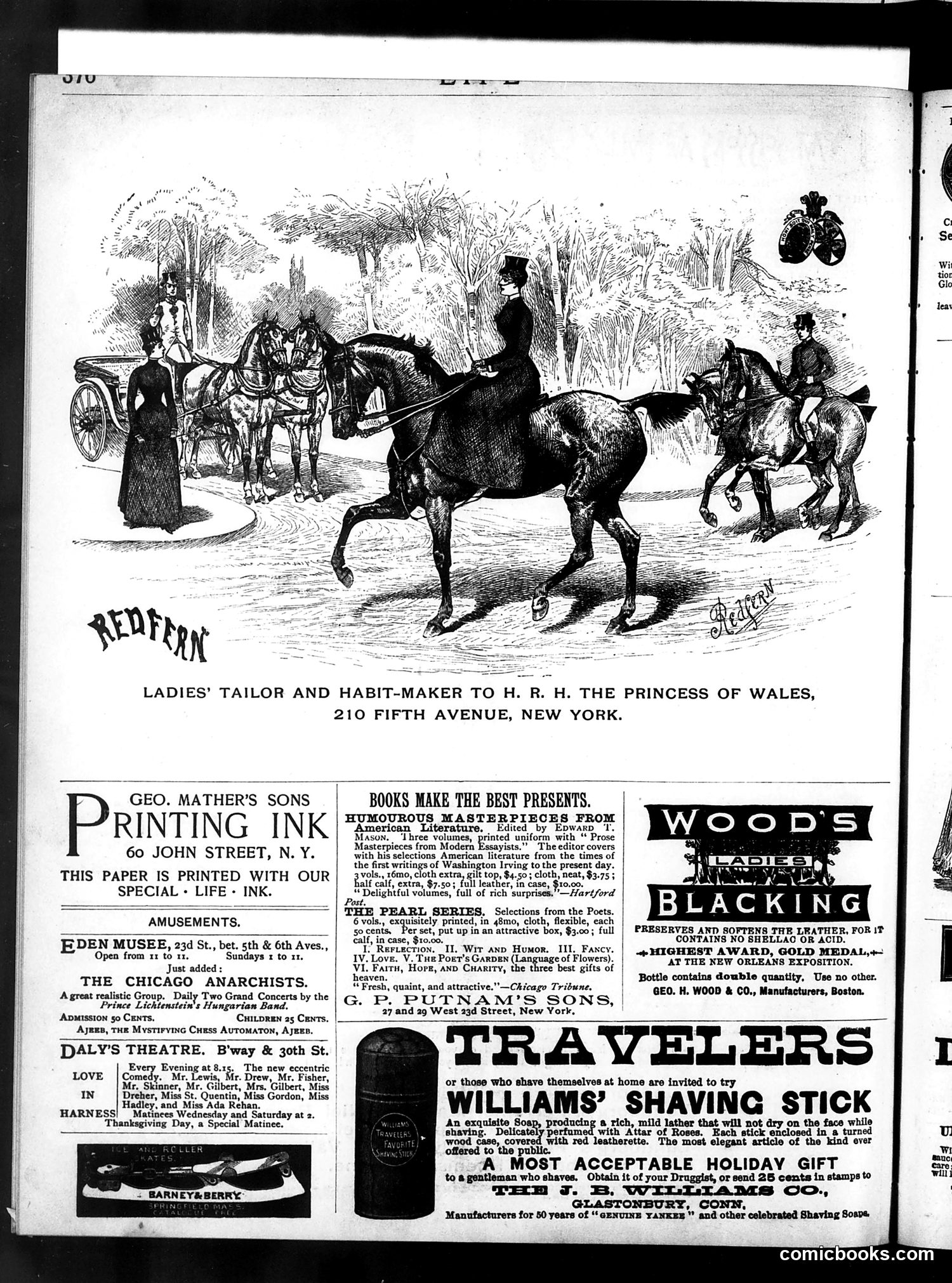
This page is primarily **advertisements and entertainment listings** rather than political satire. The main illustration at top depicts a fashionable equestrian scene—women in riding habits and Victorian dress alongside horse-drawn carriages in what appears to be a park or promenade. The caption identifies this as promoting **Redfern**, a tailor and habit-maker to the Princess of Wales, located on Fifth Avenue in New York. This is straightforward luxury advertising: the image showcases the elegance of Redfern's riding habits by depicting well-dressed society figures in fashionable outdoor settings. The remainder of the page contains typical period advertisements for printing ink, theater productions (including "The Chicago Anarchists"), books, shoe blacking, and Williams' Shaving Stick. There is **no political cartoon or satirical content** visible. This appears to be a standard commercial page from Life magazine's advertising section.
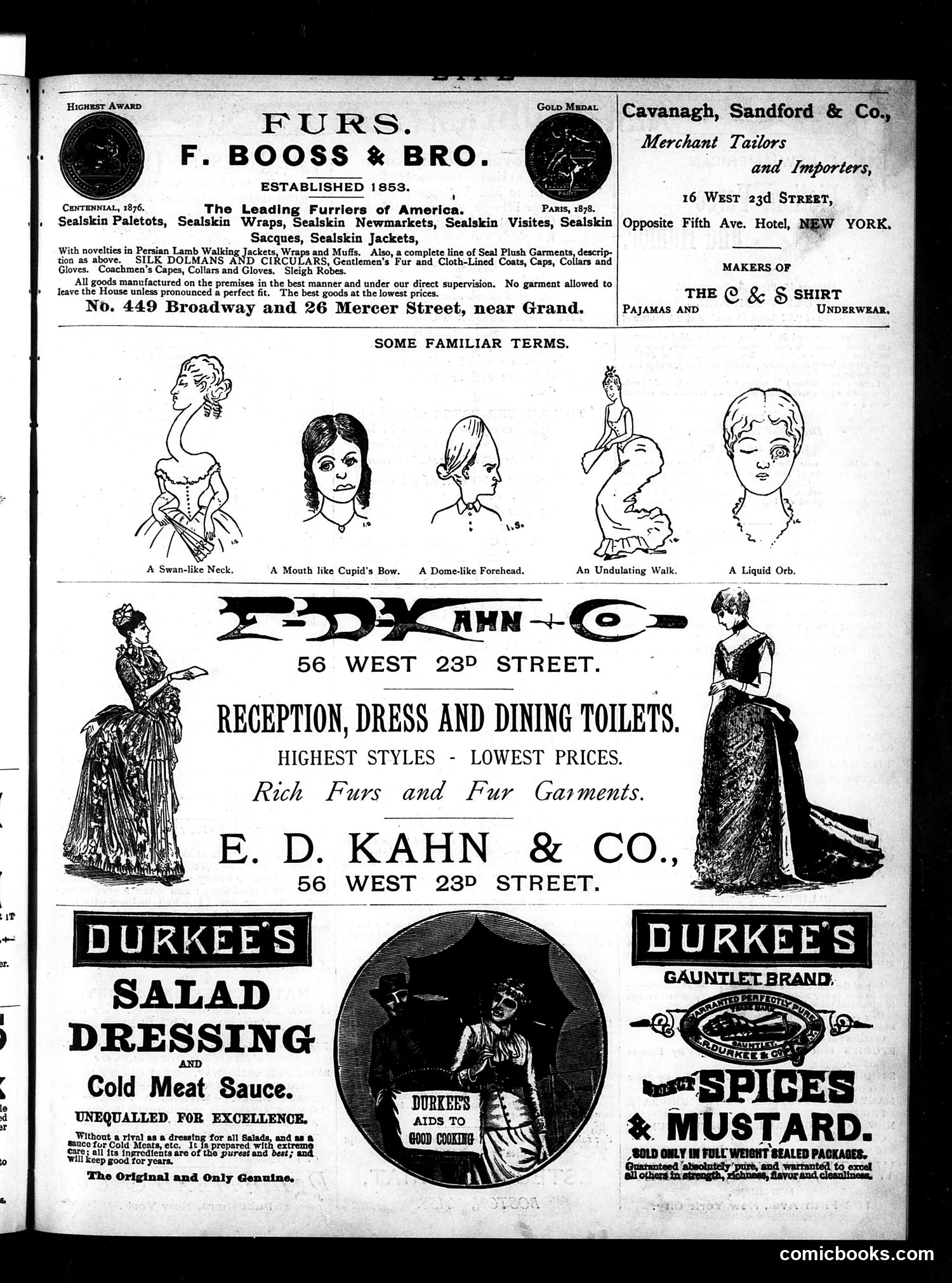
This is not a satirical cartoon page but rather a commercial advertising section from *Life* magazine. It consists almost entirely of late-19th-century advertisements for New York businesses: - **F. Booss & Bro.** (furs, established 1853) - **Cavanagh, Sandford & Co.** (merchant tailors) - **E. D. Kahn & Co.** (women's clothing and furs) - **Durkee's** (salad dressing and mustard) The only potentially humorous content is the section labeled "Some Familiar Terms," which depicts five illustrated female faces with labels like "A Swan-like Neck" and "A Mouth like Cupid's Bow"—these appear to be fashionable beauty standards or physical attributes valued in the era, presented in a somewhat tongue-in-cheek manner. The page reflects commercial advertising practices and beauty ideals of the 1870s-1880s rather than political satire.
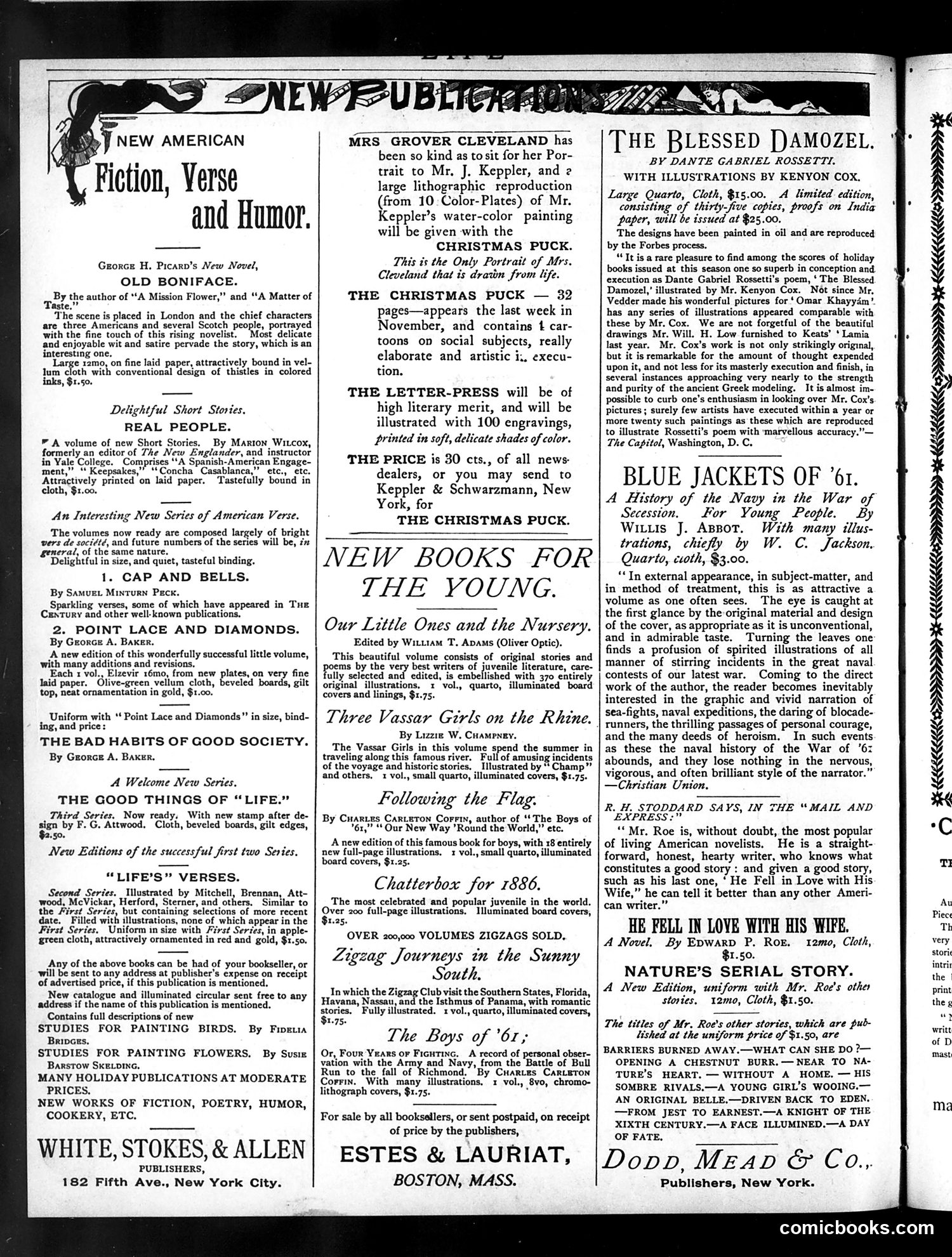
This is primarily a **book advertisement page** from Life magazine, not a political cartoon page. The content consists almost entirely of publisher advertisements for new books and literary works. The notable exception is a **promotional announcement** for *The Christmas Puck* (a sister publication to Life), which advertises that it will include an **original portrait of Mrs. Grover Cleveland**, wife of the current U.S. President. The advertisement emphasizes this is "the Only Portrait of Mrs. Cleveland that is drawn from life," created by J. Keppler (the magazine's cartoonist). This represents typical **Gilded Age celebrity culture**—the First Lady's portrait was considered newsworthy enough to be a major selling point for a holiday magazine issue. The page reflects late-19th-century publishing practices where satirical magazines like *Puck* and *Life* also functioned as general-interest publications featuring literature, humor, and news.
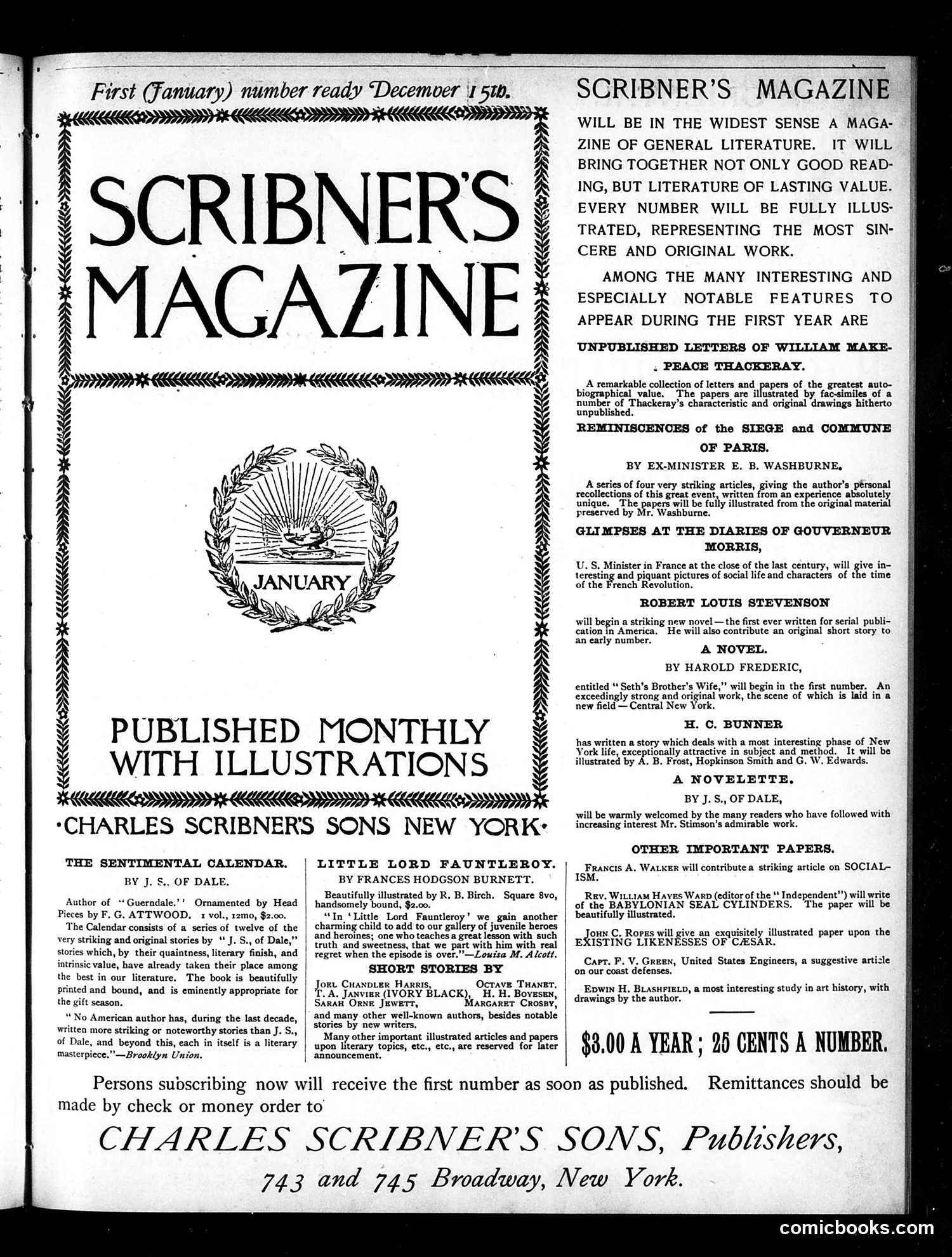
This is a title/advertisement page for **Scribner's Magazine**, announcing its inaugural January issue (ready December 15th). It's not a cartoon page but rather promotional material for a new literary publication. The page lists upcoming content to attract subscribers: unpublished letters from Victorian writer William Makepeace Thackeray; historical articles on the Paris Commune by a former U.S. minister; a serialized novel by Robert Louis Stevenson (author of *Treasure Island*); and works by popular contemporary authors like Frances Hodgson Burnett (*Little Lord Fauntleroy*). The appeal is to educated, affluent readers valuing "literature of lasting value" and fine illustration. At $3/year (25¢ per issue), this targeted the middle/upper-class market. The emphasis on "unpublished" historical materials and renowned authors signals this as a prestigious literary venture—a competitor to established magazines like *The Atlantic Monthly*.
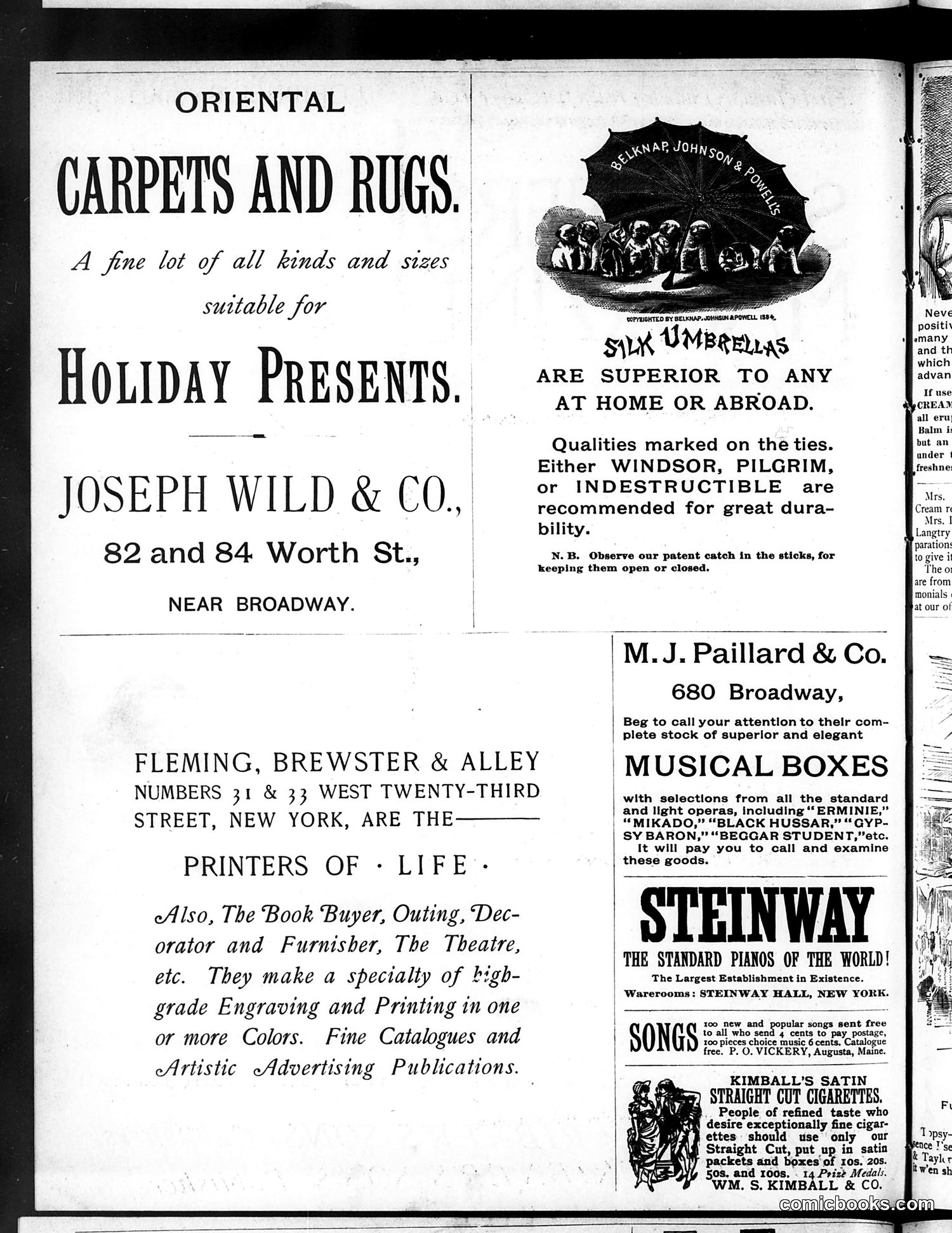
This is primarily a **advertising page** from Life magazine, not a satirical cartoon page. The page contains commercial advertisements for luxury goods suitable as holiday gifts: oriental carpets from Joseph Wild & Co., silk umbrellas (with a small illustration showing people under an umbrella), musical boxes from M.J. Paillard & Co., Steinway pianos, sheet music, and Kimball's cigarettes. There is also a **self-promotional advertisement** for Fleming, Brewster & Alley, identifying themselves as the printers of Life magazine itself, highlighting their engraving and printing services. The only visual element is a small **umbrella illustration** at top right, showing figures sheltering under a parasol—a straightforward product image rather than political satire. This page reflects Life's dual nature as both satirical publication and vehicle for upscale consumer advertising in the 19th century.
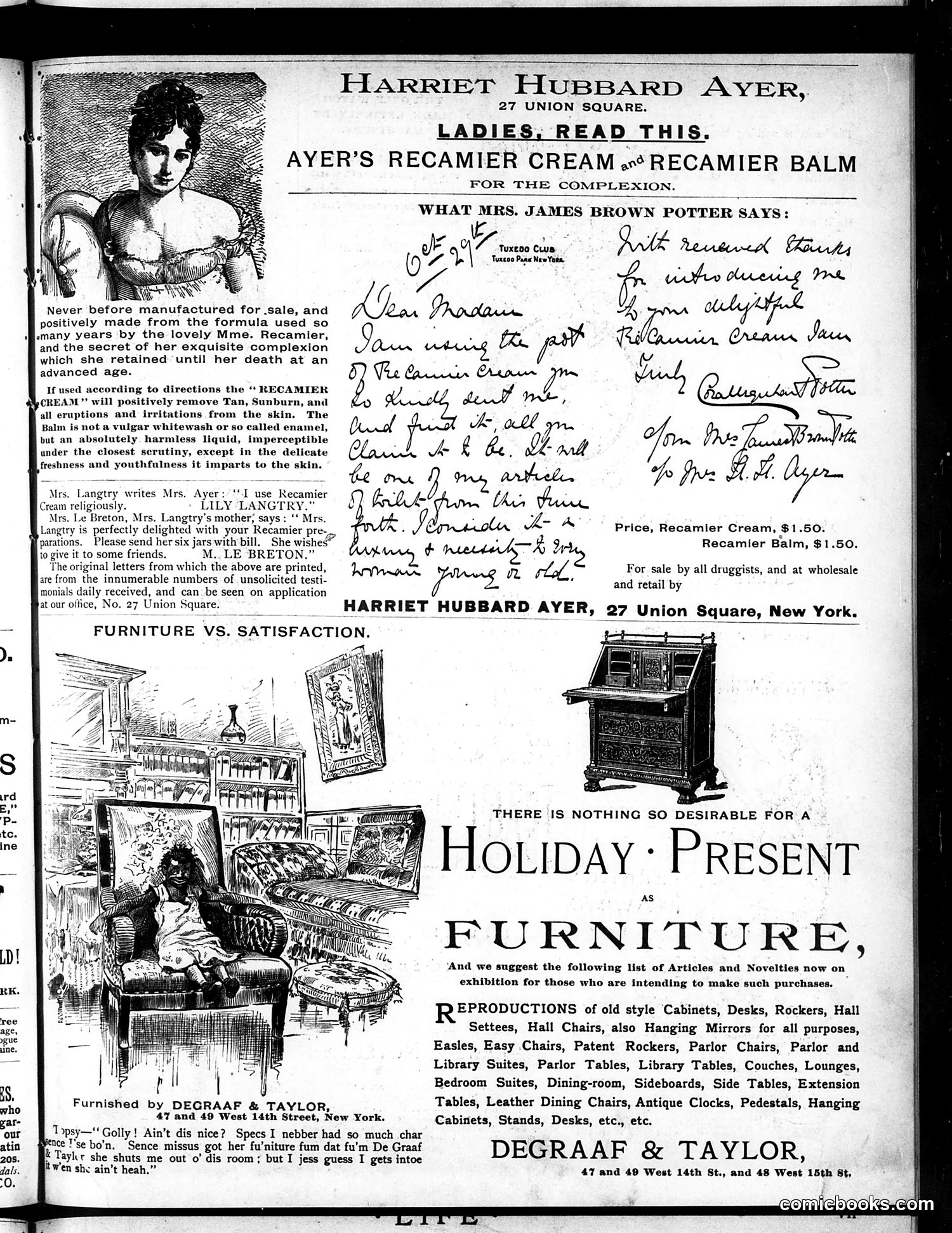
This page is primarily **advertising**, not satire or editorial content. It contains two main ads: 1. **Harriet Hubbard Ayer Cosmetics** (top): Promotes "Recamier Cream" and "Recamier Balm" for complexion care. It features endorsements from celebrity women, including Mrs. James Brown Potter and references to "Mrs. Langtry" (likely Lillie Langtry, a famous actress), lending prestige through association with society figures. 2. **DeGraaf & Taylor Furniture** (bottom): Advertises holiday furniture presents. The only satirical element is a small cartoon showing a Black child (in period dialect) admiring furniture, with the joke being she appreciates it more when the mistress isn't present—a crude racial stereotype typical of the era. The page reflects late-19th-century advertising strategies: celebrity endorsement and racist humor were considered acceptable promotional tools.
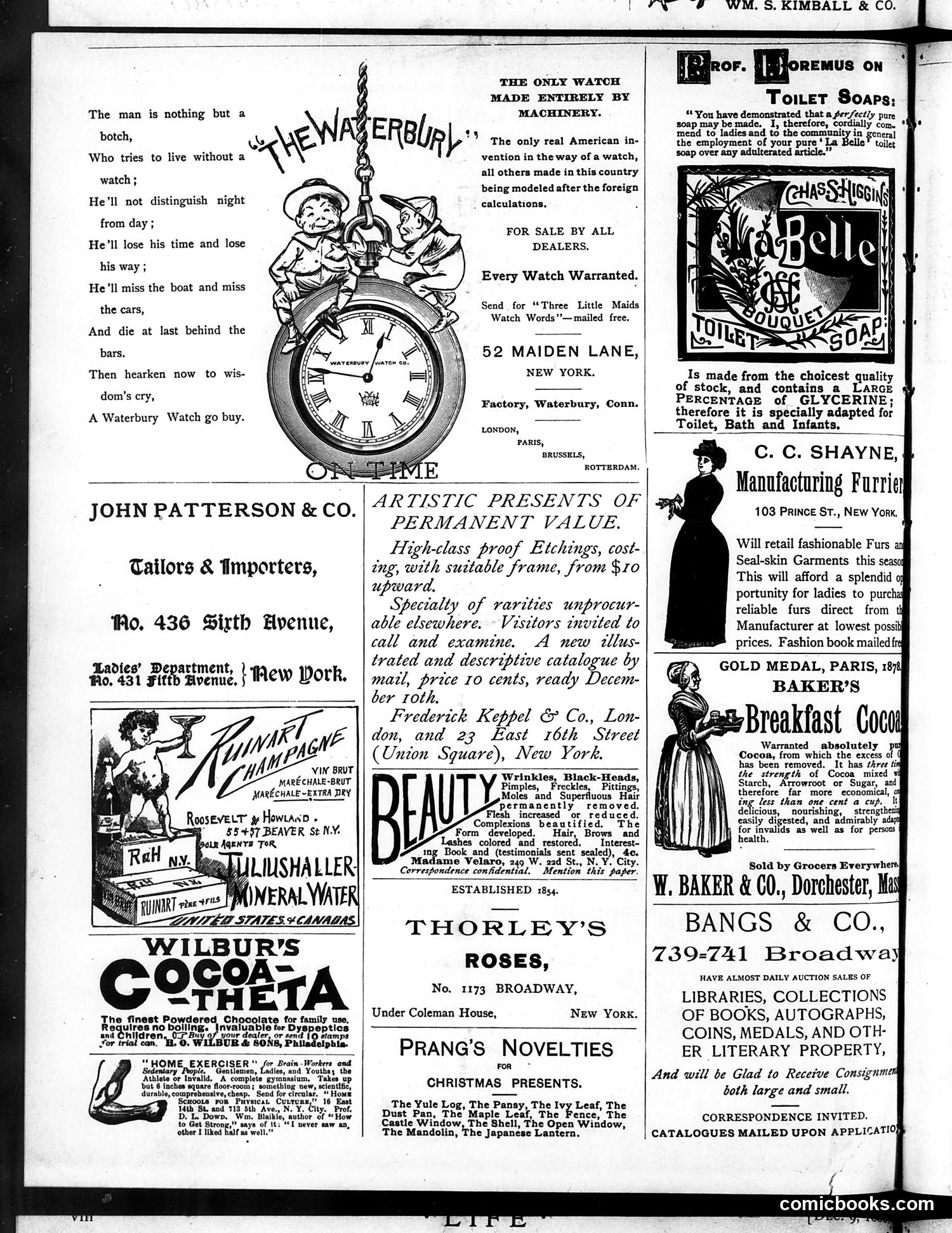
This page is primarily **advertisements** rather than political satire. The dominant feature is a large **Waterbury Watch ad** with an accompanying poem mocking men who lack timepieces—depicting them as incompetent failures who "miss the boat," "lose his way," and "die at last behind the bars." The satire here is **commercial rather than political**: it's a humorous exaggeration designed to sell watches by suggesting that owning one is essential to respectable masculine identity and success. The poem's overwrought language about time-keeping as a moral imperative is deliberately hyperbolic. The ad emphasizes that Waterbury watches are "the only real American invention" in watchmaking—a **nationalist marketing claim** playing on American manufacturing pride, contrasting domestic mass-produced watches against foreign competitors. The remainder of the page contains routine period advertisements for soap, cocoa, furs, tailoring, and other goods—typical of *Life* magazine's revenue model of combining satirical editorial content with paid advertising.
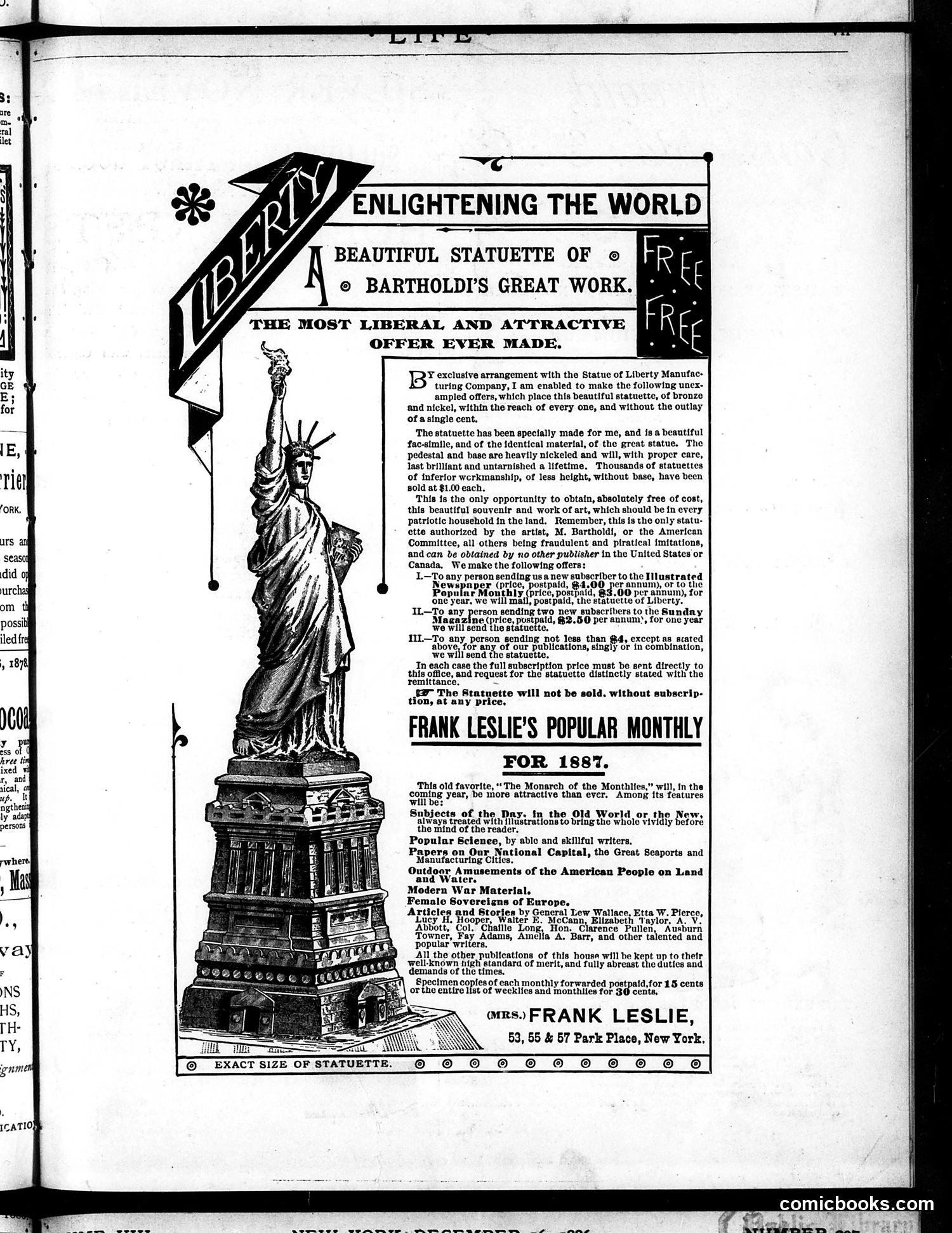
This is primarily **advertising, not political satire**. Frank Leslie's Popular Monthly magazine is offering a miniature bronze Statue of Liberty statuette as a free premium to new subscribers—a common 19th-century marketing tactic. The key appeal: subscribers could obtain this "beautiful souvenir" at no cost by subscribing to Leslie's publications. The ad emphasizes it's "the only statuette authorized by the artist, M. Bartholdi," distinguishing it from "fraudulent and piratical imitations" sold elsewhere. The subscription offers were tiered—new subscribers to the Illustrated Newspaper or Popular Monthly received the statuette; those subscribing to the Sunday Magazine could also get one. The Statue of Liberty was still relatively new (dedicated 1886), making Liberty merchandise timely and patriotically appealing. The ad targets "every patriotic household" to capitalize on nationalist sentiment. **This reflects Gilded Age publishing competition and mass-marketing innovation, not satire.**
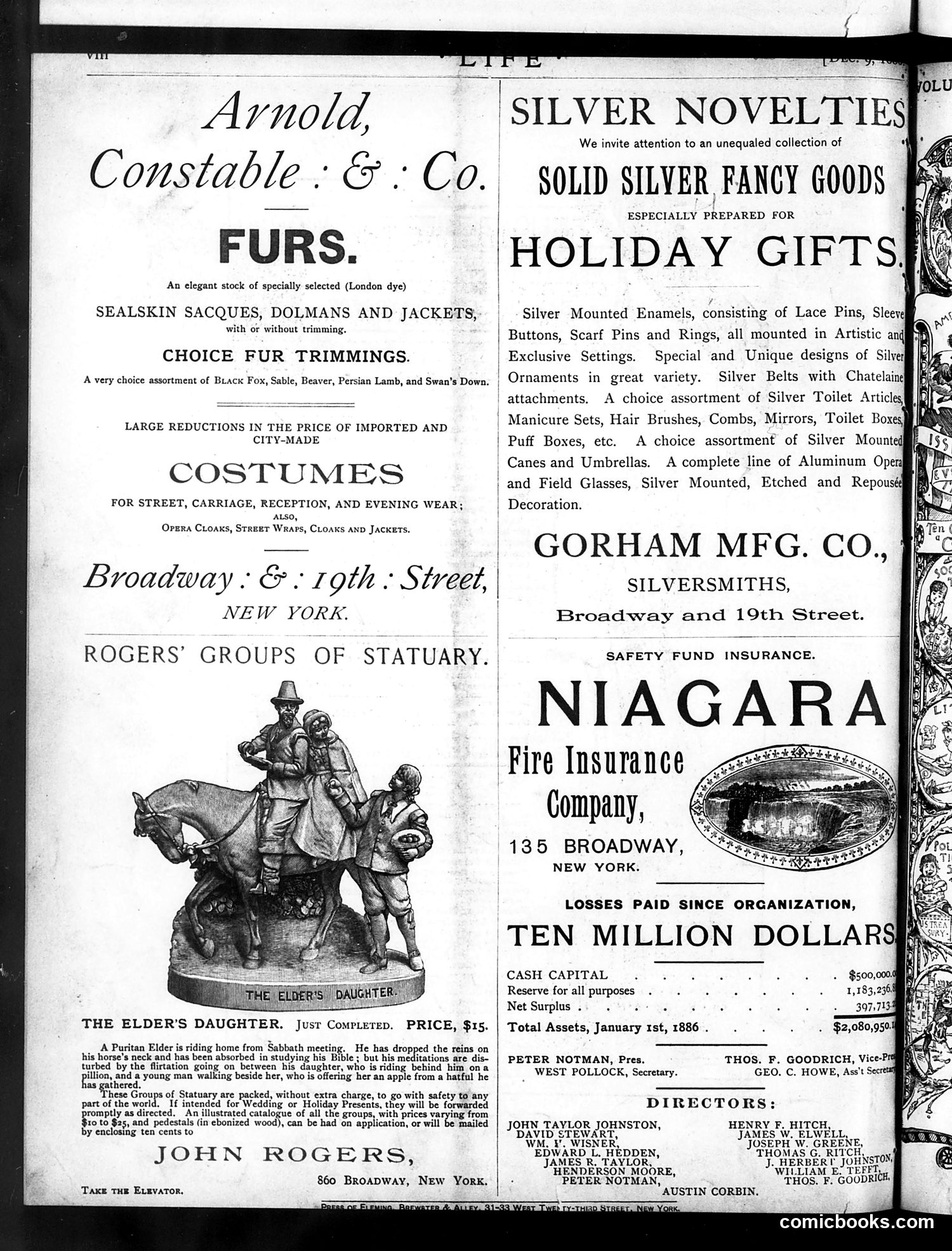
This page is primarily **advertising**, not satire or political commentary. The main content includes: **"The Elder's Daughter"** — A Rogers' Groups of Statuary piece (price $15). The sculpture depicts a Puritan Elder riding home from church, absorbed in Bible study, while his daughter flirts with a young man walking beside them who offers her an apple. This appears to reference the **temptation narrative** (Eve and the serpent/forbidden fruit), suggesting ironic commentary on Puritan strictness versus youthful desire and transgression. The sculpture plays on tension between religious piety and worldly temptation. The rest of the page contains standard late-19th-century luxury advertisements: fur garments, silver novelties, insurance companies, and high-end Broadway retailers—typical content for *Life* magazine's wealthy readership circa 1886.