
Life, 1886-12-09 · page 10 of 36
Life — December 9, 1886 — page 10: what you’re looking at
What you’re looking at
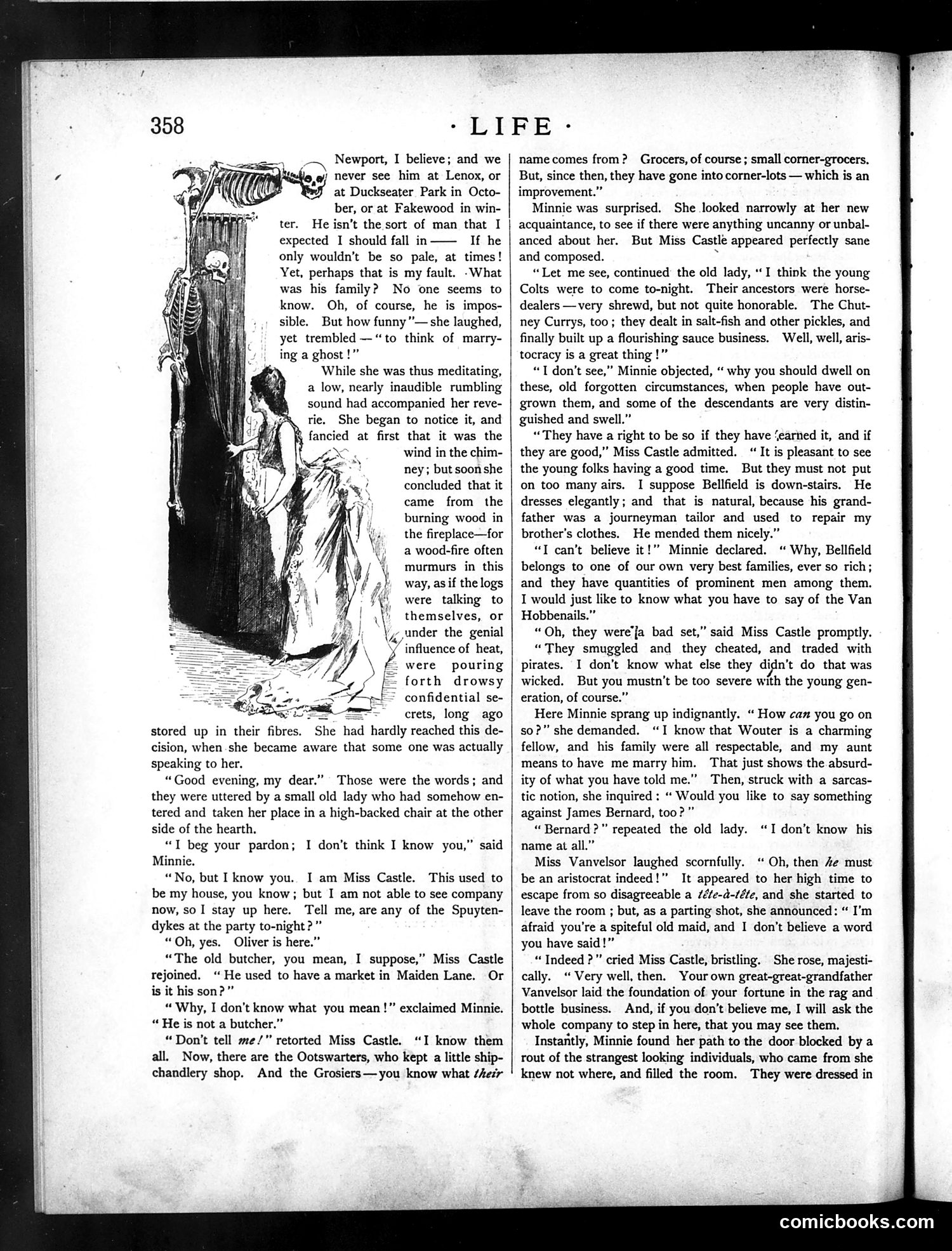
This page contains a fictional narrative dialogue rather than a political cartoon. The illustrated scene shows a woman in Victorian dress speaking with an older woman in a chair, suggesting a social encounter at a party. The text depicts a conversation about family lineage and social status. Miss Castle, apparently from an established family, questions Minnie about her acquaintances' backgrounds—specifically the "Colts," "Currys," and "Van Hobbernails." The dialogue satirizes Victorian-era class consciousness and snobbery, mocking how society obsessed over family pedigrees and respectability. Miss Castle dismisses new money and scandals in families' histories, while Minnie defends people who've "earned" respectability. The satire targets the rigid social hierarchies and arbitrary judgments based on ancestry rather than character.
📄 Transcribed text from this page (OCR, searchable)
Machine-transcribed from the original scan — historical spelling and the odd misread are preserved.
> LIFE: 3 Newport, I believe; and we ae es Slo, never see him at Lenox, or at Duckseater Park in Octo- ber, or at Fakewood in win- ter. He isn’t the sort of man that I expected I should fall in—— If he only wouldn’t be so pale, at times! Yet, perhaps that is my fault. -What was his family? No one seems to know. Oh, of course, he is impos- sible. But how funny ”— she laughed, yet trembled —“to think of marry- ing a ghost!” While she was thus meditating, a low, nearly inaudible rumbling sound had accompanied her reve- tie. She began to notice it, and fancied at first that it was the wind in the chim- ney; but soon she concluded that it came from the burning wood in the fireplace—for a wood-fire often murmurs in this way, as if the logs were talking to themselves, or -under the genial influence of heat, were pouring forth drowsy confidential se- crets, long ago stored up in their fibres. She had hardly reached this de- cision, when she became aware that some one was actually speaking to her. “Good evening, my dear.” Those were the words; and they were uttered by a small old lady who had somehow en- tered and taken her place in a high-backed chair at the other side of the hearth, “I beg your pardon; I don’t think I know you,” said Minnie. “No, but I know you. I am Miss Castle. This used to be my house, you know; but I am not able to see company now, sol stay up here. Tell me, are any of the Spuyten- dykes at the party to-night?” “Oh, yes. Oliver is here.” “The old butcher, you mean, I suppose,” Miss Castle rejoined. “He used to have a market in Maiden Lane. Or is it his son?” “Why, I don’t know what you mean!” exclaimed Minnie. “ He is not a butcher.” “Don't tell me/” retorted Miss Castle. “I know them all. Now, there are the Ootswarters, who kept a little ship- chandlery shop. And the Grosiers—you know what their namecomes from? Grocers, of course ; small corner-grocers. But, since then, they have gone into corner-lots — which is an improvement.” Minnie was surprised. She looked narrowly at her new acquaintance, to see if there were anything uncanny or unbal- anced about her. But Miss Castle appeared perfectly sane and composed. : “Let me see, continued’ the old lady, “I think the young Colts were to come to-night. Their ancestors were horse- dealers —very shrewd, but not quite honorable. The Chut- ney Currys, too; they dealt in salt-fish and other pickles, and finally built up a flourishing sauce business, Well, well, aris- tocracy is a great thing !”” “1 don’t see,” Minnie objected, “ why you should dwell on these, old forgotten circumstances, when people have out- grown them, and some of the descendants are very distin- guished and swell.” “They have a right to be so if they have ‘earned it, and if they are good,” Miss Castle admitted. “ It is pleasant to see the young folks having a good time. But they must not put on too many airs. I suppose Bellfield is down-stairs. He dresses elegantly; and that is natural, because his grand- father was a journeyman tailor and used to repair my brother's clothes. He mended them nicely.” “I can’t believe it!” Minnie declared. “ Why, Bellfield belongs to one of our own very best families, ever so rich; and they have quantities of prominent men among them. I would just like to know what you have to say of the Van Hobbenails.” “Oh, they were’[a bad set,” said Miss Castle promptly. “They smuggled and they cheated, and traded with pirates. I don’t know what else they didn’t do that was wicked. But you mustn’t be too severe with the young gen- eration, of course.” Here Minnie sprang up indignantly. “ How cam you go on so?” she demanded. “I know that Wouter is a charming fellow, and his family were all respectable, and my aunt means to have me marry him. That just shows the absurd- ity of what you have told me.” Then, struck with a sarcas- tic notion, she inquired : “ Would you like to say something against James Bernard, too?” “Bernard?” repeated the old lady. name at all.” Miss Vanvelsor laughed scornfully. ‘ Oh, then Ze must be an aristocrat indeed!” It appeared to her high time to escape from so disagreeable a /éte-d-téte, and she started to leave the room ; but, as a parting shot, she announced: “ I’m afraid you're a spiteful old maid, and I don’t believe a word you have said!” “Indeed ?” cried Miss Castle, bristling. She rose, majesti- cally. “ Very well, then. Your own great-great-grandfather Vanvelsor laid the foundation of your fortune in the rag and bottle business. And, if you don’t believe me, I will ask the whole company to step in here, that you may see them. Instantly, Minnie found her path to the door blocked by a rout of the strangest looking individuals, who came from she knew not where, and filled the room. They were dressed in “T don’t know his comicbooks.com