
Life, 1886-12-09 · page 9 of 36
Life — December 9, 1886 — page 9: what you’re looking at
What you’re looking at
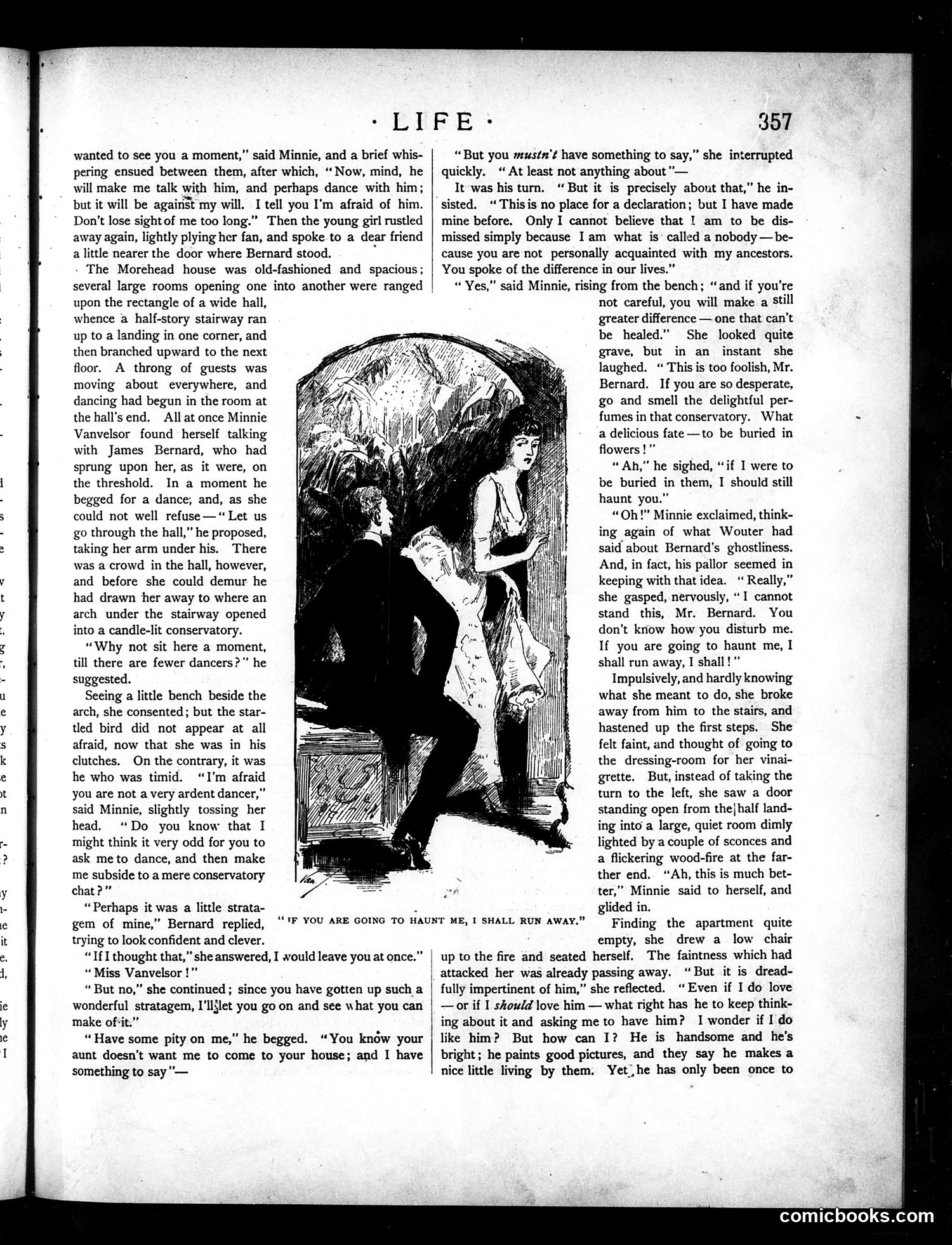
This page appears to be from a serialized fiction story in *Life* magazine, not a political cartoon. The illustrated scene shows a romantic or dramatic encounter between a man (Bernard) and a woman (Minnie) in what appears to be an elegant mansion, near a stairway and conservatory. The narrative depicts social tension around class differences and courtship propriety. Bernard, appearing to be a gentleman caller, is pressing Minnie regarding her feelings, while she expresses anxiety about their different social standings ("difference in our lives"). The scene captures a moment of romantic uncertainty typical of early 20th-century fiction serialized in such magazines. The illustration and accompanying dialogue focus on personal drama rather than political satire.
📄 Transcribed text from this page (OCR, searchable)
Machine-transcribed from the original scan — historical spelling and the odd misread are preserved.
ISRO: = wanted to see you a moment,” said Minnie, and a brief whis- pering ensued between them, after which, ‘Now, mind, he will make me talk with him, and perhaps dance with him; but it will be against my will. I tell you I'm afraid of him. Don’t lose sight of me too long.” Then the young girl rustled away again, lightly plying her fan, and spoke.to a dear friend a little nearer the door where Bernard stood. : The Morehead house was old-fashioned and spacious; several large rooms opening one into another were ranged | upon the rectangle of a wide hall, whence a half-story stairway ran up to a landing in one corner, and then branched upward to the next floor. A throng of guests was moving about everywhere, and dancing had begun in the room at the hall's end. All at once Minnie Vanvelsor found herself talking with James Bernard, who had sprung upon her, as it were, on the threshold. In a moment he begged for a dance, and, as she could not well refuse—“ Let us go through the hall,” he proposed, taking her arm under his. There was a crowd in the hall, however, and before she could demur he had drawn ther away to where an arch under the stairway opened into a candle-lit conservatory. “Why not sit here a moment, till there are fewer dancers?” he suggested. Seeing a little bench beside the arch, she consented ; but the star- tled bird did not appear at all afraid, now that she was in his clutches. On the contrary, it was he who was timid. “I’m afraid you are not a very ardent dancer,” said Minnie, slightly tossing her head. “Do you know that I might think it very odd for you to ask me to dance, and then make me subside to a mere conservatory chat?” “Perhaps it was a little strata- gem of mine,” Bernard replied, trying to look confident and clever. ‘(IF YOU ARE GOING TO HAUNT ME, I SHALL RUN AWAY.” 357 “But you mustn't have something to say,” she interrupted quickly. “At least not anything about ”— It was his turn. ‘But it is precisely about that,” he in- sisted. ‘Thisis no place for a declaration; but I have made mine before. Only I cannot believe that | am to be dis- missed simply because I am what is’ called a nobody —be- cause you are not personally acquainted with my ancestors. You spoke of the difference in our lives.” “Yes,” said Minnie, rising from the bench; “and if you're not careful, you will make a still greater difference — one that can’t be healed.” She looked quite grave, but in an instant she laughed. “ This is too foolish, Mr. Bernard. If you are so desperate, go and smell the delightful per- fumes in that conservatory. What a delicious fate—to be buried in flowers!” “Ah,” he sighed, “if I were to be buried in them, I should still haunt you.” “Oh!” Minnie exclaimed, think- ing again of what Wouter had said about Bernard's ghostliness. And, in fact, his pallor seemed in keeping with that idea. “Really,” she gasped, nervously, “I cannot. stand this, Mr. Bernard. You don’t know how you disturb me. If you are going to haunt me, I shall run away, I shall!” Impulsively, and hardly knowing what she meant to do, she broke away from him to the stairs, and hastened up the first steps. She felt faint, and thought of going to the dressing-room for her vinai- grette. But, instead of taking the turn to the left, she saw a door standing open from thejhalf land- ing into a large, quiet room dimly lighted by a couple of sconces and a flickering wood-fire at the far- ther end. “Ah, this is much bet- ter,” Minnie said to herself, and glided in. Finding the apartment quite empty, she drew a low chair “IfI thought that,” she answered, I would leave you at once.” | up to the fire and seated herself. The faintness which had “Miss Vanvelsor !” “ But no,” she continued ; since you have gotten up such a wonderful stratagem, I’lljlet you go on and see what you can make oftit.” “Have some pity on me,” he begged. “You know your aunt doesn’t want me to come to your house; and I have something to say ”— |, attacked her was already passing away. “But it is dread- fully impertinent of him,” she reflected. “Even if I do love —or if I should love him — what right has he to keep think- ing about it and asking me to have him? I wonder if I do like him? But how can I? He is handsome and he’s bright; he paints good pictures, and they say he makes a nice little living by them. Yet.,he has only been once to comicbooks.com