
Life, 1886-12-09 · page 16 of 36
Life — December 9, 1886 — page 16: what you’re looking at
What you’re looking at
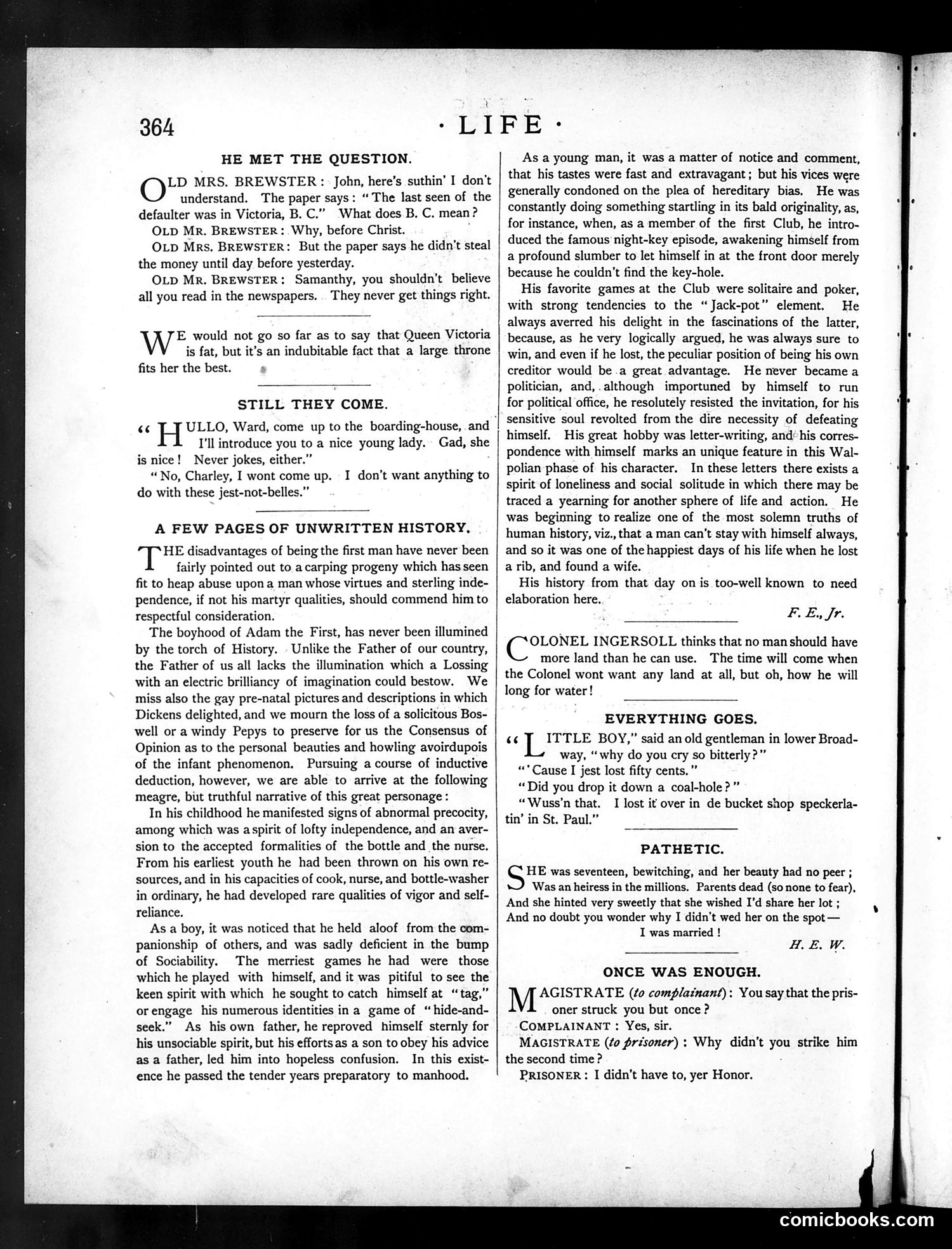
This page collects short humorous sketches typical of Life's satirical format: **"He Met the Question"**: A joke about newspaper abbreviations. Old Mr. Brewster misinterprets "B.C." (British Columbia) as "Before Christ," creating absurdity when his wife notes the defaulter only fled recently. **"Still They Come"**: A brief social satire about courting, where a man avoids meeting a woman described as someone "who never jokes"—suggesting the period valued wit and personality in potential partners. **"A Few Pages of Unwritten History"**: The main feature, a mock-serious essay about "Adam the First" (humanity's ancestor). It satirizes both historical hagiography and phrenology (the pseudoscience of skull bumps determining personality). The piece humorously describes Adam's solitary childhood, social awkwardness, and peculiar adult behavior—all presented in inflated, pseudo-scholarly language that parodies both history-writing and 19th-century pseudo-science. The humor relies on readers recognizing overwrought historical rhetoric and the absurdity of applying modern social commentary to biblical prehistory.
📄 Transcribed text from this page (OCR, searchable)
Machine-transcribed from the original scan — historical spelling and the odd misread are preserved.
364 HE MET THE QUESTION. OF MRS. BREWSTER: John, here’s suthin’ 1 don't understand. The paper says: “The last seen of the defaulter was in Victoria, B.C.” What does B. C. mean? OLD Mr. BREWSTER: Why, before Christ. OLD Mrs. BREWSTER: But the paper says he didn’t steal the money until day before yesterday. OLD MR. BREWSTER: Samanthy, you shouldn’t believe all you read in the newspapers. They never get things right. E would not go so far as to say that Queen Victoria is fat, but it’s an indubitable fact that a large throne fits her the best. STILL THEY COME. “ ULLO, Ward, come up to the boarding-house, and I'll introduce you to a nice young lady. Gad, she is nice! Never jokes, either.” “No, Charley, I wont come up. do with these jest-not-belles.”” I don’t want anything to A FEW PAGES OF UNWRITTEN HISTORY, "Ta disadvantages of being the first man have never been fairly pointed out to acarping progeny which has seen fit to heap abuse upon a man whose virtues and sterling inde- pendence, if not his martyr qualities, should commend him to respectful consideration. The boyhood of Adam the First, has never been illumined by the torch of History. Unlike the Father of our country, the Father of us all lacks the illumination which a Lossing with an electric brilliancy of imagination could bestow. We miss also the gay pre-natal pictures and descriptions in which Dickens delighted, and we mourn the loss of a solicitous Bos- well or a windy Pepys to preserve for us the Consensus of Opinion as to the personal beauties and howling avoirdupois of the infant phenomenon. Pursuing a course of inductive deduction, however, we are able to arrive at the following meagre, bit truthful narrative of this great personage : In his childhood he manifested signs of abnormal precocity, among which was aspirit of lofty independence, and an aver- sion to the accepted formalities of the bottle and the nurse. From his earliest youth he had been thrown on his own re- sources, and in his capacities of cook, nurse, and bottle-washer in ordinary, he had developed rare qualities of vigor and self- reliance. As a boy, it was noticed that he held aloof from the com- panionship of others, and was sadly deficient in the bump of Sociability. The merriest games he had were those which he played with himself, and it was pitiful to see the keen spirit with which he sought to catch himself at “tag,” or engage his numerous identities ina game of “hide-and- seek.” As his own father, he reproved himself sternly for his unsociable spirit, but his effortsas a son to obey his advice as a father, led him into hopeless confusion. In this exist- ence he passed the tender years preparatory to manhood. EIFE - As a young man, it was a matter of notice and comment, that his tastes were fast and extravagant; but his vices were generally condoned on the plea of hereditary bias. He was constantly doing something startling in its bald originality, as, for instance, when, as a member of the first Club, he intro- duced the famous night-key episode, awakening himself from a profound slumber to let himself in at the front door merely because he couldn’t find the key-hole. His favorite games at the Club were solitaire and poker, with strong tendencies to the “Jack-pot” element. He always averred his delight in the fascinations of the latter, because, as he very logically argued, he was always sure to win, and even if he lost, the peculiar position of being his own creditor would be .a great advantage. He never became a politician, and,.although importuned by himself to run for political office, he resolutely resisted the invitation, for his sensitive soul revolted from the dire necessity of defeating himself. His great hobby was letter-writing, and’ his corres- pondence with himself marks an unique feature in this Wal- polian phase of his character. In these letters there exists a spirit of loneliness and social solitude in which there may be traced a yearning for another sphere of life and action. He was beginning to realize one of the most solemn truths of human history, viz., that a man can’t stay with himself always, and so it was one of the happiest days of his life when he lost a rib, and found a wife. His history from that day on is too-well known to need elaboration here. F.E, Jr. OLONEL INGERSOLL thinks that no man should have more land than he can use. The time will come when the Colonel wont want any land at all, but oh, how he will long for water! EVERYTHING GOES. ““ ITTLE BOY,” said an old gentleman in lower Broad- way, “why do you cry so bitterly?” “* Cause I jest lost fifty cents.” “Did you drop it down a coal-hole?” “Wuss’n that. I lost it over in de bucket shop speckerla- tin’ in St. Paul.” PATHETIC. HE was seventeen, bewitching, and her beauty had no peer ; Was an heiress in the millions. Parents dead (so none to fear), And she hinted very sweetly that she wished I'd share her lot ; And no doubt you wonder why I didn’t wed her on the spot — I was married ! HE. W. ONCE WAS ENOUGH. AGISTRATE (¢o complainant): You say that the pris- oner struck you but once ? COMPLAINANT : Yes, sir. MAGISTRATE (¢o prisoner) : Why didn’t you strike him the second time ? PRISONER: I didn’t have to, yer Honor. ; comicbooks.com