
Life, 1886-12-09 · page 12 of 36
Life — December 9, 1886 — page 12: what you’re looking at
What you’re looking at
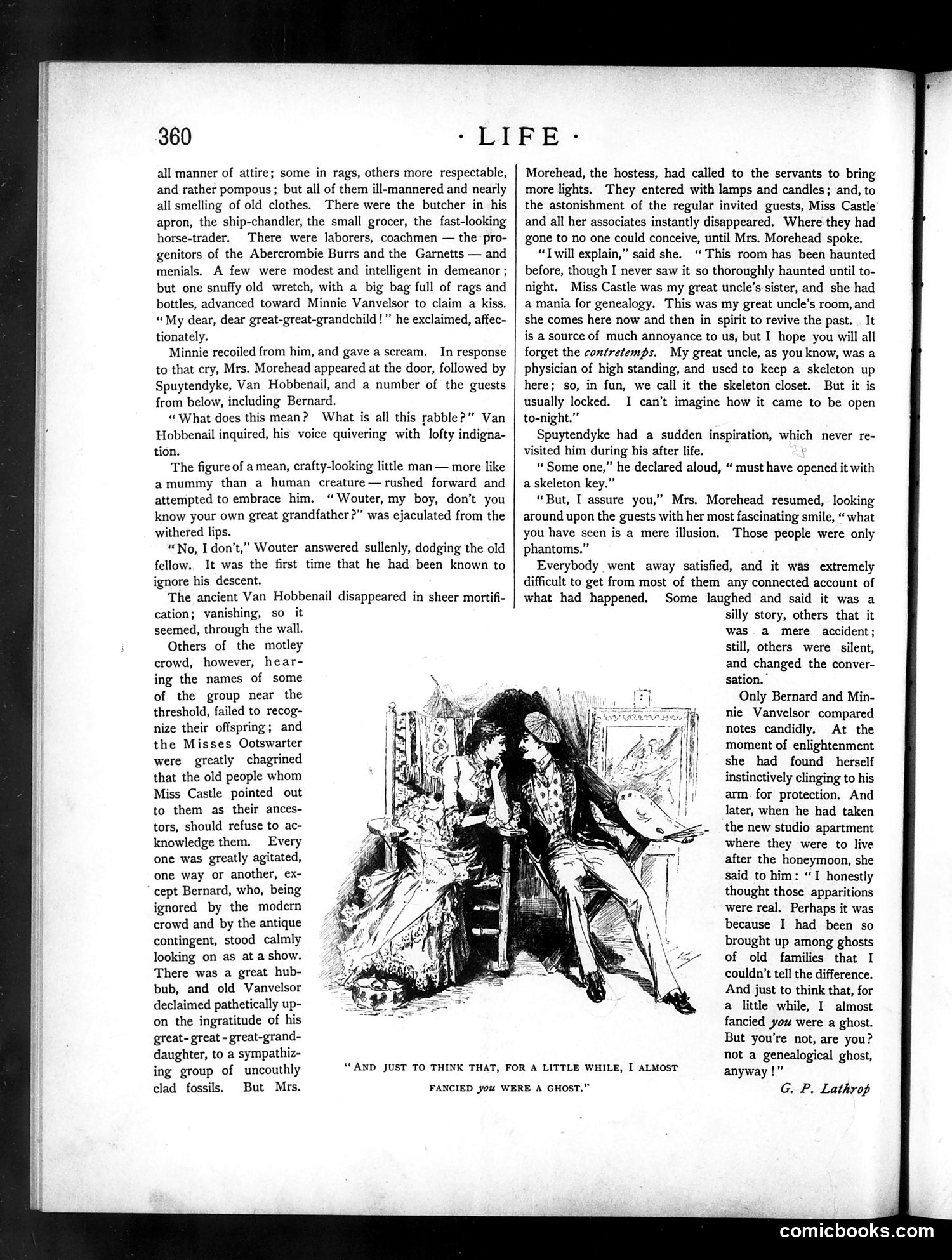
This page contains a narrative fiction piece with an embedded illustration, not a political cartoon. The story satirizes American class pretensions and genealogical snobbery. The plot involves a séance-like supernatural episode where ancestral ghosts—working-class figures (butchers, laborers, coachmen)—appear to wealthy descendants who had claimed refined ancestry. The aristocratic Van Hobbenail family recoils in mortification, refusing to acknowledge their humble forebears. **The satire's point**: The story mocks the American upper class's obsession with genealogy and respectability while their actual ancestors were common laborers and tradespeople. When confronted with their true origins, the modern "refined" descendants deny them—highlighting the hypocrisy of class-consciousness based on fabricated or forgotten ancestry. The resolution—Mrs. Morehead dismisses the apparitions as "phantoms" and an optical illusion—satirizes how the wealthy rationalize away inconvenient truths about their origins. The illustration shows an elderly ghostly figure attempting to embrace a horrified young aristocrat, dramatizing this clash between pretension and genealogical reality.
📄 Transcribed text from this page (OCR, searchable)
Machine-transcribed from the original scan — historical spelling and the odd misread are preserved.
360 all manner of attire; some in rags, others more respectable, and rather pompous ; but all of them ill-mannered and nearly all smelling of old clothes. There were the butcher in his apron, the ship-chandler, the small grocer, the fast-looking horse-trader. There were laborers, coachmen — the :pro- genitors of the Abercrombie Burrs and the Garnetts — and menials. A few were modest and intelligent in demeanor ; but one snuffy old wretch, with a big bag full of rags and bottles, advanced toward Minnie Vanvelsor to claim a kiss. “My dear, dear great-great-grandchild!” he exclaimed, affec- tionately. Minnie recoiled from him, and gave a scream. In response to that cry, Mrs. Morehead appeared at the door, followed by Spuytendyke, Van Hobbenail, and a number of the guests from below, including Bernard. “What does this mean? What is all this rabble?” Van Hobbenail inquired, his voice quivering with lofty indigna- tion. The figure of a mean, crafty-looking little man — more like amummy than a human creature—rushed forward and attempted to embrace him. “Wouter, my boy, don’t you know your own great grandfather?” was ejaculated from the withered lips. "No, I don’t,” Wouter answered sullenly, dodging the old fellow.. It was the first time that he had been known to ignore his descent. The ancient Van Hobbenail disappeared in sheer mortifi- cation; vanishing, so it seemed, through the wall. Others of the motley crowd, however, hear- ing the names of some of the group near the threshold, failed to recog- nize their offspring; and the Misses Ootswarter were greatly chagrined that the old people whom Miss Castle pointed out to them as their ances- tors, should refuse to ac- knowledge them. Every one was greatly agitated, one way or another, ex- cept Bernard, who, being ignored by the modern crowd and by the antique contingent, stood calmly looking on as at a show. There was a great hub- bub, and old Vanvelsor declaimed pathetically up- on the ingratitude of his great-great - great-grand- daughter, to a sympathiz- - LIFE: Morehead, the hostess, had called to the servants to bring more lights. They entered with lamps and candles; and, to the astonishment of the regular invited guests, Miss Castle and all her associates instantly disappeared. Where they had gone to no one could conceive, until Mrs. Morehead spoke. “Twill explain,” said she. “This room has been haunted before, though I never saw it so thoroughly haunted until to- night. Miss Castle was my great uncle’s:sister, and she had a mania for genealogy. This was my great uncle’s room, and she comes here now and then in spirit to revive the past. It is a source of much annoyance to us, but I hope you will all forget the contretemps. My great uncle, as you know, was a physician of high standing, and used to keep a skeleton up here; so, in fun, we call it the skeleton closet. But it is usually locked. I can’t imagine how it came to be open to-night.” Spuytendyke had a sudden inspiration, which never re- visited him during his after life. “ Some one,” he declared aloud, “ must have opened it with a skeleton key.” “But, I assure you,” Mrs, Morehead resumed, looking around upon the guests with her most fascinating smile, “ what you have seen is a mere illusion. Those people were only phantoms.” Everybody went away satisfied, and it was extremely difficult to get from most of them any connected account of what had happened. Some laughed and said it was a silly story, others that it was a mere accident; still, others were silent, and changed the conver- sation. Only Bernard and Min- nie Vanvelsor compared notes candidly. At the moment of enlightenment she had found herself instinctively clinging to his arm. for protection. And later, when he had taken the new studio apartment where they were to live after the honeymoon, she said to him: “I honestly thought those apparitions were real. Perhaps it was because I had been so brought up among ghosts of old families that I couldn’t tell the difference. And just to think that, for a little while, I almost fancied you were a ghost. But you're not, are you? not a genealogical ghost, ing group of uncouthly clad fossils. But Mrs. ““AND JUST TO THINK THAT, FOR A LITTLE WHILE, I ALMOST FANCIED you WERE A GHOST.” anyway !” G. P. Lathrop comicbooks.com