
A complete issue · 16 pages · 1884
Life — November 13, 1884
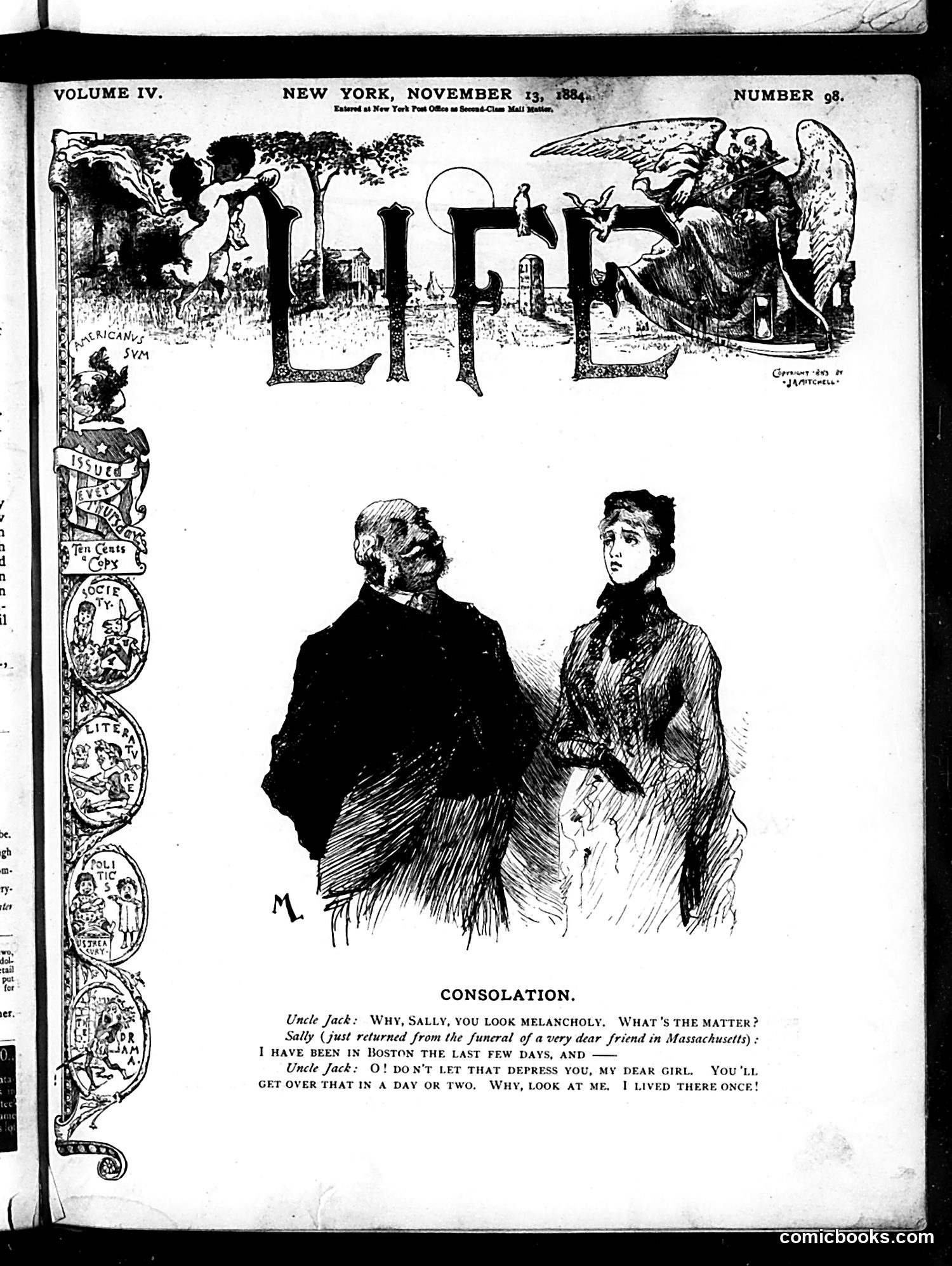
This page contains a single comic sketch titled "Consolation," depicting an older man (labeled "Uncle Jack") comforting a young woman named Sally who has recently returned from a funeral in Boston. Sally is melancholy over the death of "a very dear friend in Massachusetts." Uncle Jack attempts to cheer her by sharing his own experience of loss—he claims to have once lived in Boston and lost someone dear, yet recovered within "a day or two." The humor appears to derive from the era's social convention of mourning periods and the somewhat callous suggestion that grief should be quickly overcome. The sketch likely satirizes either sentimentality about loss or Boston's reputation during this period, though the specific reference remains unclear without additional historical context.
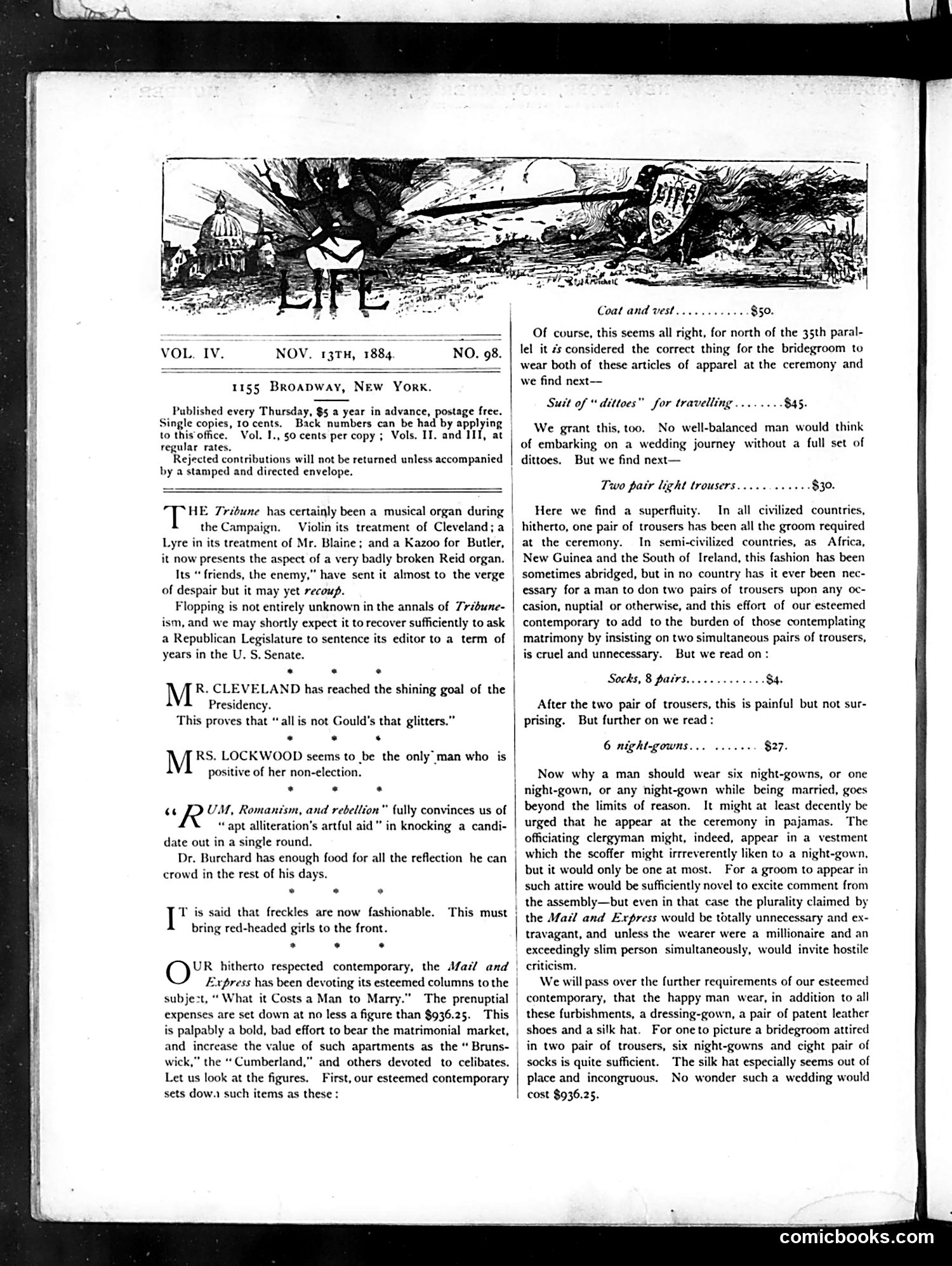
The cartoon depicts a figure sitting amid wreckage labeled with political references. Based on the text, this appears to satirize the **Tribune newspaper's decline** during the Cleveland presidential campaign. The magazine notes the Tribune has become "a very badly broken Reed organ"—a pun referencing both the musical instrument and likely **James A. Reed**, a political figure. The text discusses Cleveland reaching the presidency and criticizes the Tribune's editorial positions on contemporary issues. The surrounding wreckage suggests the publication's credibility was damaged by its coverage or stance during the 1884 election campaign. The accompanying fashion commentary about wedding attire appears unrelated to the political satire—typical of Life's mixed content format.
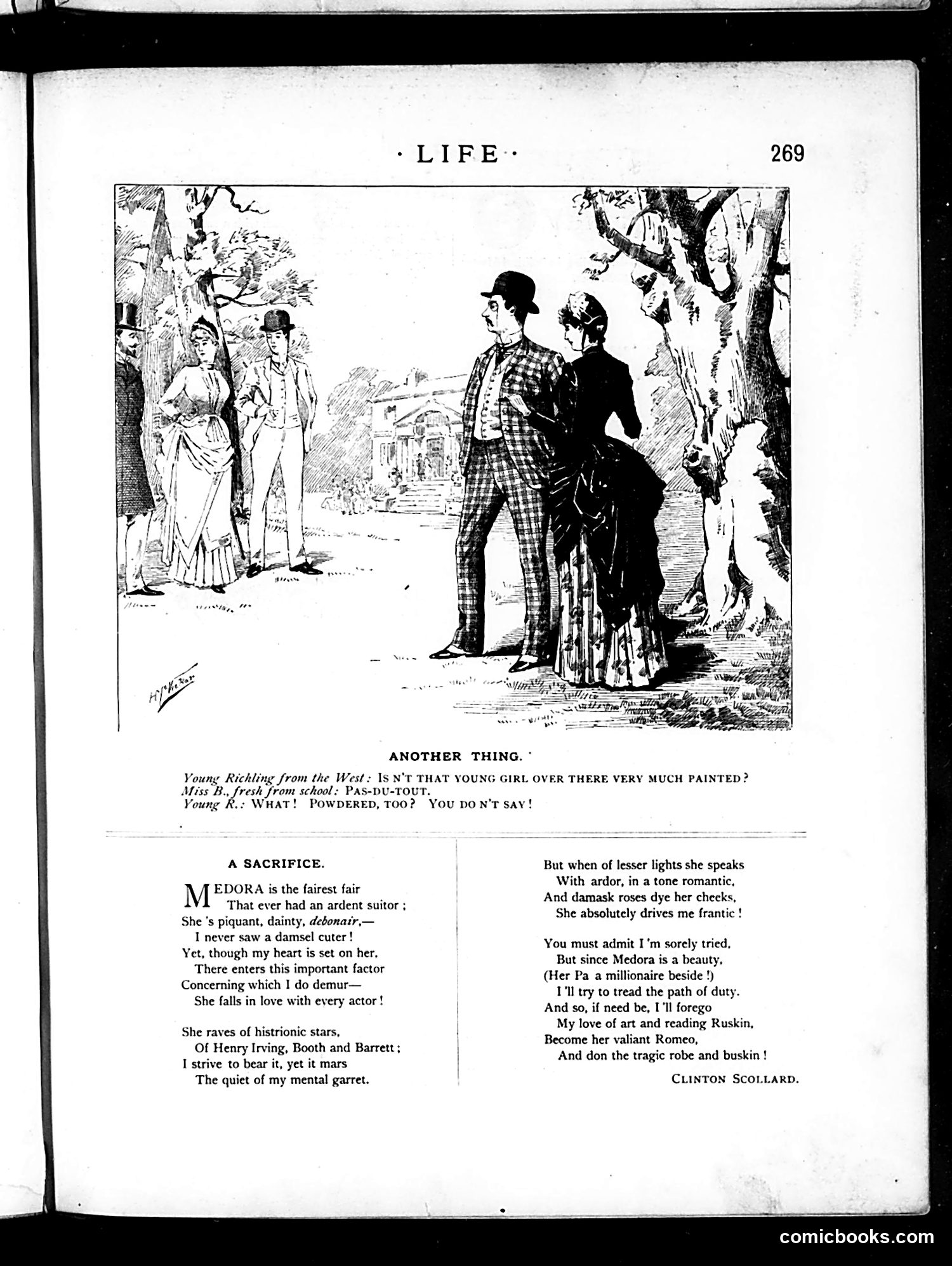
**The Cartoon "Another Thing":** This social satire depicts a young wealthy man from the West encountering a schoolgirl (Miss B.) who appears heavily made-up or "painted." His companion expresses shock at her appearance, asking if she's "powdered, too." The joke satirizes the cosmetics and fashion practices of young women, particularly the contrast between rural/Western innocence and urban sophistication. The cartoon mocks both the excessive use of makeup by fashionable young women and the disapproving attitudes of observers. **"A Sacrifice" Poem:** A romantic verse by Clinton Scollard about a suitor named Medora who must choose between love and his artistic ambitions (referencing actors Henry Irving, Booth, and Barrett). The poem is sentimental Victorian-era verse typical of Life's literary content.
This page contains satirical commentary and fables rather than political cartoons. Key content includes: **"The Brilliant Raccoon"** fable mocks presidential candidates, suggesting it's difficult to elect someone who simultaneously represents fifteen different political parties—satirizing candidates' tendency to take contradictory positions to appeal to various constituencies. **"The Gifted Rabbit"** fable warns against attempting quick fixes (immersing problems in tar) that create worse situations—likely social commentary on poorly conceived solutions to public problems. **"A Broken Silence Which Is Not Golden"** criticizes Samuel K. Cowan's song collection, lamenting that certain sentimental poetry was excluded, with quoted verse expressing romantic sentiment. The page's humor relies on fables and literary critique rather than visual caricature, reflecting Life's satirical approach to contemporary politics and culture.
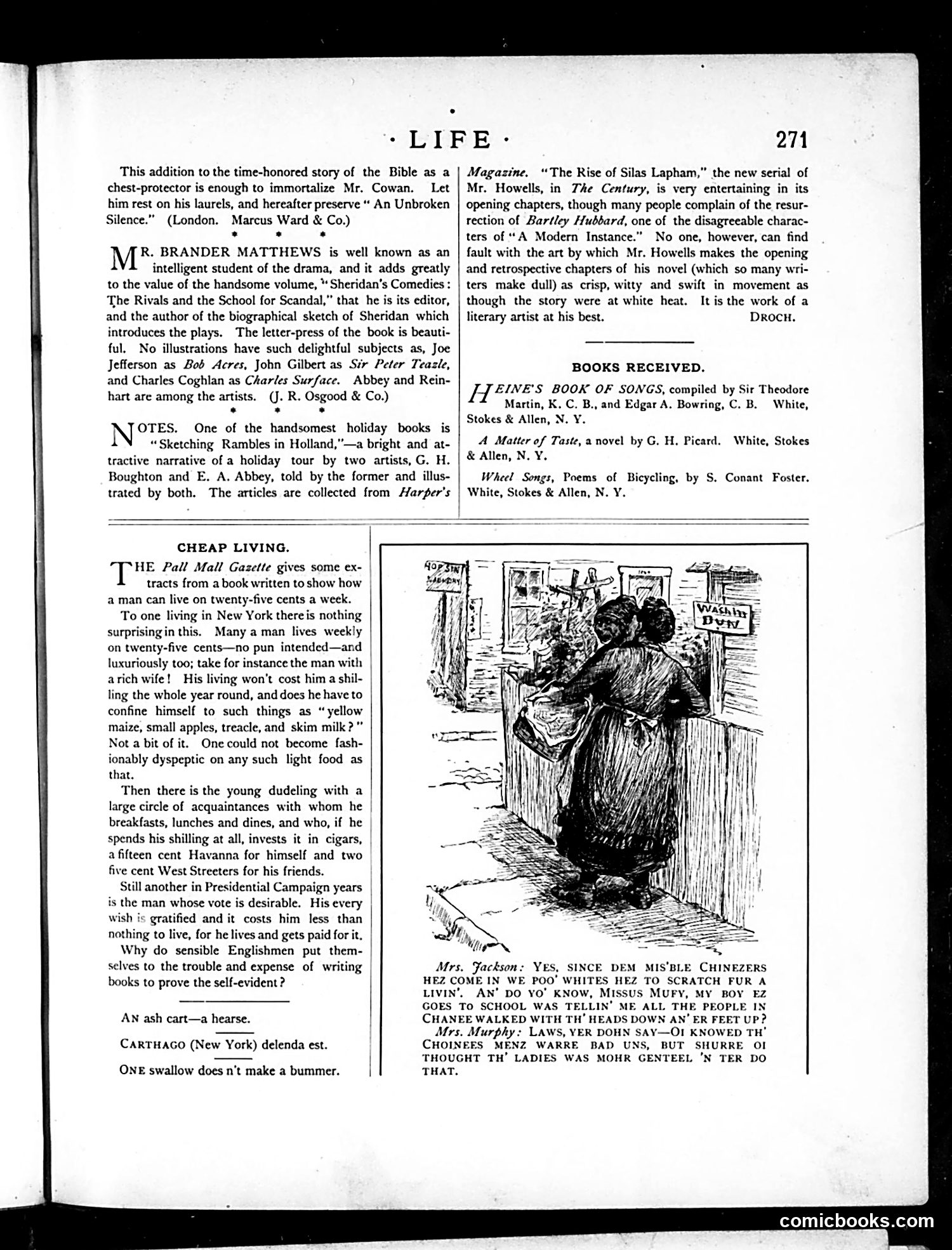
The main cartoon depicts **Mrs. Jackson** and **Mrs. Murphy**, working-class women discussing domestic life and their husbands' behavior. The dialogue—rendered in heavy dialect—concerns how men spend money frivolously on cigars and entertainment while expecting wives to manage households on minimal budgets. The satire targets **class economics and gender relations**: wealthy men enjoy luxuries while working-class wives must stretch pennies for food ("yellow maize, small apples, treacle, and skim milk"). The cartoon critiques the hypocrisy of men demanding thrift from wives while indulging themselves. The surrounding text on "Cheap Living" reinforces this theme, listing absurdly minimal weekly budgets (25 cents) that contrast sharply with men's wasteful spending habits—a commentary on economic inequality and domestic power dynamics in early 20th-century America.
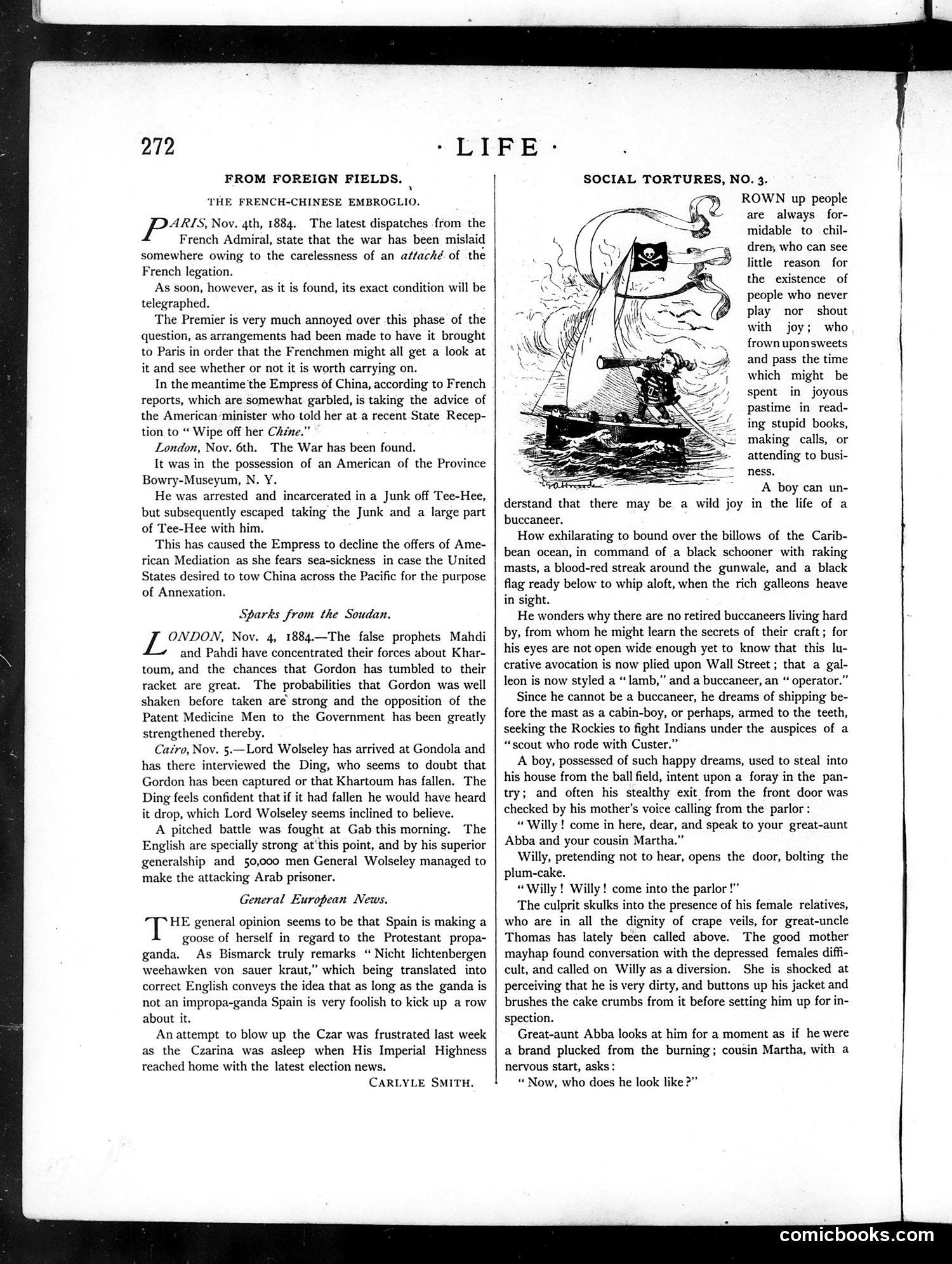
This page contains news items and a satirical illustration titled "Social Tortures, No. 3" depicting a child flying a pirate flag from a window or rooftop. The cartoon satirizes childhood misbehavior—specifically a boy sneaking stolen plum-cake into his house despite his mother's calls. The accompanying text humorously describes how children fantasize about adventure (becoming "buccaneers" sailing pirate ships) while engaging in petty household theft. The pirate flag transforms mundane domestic transgression into mock-heroic adventure. The joke targets both children's overactive imaginations and parents' frustrations with youthful misconduct. The satire gently mocks how ordinary childhood disobedience becomes thrilling in children's minds. The page's left column contains foreign news dispatches about Franco-Chinese conflict and British colonial matters in Sudan.
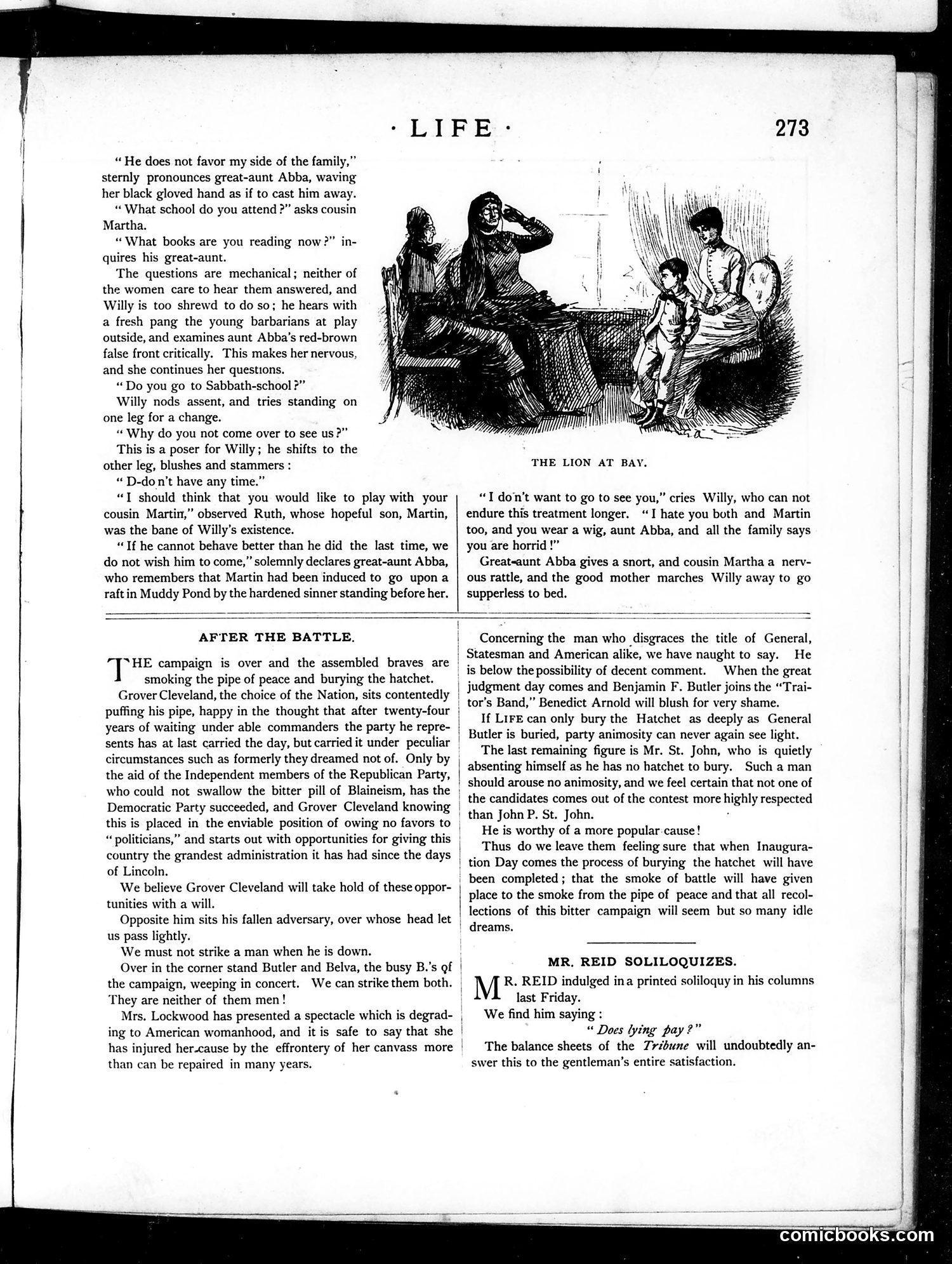
This illustration depicts a domestic conflict between **great-aunt Abba** and her young nephew **Willy**, with **cousin Martha** also present. Willy resists visiting his relatives, particularly objecting to great-aunt Abba's authority and her criticism of his family. He claims to "hate" both Abba and Martin, accusing them of wearing wigs and being "horrid." The "lion at bay" metaphor refers to Willy's defiant stance against adult relatives' control. The cartoon satirizes the tension between Victorian family hierarchies and children's growing resistance to elder authority. The social commentary critiques rigid familial power structures where aunts wielded significant domestic control, shown here as increasingly ineffective against youthful rebellion.
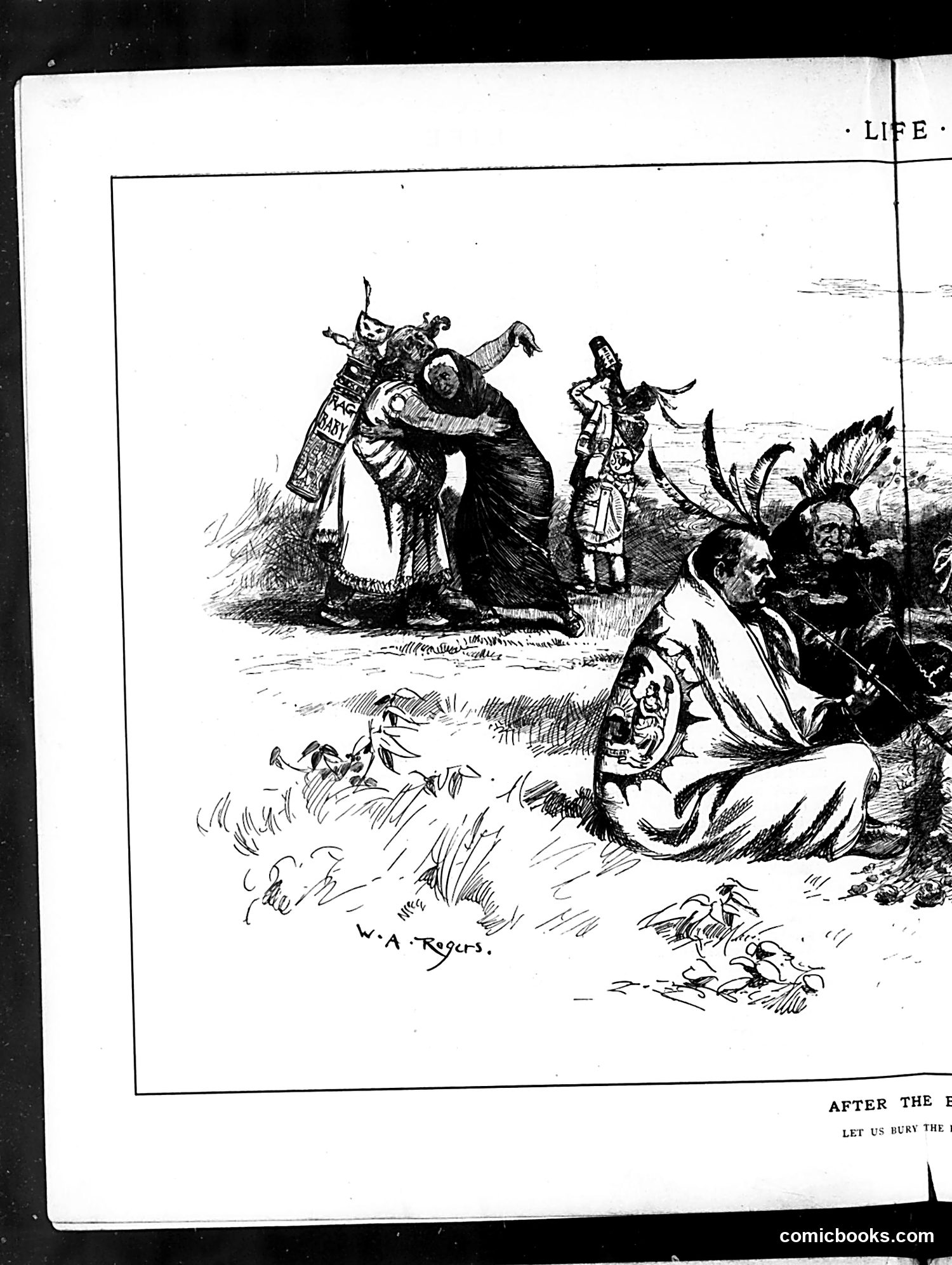
This W.A. Rogers cartoon appears to depict a funeral or burial scene with military and political figures. The central figure—a tall person in dark clothing carrying or presenting what looks like a coffin or official document marked "ARMY"—is surrounded by soldiers in various uniforms and indigenous peoples. The partially visible caption reads "AFTER THE B[ATTLE]" and "LET US BURY THE [?]", suggesting this addresses post-conflict consequences or responsibilities. Without the complete caption or publication date visible, the specific political situation remains unclear. However, the composition suggests satire about military affairs, possibly commenting on how political figures handle (or fail to handle) obligations following military conflict or casualties.
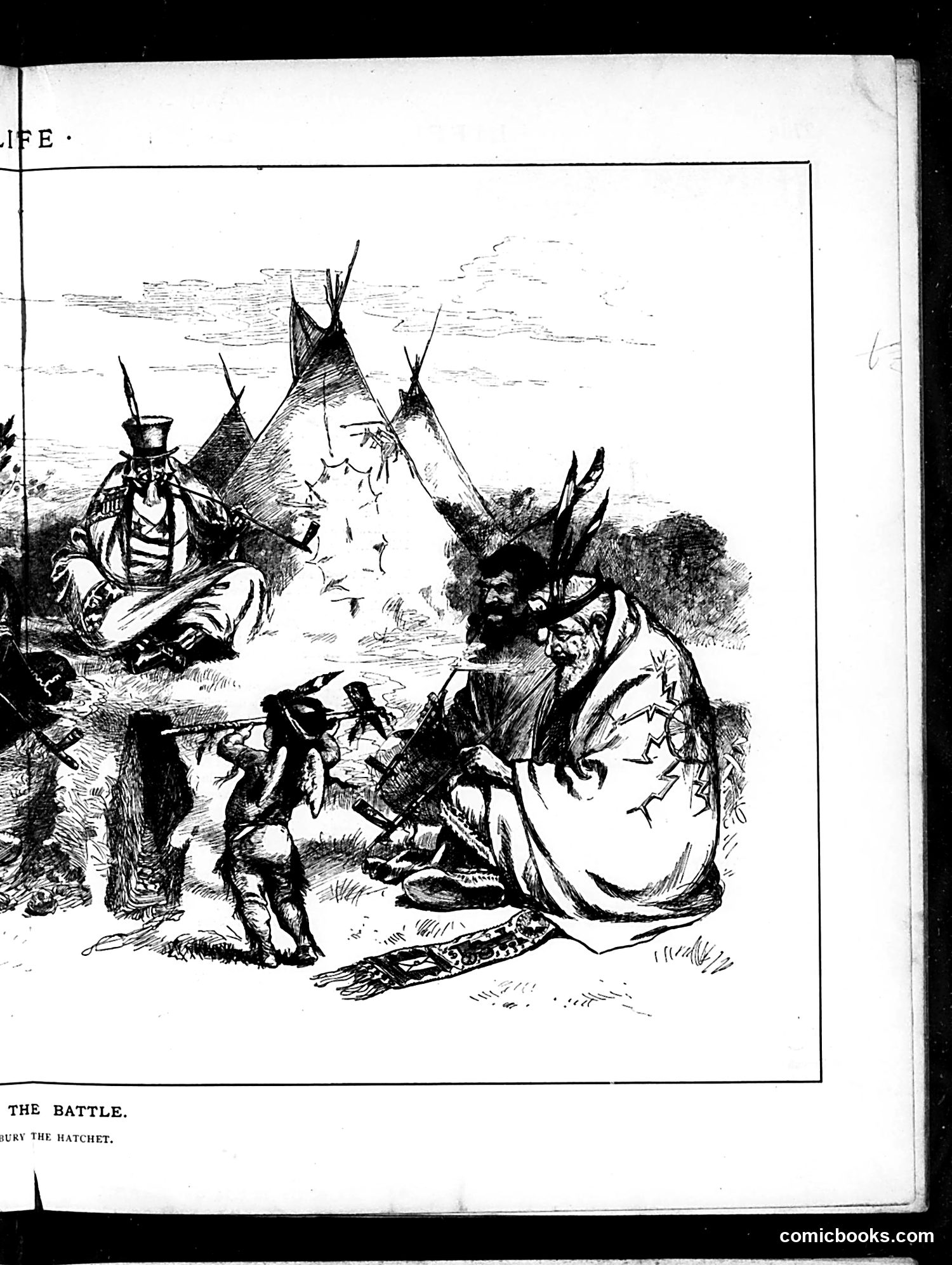
This illustration depicts a dramatic confrontation between Native Americans and what appears to be a European settler or soldier. The scene shows a large figure (likely representing a settler or military officer) confronting Native Americans near teepees in a landscape setting. The caption reads "THE BATTLE" with a partial credit visible as "BURY THE HATCHET." This appears to be satirical commentary on American frontier conflicts and the phrase "bury the hatchet"—an idiom ironically invoking Native American peace-making traditions while depicting actual violent conflict. The cartoon likely critiques either American expansionism, broken peace treaties, or the contradiction between rhetoric of peace and actual military confrontation during the Indian Wars era. The specific historical reference remains unclear without additional context.
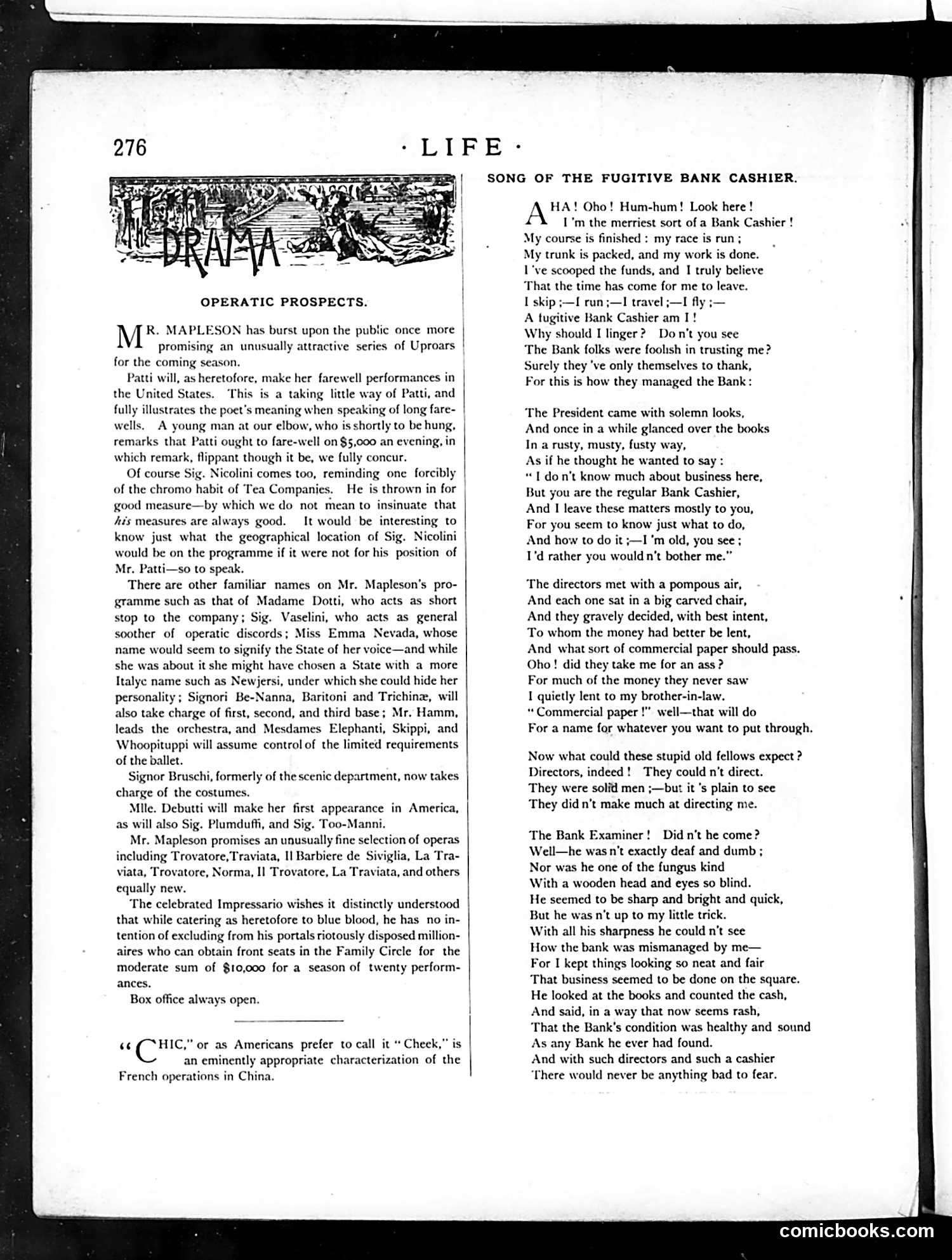
**"Operatic Prospects"** mocks impresario Mapleson's upcoming opera season. The satire ridicules soprano Patti's repeated "farewell" performances (a real phenomenon—she toured America many times claiming each would be her last). The piece uses baseball terminology to describe the cast, treating singers as interchangeable players. Names like "Emma Nevada" and "Elephanti" appear to be invented or exaggerated Italian stage names, mocking both operatic pretension and the public's appetite for exotic foreign talent. The joke targets wealthy patrons paying exorbitant prices ($10,000 per season) for "blue blood" entertainment. **"Song of the Fugitive Bank Cashier"** satirizes widespread embezzlement by bank employees, a common crime of the era. The lyrics mock negligent bank management—a disengaged president and inattentive directors who leave finances entirely to the cashier, then express shock when he absconds with funds. The song treats theft as inevitable given such lax oversight, blaming institutional incompetence rather than criminality.
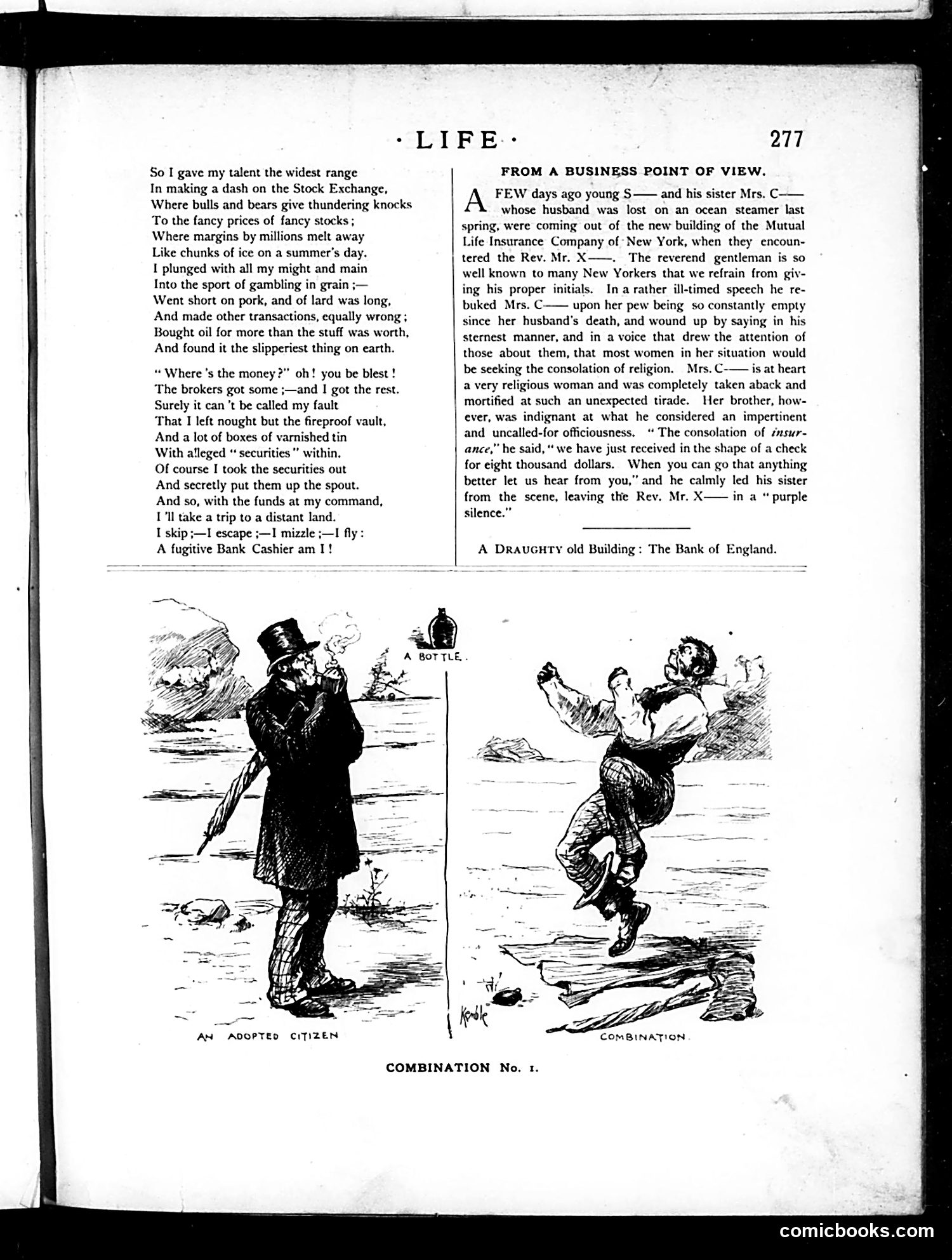
This page contains two satirical pieces about financial crime and hypocrisy in the Gilded Age. **Top section ("An Adopted Citizen"):** A first-person monologue by a fugitive bank cashier who confesses to reckless stock speculation, grain gambling, and embezzlement. He admits losing depositors' money on bad investments, then stealing the remaining securities before fleeing the country. The satire targets both the cashier's shameless admission and the era's financial corruption—the "adopted citizen" reference suggests immigrant criminality was a contemporary anxiety. **Bottom section ("From a Business Point of View"):** A clergyman rebukes a widow for sparse church attendance since her husband's death at sea, urging her toward religious consolation. Her brother retorts that they've received an $8,000 insurance check instead—implying material compensation matters more than spiritual comfort. The satire critiques the clergy's presumptuous moralizing while suggesting insurance has replaced faith as society's true consolation. Both pieces satirize late-19th-century American values: financial dishonesty, materialism over morality, and the hypocrisy of institutions.
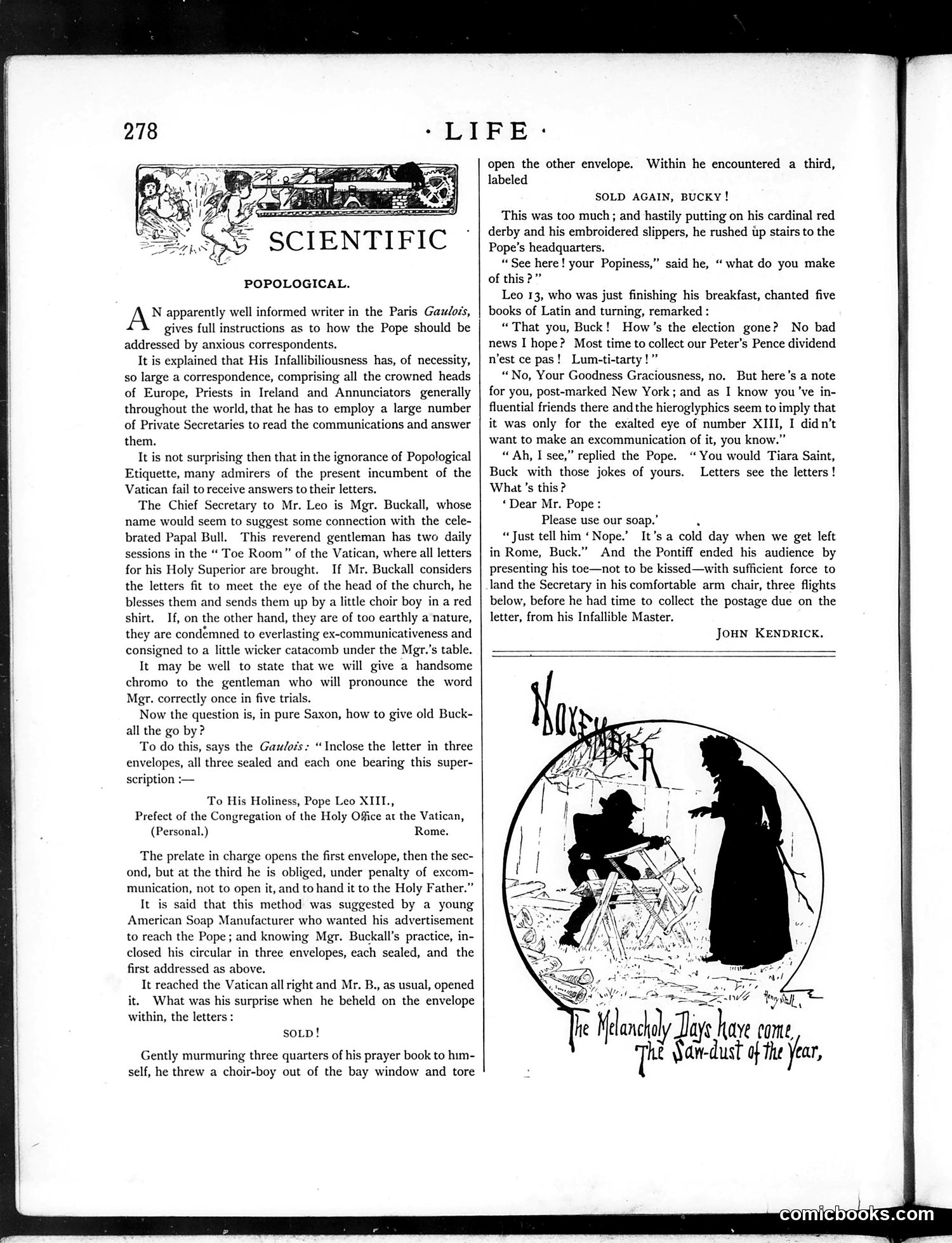
This satirical piece mocks Vatican bureaucracy and Catholic authority. The setup concerns Pope Leo XIII's overwhelmed correspondence—he must employ secretaries like the fictional "Mgr. Buckall" to filter letters. The joke centers on an American soap manufacturer who exploits Catholic doctrine: he mails his advertisement in three sealed envelopes, labeled "SOLD!" and "SOLD AGAIN, BUCKY!"—knowing Church law forbids opening the third envelope without papal permission. The scheme forces the letter directly to the Pope. The satire targets both American commercial aggression (a soap ad reaching the Pope) and papal pretension. The Pope's casual response—dismissing it as a joke while remaining unmoved—suggests the Church's imperviousness to worldly concerns, even advertising. The humor relies on readers understanding papal protocol, the reverence for Church authority, and contemporary American business tactics. The cartoon illustrates the dusty, antiquated Vatican contrasted with modern commercialism.
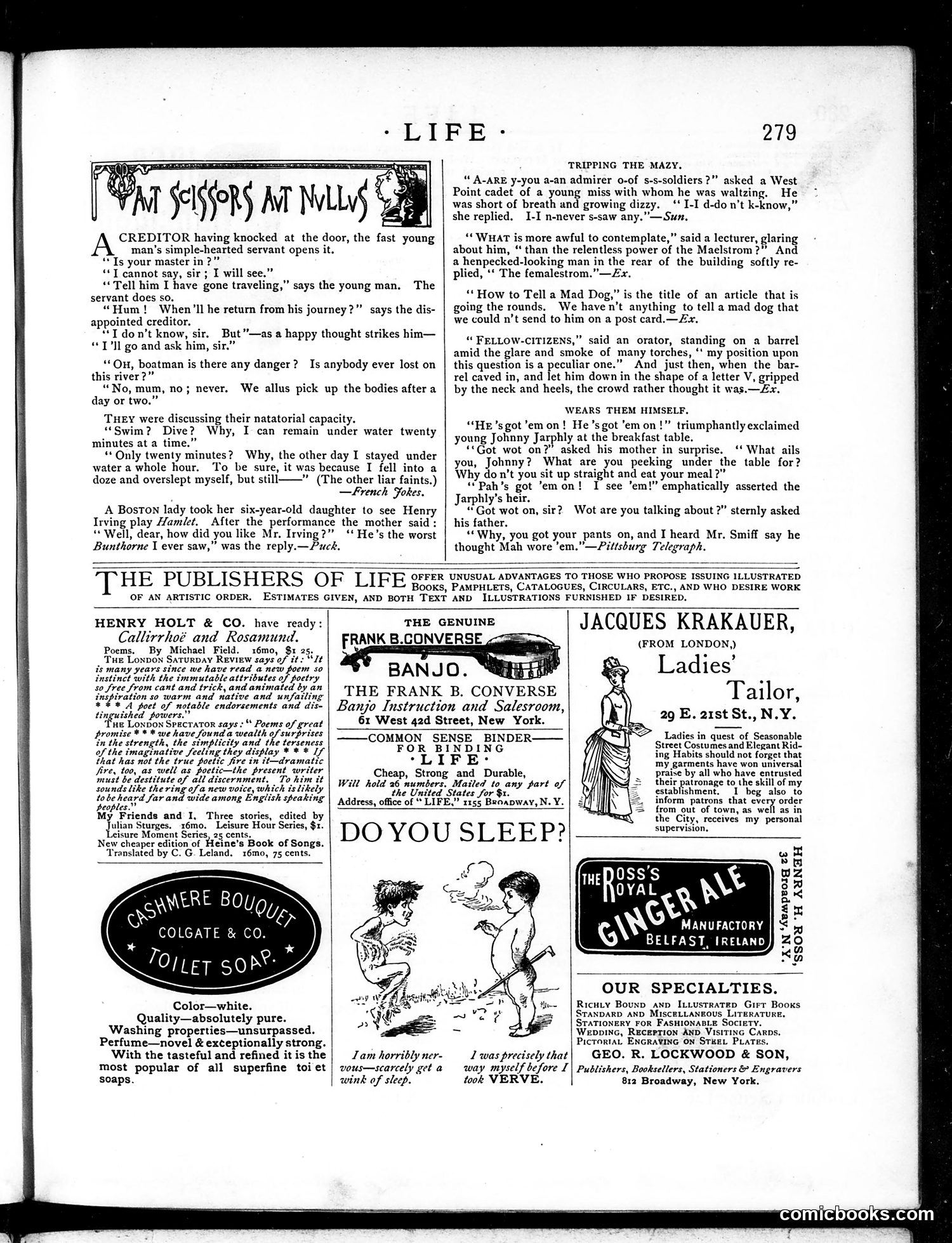
This page contains **humorous short anecdotes** rather than political cartoons. The jokes satirize everyday Victorian social situations: 1. **"Tripping the Mazy"** section includes brief comedic stories mocking: - A West Point cadet's breathlessness while dancing (physical weakness despite military status) - A henpecked husband's fear of his wife, compared to the mythical Maelstrom whirlpool - A child innocently revealing his father wears pants, after overhearing Mr. Smith's comment—the humor derives from the child's misunderstanding and the father's embarrassment 2. The humor targets **Victorian social anxieties**: masculine weakness, marital dynamics, and children's inadvertent social embarrassment. 3. The page also includes **advertisements** for books, banjos, tailoring services, and soap—typical of Life's mixed content model. The anecdotes reflect genteel society's preoccupations rather than political satire, relying on wordplay and social observation.
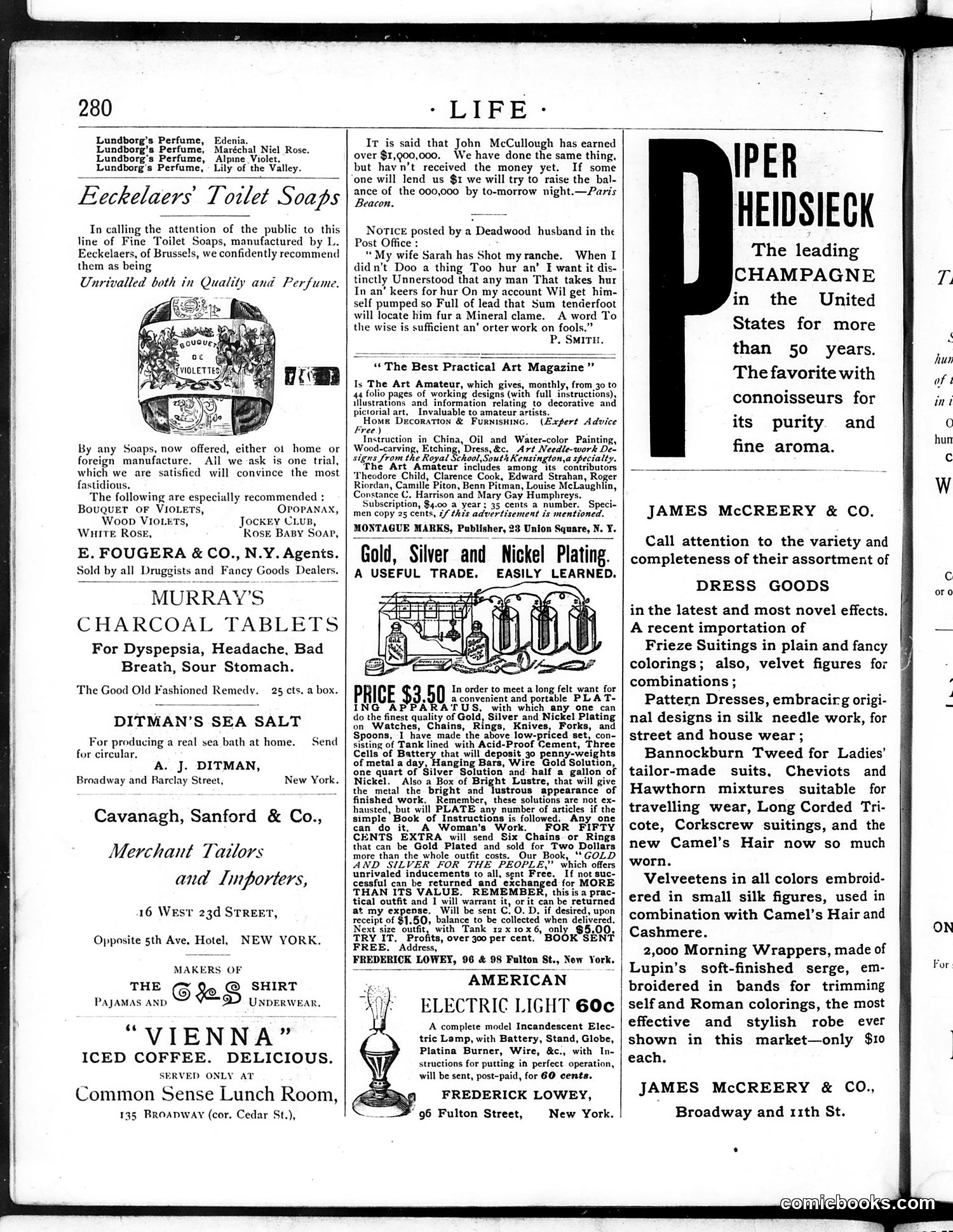
This page is primarily **advertisements and filler content** from *Life* magazine, not political satire. The brief humorous items include: 1. A joke about the actor John McCullough earning $1.9 million—the writer claims to have done the same but hasn't received payment yet, asking to borrow $1 to make up the difference by tomorrow. 2. A **frontier humor piece**: a deliberately misspelled notice posted by a "Deadwood husband" warning other men not to take in his wife Sarah after she shot his ranch, threatening to fill them with lead. This plays on rough Western dialect and frontier lawlessness for comic effect. The rest consists of period advertisements for soaps, patent medicines, tailoring services, and a mail-order gold/silver plating apparatus. The page reflects late 19th-century American consumer culture rather than political commentary.
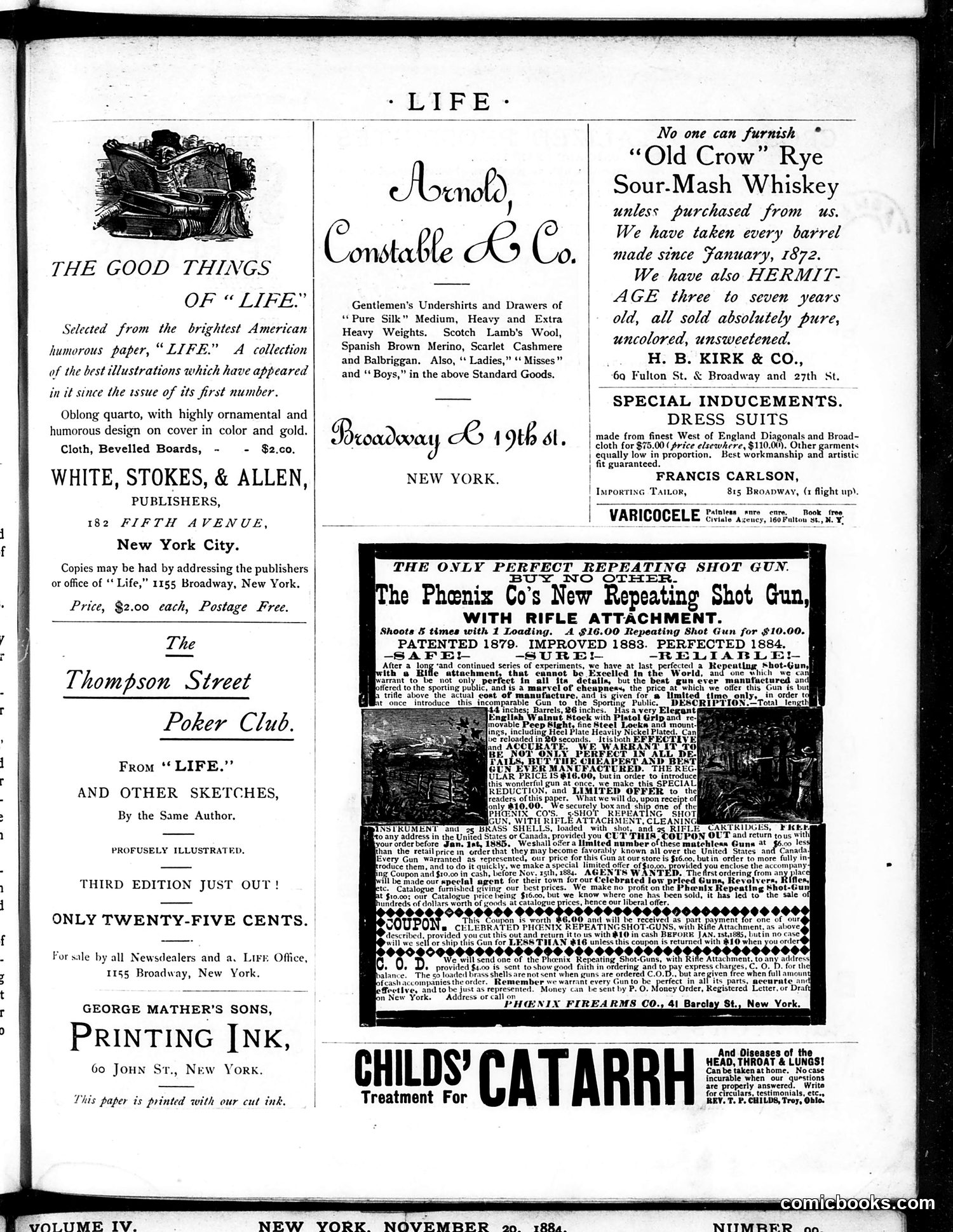
This is primarily an **advertising and announcements page** from Life magazine's fourth volume, not a political cartoon page. The layout showcases various commercial advertisements typical of the 1880s: **Key advertisements include:** - Arnold, Constable & Co. (upscale menswear on Broadway) - H.B. Kirk & Co. (whiskey, claiming monopoly on "Old Crow" Rye since 1872) - White, Stokes & Allen (publishers selling Life's collected humor illustrations for $2.00) - Francis Carlson (tailoring services) - Phenix Co. (a repeating shotgun with rifle attachment, marketed at $10 versus competitors' $16) - Childs' Catarrh Treatment (patent medicine) **The satire is implicit:** These advertisements themselves were often subjects of Life's humor—exaggerated marketing claims, dubious patent medicines, and luxury goods pitched to wealthy New York readers. The page demonstrates how 1880s publications monetized content through aggressive, sometimes absurd advertising.
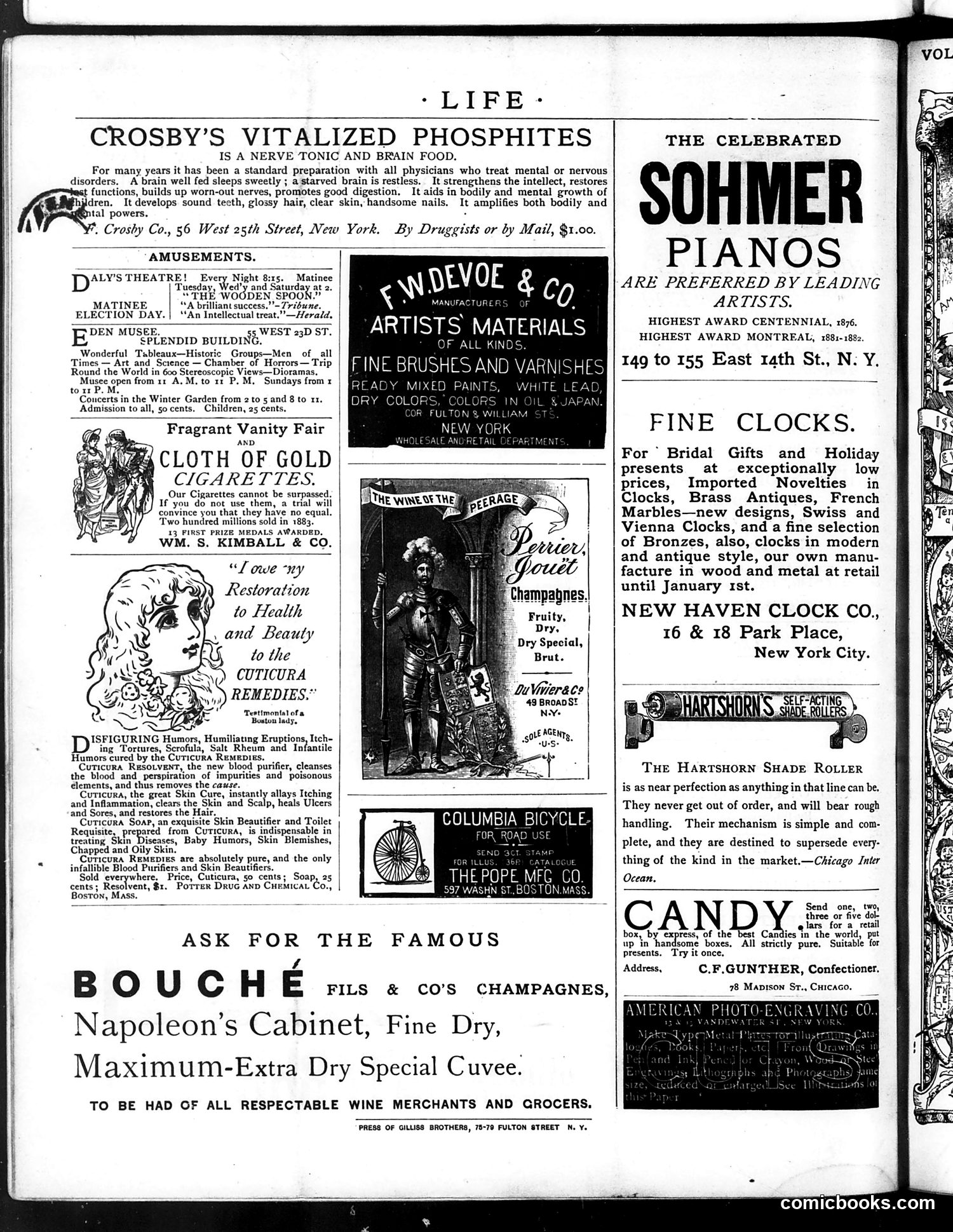
This is primarily an **advertising page**, not a satirical or political cartoon page. It consists almost entirely of commercial advertisements from the 1880s, with no visible political cartoons or satire to analyze. The ads promote various products: patent medicines (Crosby's Phosphites for nerves, Cuticura remedies for skin conditions), consumer goods (Sohmer pianos, Hartshorn shade rollers, Columbia bicycles), luxury items (champagne, fine clocks), and entertainment venues (theaters, museums). The only notable element is **Crosby's Phosphites ad**, which claims to be a "nerve tonic and brain food" — reflecting the era's obsession with patent medicines and pseudoscientific health remedies. The language about "starved brains" and "worn-out nerves" reflects 19th-century medical anxieties about mental exhaustion. This appears to be a standard revenue-generating page from Life magazine, not an editorial or satirical feature.