
Life, 1884-11-13 · page 7 of 16
Life — November 13, 1884 — page 7: what you’re looking at
What you’re looking at
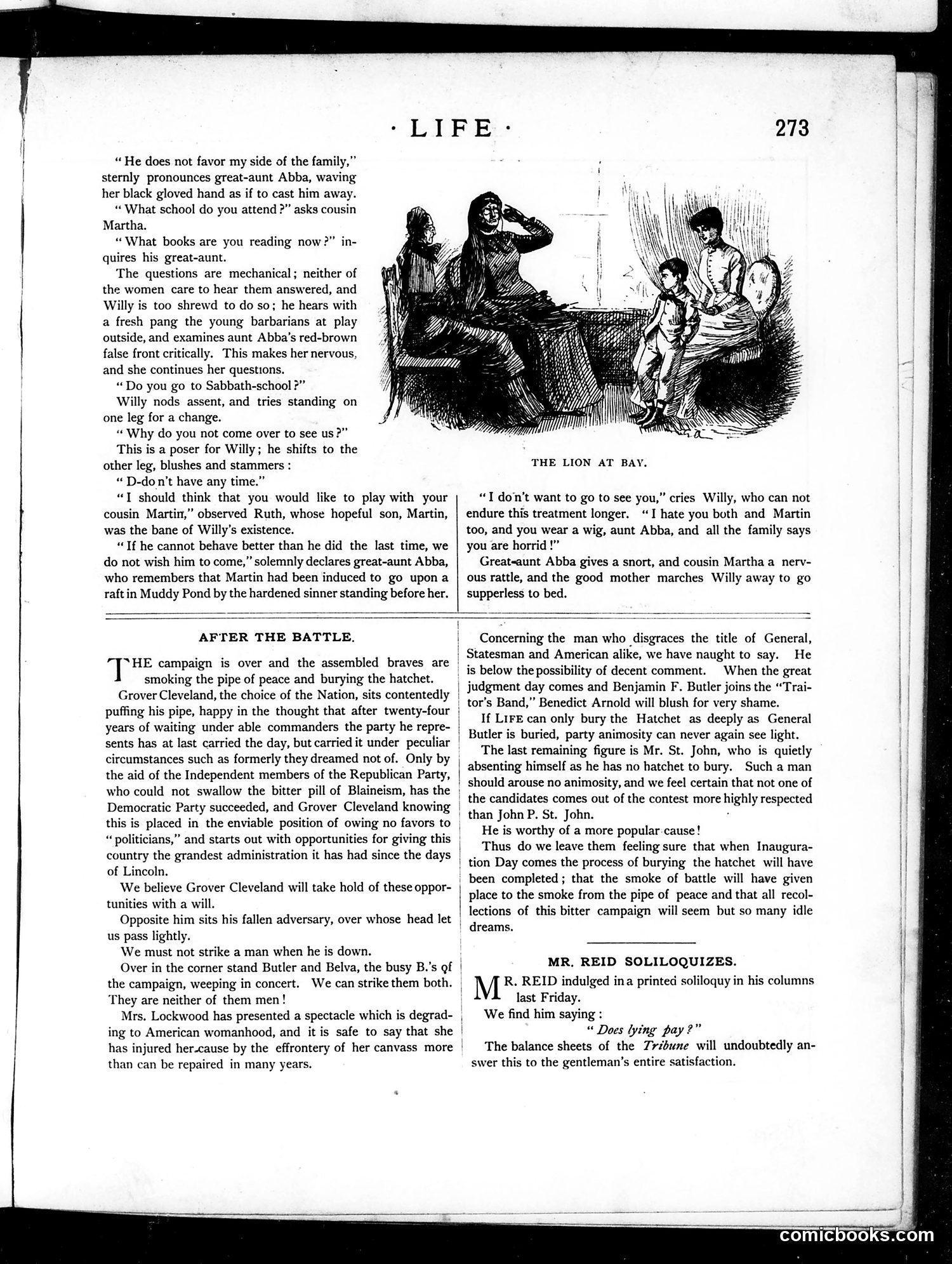
This illustration depicts a domestic conflict between **great-aunt Abba** and her young nephew **Willy**, with **cousin Martha** also present. Willy resists visiting his relatives, particularly objecting to great-aunt Abba's authority and her criticism of his family. He claims to "hate" both Abba and Martin, accusing them of wearing wigs and being "horrid." The "lion at bay" metaphor refers to Willy's defiant stance against adult relatives' control. The cartoon satirizes the tension between Victorian family hierarchies and children's growing resistance to elder authority. The social commentary critiques rigid familial power structures where aunts wielded significant domestic control, shown here as increasingly ineffective against youthful rebellion.
📄 Transcribed text from this page (OCR, searchable)
Machine-transcribed from the original scan — historical spelling and the odd misread are preserved.
“He does not favor my side of the family,” sternly pronounces great-aunt Abba, waving her black gloved hand as if to cast him away. “What school do you attend ?” asks cousin Martha. “What books are you reading now?” in- quires his great-aunt. The questions are mechanical; neither of the women care to hear them answered, and Willy is too shrewd to do so; he hears with a fresh pang the young barbarians at play outside, and examines aunt Abba’s red-brown false front critically. This makes her nervous, and she continues her questions. “Do you go to Sabbath-school ?” Willy nods assent, and tries standing on one leg for a change. “Why do you not come over to see us?” This is a poser for Willy; he shifts to the other leg, blushes and stammers : “D-don’t have any time.” “T should think that you would like to play with your cousin Martin,” observed Ruth, whose hopeful son, Martin, was the bane of Willy's existence. “If he cannot behave better than he did the last time, we do not wish him to come,” solemnly declares great-aunt Abba, who remembers that Martin had been induced to go upon a raft in Muddy Pond by the hardened sinner standing before her. THE LION AT BAY, “T don’t want to go to see you,” cries Willy, who can not endure this treatment longer. “I hate you both and Martin too, and you wear a wig, aunt Abba, and all the family says you are horrid !” Great-aunt Abba gives a snort, and cousin Martha a nerv- ous rattle, and the good mother marches Willy away to go supperless to bed. AFTER THE BATTLE. T ~HE campaign is over and the assembled braves are smoking the pipe of peace and burying the hatchet. Grover Cleveland, the choice of the Nation, sits contentedly puffing his pipe, happy in the thought that after twenty-four | years of waiting under able commanders the party he repre- | sents has at last carried the day, but carried it under peculiar circumstances such as formerly they dreamed not of. Only by the aid of the Independent members of the Republican Party, who could not swallow the bitter pill of Blaineism, has the | Democratic Party succeeded, and Grover Cleveland knowing this is placed in the enviable position of owing no favors to “ politicians,” and starts out with opportunities for giving this country the grandest administration it has had since the days of Lincoln. We believe Grover Cleveland will take hold of these oppor- | place to the smoke from the pipe of peace and that all recol- | Gosg rehab A E ; Opposite him sits his fallen adversary, over whose head let | fections) off tus’ bitter’ campaign’ will seem bubso many idle tunities with a will. us pass lightly. We must not strike a man when he is down. Over in the corner stand Butler and Belva, the busy B.'s of the campaign, weeping in concert. We can strike them both. They are neither of them men! Mrs. Lockwood has presented a spectacle which is degrad- ing to American womanhood, and it is safe to say that she has injured her-cause by the effrontery of her canvass more than can be repaired in many years. Concerning the man who disgraces the title of General, Statesman and American alike, we have naught to say. He is below the possibility of decent comment. When the great judgment day comes and Benjamin F. Butler joins the “Trai- tor’s Band,” Benedict Arnold will blush for very shame. If L1FE can only bury the Hatchet as deeply as General Butler is buried, party animosity can never again see light. The last remaining figure is Mr. St. John, who is quietly absenting himself as he has no hatchet to bury. Such a man should arouse no animosity, and we feel certain that not one of the candidates comes out of the contest more highly respected than John P. St. John. : He is worthy of a more popular:cause! Thus do we leave them feeling sure that when Inaugura- | tion Day comes the process of burying the hatchet will have been completed ; that the smoke of battle will have given dreams. MR. REID SOLILOQUIZES. R. REID indulged ina printed soliloquy in his columns last Friday. We find him saying : “ Does lying pay?” The balance sheets of the Zrzbune will undoubtedly an- swer this to the gentleman’s entire satisfaction.