
Life, 1884-11-13 · page 10 of 16
Life — November 13, 1884 — page 10: what you’re looking at
What you’re looking at
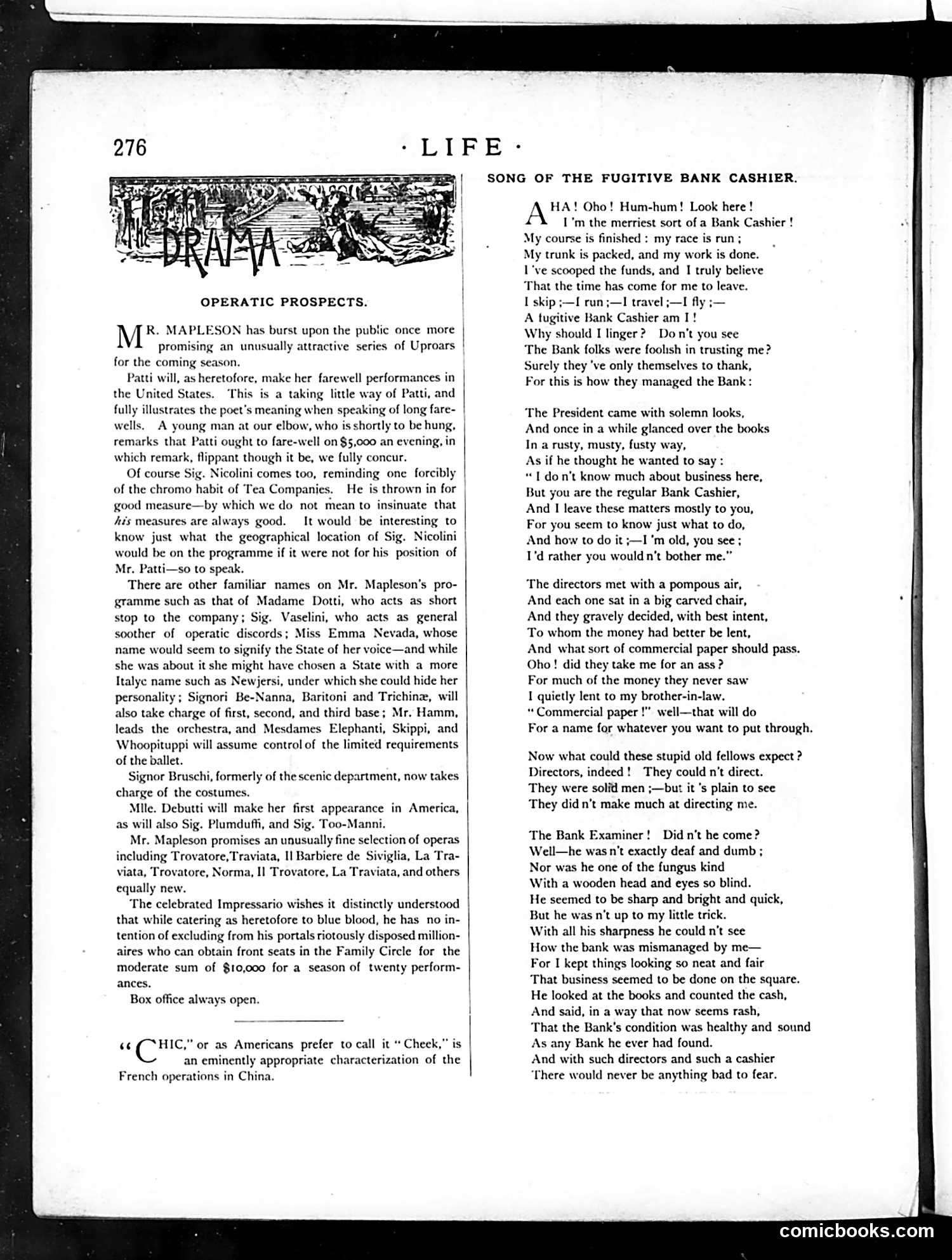
**"Operatic Prospects"** mocks impresario Mapleson's upcoming opera season. The satire ridicules soprano Patti's repeated "farewell" performances (a real phenomenon—she toured America many times claiming each would be her last). The piece uses baseball terminology to describe the cast, treating singers as interchangeable players. Names like "Emma Nevada" and "Elephanti" appear to be invented or exaggerated Italian stage names, mocking both operatic pretension and the public's appetite for exotic foreign talent. The joke targets wealthy patrons paying exorbitant prices ($10,000 per season) for "blue blood" entertainment. **"Song of the Fugitive Bank Cashier"** satirizes widespread embezzlement by bank employees, a common crime of the era. The lyrics mock negligent bank management—a disengaged president and inattentive directors who leave finances entirely to the cashier, then express shock when he absconds with funds. The song treats theft as inevitable given such lax oversight, blaming institutional incompetence rather than criminality.
📄 Transcribed text from this page (OCR, searchable)
Machine-transcribed from the original scan — historical spelling and the odd misread are preserved.
- LIFE: OPERATIC PROSPECTS. R. MAPLESON has burst upon the public once more promising an unusually attractive series of Uproars for the coming season, Patti will, as heretofore, make her farewell performances in the United States. This is a taking little way of Patti, and fully illustrates the poet’s meaning when speaking of long fare- wel A young man at our elbow, who is shortly to be hung, remarks that Patti ought to fare-well on $5,000 an evening, in which remark, flippant though it be, we fully concur. Of course Sig. Nicolini comes too, reminding one forcibly of the chromo habit of Tea Companies. He is thrown in for good measure—by which we do not mean to insinuate that Aés measures are always good. It would be interesting to know just what the geographical location of Sig. Nicolini would be on the programme if it were not for his position of Mr. Patti—so to speak. There are other familiar names on Mr. Mapleson’s pro- gramme such as that of Madame Dotti, who acts as short stop to the company; Sig. Vaselini, who acts as general soother of operatic discords; Miss Emma Nevada, whose name would seem to signify the State of her voice—and while she was about it she might have chosen a State with a more Italye name such as Newjersi, under which she could hide her personality; Signori Be-Nanna, Baritoni and Trichinz, will | also take charge of first, second, and third base; Mr. Hamm, leads the orchestra, and Mesdames Elephanti, Skippi, and Whoopituppi will assume control of the limited requirements of the ballet. Signor Bruschi, formerly of the scenic department, now takes charge of the costumes. Mile. Debutti will make her first appearance in America, as will also Sig. Plumduffi, and Sig. Too-Manni. Mr. Mapleson promises an unusually fine selection of operas including Trovatore,Traviata, Il Barbiere de Siviglia, La Tra- viata, Trovatore, Norma, II Trovatore, La Traviata, and others equally new. The celebrated Impressario wishes it distinctly understood that while catering as heretofore to blue blood, he has_no in- tention of excluding from his portals riotously disposed million- aires who can obtain front seats in the Family Circle for the | moderate sum of $10,000 for a season of twenty perform- ances. Box office always open. 73 HIC,” or as Americans prefer to call it “ Cheek,” is an eminently appropriate characterization of the French operations in China. SONG OF THE FUGITIVE BANK CASHIER. HA! Oho! Hum-hum! Look here! L I'm the merriest sort of a Bank Cashier ! My course is finished : my race is run ; My trunk is packed, and my work is done. I've scooped the funds, and I truly believe That the time has come for me to leave. I skip ;—[ run ;—I travel ;—I fly ;— A fugitive Bank Cashier am I! Why should I linger? Don't you see The Bank folks were foolish in trusting me? Surely they ‘ve only themselves to thank, For this is how they managed the Bank: The President came with solemn looks, And once in a while glanced over the books In a rusty, musty, fusty way, As if he thought he wanted to say : “1 don’t know much about business here, But you are the regular Bank Cashier, And I leave these matters mostly to you, For you seem to know just what to do, And how to do it ;—I''m old, you see ; I'd rather you would n’t bother me.” The directors met with a pompous air, And each one sat in a big carved chair, And they gravely decided, with best intent, To whom the money had better be lent, And what sort of commercial paper should pass. Oho ! did they take me for an ass ? For much of the money they never saw I quietly lent to my brother-in-law. “Commercial paper !"" well—that will do For a name for whatever you want to put through, Now what could these stupid old fellows expect ? Directors, indeed! They could n’t direct. They were solid men ;—but it ‘s plain to see They didn’t make much at directing me. The Bank Examiner! Did n’t he come? Well—he was n't exactly deaf and dumb ; Nor was he one of the fungus kind With a wooden head and eyes so blind. He seemed to be sharp and bright and quick, But he was n't up to my little trick. With all his sharpness he could n't see How the bank was mismanaged by me— For I kept things looking so neat and fair That business seemed to be done on the square. He looked at the books and counted the cash, And said, in a way that now seems rash, That the Bank's condition was healthy and sound As any Bank he ever had found. And with such directors and such a cashier ‘There would never be anything bad to fear. comicbooks.com