
Life, 1884-11-13 · page 2 of 16
Life — November 13, 1884 — page 2: what you’re looking at
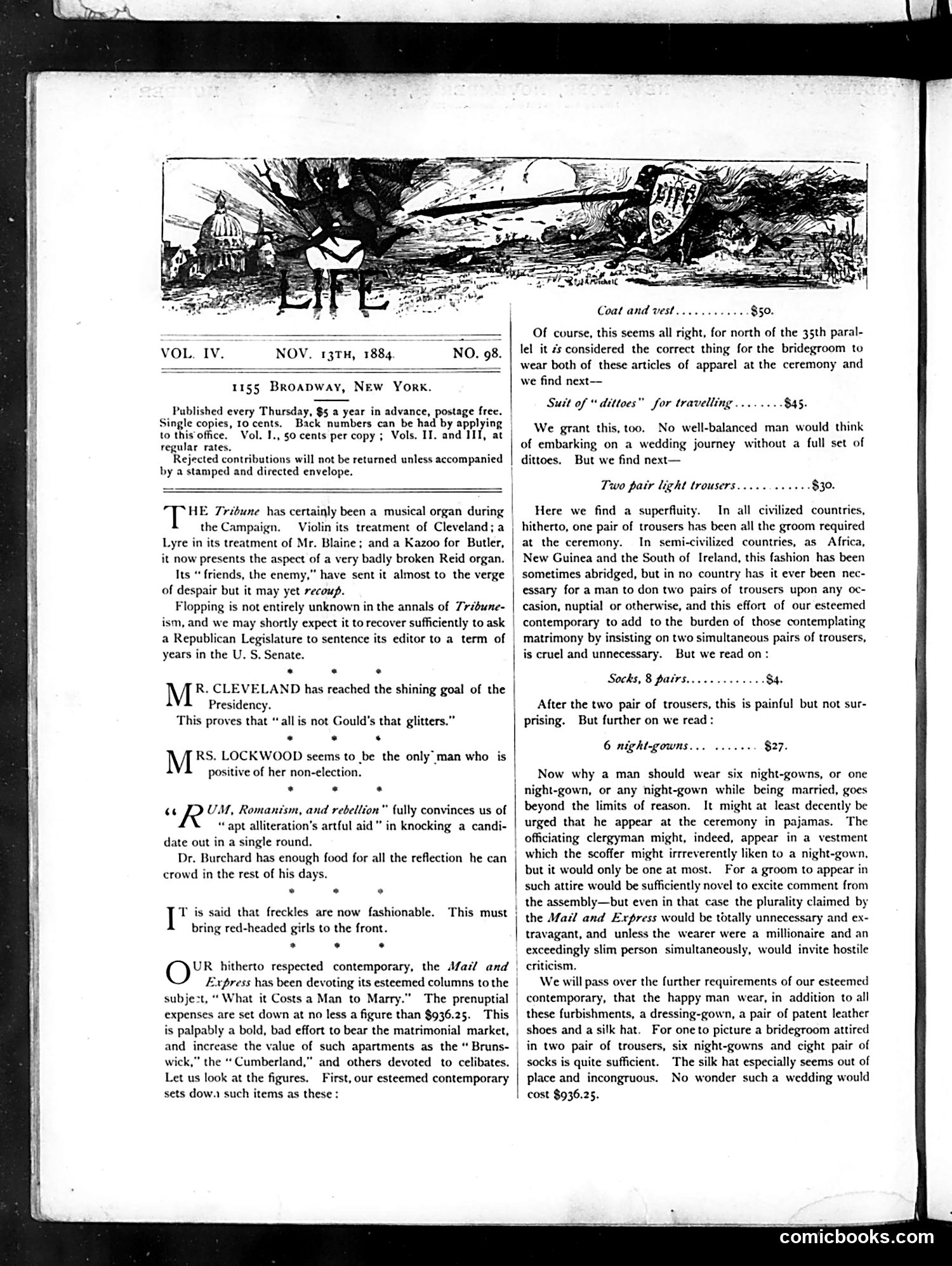
What you’re looking at
The cartoon depicts a figure sitting amid wreckage labeled with political references. Based on the text, this appears to satirize the **Tribune newspaper's decline** during the Cleveland presidential campaign. The magazine notes the Tribune has become "a very badly broken Reed organ"—a pun referencing both the musical instrument and likely **James A. Reed**, a political figure. The text discusses Cleveland reaching the presidency and criticizes the Tribune's editorial positions on contemporary issues. The surrounding wreckage suggests the publication's credibility was damaged by its coverage or stance during the 1884 election campaign. The accompanying fashion commentary about wedding attire appears unrelated to the political satire—typical of Life's mixed content format.
📄 Transcribed text from this page (OCR, searchable)
Machine-transcribed from the original scan — historical spelling and the odd misread are preserved.
VOL, IV. NOV. 13TH, 1884. 1155 Broapway, New York. Published every Thursday, $5 a year in advance, postage free. ngle copies, 10 cents. Back numbers can be had by applying to this office.’ Vol. I., 50 cents per copy ; Vols. IT. and IIT, at regular rates, Rejected contributions will not be returned unless accompanied by a stamped and directed envelope. HE 7riéune has certainly been a musical organ during the Campaign. Violin its treatment of Cleveland; a Lyre in its treatment of Mr. Blaine; and a Kazoo for Butler, it now presents the aspect of a very badly broken Reid organ. Its “ friends, the enemy,” have sent it almost to the verge of despair but it may yet recoup. Flopping is not entirely unknown in the annals of 7rzbune- ism, and we may shortly expect it to recover sufficiently to ask a Republican Legislature to sentence its editor to a term of years in the U. S, Senate. | . . . R. CLEVELAND has reached the shining goal of the Presidency. This proves that “all is not Gould’s that glitters.” . . . RS. LOCKWOOD seems to be the only’ man who is positive of her non-election. | . . . “R UM, Romanism, and rebellion" fully convinces us of “apt alliteration’s artful aid” in knocking a candi- date out in a single round, Dr. Burchard has enough food for all the reflection he can crowd in the rest of his days. . ° ° T is said that freckles are now fashionable. bring red-headed girls to the front. . . . This must } UR hitherto respected contemporary, the Mas? and press has been devoting its esteemed columns tothe | subject, “What it Costs a Man to Marry.” The prenuptial | expenses are set down at no less a figure than $936.25. This | is palpably a bold, bad effort to bear the matrimonial market, and increase the value of such apartments as the “ Bruns- wick,” the “Cumberland,” and others devoted to celibates. | Let us look at the figures. First, our esteemed contemporary sets dow.) such items as these: dittoes, Coat and vest Of course, this seems all right, for north of the 35th paral- lel it #s considered the correct thing for the bridegroom to wear both of these articles of apparel at the ceremony and we find next— Suit of “ dittoes” for travelling We grant this, too, No well-balanced man would think of embarking on a wedding journey without a full set of But we find next— Two patr light trousers. ....0 +++ ++ $30. Here we find a superfiuity. In all civilized countries, hitherto, one pair of trousers has been all the groom required at the ceremony. In semi-civilized countries, as Africa, New Guinea and the South of Ireland, this fashion has been | sometimes abridged, but in no country has it ever been nec- essary for a man to don two pairs of trousers upon any oc- casion, nuptial or otherwise, and this effort of our esteemed contemporary to add to the burden of those contemplating matrimony by insisting on two simultaneous pairs of trousers, is cruel and unnecessary. But we read on: Socks, 8 pairs. After the two pair of trousers, this is painful but not sur- prising. But further on we read: 6 night-gowns... . Now why a man should wear six night-gowns, or one night-gown, or any night-gown while being married, goes beyond the limits of reason. It might at least decently be urged that he appear at the ceremony in pajamas. The officiating clergyman might, indeed, appear in a vestment which the scoffer might irrreverently liken to a night-gown, but it would only be one at most. For a groom to appear in such attire would be sufficiently novel to excite comment from the assembly—but even in that case the plurality claimed by the Mazl and Express would be totally unnecessary and ex- travagant, and unless the wearer were a millionaire and an exceedingly slim person simultaneously, would invite hostile criticism. We will pass over the further requirements of our esteemed contemporary, that the happy man wear, in addition to all these furbishments, a dressing-gown, a pair of patent leather shoes and a silk hat. For oneto picture a bridegroom attired in two pair of trousers, six night-gowns and cight pair of socks is quite sufficient. The silk hat especially seems out of place and incongruous. No wonder such a wedding would cost $936.25.