
Life, 1884-11-13 · page 5 of 16
Life — November 13, 1884 — page 5: what you’re looking at
What you’re looking at
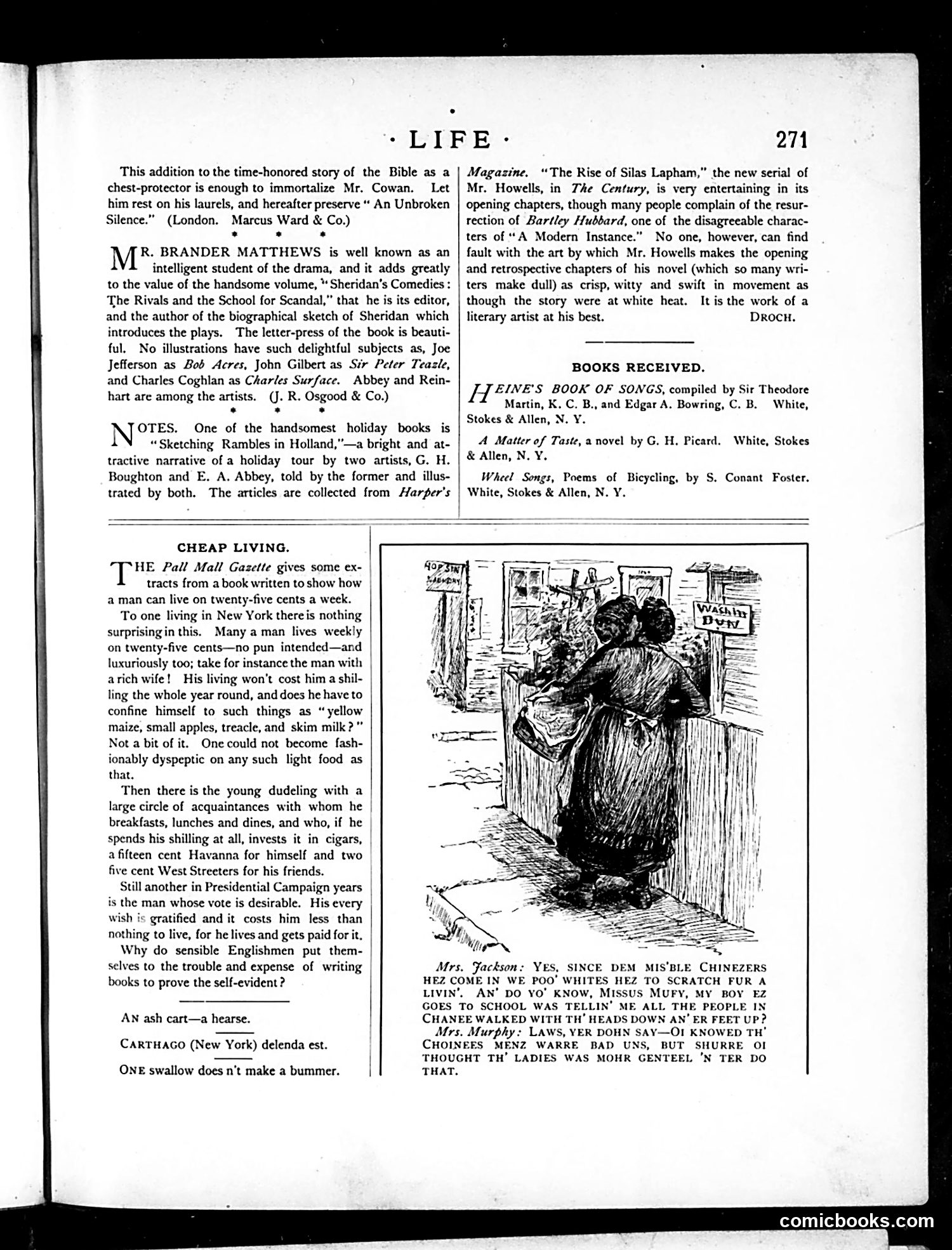
The main cartoon depicts **Mrs. Jackson** and **Mrs. Murphy**, working-class women discussing domestic life and their husbands' behavior. The dialogue—rendered in heavy dialect—concerns how men spend money frivolously on cigars and entertainment while expecting wives to manage households on minimal budgets. The satire targets **class economics and gender relations**: wealthy men enjoy luxuries while working-class wives must stretch pennies for food ("yellow maize, small apples, treacle, and skim milk"). The cartoon critiques the hypocrisy of men demanding thrift from wives while indulging themselves. The surrounding text on "Cheap Living" reinforces this theme, listing absurdly minimal weekly budgets (25 cents) that contrast sharply with men's wasteful spending habits—a commentary on economic inequality and domestic power dynamics in early 20th-century America.
📄 Transcribed text from this page (OCR, searchable)
Machine-transcribed from the original scan — historical spelling and the odd misread are preserved.
-LIFE- This addition to the time-honored story of the Bible as a chest-protector is enough to immortalize Mr. Cowan. Let him rest on his laurels, and hereafter preserve “ An Unbroken Silence.” (London. Marcus Ward & Co.) * . * R. BRANDER MATTHEWS is well known as an intelligent student of the drama, and it adds greatly to the value of the handsome volume, * Sheridan's Comedies : The Rivals and the School for Scandal,” that he is its editor, and the author of the biographical sketch of Sheridan which introduces the plays. The letter-press of the book is beauti- ful. No illustrations have such delightful subjects as, Joe Jefferson as Bob Acres, John Gilbert as Sir Peter Teazle, and Charles Coghlan as Charles Surface. Abbey and Rein- hart are among the artists. . GJ. R. Osgood & Co.) * . i OTES. One of the handsomest holiday books is “Sketching Rambles in Holland,”—a bright and at- | tractive narrative of a holiday tour by two artists, G. H. Boughton and E. A. Abbey, told by the former and illus- trated by both. The articles are collected from Harper's CHEAP LIVING. HE Pall Mall Gazette gives some ex- tracts from a book written to show how a man can live on twenty-five cents a week. To one living in New York thereis nothing surprisingin this. Many a man lives weekly on twenty-five cents—no pun intended—and luxuriously too; take for instance the man with arich wife! His living won't cost him a shil- | ling the whole year round, and does he have to confine himself to such things as “yellow maize, small apples, treacle, and skim milk?” Not a bit of it. Onecould not become fash- ionably dyspeptic on any such light food as that, Then there is the young dudeling with a large circle of acquaintances with whom he breakfasts, lunches and dines, and who, if he spends his shilling at all, invests it in cigars, afifteen cent Havanna for himself and two five cent West Streeters for his friends. Still another in Presidential Campaign years is the man whose vote is desirable. His every | wish is gratified and it costs him less than nothing to live, for he lives and gets paid for it, Why do sensible Englishmen put them- | selves to the trouble and expense of writing Mrs. Jackson: YES 271 Magazine. “The Rise of Silas Lapham,” the new serial of Mr. Howells, in The Century, is very entertaining in its opening chapters, though many people complain of the resur- rection of Bartley Hubbard, one of the disagreeable charac- ters of “A Modern Instance.” No one, however, can find fault with the art by which Mr. Howells makes the opening and retrospective chapters of his novel (which so many wri- | ters make dull) as crisp, witty and swift in movement as though the story were at white heat. It is the work of a literary artist at his best. Drocu. BOOKS RECEIVED. E EINE'’S BOOK OF SONGS, compiled by Sir Theodore Martin, K. C. B., and Edgar A. Bowring, C. B. White, Stokes & Allen, N. Y. A Matter of Taste, a novel by G. H. Picard. & Allen, N.Y, White, Stokes Wheel Songs, Poems of Bicycling, by S. Conant Foster. | White, Stokes & Allen, N. Y. E DEM MIS'BLE CHINEZERS books to prove the self-evident ? AN ash cart—a hearse. CARTHAGO (New York) delenda est. ONE swallow does n't make a bummer. HEZ COME IN WE POO’ WHITES HEZ TO SCRATCH FUR A Livin’. AN’ DO YO" KNow, MIssus MUFY, MY BOY EZ GOES To SCHOOL WAS TELLIN’ ME ALL THE PEOPLE IN CHANEE WALKED WITH TH’ HEADS DOWN AN’ ER FEET UP? Mrs. Murphy: LAWS, YER DOHN SAY—OI KNOW TH’ CHOINEES MENZ WARRE BAD UNS, BUT SHURRE OI THOUGHT TH’ LADIES WAS MOHR GENTEEL 'N TER DO THAT. comicbooks.com