
A complete issue · 16 pages · 1884
Life — February 21, 1884
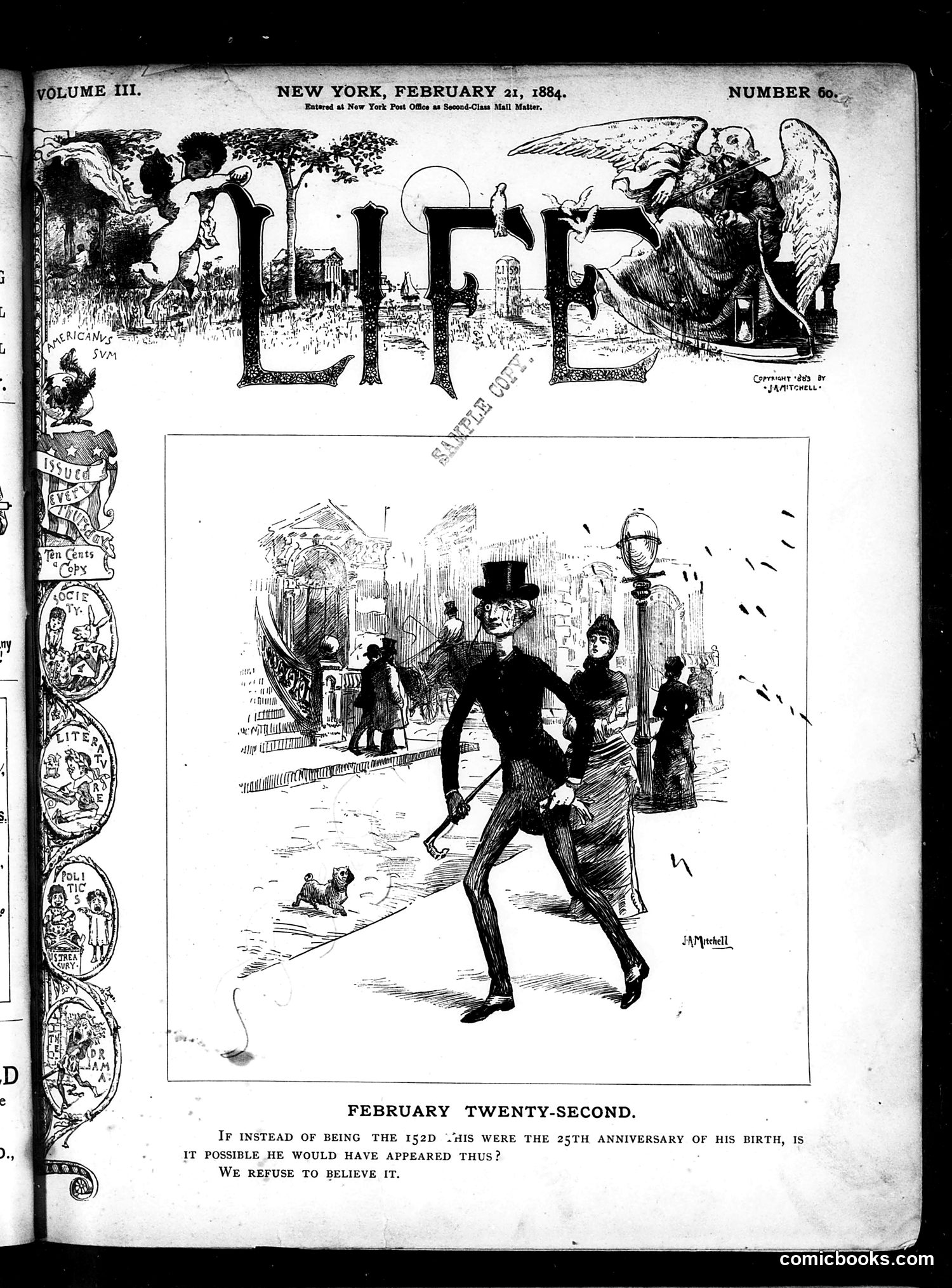
This satirical cartoon references **George Washington's birthday** (February 22). The caption states: "If instead of being the 152d [sic] his were the 25th anniversary of his birth, is it possible he would have appeared thus? We refuse to believe it." The joke contrasts Washington's dignified historical image with the exaggerated, skeletal figure depicted jumping rope in a modern urban street scene. The satire mocks either: 1. The degradation of historical figures through modern popular culture, or 2. The idea that Washington, if somehow reincarnated young in 1884, would engage in undignified contemporary behavior. The cartoonist uses physical caricature and the juxtaposition of past dignity versus present frivolity to make a commentary on American values or cultural decline.
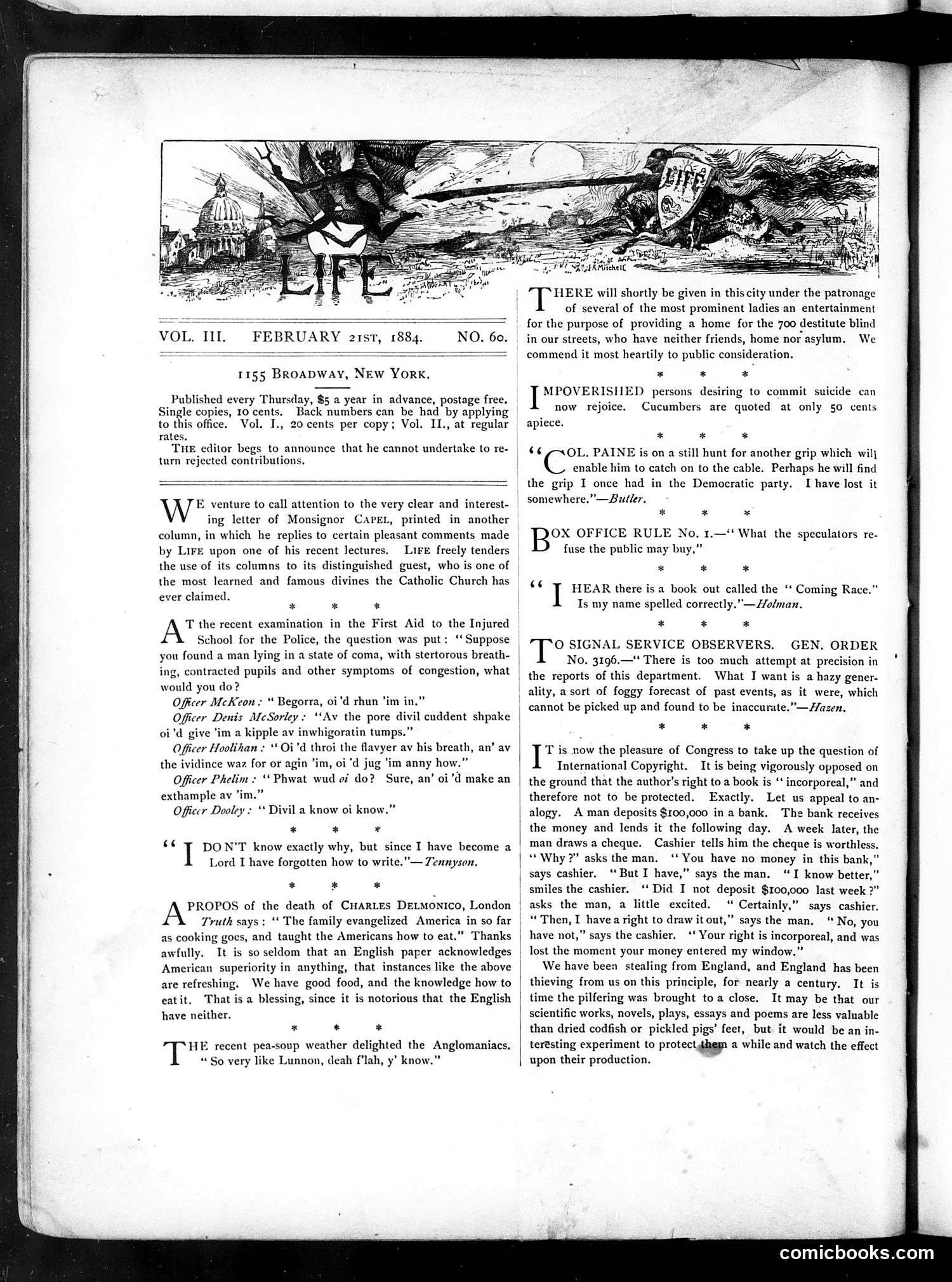
The masthead cartoon depicts "LIFE" as a winged figure battling dark forces (possibly representing death or corruption), set against a cityscape. This reflects the magazine's satirical mission as social critic. The text consists primarily of brief humorous anecdotes and editorial commentary rather than political cartoons. Notable items include: - A joke about a First Aid examination involving medical terminology - A reference to "Colonel Paine" seeking a political "grip" he lost in the Democratic Party - Commentary on international copyright protection (a contemporary debate) - A banking analogy about deposits and worthless checks The content reflects 1880s American concerns: medical education, party politics, intellectual property rights, and financial trust. The humor relies on wordplay and topical references that would resonate with educated urban readers of the era.
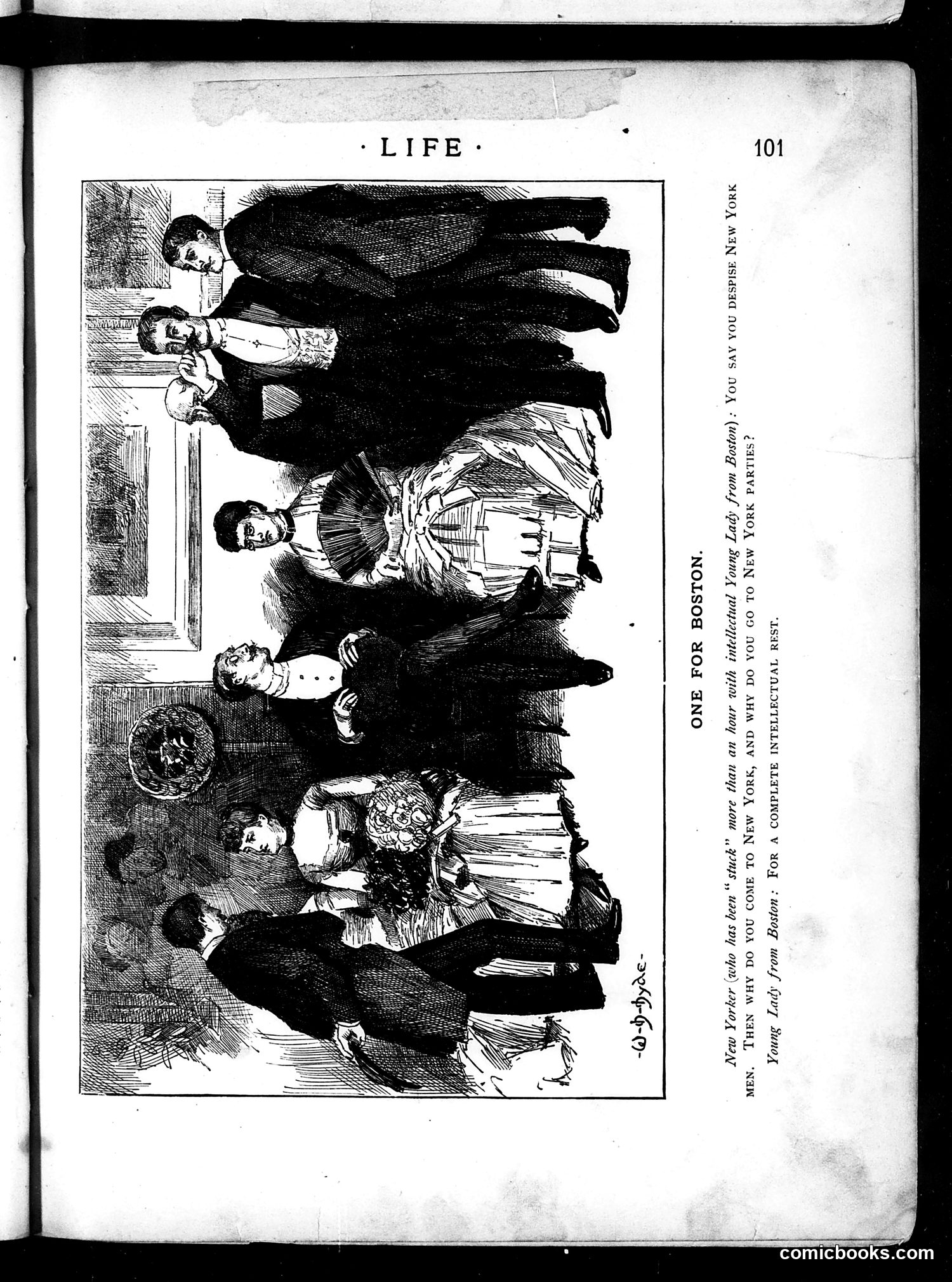
This satirical cartoon depicts a domestic scene critiquing wealth inequality and social pretension. The image shows a wealthy family in their home—adults in formal dress with a child—alongside their servants or working-class staff members depicted in contrasting attire. The satire appears to target the hypocrisy of the wealthy classes: the caption references "Mrs. Twerp" saving "one for Boston" and mentions "New York parasites," suggesting mockery of elite families who claim moral superiority while depending on and exploiting lower-class labor. The spatial arrangement—with the servants physically positioned below or outside the family's immediate space—visualizes the social hierarchy the cartoon critiques. This is typical early-20th-century Life magazine satire attacking class pretensions and the invisible labor systems sustaining wealthy households.
This page contains no cartoon or satirical illustration. It is entirely textual content consisting of two sections: 1. **"Monsignor Capel's Reply"** — a letter from Monsignor T.J. Capel responding to criticisms about the Catholic Church's stance on science and reason, particularly addressing claims that the Church opposes scientific progress. 2. **Editorial commentary** from Life's editors responding to Capel's letter, offering numbered counterpoints about journalism ethics, the Church's historical position on education and science, and references to historical figures like Vanini. The debate concerns whether faith and reason are compatible, and whether the Church appropriately supports or hinders scientific investigation. This appears to be part of a larger 19th-century controversy about religion and science.
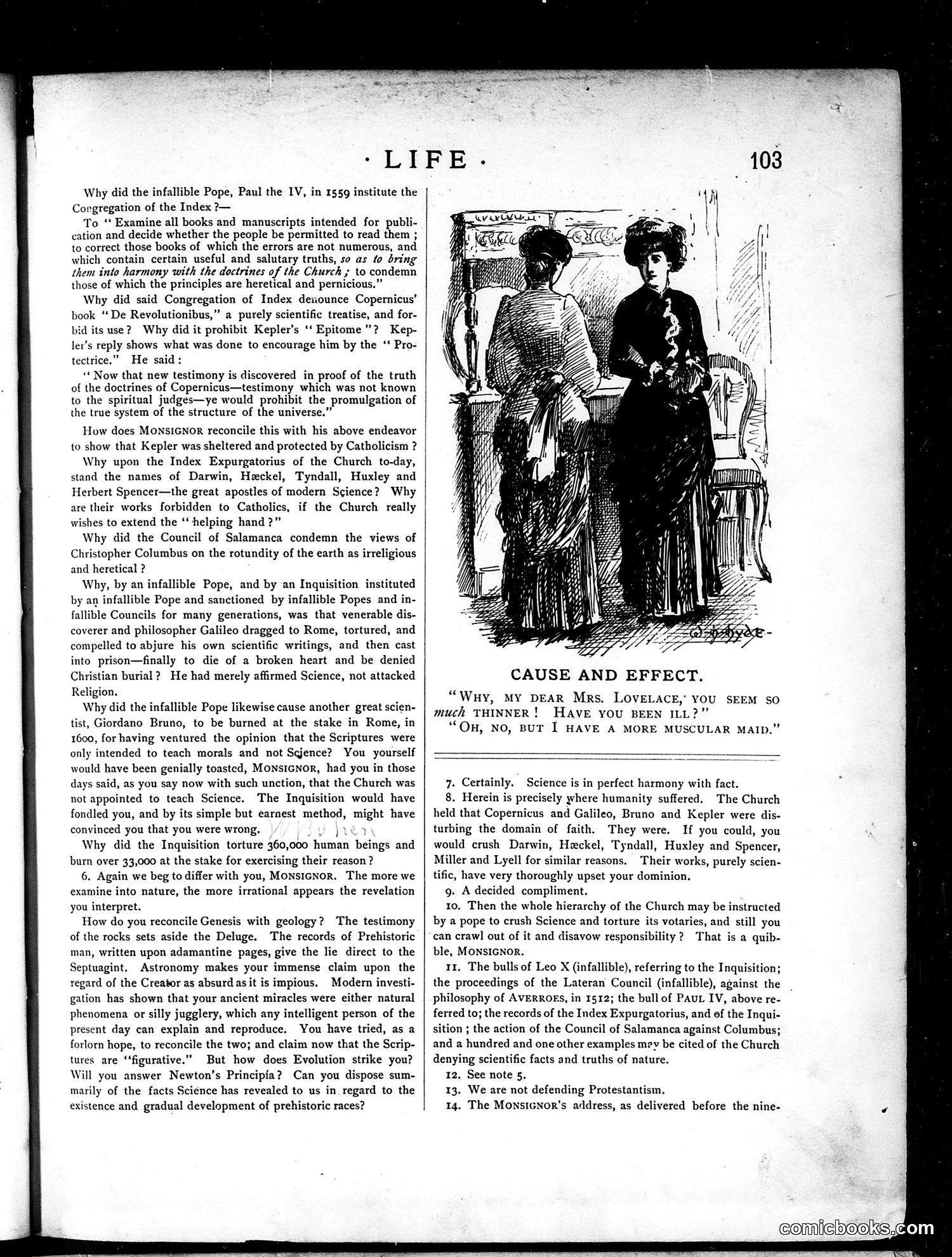
This single-panel satirical cartoon depicts two women in conversation. The caption reads: "Why, my dear Mrs. Lovelace, you seem so much thinner! Have you been ill?" The response: "Oh, no, but I have a more muscular maid." The joke plays on Victorian-era class assumptions about female thinness as a beauty standard and marker of leisure. The implication is that Mrs. Lovelace appears thinner not from illness but because she now has a stronger maid to do physical labor—previously requiring Mrs. Lovelace's own exertion. The satire critiques how wealthy women's bodies reflected their servants' labor, and how acquiring better household help signaled social status and allowed women to maintain fashionable thinness without actual hardship.
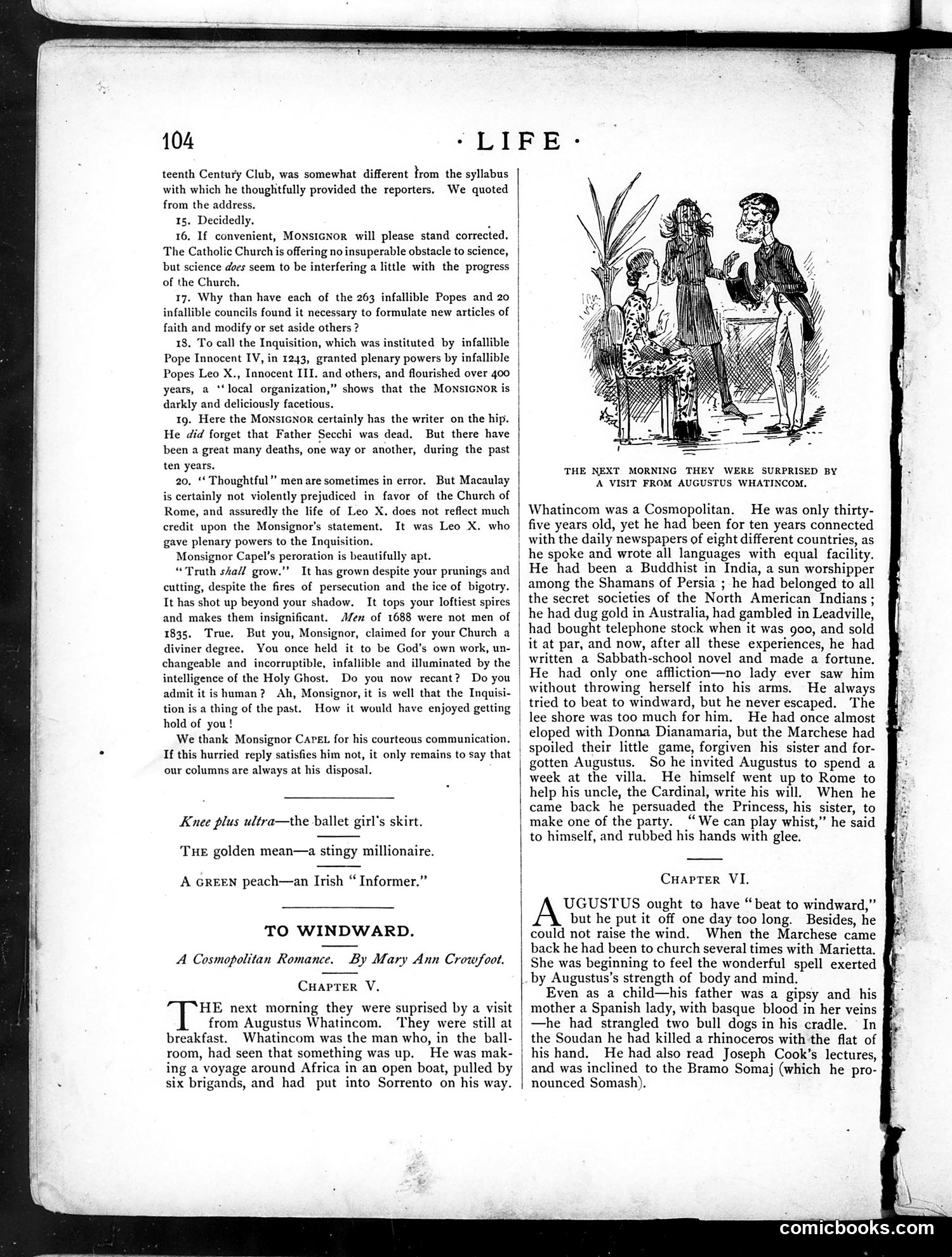
The illustrated cartoon depicts three figures in what appears to be a social scene. Based on the accompanying text from "To Windward: A Cosmopolitan Romance" by Mary Ann Crevefoot, this illustrates a moment when Augustus Whatincom, described as a thirty-five-year-old cosmopolitan adventurer, surprises the household during breakfast. The image shows what appears to be a well-dressed man greeting two women (likely including a nun or religious figure, given the habit visible). The caption reads "THE NEXT MORNING THEY WERE SURPRISED BY A VISIT FROM AUGUSTUS WHATINCOM." The satire appears to target Augustus's character—a globe-trotting dilettante with an exaggerated résumé of exotic experiences (Buddhist, gold digger, gambler, etc.), whose arrival disrupts domestic order. The humor lies in his pretentious cosmopolitanism and the social awkwardness his visit creates.
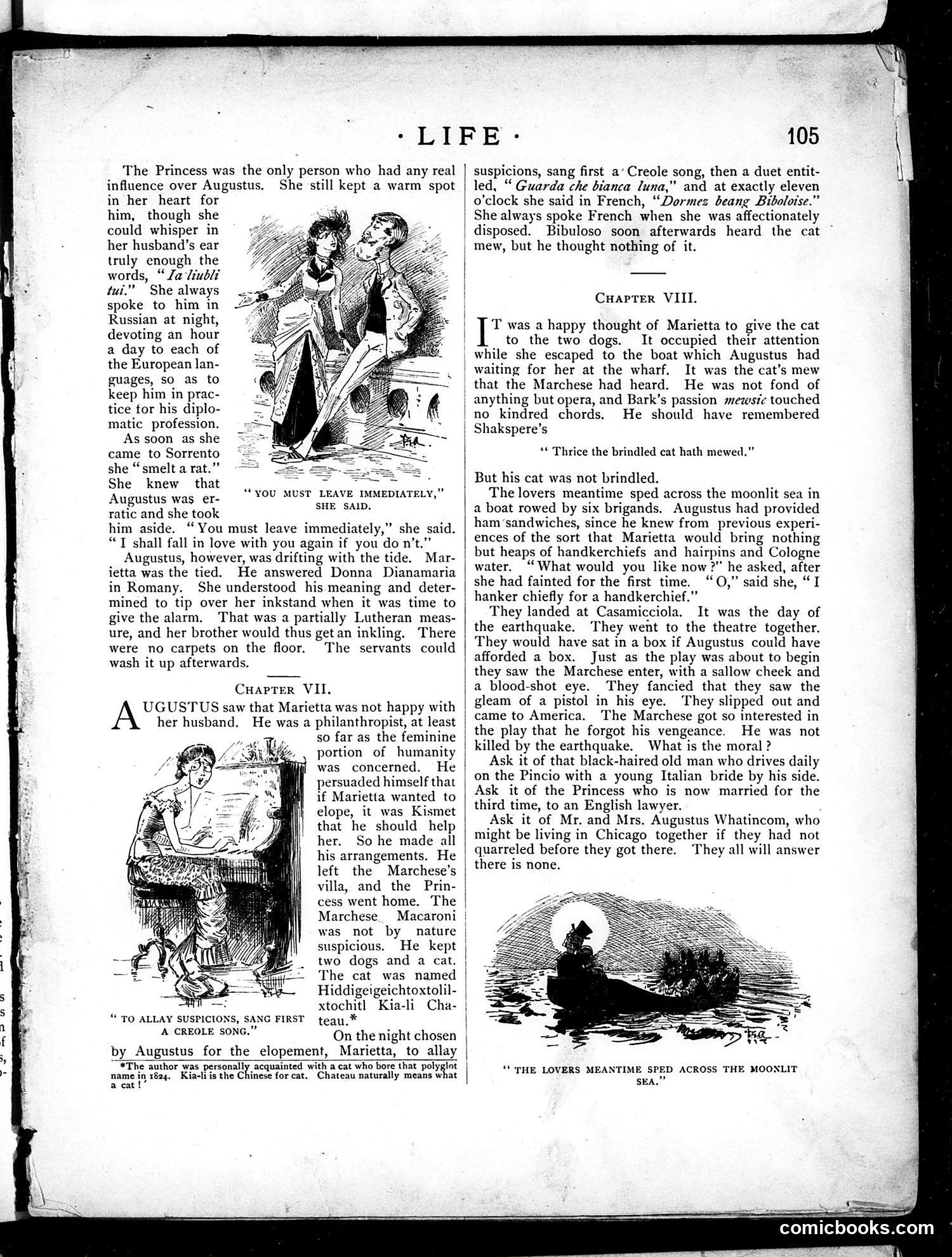
This page contains **serialized fiction**, not political satire or cartoons. It's Chapter VIII of a story involving characters named Marietta, Augustus, and a Marchese, with plot points about elopement, dogs, a cat, and travel to America. The three illustrations are **narrative drawings** accompanying the story: 1. A couple in period dress with the caption "You must leave immediately," she said" 2. A woman at a desk or table 3. A silhouette of lovers in a boat on moonlit water, captioned "The lovers meantime sped across the moonlit sea" These are conventional story illustrations of the era, not satirical content. The page represents Life magazine's literary serialization function—common in 19th-century periodicals—rather than its more famous satirical cartoons about politics and society.
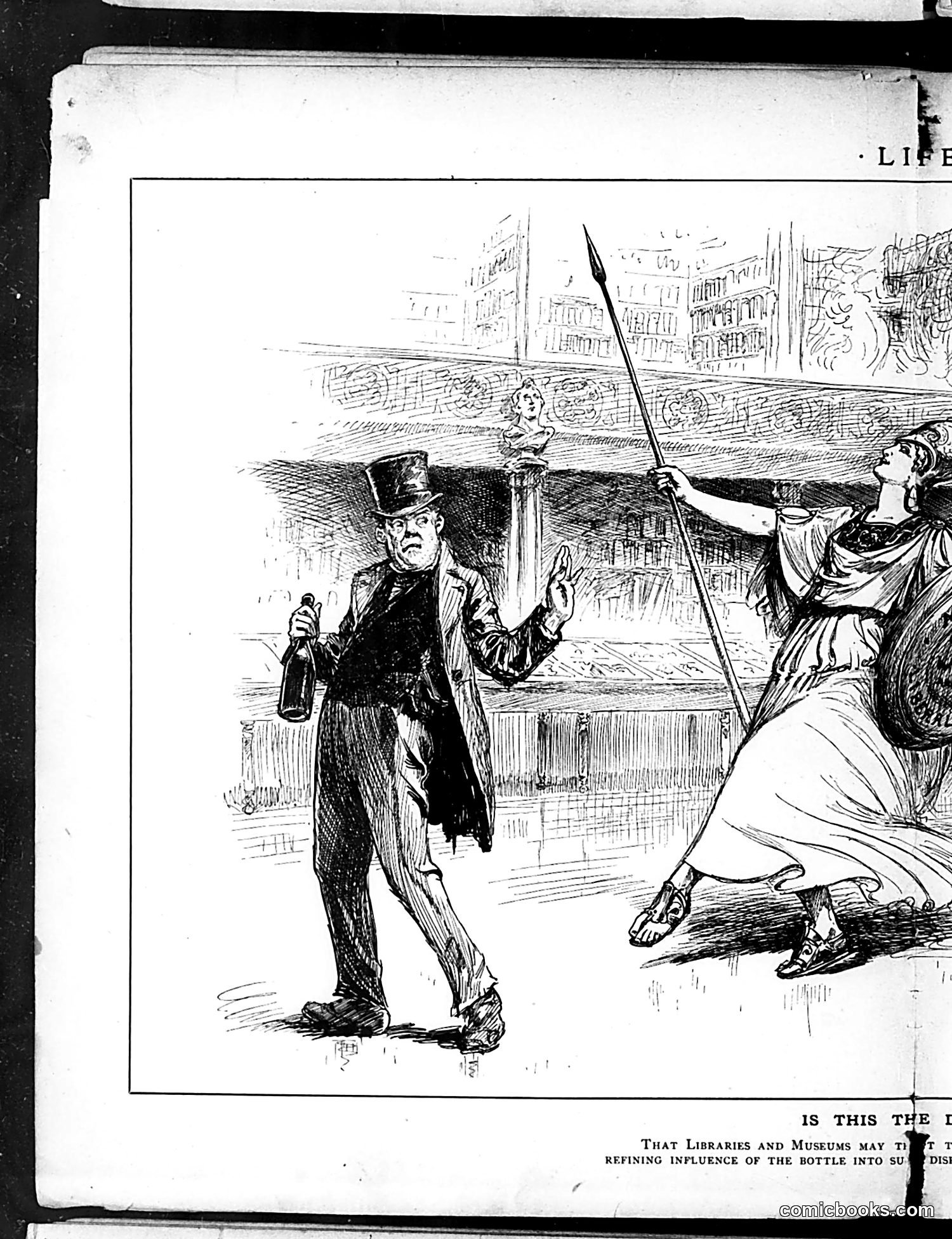
This appears to be a satirical cartoon from *Life* magazine depicting a confrontation between a well-dressed man in a top hat (likely representing a wealthy patron or cultural figure) and a woman wielding a large spear or pole (appears to represent "Britannia" or a figure symbolizing reform/activism). The caption references "libraries and museums" and "refining influence of the bottle into some" (text is cut off). The cartoon satirizes tension between cultural institutions and either prohibitionist movements or working-class activism. The gentleman's defensive posture and the woman's aggressive stance suggest mockery of reformist efforts or institutional pretension. Without the complete caption, the precise satirical target remains unclear—though it likely critiques either temperance advocates or challenges to elite cultural authority.
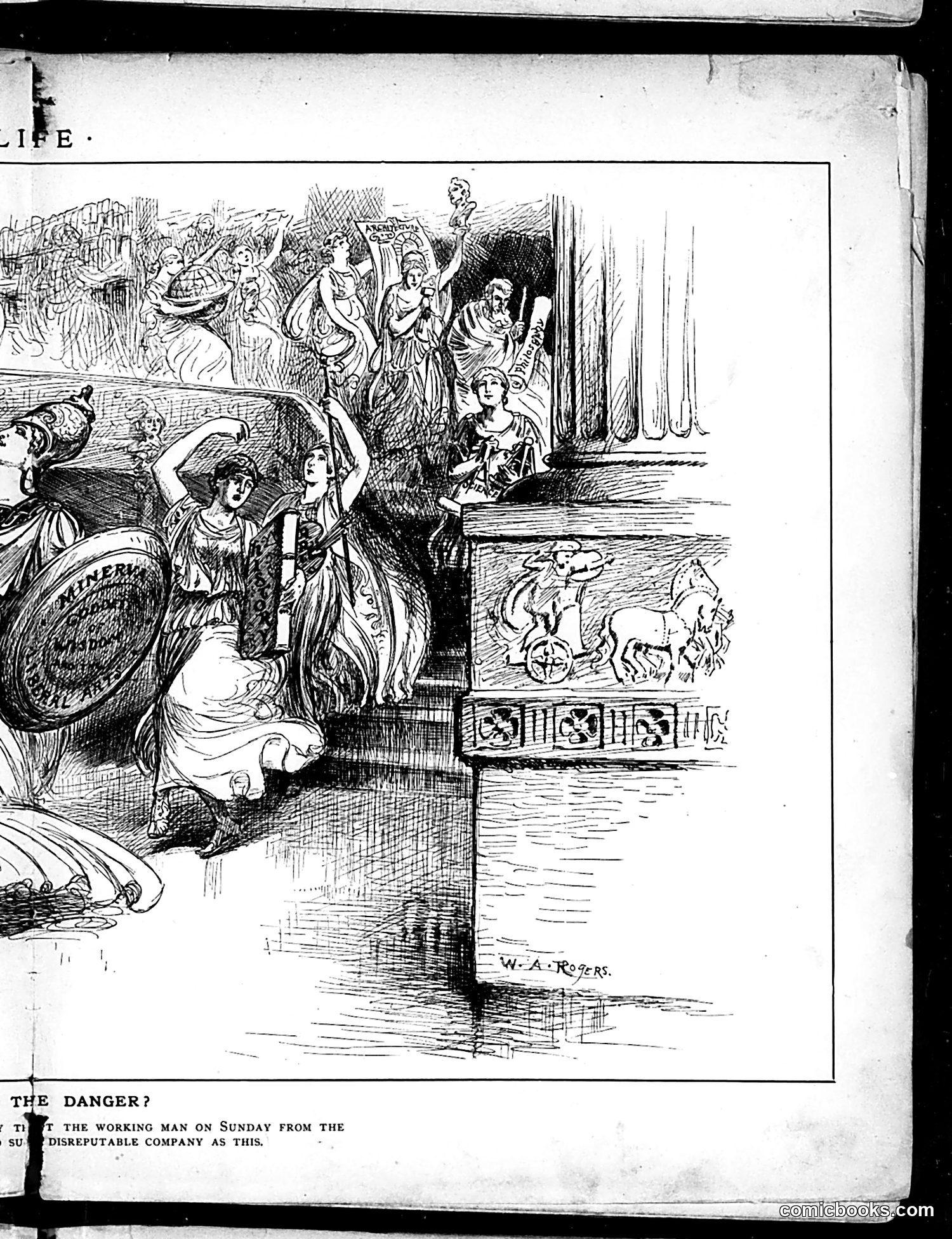
This appears to be a satirical commentary titled "THE DANGER?" critiquing "the working man on Sunday from the so disreputable company as this." The cartoon depicts what appears to be a theatrical or circus scene with classical/allegorical female figures (possibly representing virtues or social ideals) looking down disapprovingly at lower-class workers enjoying leisure activities on Sunday. The elaborate staging and the contrast between the elevated "respectable" figures and the working-class figures below suggests social class commentary. The satire likely critiques either Sunday labor practices, working-class recreation, or moral anxieties about workers' activities during their day of rest. The specific "disreputable company" referenced remains unclear without additional context, though the classical staging suggests concerns about cultural or moral standards of the era. The artist is credited as W.A. Rogers.
This page contains two pieces of **romantic/social satire** typical of Life magazine's humor. **The poem** (top) is a humorous Valentine's Day verse playfully cataloging a maiden's attractions—her eyes, lips, hands, and heart—while asking increasingly domestic questions (can she mend garments?). The satire gently mocks both romantic excess and the gap between idealized courtship and practical marriage. **The book review** (bottom) satirizes Philadelphia's rigid Quaker-descended society and the concept of the "flirt." It reviews *A Latter Day Saint*, describing protagonist Ethel Jones's scandalous behavior: talking to two men simultaneously, attending assemblies, allowing a kiss on the beach. The satire is heavy-handed—treating these minor social infractions as moral catastrophes. The joke targets Philadelphia's stifling conventionality and hypocrisy: a city so proper that innocent flirtation appears genuinely sinful. The reference to the Quaker who purchased the land "for a pack of prize candy" adds historical mockery of the city's founding restraint.
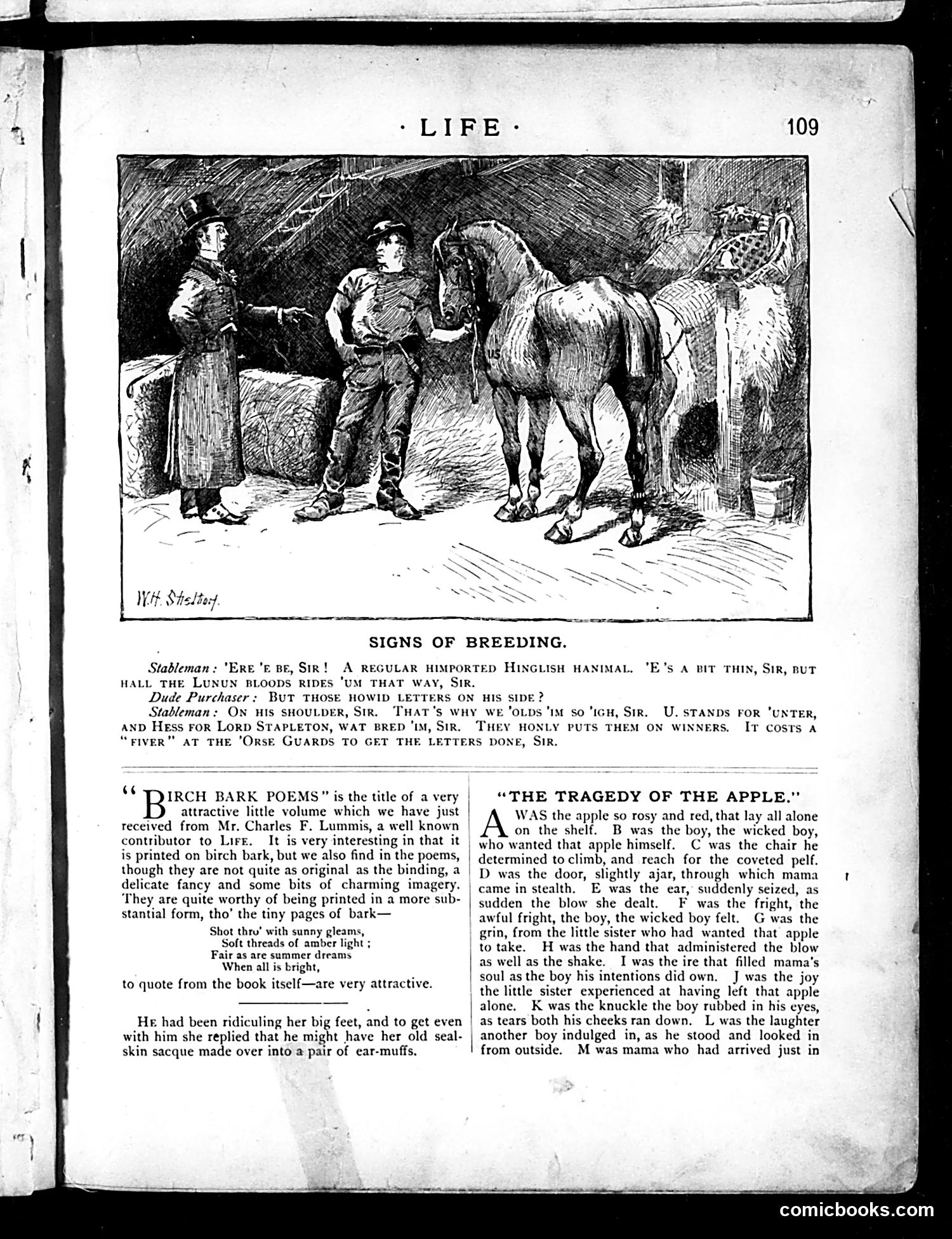
This cartoon satirizes class pretension and the English obsession with pedigree. A wealthy "dude purchaser" (likely American) is buying a horse from a working-class stableman. The stableman boasts the horse has "all the Lunun bloods"—aristocratic bloodlines—despite being thin. When the buyer notices letters ("U" and "H") branded on the horse's shoulder, the stableman explains they denote the horse's breeder: "U" for "Unter" and "H" for "Lord Stapleton." Only winning horses receive these expensive letter-brands (costing a "fiver"). The satire targets the absurdity of valuing animals (and by extension, people) purely by pedigree markers and breeding credentials, even when the animal itself appears inferior. The stableman's working-class dialect contrasts with the buyer's gullibility, mocking both social climbing and the shallow judgment of "breeding" as a measure of worth.
This page contains two distinct pieces of fiction from *Life* magazine, a 19th-century American satirical publication. The upper section is an alphabetical narrative about childhood punishment—a comedic recounting of a boy's misdeed (stealing an apple) and the escalating consequences from his mother and father, ending with him vowing revenge on the family cat. It's genteel Victorian humor about domestic discipline. The main story, "That Valentine," satirizes class anxiety and romantic pretension. Patricius De Vere O'Dowd is a poor Irish clerk at a Broadway dry-goods store who loves Amarylis McGettigan, daughter of a wealthy former politician (possibly connected to Tammany Hall corruption, given the Tweed reference). The satire lies in Patricius's pretentious French-style name masking his actual poverty—he can't pay his laundry bill or landlady, yet invests in expensive opera tickets and elaborate valentines to impress her. The story plays on the tension between romantic aspiration and financial reality, ending with Amarylis discovering his deception when he arrives without proper evening dress.
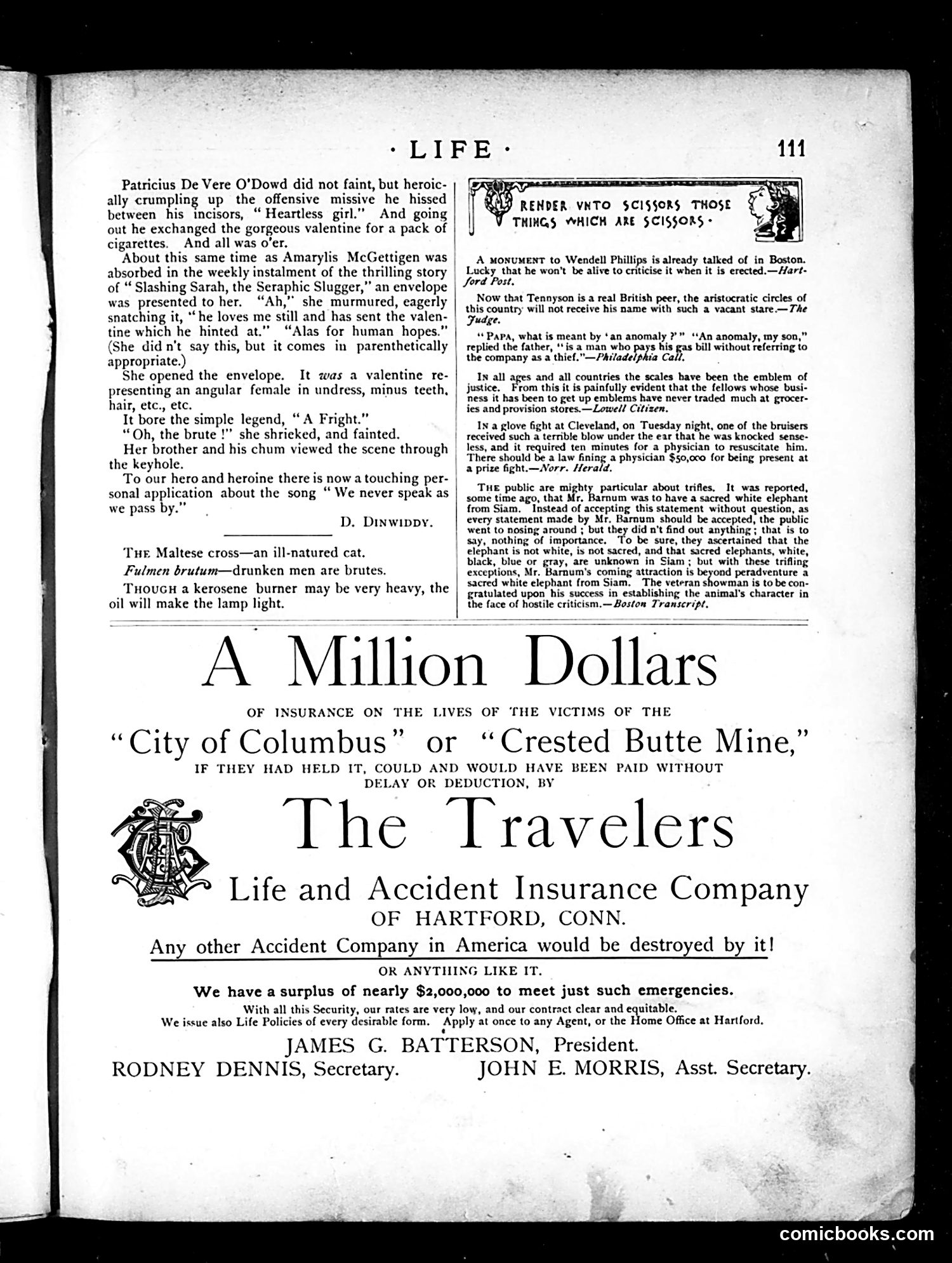
This page contains two distinct elements: **Upper Section - Satirical Stories:** Brief humorous vignettes about Valentine's Day mishaps. A man receives a romantic valentine but exchanges it for cigarettes; a woman receives a cruel valentine calling her "A Fright" and faints. The satire mocks sentimental romance and social pretension. Also includes dictionary-style jokes ("Fulmen brutum—drunken men are brutes") and commentary on contemporary figures like Wendell Phillips and Tennyson. **Lower Section - Insurance Advertisement:** A full-page ad for The Travelers Life and Accident Insurance Company (Hartford, Connecticut) capitalizing on two recent disasters: the "City of Columbus" (likely a shipwreck) and the "Crested Butte Mine" (mining disaster). The company boasts it would have paid victims' families "$a Million Dollars" without delay, claiming a $2,000,000 surplus and superior reliability compared to competitors. This appears to be opportunistic disaster-marketing—using real tragedies to advertise insurance coverage.
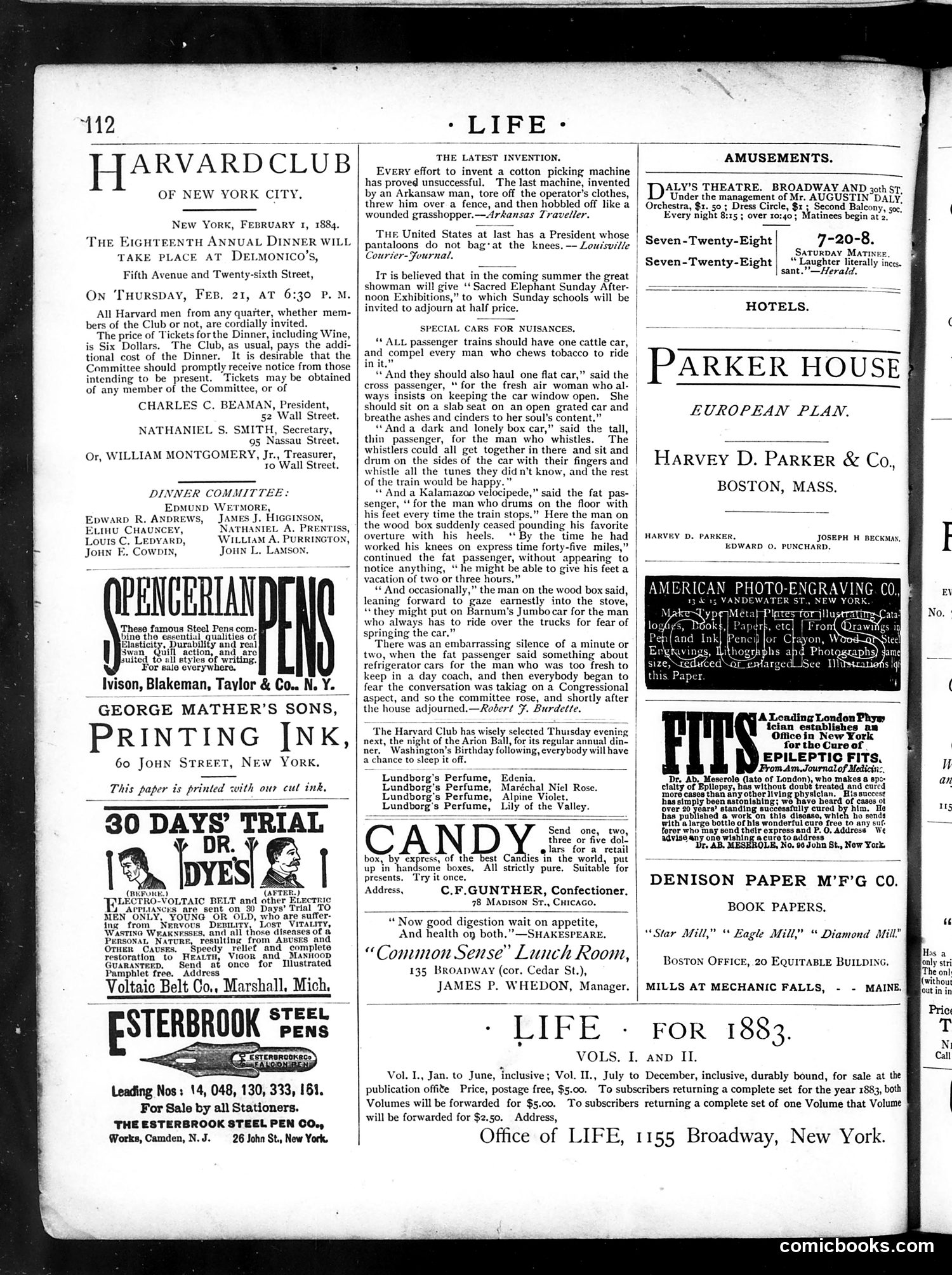
This page is predominantly **advertisements and announcements** rather than political cartoons or satirical illustrations. The main content includes: - A Harvard Club of New York City dinner announcement (February 21, 1884) - Product advertisements (printing ink, steel pens, electrical belts, candies) - A brief "Latest Invention" humor section mocking failed cotton-picking machinery from Arkansas The only satirical content is the short **"Special Cars for Nuisances"** piece—a train-car satire where passengers humorously propose segregating annoying fellow travelers (the woman who opens windows, the man who whistles, the foot-drummer). It's gentle social satire about shared transportation etiquette, reflecting 1880s urban frustrations with public transit rather than political commentary. The page reflects Life's mix of high-society notices, advertising revenue, and brief humor pieces typical of the era.
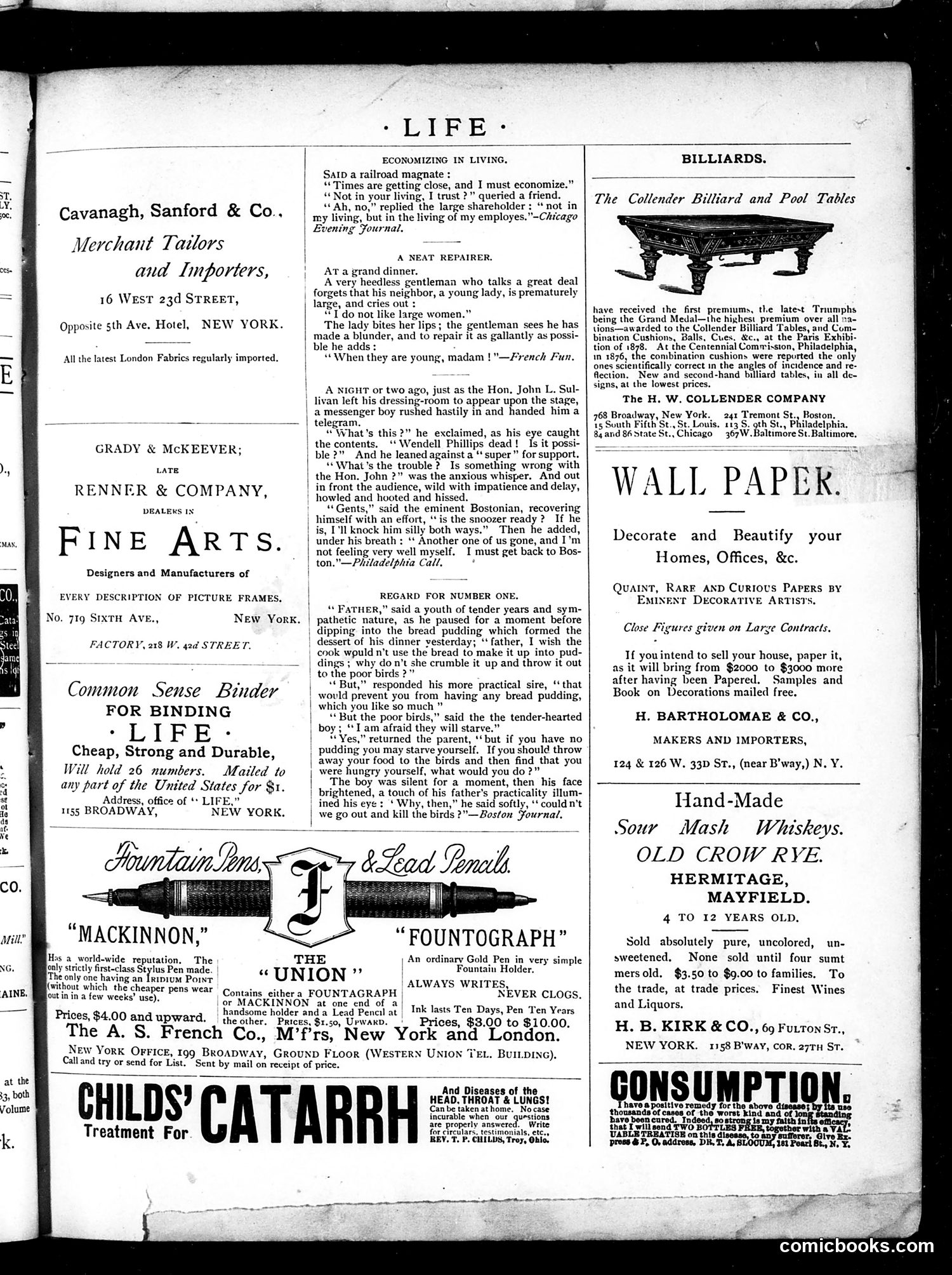
This is primarily an **advertising page** with minimal satirical content. The few short humor pieces included are: 1. **"Economizing in Living"**: A railroad magnate claims to economize during hard times—but only by cutting his *employees'* wages, not his own lifestyle. This satirizes wealthy industrialists' hypocrisy during economic downturns. 2. **"A Neat Repairer"**: A man insults a woman by saying he dislikes "large women," then awkwardly tries to recover by adding "when they are young, madam!" The humor relies on his failed social repair. 3. **"A Night or Two Ago"**: References boxer John L. Sullivan receiving news of abolitionist Wendell Phillips's death mid-performance. Sullivan's self-centered response—worrying about his own health rather than Phillips's passing—is the satirical point. 4. **"Regard for Number One"**: A boy suggests feeding bread pudding to poor birds; his father's practical response reveals the boy ultimately cares more about himself than charity. The page's dominant purpose is advertising merchant tailors, art suppliers, billiard tables, wall paper, and fountain pens.
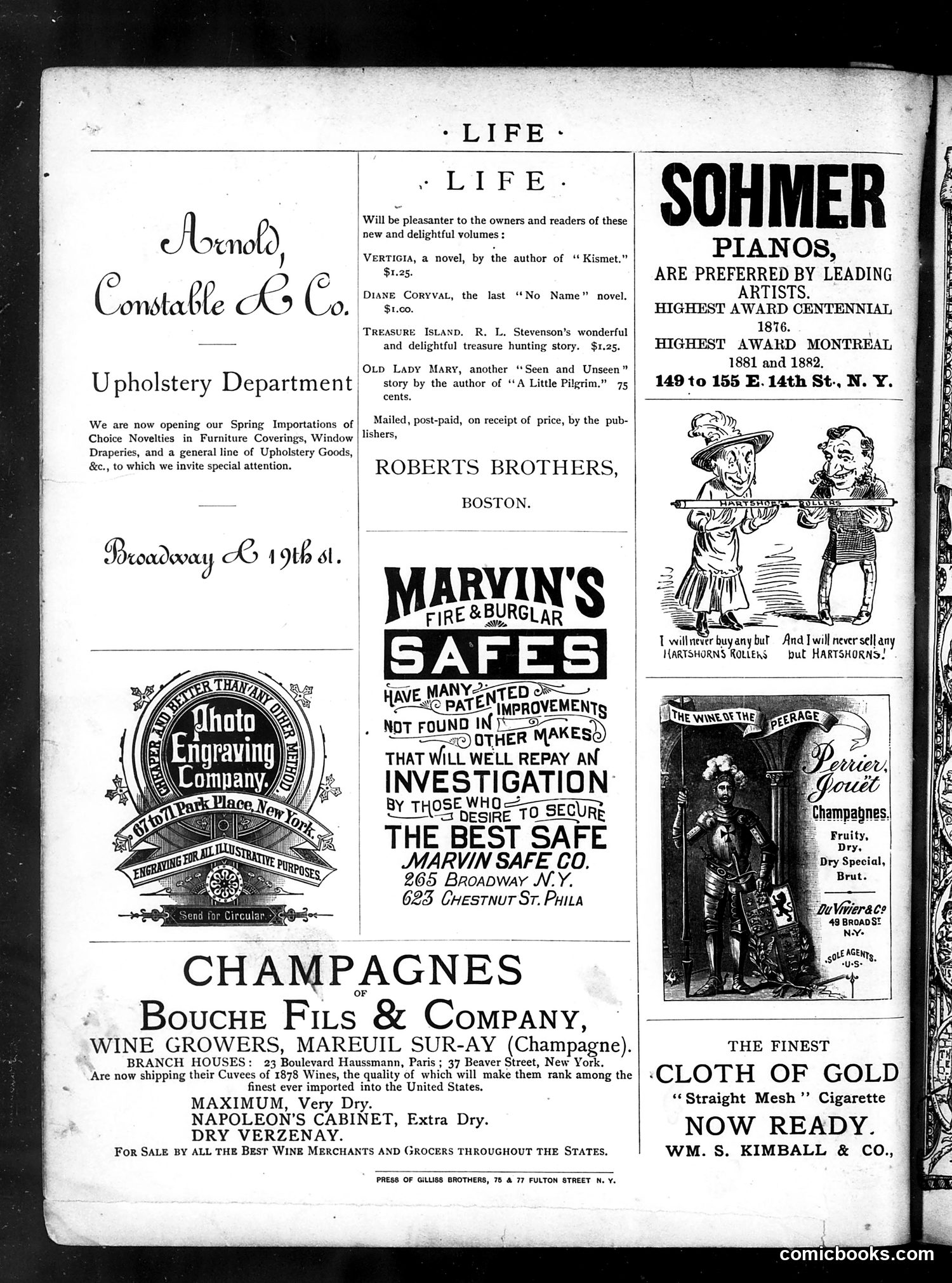
This is primarily a **commercial advertisement page** from Life magazine, not a political cartoon page. It contains multiple product advertisements typical of late 19th-century American publications. The only illustrated content appears to be two small cartoons advertising **Hartshorns Rollers** (window shade hardware). One cartoon shows a woman and man in conversation, with dialogue about never buying or selling competing products—a humorous pitch for brand loyalty using domestic comedy. The page also advertises: - Upholstery goods and furniture - Books from Roberts Brothers publisher (including Stevenson's *Treasure Island*) - Marvin Fire & Burglar Safes - Champagne from Bouche Fils & Company - Sohmer Pianos (award-winning) - Cloth of Gold cigarettes **No political satire is present.** This reflects Life's evolution: while it began as a satirical publication, by this period it had become increasingly commercial, mixing editorial content with extensive advertising to sustain operations.