
Life, 1884-02-21 · page 11 of 16
Life — February 21, 1884 — page 11: what you’re looking at
What you’re looking at
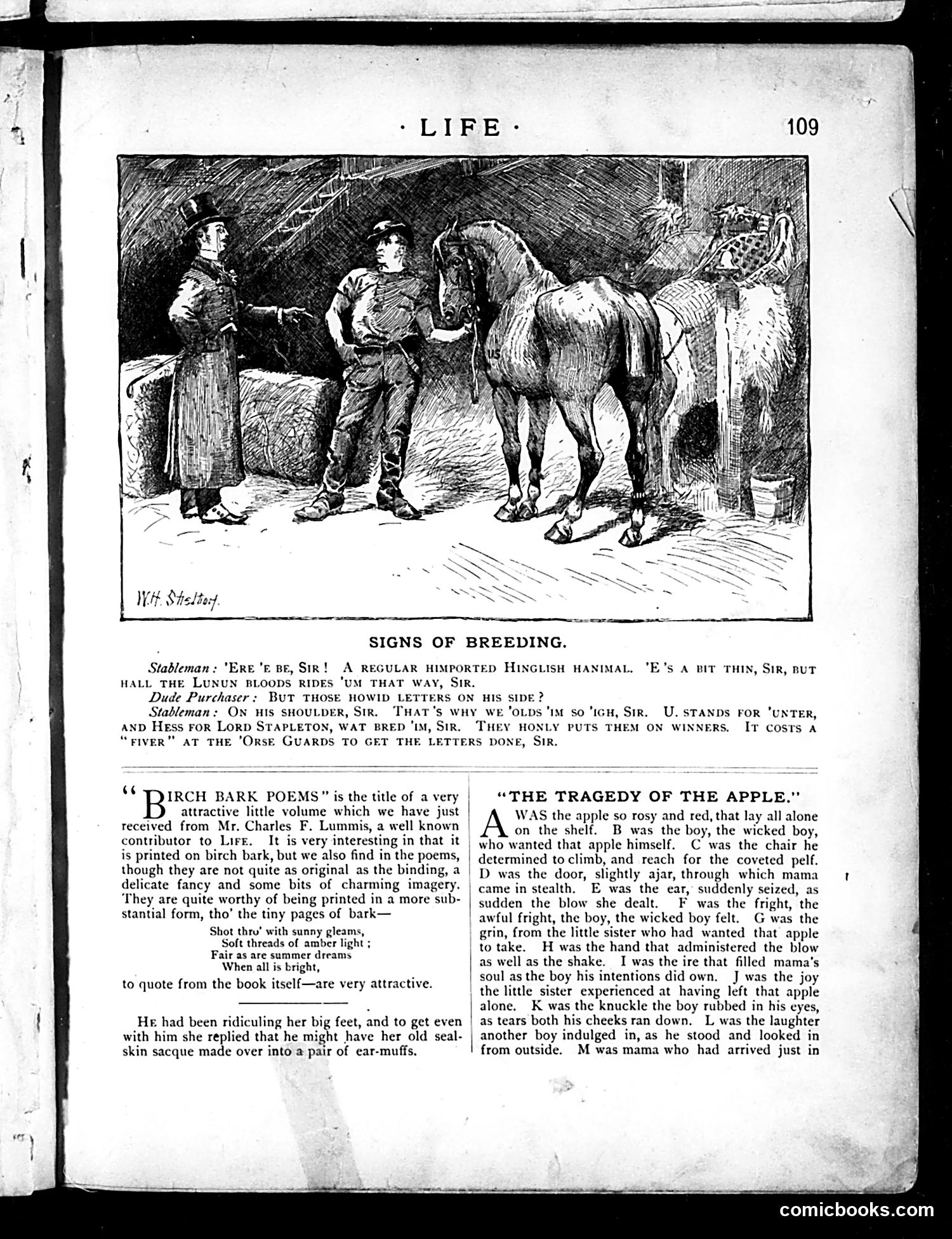
This cartoon satirizes class pretension and the English obsession with pedigree. A wealthy "dude purchaser" (likely American) is buying a horse from a working-class stableman. The stableman boasts the horse has "all the Lunun bloods"—aristocratic bloodlines—despite being thin. When the buyer notices letters ("U" and "H") branded on the horse's shoulder, the stableman explains they denote the horse's breeder: "U" for "Unter" and "H" for "Lord Stapleton." Only winning horses receive these expensive letter-brands (costing a "fiver"). The satire targets the absurdity of valuing animals (and by extension, people) purely by pedigree markers and breeding credentials, even when the animal itself appears inferior. The stableman's working-class dialect contrasts with the buyer's gullibility, mocking both social climbing and the shallow judgment of "breeding" as a measure of worth.
📄 Transcribed text from this page (OCR, searchable)
Machine-transcribed from the original scan — historical spelling and the odd misread are preserved.
SIGNS OF BREEDING. Stableman: 'ERE'E BE, SIR! A REGULAR HIMPORTED HINGLISH HANIMAL. ’E’s A BIT THIN, SIR, BUT HALL THE LUNUN BLOODS RIDES 'UM THAT WAY, SIR. Dude Purchaser; BUT THOSE HOWID LETTERS ON HIS SIDE? Stableman: ON His SHOULDER, Str. THAT'S WHY WE 'OLDS ‘IM So 'IGH, SIR. U. STANDS FOR "UNTER, AND Hess For Lorp STAPLETON, WAT BRED ‘IM, SIR. THEY HONLY PUTS THEM ON WINNERS. It Costs A “FIVER” AT THE 'ORSE GUARDS TO GET THE LETTERS DONE, SIR. IRCH BARK POEMS" is the title of a very | attractive little volume which we have just ed from Mr. Charles F. Lummis, a well known | contributor to Lirg. It is very interesting in that it is printed on birch bark, but we also find in the poems, | though they are not quite as original as the binding, a delicate fancy and some bits of charming imagery. They are quite worthy of being printed in a more sub- stantial form, tho’ the tiny pages of bark— Shot thro’ with sunny gleams, Soft threads of amber light ; Fair as are summer dreams When all is bright, to quote from the book itself—are very attractive. HE had been ridiculing her big feet, and to get even with him she replied that he might have her old seal- skin sacque made over into a pair of ear-muffs, “THE TRAGEDY OF THE APPLE.” WAS the apple so rosy and red, that lay all alone on the shelf. B was the boy, the wicked boy, who wanted that apple himself. C was the chair he determined to climb, and reach for the coveted pelf. D was the door, slightly ajar, through which mama came in stealth, E was the ear, suddenly seized, as sudden the blow she dealt. F was the fright, the awful fright, the boy, the wicked boy felt. G was the grin, from the little sister who had wanted that apple to take. H was the hand that administered the blow as well as the shake. I was the ire that filled mama's soul as the boy his intentions did own. J was the joy | the little sister experienced at having left that apple alone. K was the knuckle the boy rubbed in his eyes, as tears both his cheeks ran down. L was the laughter another boy indulged in, as he stood and looked in from outside. M was mama who had arrived just in comicbooks.com