
Life, 1884-02-21 · page 2 of 16
Life — February 21, 1884 — page 2: what you’re looking at
What you’re looking at
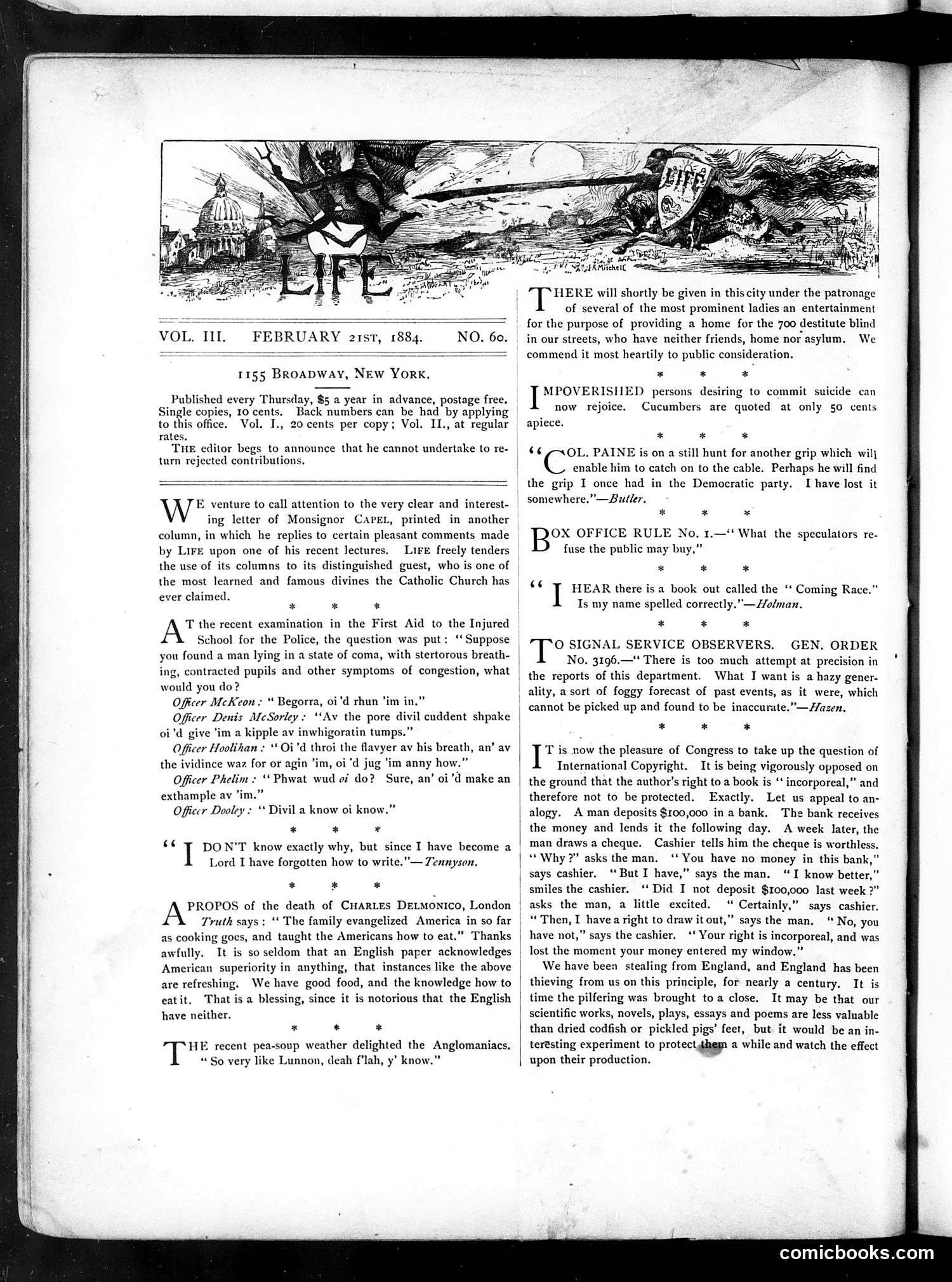
The masthead cartoon depicts "LIFE" as a winged figure battling dark forces (possibly representing death or corruption), set against a cityscape. This reflects the magazine's satirical mission as social critic. The text consists primarily of brief humorous anecdotes and editorial commentary rather than political cartoons. Notable items include: - A joke about a First Aid examination involving medical terminology - A reference to "Colonel Paine" seeking a political "grip" he lost in the Democratic Party - Commentary on international copyright protection (a contemporary debate) - A banking analogy about deposits and worthless checks The content reflects 1880s American concerns: medical education, party politics, intellectual property rights, and financial trust. The humor relies on wordplay and topical references that would resonate with educated urban readers of the era.
📄 Transcribed text from this page (OCR, searchable)
Machine-transcribed from the original scan — historical spelling and the odd misread are preserved.
Ii. FEBRUARY aust, 1884. VOL. 1155 BROADWAY, NEw YorK. Published every Thursday, $5 a year in advance, postage free. Single copies, 10 cents. Back numbers can be had by applying to this office. Vol. I., 20 cents per copy; Vol. II., at regular rates, THE editor begs to announce that he cannot undertake to re- turn rejected contributions. E venture to call attention to the very clear and interest- ing letter of Monsignor Caper, printed in another column, in which he replies to certain pleasant comments made by Lire upon one of his recent Jectures. LiFe freely tenders the use of its columns to its distinguished guest, who is one of the most learned and famous divines the Catholic Church has ever claimed. * * * T the recent examination in the First Aid to the Injured School for the Police, the question was put: ‘Suppose you found a man lying in a state of coma, with stertorous breath- ing, contracted pupils and other symptoms of congestion, what would you do? Officer McKeon : “ Begorra, oi'd rhun ‘im in,” Officer Denis McSorley : *‘Aw the pore divil cuddent shpake oi'd give ‘im a kipple av inwhigoratin tumps.” Officer Hoolihan : “« Oi'd throi the flavyer av his breath, an’ av the ividince waz for or agin ‘im, oi 'd jug 'im anny how.” Officer Phelim : “Phwat wud of do? Sure, an’ oid make an exthample av ‘im.” Officer Dooley : * Divil a know oi know.” * * * 6¢ T DON’T know exactly why, but since I have become a Lord I have forgotten how to write."— Tennyson. * * * PROPOS of the death of CHARLES DELMontco, London Truth says; “ The family evangelized America in so far as cooking goes, and taught the Americans how to eat.” Thanks awfully. ‘American superiority in anything, that instances like the above are refreshing. eat it. have neither. * * * HE recent pea-soup weather delighted the Anglomaniacs. | “ So very like Lunnon, deah f'lah, y’ know.” It is so seldom that an English paper acknowledges | We have good food, and the knowledge how to | That is a blessing, since it is notorious that the English | HERE will shortly be given in this city under the patronage of several of the most prominent ladies an entertainment for the purpose of providing a home for the 700 destitute blind in our streets, who have neither friends, home nor asylum, We commend it most heartily to public consideration. * * * MPOVERISHIED persons desiring to commit suicide can now rejoice. Cucumbers are quoted at only 50 cents apiece. * * * 66 -AOL. PAINE is on a still hunt for another grip which wil] ( enable him to catch on to the cable. Perhaps he will find the grip I once had in the Democratic party. I have lost it somewhere.” —Butler, * * * OX OFFICE RULE No. 1.—‘‘ What the speculators re- fuse the public may buy,” % * * 66 7 HEAR there isa book out called the ‘ Coming Race.” Is my name spelled correctly.”—Holman. * * * O SIGNAL SERVICE OBSERVERS. GEN. ORDER No. 3196.—"‘ There is too much attempt at precision in the reports of this department. What I want is a hazy gener- ality, a sort of foggy forecast of past events, as it were, which cannot be picked up and found to be inaccurate.”—Hazen. I [ is now the pleasure of Congress to take up the question of International Copyright. It is being vigorously opposed on the ground that the author's right to a book is ‘ incorporeal,” and therefore not to be protected. Exactly. Let us appeal to an- alogy. A man deposits $100,000 in a bank. The bank receives the money and lends it the following day. A week later, the man draws a cheque. Cashier tells him the cheque is worthless. ‘Why ?” asks the man. ‘‘ You have no money in this bank,” says cashier. ‘But I have,” says the man. “I know better,” smiles the cashier. ‘‘ Did I not deposit $100,000 last week ?” asks the man, a little excited. “Then, I havea right to draw it out,” says the man. “No, you have not,” says the cashier. ‘* Your right is incorporeal, and was lost the moment your money entered my window.” We have been stealing from England, and England has been thieving from us on this principle, for nearly a century. It is time the pilfering was brought toa close. It may be that our * * * “ Certainly,” says. cashier, | scientific works, novels, plays, essays and poems are less valuable | than dried codfish or pickled pigs’ feet, but it would be an in- teresting experiment to protecthem a while and watch the effect upon their production. comicbooks.com