
Life, 1884-02-21 · page 4 of 16
Life — February 21, 1884 — page 4: what you’re looking at
What you’re looking at
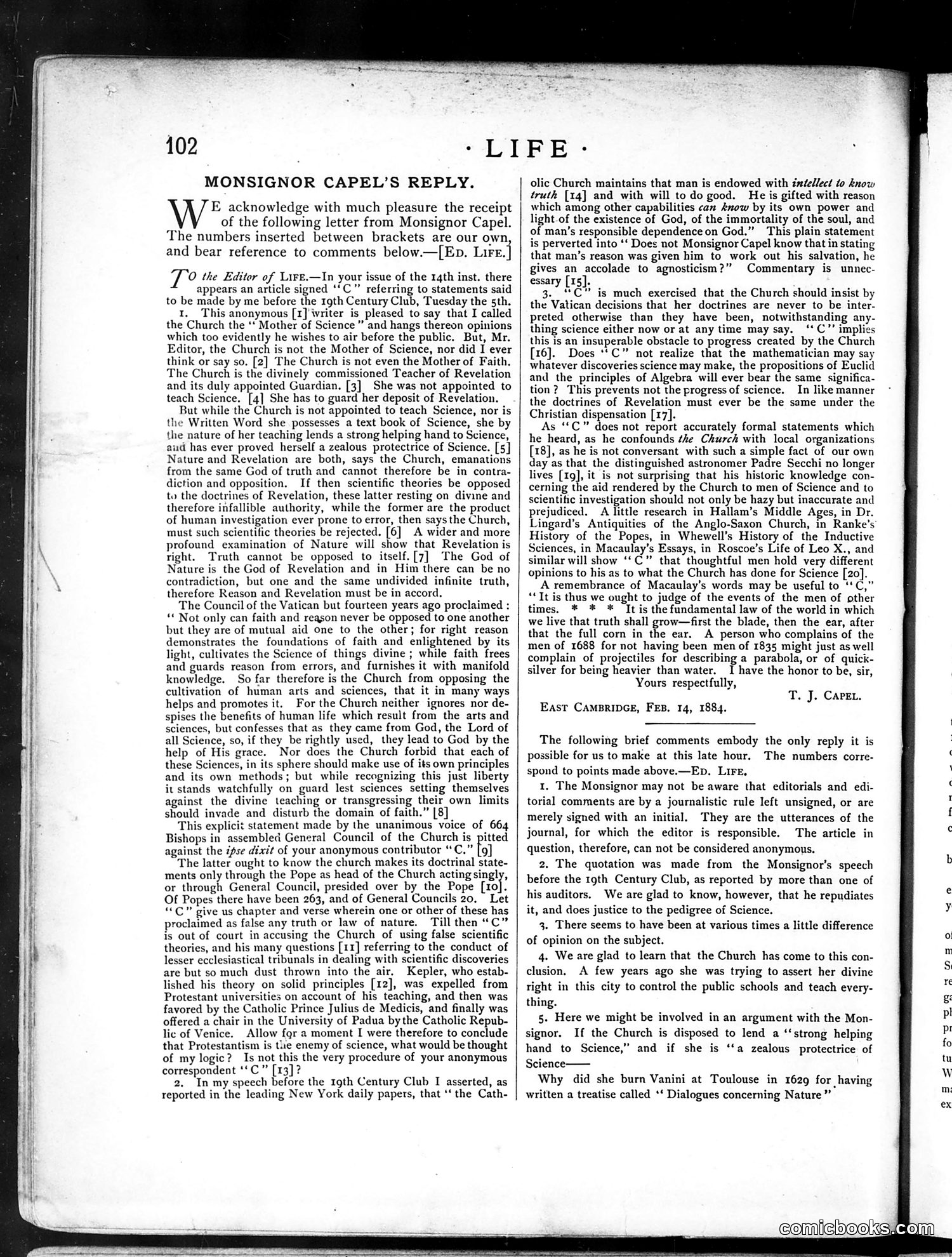
This page contains no cartoon or satirical illustration. It is entirely textual content consisting of two sections: 1. **"Monsignor Capel's Reply"** — a letter from Monsignor T.J. Capel responding to criticisms about the Catholic Church's stance on science and reason, particularly addressing claims that the Church opposes scientific progress. 2. **Editorial commentary** from Life's editors responding to Capel's letter, offering numbered counterpoints about journalism ethics, the Church's historical position on education and science, and references to historical figures like Vanini. The debate concerns whether faith and reason are compatible, and whether the Church appropriately supports or hinders scientific investigation. This appears to be part of a larger 19th-century controversy about religion and science.
📄 Transcribed text from this page (OCR, searchable)
Machine-transcribed from the original scan — historical spelling and the odd misread are preserved.
102 > LIFE: MONSIGNOR CAPEL’S REPLY. \ \ 7 acknowledge with much pleasure the receipt of the following letter from Monsignor Capel. The numbers inserted between brackets are our own, and bear reference to comments below.—[Ep. Lire. T° the Editor of Lire.—In your issue of the 14th inst. there appears an article signed ‘‘C” referring to statements said to be made by me before the 19th Century Club, Tuesday the 5th. 1._ This anonymous [1] writer is pleased to say that I called the Church the ‘* Mother of Science” and hangs thereon opinions which too evidently he wishes to air before the public. But, Mr. Editor, the Church is not the Mother of Science, nor did I ever think or say so. [2] The Church is not even the Mother of Faith. The Church is the divinely commissioned Teacher of Revelation and its duly appointed Guardian, [3] She was not appointed to teach Science. [4] She has to guard her deposit of Revelation. But while the Church is not appointed to teach Science, nor is the Written Word she possesses a text book of Science, she by the nature of her teaching lends a strong helping hand to Science, aud has ever proved herself a zealous protectrice of Science. [5] Nature and Revelation are both, says the Church, emanations from the same God of truth and cannot therefore be in contra- diction and opposition. If then scientific theories be opposed to the doctrines of Revelation, these latter resting on divine and therefore infallible authority, while the former are the product of human investigation ever prone to error, then saysthe Church, must such scientific theories be rejected. [6] A wider and more profound examination of Nature will show that Revelation is right. Truth cannot be opposed to itself.[7] The God of Nature is the God of Revelation and in Him there can be no contradiction, but one and the same undivided infinite truth, therefore Reason and Revelation must be in accord. The Council of the Vatican but fourteen years ago proclaimed : ‘« Not only can faith and reason never be opposed to one another but they are of mutual aid one to the other; for right reason demonstrates the foundations of faith and enlightened by its light, cultivates the Science of things divine ; while faith frees and guards reason from errors, and furnishes it with manifold knowledge. So far therefore is the Church from opposing the cultivation of human arts and sciences, that it in many ways helps and promotes it. For the Church neither ignores nor de- spises the benefits of human life which result from the arts and sciences, but confesses that as they came from God, the Lord of all Science, so, if they be rightly used, they lead to God by the help of His grace. Nor does the Church forbid that each of these Sciences, in its sphere should make use of its own principles and its own methods; but while recognizing this just liberty it stands watchfully on guard lest sciences setting themselves against the divine teaching or transgressing their own limits should invade and disturb the domain of faith.” [8] This explicit statement made by the unanimous voice of 664 Bishops in assembled General Council of the Church is pitted against the ipse dixit of your anonymous contributor “C.” [9] The latter ought to know the church makes its doctrinal state- ments only through the Pope as head of the Church acting singly, or through General Council, presided over by the Pope [rol Of Popes there have been 263, and of General Councils 20. Let “C” give us chapter and verse wherein one or other of these has proclaimed as false any truth or law of nature. Till then “C” is out of court in accusing the Church of using false scientific theories, and his many questions [11] referring to the conduct of lesser ecclesiastical tribunals in dealing with scientific discoveries are but so much dust thrown into the air. Kepler, who estab- lished his theory on solid principles [12], was expelled from Protestant universities on account of his teaching, and then was favored by the Catholic Prince Julius de Medicis, and finally was offered a chair in the University of Padua bythe Catholic Repub- lic of Venice. Allow for a moment I were therefore to conclude that Protestantism is te enemy of science, what would be thought of my logic? Is not this the very procedure of your anonymous correspondent ‘*C” [13]? 2. In my speech before the 19th Century Club I asserted, as reported in the leading New York daily papers, that ‘‘ the Cath- olic Church maintains that man is endowed with intellect to know truth [14] and with will to do good. He is gifted with reason which among other capabilities can Anow by its own power and light-of the existence of God, of the immortality of the soul, and of man’s responsible dependence on God.” This plain statement is perverted into ‘* Does not Monsignor Capel know that in stating that man’s reason was given him to work out his salvation, he gives an accolade to agnosticism?” Commentary is unnec- essary [15]. . “C” is much exercised that the Church should insist by the Vatican decisions that her doctrines are never to be inter- preted otherwise than they have been, notwithstanding any- thing science either now or at any time may say. ‘*C”’ implies this is an insuperable obstacle to progress created by the Church [16]. Does ‘*C” not realize that the mathematician may say whatever discoveries science may make, the propositions of Euclid and the principles of Algebra will ever bear the same significa- tion? This prevents not the progress of science. In like manner the doctrines of Revelation must ever be the same under the Christian dispensation [17]. As ‘‘C” does not report accurately formal statements which he heard, as he confounds the Church with local organizations [18], as he is not conversant with such a simple fact of our own day as that the distinguished astronomer Padre Secchi no longer lives [19], it is not surprising that his historic knowledge con- cerning the aid rendered by the Church to men of Science and to scientific investigation should not only be hazy but inaccurate and prejudiced. A little research in Hallam’s Middle Ages, in Dr. Lingard’s Antiquities of the Anglo-Saxon Church, in Ranke'’s History of the Popes, in Whewell’s History of the Inductive Sciences, in Macaulay’s Essays, in Roscoe’s Life of Leo X., and similar will show ‘‘C” that thoughtful men hold very different opinions to his as to what the Church has done for Science [20]. A remembrance of Macaulay’s words may be useful to ‘‘C,” “*It is thus we ought to judge of the events of the men of other times. * * * It is the fundamental law of the world in which we live that truth shall grow—first the blade, then the ear, after that the full corn in the ear. A person who complains of the men of 1688 for not having been men of 1835 might just as well complain of projectiles for describing a parabola, or of quick- silver for being heavier than water. I have the honor to be, sir, Yours respectfully, T. J. Capen. East CAMBRIDGE, FEB. 14, 1884. The following brief comments embody the only reply it is possible for us to make at this late hour. The numbers corre- spond to points made above.—Ep, LIFE, 1. The Monsignor may not be aware that editorials and edi- torial comments are by a journalistic rule left unsigned, or are merely signed with an initial. They are the utterances of the journal, for which the editor is responsible. The article in question, therefore, can not be considered anonymous, 2, The quotation was made from the Monsignor’s speech before the 19th Century Club, as reported by more than one of his auditors. We are glad to know, however, that he repudiates it, and does justice to the pedigree of Science. 3. There seems to have been at various times a little difference of opinion on the subject. 4. We are glad to learn that the Church has come to this con- clusion, A few years ago she was trying to assert her divine right in this city to control the public schools and teach every- thing. 5. Here we might be involved in an argument with the Mon- signor. If the Church is disposed to lend a ‘strong helping hand to Science,” and if she is ‘‘a zealous protectrice of Science— Why did she burn Vanini at Toulouse in 1629 for having written a treatise called ‘‘ Dialogues concerning Nature” comichooksifom