
Life, 1884-02-21 · page 6 of 16
Life — February 21, 1884 — page 6: what you’re looking at
What you’re looking at
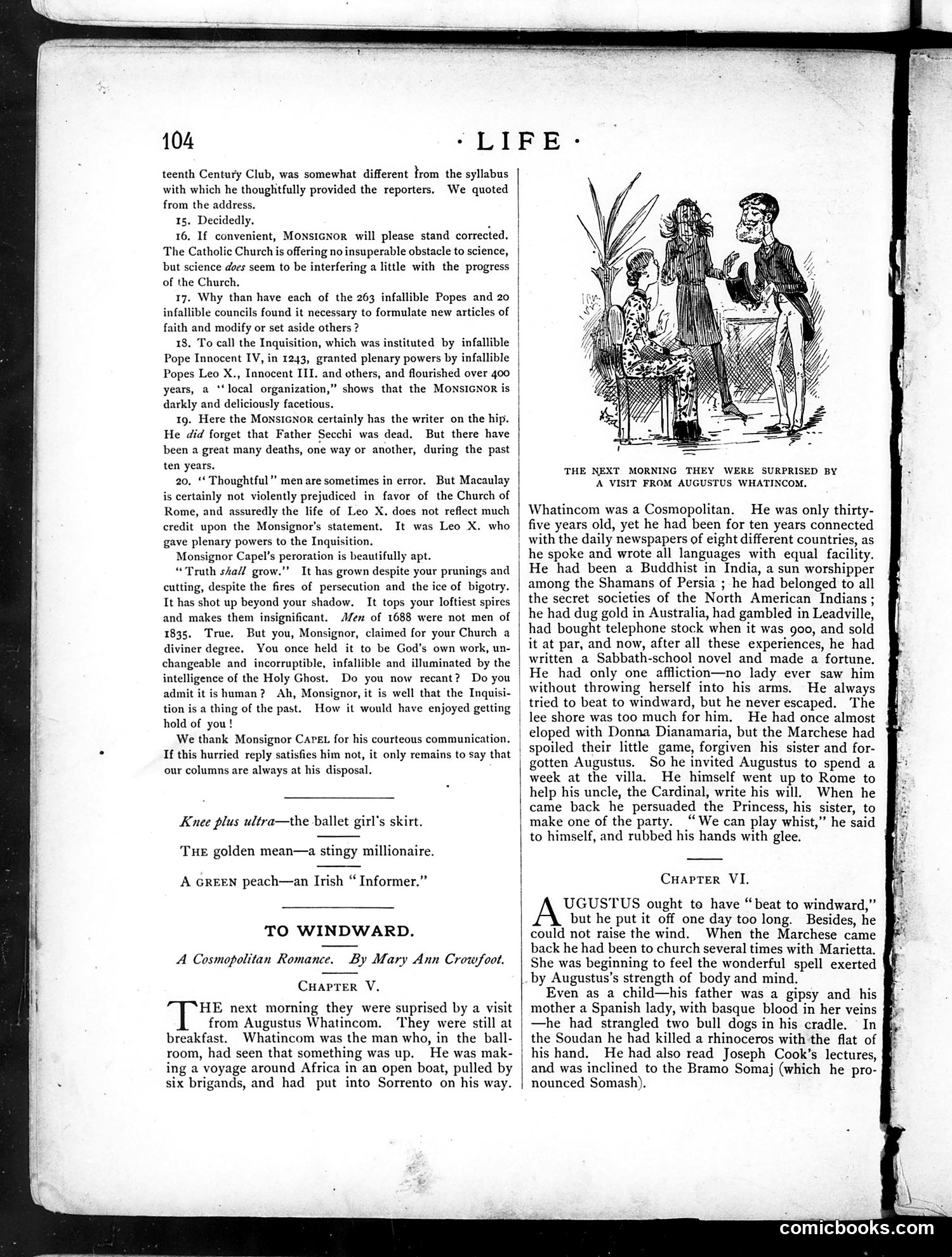
The illustrated cartoon depicts three figures in what appears to be a social scene. Based on the accompanying text from "To Windward: A Cosmopolitan Romance" by Mary Ann Crevefoot, this illustrates a moment when Augustus Whatincom, described as a thirty-five-year-old cosmopolitan adventurer, surprises the household during breakfast. The image shows what appears to be a well-dressed man greeting two women (likely including a nun or religious figure, given the habit visible). The caption reads "THE NEXT MORNING THEY WERE SURPRISED BY A VISIT FROM AUGUSTUS WHATINCOM." The satire appears to target Augustus's character—a globe-trotting dilettante with an exaggerated résumé of exotic experiences (Buddhist, gold digger, gambler, etc.), whose arrival disrupts domestic order. The humor lies in his pretentious cosmopolitanism and the social awkwardness his visit creates.
📄 Transcribed text from this page (OCR, searchable)
Machine-transcribed from the original scan — historical spelling and the odd misread are preserved.
104 teenth Century Club, was somewhat different from the syllabus with which he thouglitfully provided the reporters. We quoted from the address. 15. Decidedly. 16. If convenient, MoNsIGNor will please stand corrected. | The Catholic Church is offering no insuperable obstacle to science, | but science does seem to be interfering a little with the progress of the Church, 17. Why than have each of the 263 infallible Popes and 20 | infallible councils found it necessary to formulate new articles of faith and modify or set aside others ? 18, To call the Inquisition, which was instituted by infallible | Pope Innocent IV, in 1243, granted plenary powers by infallible Popes Leo X., Innocent III. and others, and flourished over 400 years, a ‘local organization,” shows that the MONSIGNoR is darkly and deliciously facetious. 19. Here the MonsiGNnor certainly has the writer on the hip. He did forget that Father Secchi was dead. But there have been a great many deaths, one way or another, during the past ten years. 20. ‘‘ Thoughtful” men are sometimes in error. But Macaulay is certainly not violently prejudiced in favor of the Church of Rome, and assuredly the life of Leo X. does not reflect much credit upon the Monsignor’s statement. It was Leo X. who gave plenary powers to the Inquisition. Monsignor Capel’s peroration is beautifully apt. “Truth shall grow.” It has grown despite your prunings and cutting, despite the fires of persecution and the ice of bigotry. It has shot up beyond your shadow. It tops your loftiest spires and makes them insignificant. Jen of 1688 were not men of 1835. True. But you, Monsignor, claimed for your Church a diviner degree. You once held it to be God’s own work, un- changeable and incorruptible, infallible and illuminated by the intelligence of the Holy Ghost. Do you now recant? Do you admit it ishuman? Ah, Monsignor, it is well that the Inquisi- tion is a thing of the past. How it would have enjoyed getting hold of you! We thank Monsignor Care for his courteous communication. If this hurried reply satisfies him not, it only remains to say that our columns are always at his disposal. Knee plus ultra—the ballet girl's skirt. Tue golden mean—a stingy millionaire. A GREEN peach—an Irish “ Informer.” TO WINDWARD. A Cosmopolitan Romance. By Mary Ann Crowfoot. Cuaprer V. HE next morning they were suprised by a visit from Augustus Whatincom. breakfast. Whatincom was the man who, in the ball- room, had seen that something was up. He was mak- ing a voyage around Africa in an open boat, pulled by six brigands, and had put into Sorrento on his way. | lee shore was too much for him. | eloped with Donna Dianamaria, but the Marchese had | week at the villa. ‘LIFE: THE NEXT MORNING THEY WERE SURPRISED BY A VISIT FROM AUGUSTUS WHATINCOM. Whatincom was a Cosmopolitan. He was only thirty- five years old, yet he had been for ten years connected | with the daily newspapers of eight different countries, as | he spoke and wrote all languages with equal facility. He had been a Buddhist in India, a sun worshipper among the Shamans of Persia ; he had belonged to all the secret societies of the North American Indians ; he had dug gold in Australia, had gambled in Leadville, had bought telephone stock when it was goo, and sold it at par, and now, after all these experiences, he had written a Sabbath-school novel and made a fortune. He had only one affliction—no lady ever saw him without throwing herself into his arms. He always tried to beat to windward, but he never escaped. The He had once almost spoiled their little game, forgiven his sister and for- gotten Augustus. So he invited Augustus to spend a He himself went up to Rome to help his uncle, the Cardinal, write his will. When he | came back he persuaded the Princess, his sister, to | make one of the party. “We can play whist,” he said to himself, and rubbed his hands with glee. Cuaprer VI. UGUSTUS ought te have “beat to windward,” but he put it off one day too long. Besides, he could not raise the wind. When the Marchese came back he had been to church several times with Marietta. She was beginning to feel the wonderful spell exerted by Augustus’s strength of body and mind. Even as a child—his father was a gipsy and his ‘ | mother a Spanish lady, with basque blood in her veins They were still at | —he had strangled two bull dogs in his cradle. In | the Soudan he had killed a rhinoceros with the flat of his hand, He had also read Joseph Cook’s lectures, and was inclined to the Bramo Somaj (which he pro- nounced Somash). comicbooks.com