
Life, 1884-02-21 · page 10 of 16
Life — February 21, 1884 — page 10: what you’re looking at
What you’re looking at
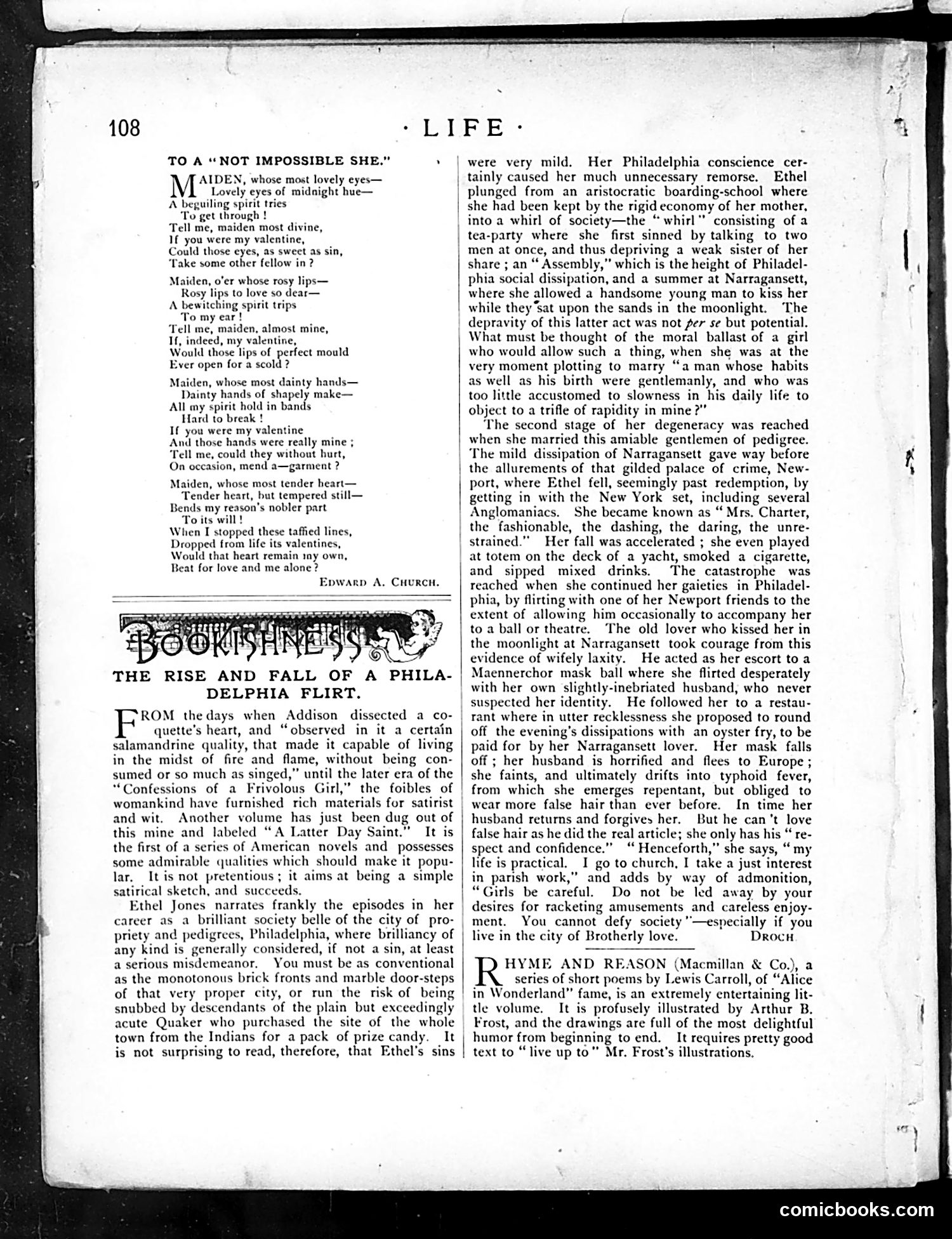
This page contains two pieces of **romantic/social satire** typical of Life magazine's humor. **The poem** (top) is a humorous Valentine's Day verse playfully cataloging a maiden's attractions—her eyes, lips, hands, and heart—while asking increasingly domestic questions (can she mend garments?). The satire gently mocks both romantic excess and the gap between idealized courtship and practical marriage. **The book review** (bottom) satirizes Philadelphia's rigid Quaker-descended society and the concept of the "flirt." It reviews *A Latter Day Saint*, describing protagonist Ethel Jones's scandalous behavior: talking to two men simultaneously, attending assemblies, allowing a kiss on the beach. The satire is heavy-handed—treating these minor social infractions as moral catastrophes. The joke targets Philadelphia's stifling conventionality and hypocrisy: a city so proper that innocent flirtation appears genuinely sinful. The reference to the Quaker who purchased the land "for a pack of prize candy" adds historical mockery of the city's founding restraint.
📄 Transcribed text from this page (OCR, searchable)
Machine-transcribed from the original scan — historical spelling and the odd misread are preserved.
LIFE TO A “NOT IMPOSSIBLE SHE.” AIDEN, whose most lovely eyes— Lovely eyes of midnight hue— uiling spirit tries To get through ! Tell me, maiden most divine, 1f you were my valentine, Could those eyes, as sweet as sin, ‘Take some other fellow in? Maiden, o'er whose rosy lips— Rosy lips to love so dear— A bewitching spirit trips To my ear! Tell me, maiden, almost mine, If, indeed, my valentine, Would those lips of perfect mould Ever open for a scold ? Maiden, whose most dainty hands— Dainty hands of shapely make— All my spirit hold in bands Hard to break ! If you were my valentine And those hands were really mine ; ‘Tell me, could they without hurt, On occasion, mend a—garment ? Maiden, whose most tender heart— Tender heart, but tempered still— Bends my reason's nobler part To its will! When I stopped these taffied lines, Dropped from life its valentines, Would that heart remain say own, Beat for love and me alone? waRD A, CHURCH, THE RISE AND FALL OF A PHILA- DELPHIA FLIRT. ROM thedays when Addison dissected a co- quette’s heart, and “observed in it a certain salamandrine quality, that made it capable of living in the midst of fire and flame, without being con- sumed or so much as singed,” until the later era of the volous Girl,” the foibles of ind have furnished rich materials for satirist Another volume has just been dug out of this mine and labeled ‘A Latter Day Saint.” It is the first of a series of American novels and possesses some admirable qualities which should make it popu- lar. It is not pretentious; it aims at being a simple sat ketch, and succeeds. Ethel ‘Jones narrates frankly the episodes in her career as a brilliant society belle of the city of pro- priety and pedigri Philadelphia, where brilliancy of any kind is generally considered, if not a sin, at least a serious misdemeanor, You must be as conventional as the monotonous brick fronts and marble door-steps of that very proper city, or run the risk of being snubbed by descendants of the plain but exceedingly acute Quaker who purchased the site of the whole town from the Indians for a pack of prize candy. It is not surprising to read, therefore, that Ethel’s sins | the fashionable, were very mild. Her Philadelphia conscience cer- | tainly caused her much unnecessary remorse. Ethel plunged from an aristocratic boarding-school where she had been kept by the rigid economy of her mother, into a whirl of society—the “whirl” consisting of a tea-party where she first sinned by talking to two men at once, and thus depriving a weak sister of her share ; an “ Assembly,” which is the height of Philadel- phia social dissipation, and a summer at Narragansett, where she allowed a handsome young man to kiss her while they Sat upon the sands in the moonlight. ‘The depravity of this latter act was not fer se but potential. What must be thought of the moral ballast of a girl who would allow such a thing, when she was at the very moment plotting to marry “a man whose habits as well as his birth were gentlemanly, and who was too little accustomed to slowness in his daily life to object to a trifle of rapidity in mine ?” The second stage of her degeneracy was reached when she married this amiable gentlemen of pedigree. The mild dissipation of Narragansett gave way before | the allurements of that gilded palace of crime, New- port, where Ethel fell, seemingly past redemption, by getting in with the New York set, including several Anglomaniacs. She became known as “ Mrs. Charter, the dashing, the daring, the unre- strained.” Her fall was accelerated ; she even played at totem on the deck of a yacht, smoked a cigarette, and sipped mixed drinks. The catastrophe was reached when she continued her gaieties in Philadel- phia, by flirting with one of her Newport friends to the extent of allowing him occasionally to accompany her to a ball or theatre. The old lover who kissed her in the moonlight at Narragansett took courage from this evidence of wifely laxity. He acted as her escort to a Maennerchor mask ball where she flirted desperately with her own slightly-inebriated husband, who never suspected her identity. He followed her to a restau- rant where in utter recklessness she proposed to round off the evening's dissipations with an oyster fry, to be paid for by her Narragansett lover. Her mask falls off ; her husband is horrified and flees to Europe ; she faints, and ultimately drifts into typhoid fever, from which she emerges repentant, but obliged to wear more false hair than ever before. In time her husband returns and forgives her. But he can't love false hair as he did the real article; she only has his “ re- spect and confidence.” “ Henceforth,” she says, “ my life is practical, I go to church, I take a just interest in parish work,” and adds by way of admonition, “Girls be careful. Do not be led away by your desires for racketing amusements and careless enjoy- ment. You cannot defy society "—especially if you live in the city of Brotherly love. Drocu HYME AND REASON (Macmillan & Co.), a series of short poems by Lewis Carroll, of “Alice in Wonderland” fame, is an extremely entertaining lit- tle volume. It is profusely illustrated by Arthur B. Frost, and the drawings are full of the most delightful humor from beginning toend. It requires pretty good text to “live up to” Mr. Frost's illustrations. comicbooks.com