
A complete issue · 16 pages · 1883
Life — November 22, 1883
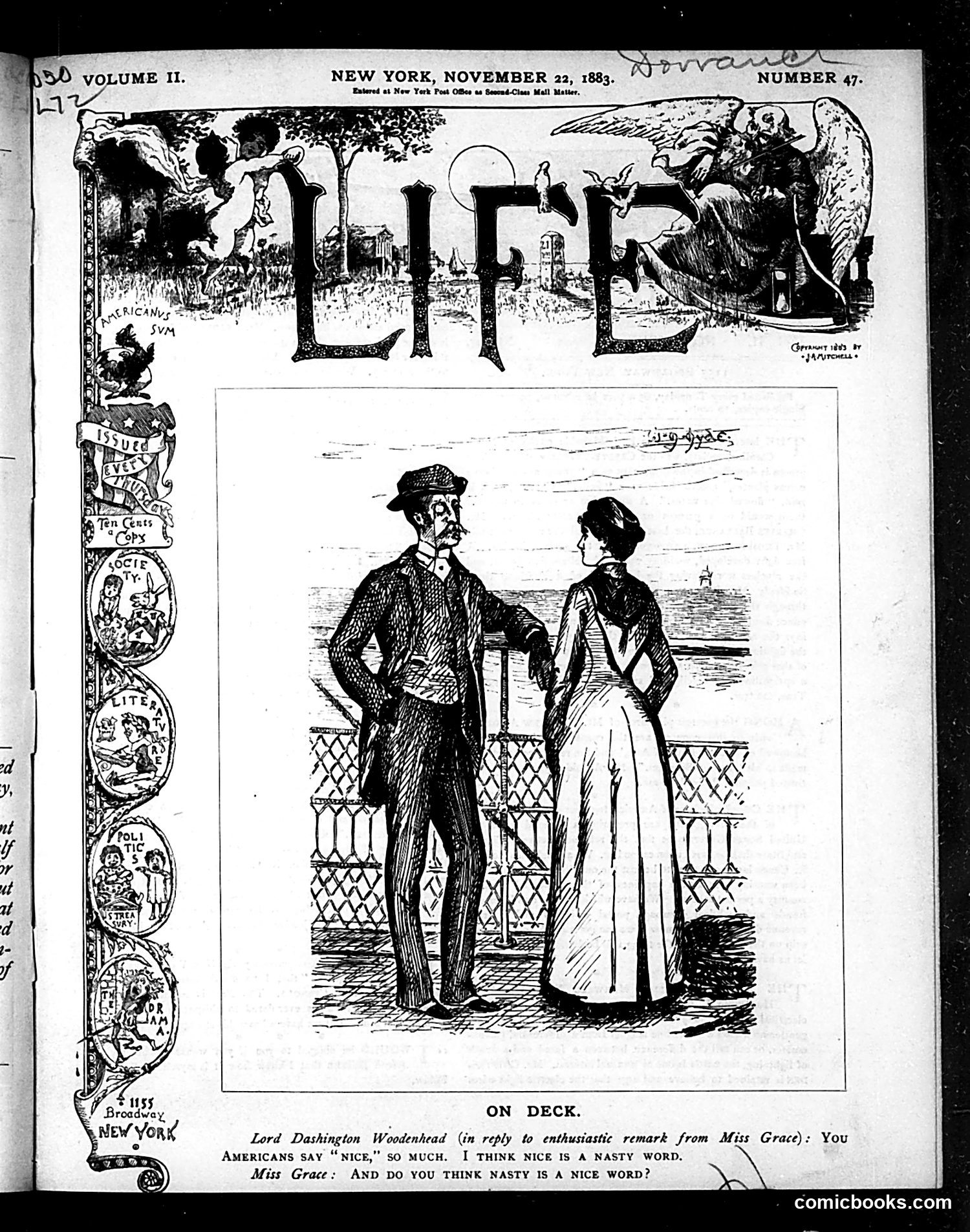
This cartoon satirizes a social exchange between British and American upper classes. Lord Daisington Woodenhead, a British aristocrat, compliments Americans by saying they are "nice"—but then Miss Grace challenges him, suggesting "nice" is actually a "nasty word," implying it's a weak or insipid compliment. The joke hinges on linguistic/cultural snobbery: the British lord intends his remark as praise, but the American woman interprets "nice" as patronizing or inadequate. The satire mocks both transatlantic pretension and the class-conscious banter of the Gilded Age elite, while highlighting tensions between British condescension toward Americans and American sensitivity to being judged as culturally inferior.
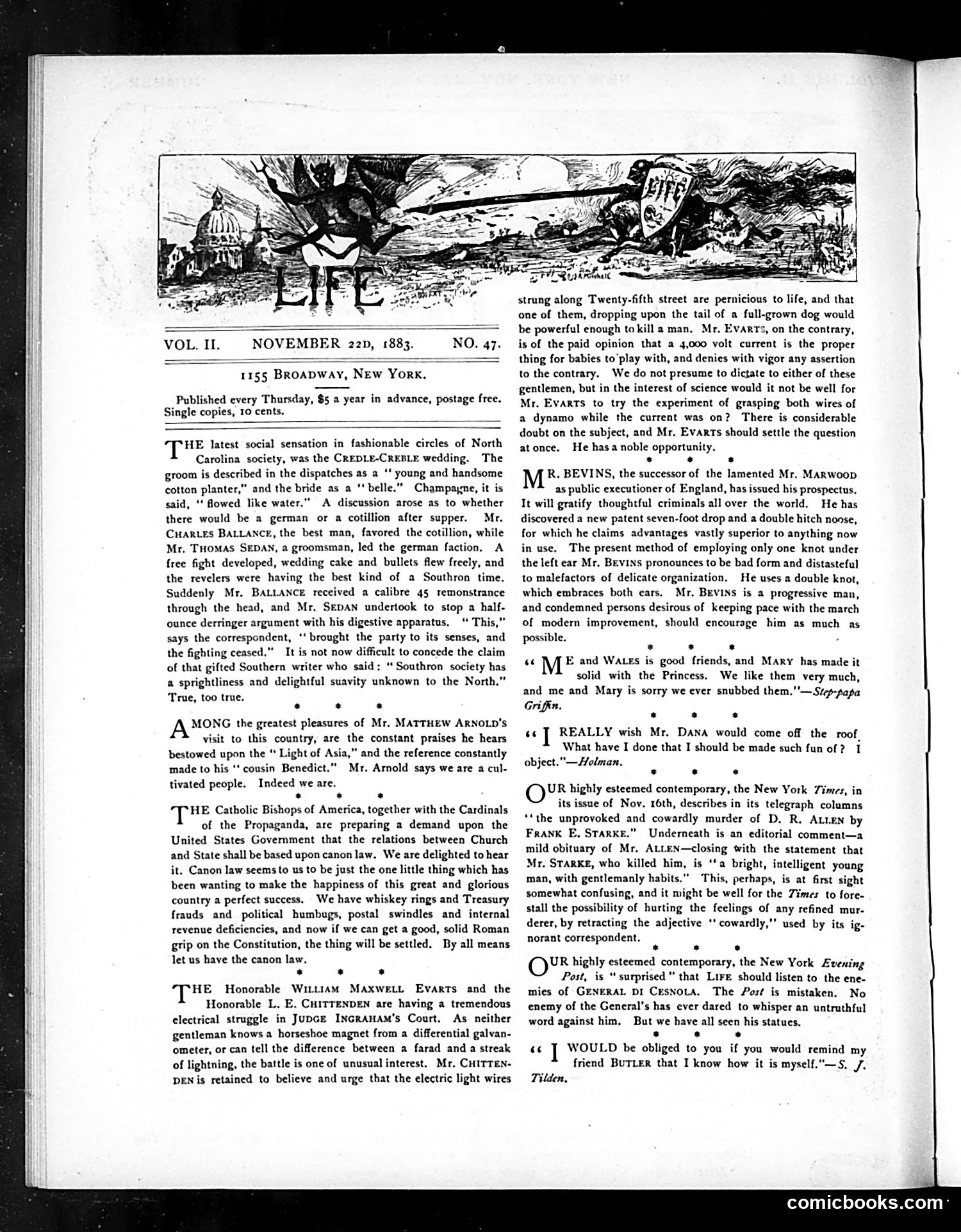
The page consists primarily of satirical commentary and social gossip rather than political cartoons. The masthead illustration shows "LIFE" personified as a classical figure. Content includes commentary on: 1. **The Credle-Creele wedding** in North Carolina—satirizing Southern society's pretensions to refinement while actual violence erupted at the event 2. **Matthew Arnold's visit**—praising the famous British critic as evidence of American cultivation 3. **Church-State relations**—supporting Catholic bishops' calls for stronger connections between Church and State regarding education 4. **William Maxwell Evarts and electrical experiments**—mocking a prominent politician's involvement in dubious electrical demonstrations The tone throughout is gossipy and sardonic, targeting social climbing, pretension, and public figures' questionable endeavors rather than partisan politics.
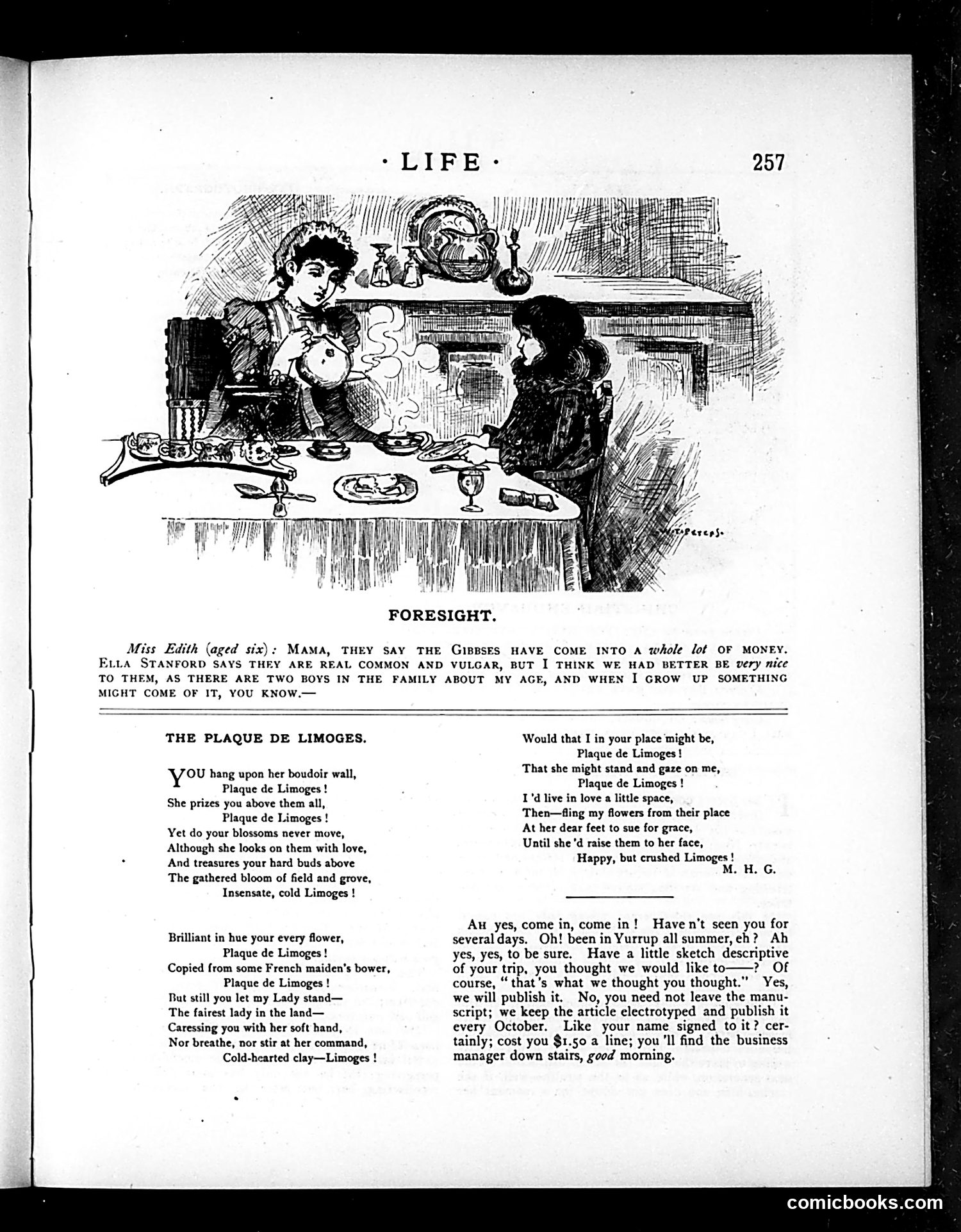
**The Main Illustration ("Foresight"):** A sketch shows two women dining together. The caption quotes a young girl (Miss Edith, aged six) claiming the Gibsons have inherited money, and predicting she'll marry one of their two sons when grown—a practical calculation about future wealth and social advantage. **The Poetry Section ("The Plaque de Limoges"):** Romantic verses about coveted French porcelain—"Plaque de Limoges"—treating decorative china as an object of desire and status. The accompanying prose dialogue satirizes magazine editors' casual exploitation of contributors, offering modest payment ($1.50/line) for published work while making publication sound prestigious. **Overall Theme:** The page satirizes upper-class materialism and social climbing—both in romance and in the publishing industry itself.
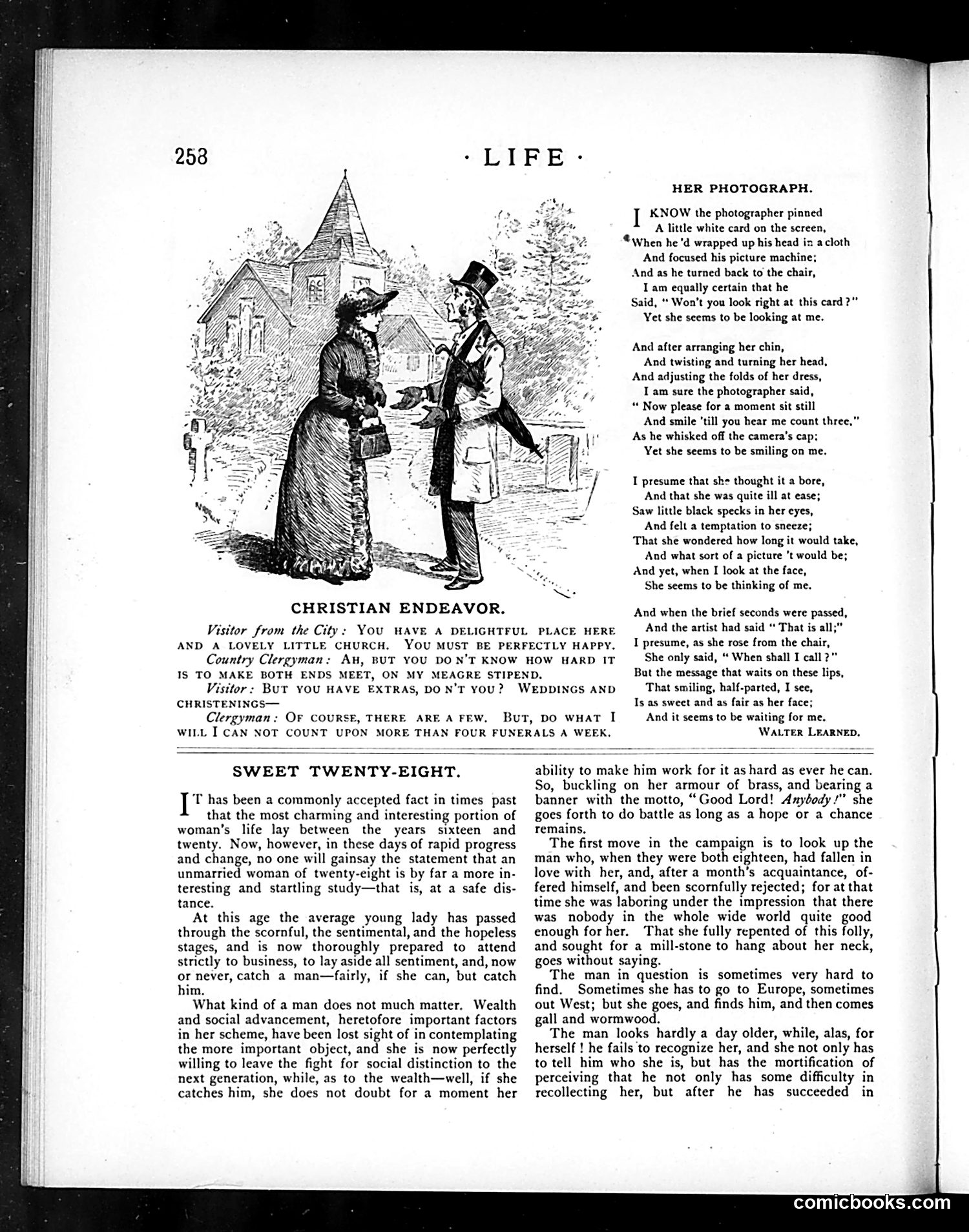
The cartoon depicts a conversation between a well-dressed male visitor and a female church member, labeled "Christian Endeavor." The satire mocks the tension between religious ideology and practical reality: the visitor praises the church as "delightful," while the female character sardonically notes that weddings and funerals are the only activities—she can't count on more than "four funerals a week." The joke critiques the gap between idealized religious community and its actual, grim functionality. The adjoining article "Sweet Twenty-Eight" discusses unmarried women of that age. It satirizes contemporary marriage-market pressures: women must shed sentimentality to "catch" a husband through strategic effort, treating romance as transactional labor rather than genuine connection. The piece reflects Victorian-era anxieties about female independence and the marriage market's commodification of women.
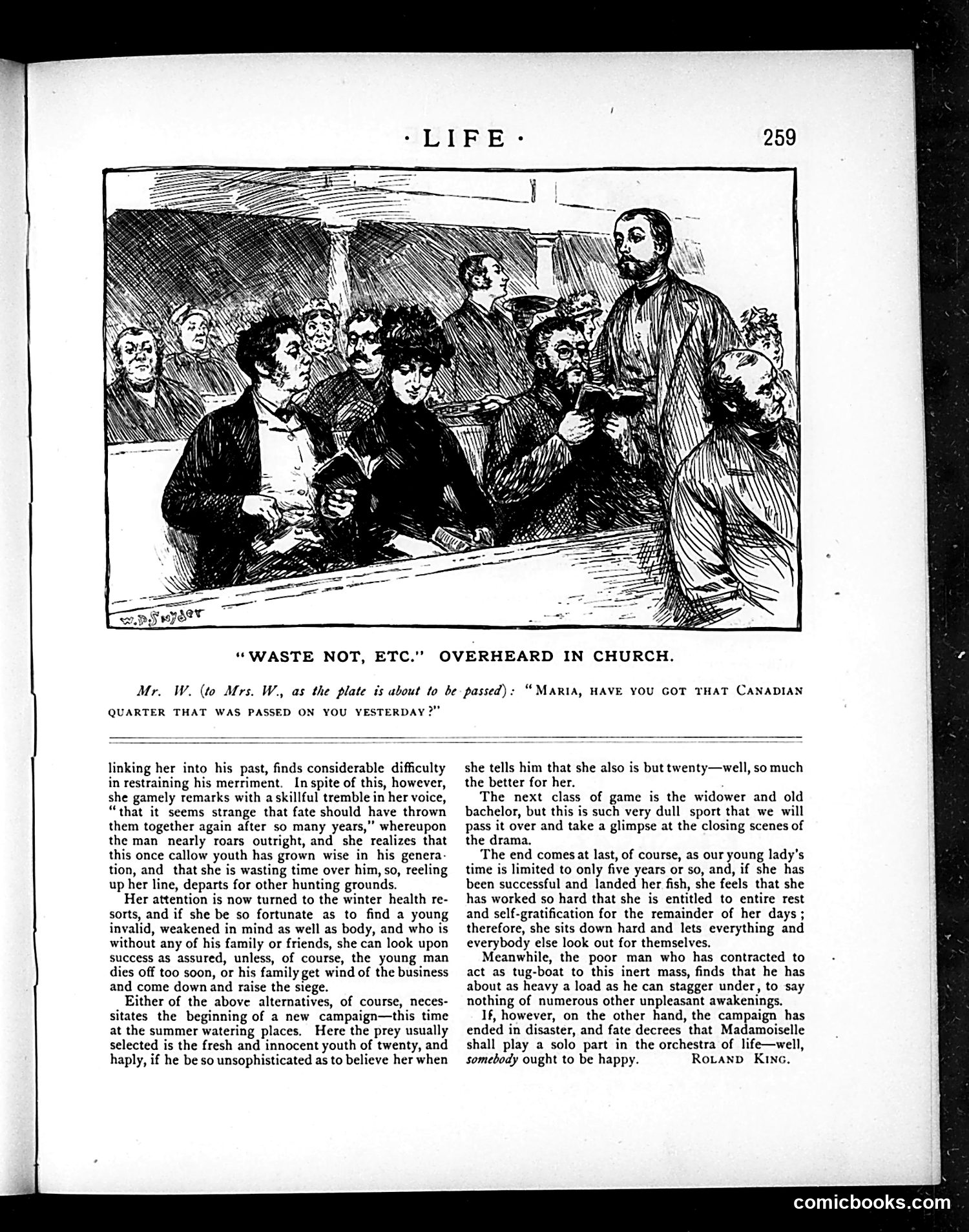
This single-panel cartoon satirizes financial penny-pinching among the wealthy during wartime (likely WWI-era, based on the "Life" publication style). The scene depicts church attendees, with one man audibly asking his wife Maria if she's recovered a Canadian quarter passed to her the previous day. The humor targets hypocrisy: these apparently well-to-do churchgoers worry obsessively about retrieving a single quarter—small change—despite their evident means. The "waste not" reference suggests wartime conservation rhetoric that the wealthy supposedly embrace publicly while remaining petty about personal finances. The church setting amplifies the satire: such miserliness contradicts Christian charitable values these worshippers ostensibly practice.
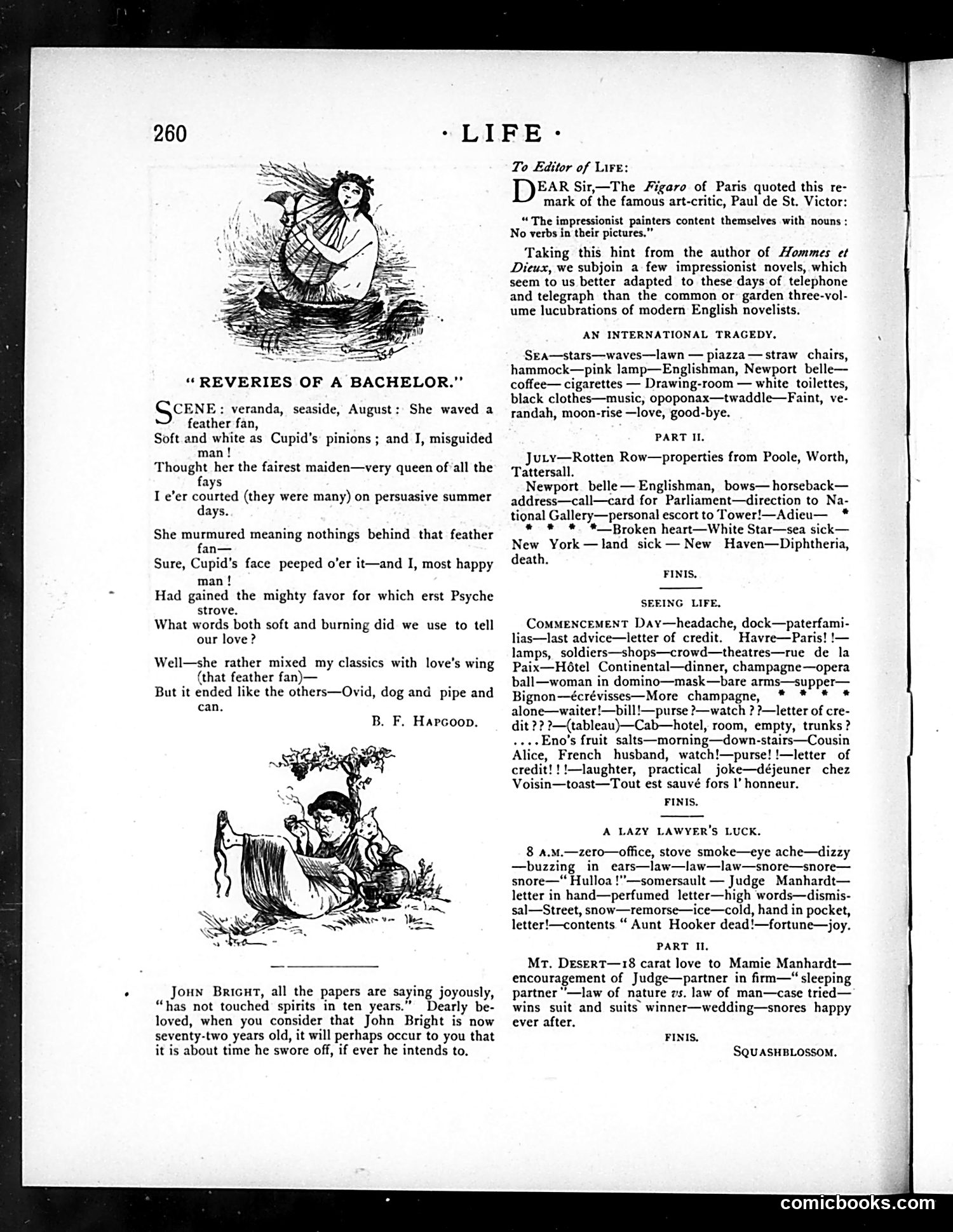
This page features two illustrations accompanying literary content. The top cartoon shows a young man daydreaming while holding a feather fan, with Cupid visible in the image—a classical reference to romantic fantasies. The accompanying poem by B.F. Hapgood humorously describes a bachelor's mixed romantic musings, blending idealized love with mundane reality (referencing "Ovid, dog and pipe"). The lower illustration depicts what appears to be a man in casual domestic circumstances, likely illustrating the contrast between romantic fantasy and actual bachelor life—a common satirical theme in Life magazine. The right column contains brief society gossip items using rapid-fire keywords (typical Life style), including references to Newport social scene and various romantic/matrimonial matters. The overall satire mocks the gap between bachelors' romantic ideals and their actual circumstances.
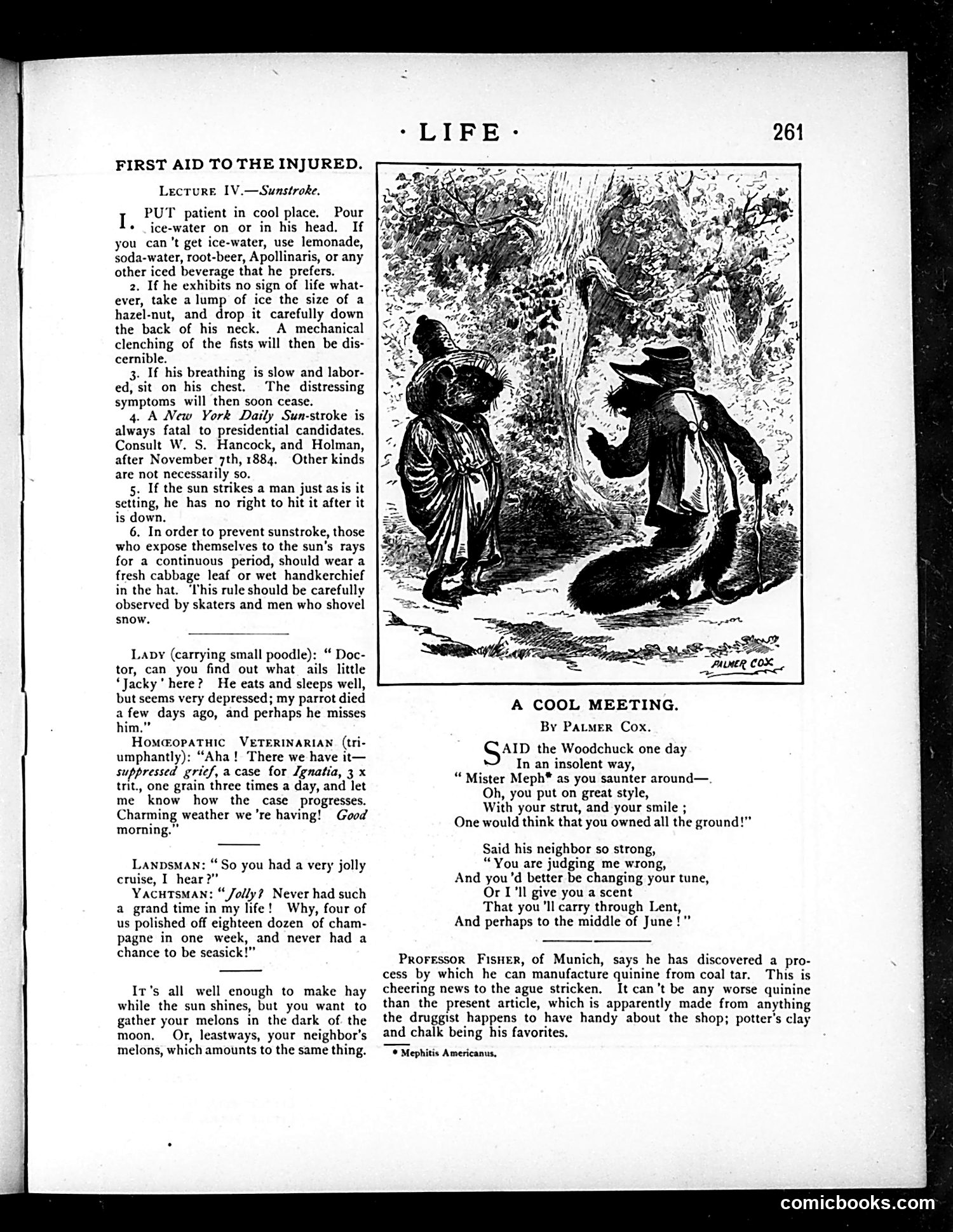
This cartoon depicts two anthropomorphic animals—a woodchuck and what appears to be a mink or similar creature—in a confrontational encounter. The woodchuck, dressed formally with a cane, is being criticized by his neighbor for his pretentious behavior and arrogant demeanor. The satire mocks social pretension and class affectation. The neighbor accuses the woodchuck of putting on airs ("great style," "strut," "airs"), suggesting he acts as though he owns everything, and threatens him with mockery ("give you a scent / That you'll carry through Lent"). This appears to be general social satire about affected behavior and snobbery rather than referencing specific political figures, using animal characters in the style typical of Palmer Cox's Brownies series.
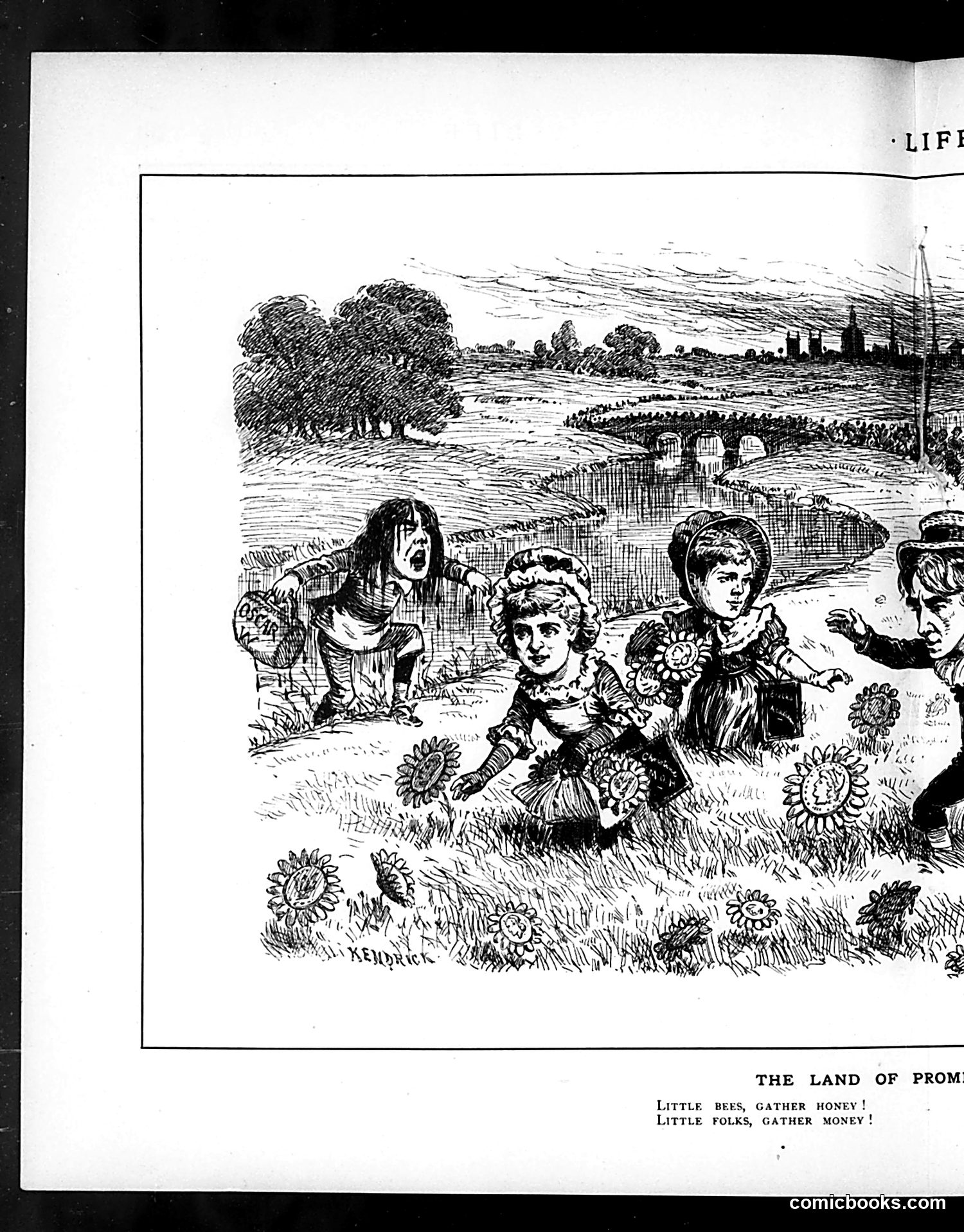
This satirical cartoon depicts children in a sunflower field with the caption "Little bees, gather honey! / Little folks, gather money!" The image appears to critique child labor and economic exploitation during the industrial era. The children are portrayed working in a pastoral, idealized landscape, yet the text's juxtaposition of "bees" (naturally gathering honey) with "folks" (children gathering money) exposes the cynical reality: children are being sent to labor for financial gain rather than education or play. The artist (signed "Kendrick") likely references the American "promised land" mythology—the idea that America offers opportunity—while showing its darker reality: economic systems that exploit vulnerable populations, particularly children. The bucolic background contrasts sharply with the grim message about childhood labor practices.
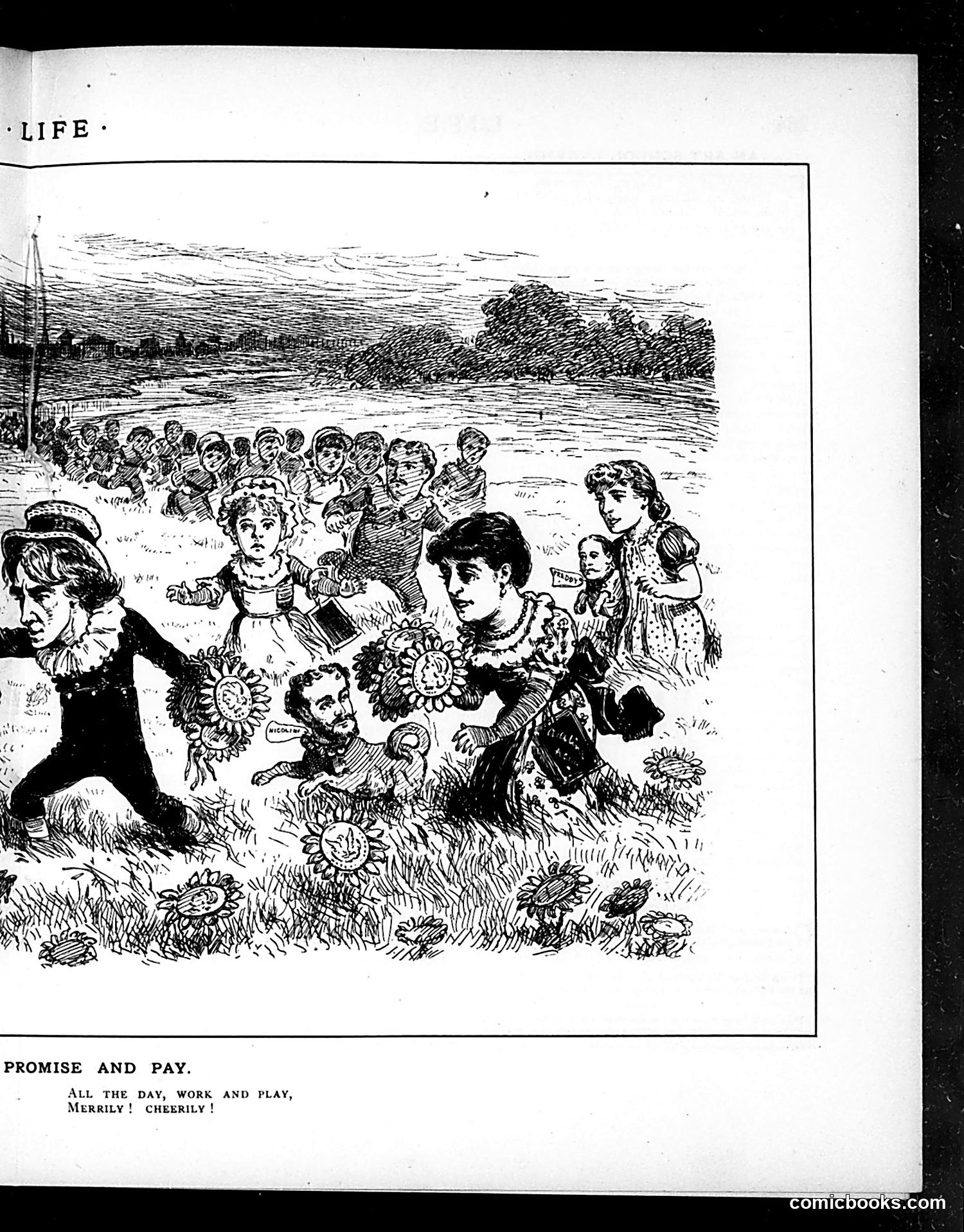
This illustration depicts a riverside picnic scene with Victorian-era figures enjoying leisure activities—picking flowers, conversing, and relaxing by the water. The title "Promise and Pay" with the subtitle "All the day, work and play, / Merrily! Cheerily!" suggests commentary on labor and leisure balance. The satire likely critiques either unfulfilled promises of rest and recreation for workers, or contrasts between promised leisure time and actual working conditions during the industrial era. The idyllic scene may be ironic—depicting an idealized vision of "work-life balance" that Life magazine's readers (primarily middle and upper-class urbanites) aspired to but rarely achieved. The specific historical context remains unclear without additional publication information.
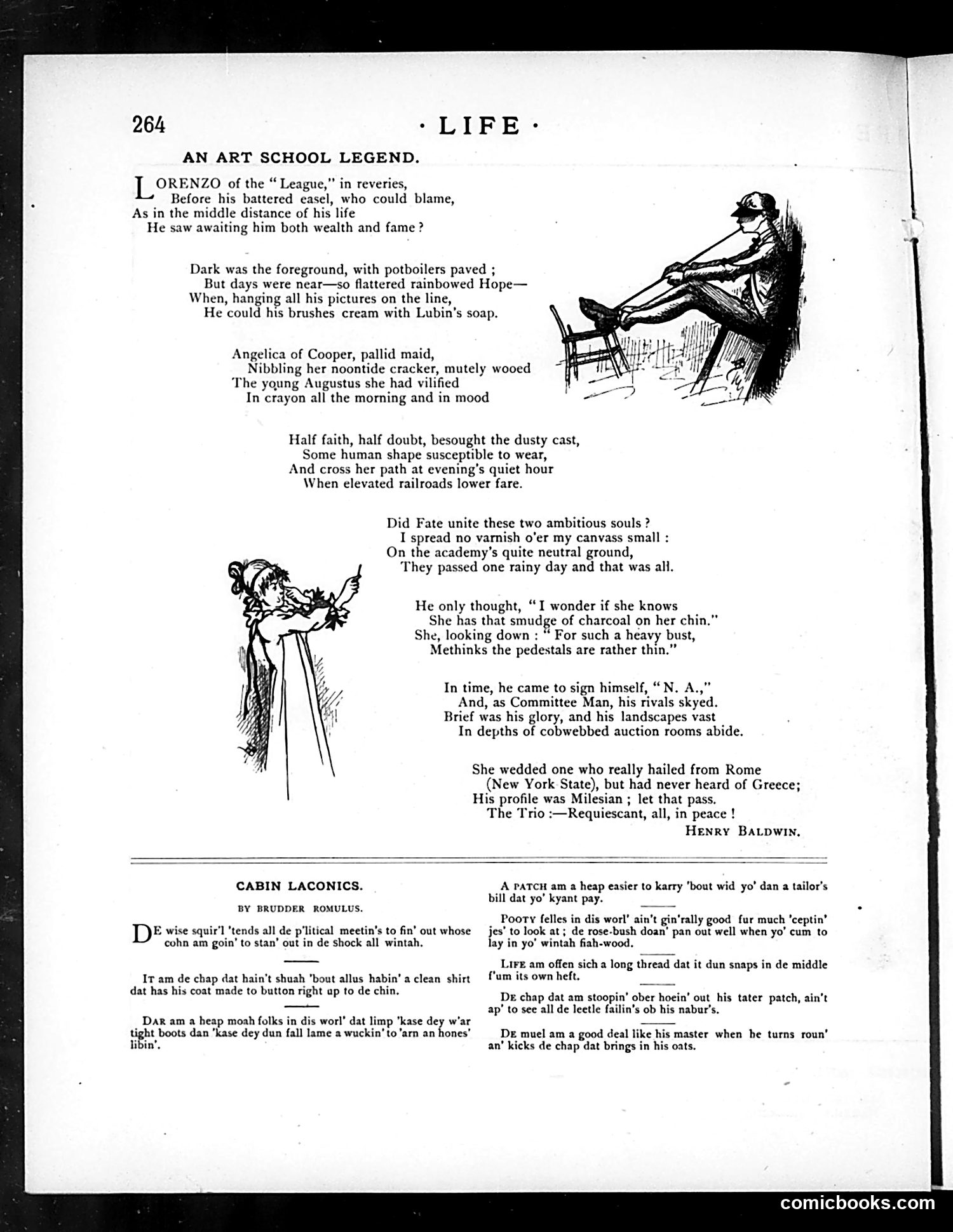
This satirical poem mocks the aspirations and romantic entanglements of art students. Lorenzo, an ambitious painter at the Art League, dreams of wealth and fame while currently churning out commercial work ("potboilers"). Angelica of Cooper, a fellow student, secretly harbors feelings for him while publicly criticizing his work in crayon sketches. The satire lies in their mutual disdain masquerading as indifference: he notices only a charcoal smudge on her chin; she insults his figure proportions. They meet once by chance and nothing comes of it. Lorenzo eventually achieves modest success (signing "N.A."—likely meaning National Academician), becoming a committee man who gets rival artists' work "skyed" (hung unfavorably high). Angelica marries someone else entirely. The ending mocks their wasted romantic opportunity and Lorenzo's forgotten legacy in dusty auction rooms. The cartoon satirizes art-world pretension, failed ambitions, and the gap between youthful artistic dreams and mundane reality.
This column mocks New York's wealthy elite and their social pretensions. The "Practical Proverbs" at the top include satirical jabs at contemporary figures: "Tammany cooks spoil the broth" references the corrupt New York political machine; "old-ticket Sam" likely refers to a local political figure; references to "dude-killer," "poker-player," and "ring-master" mock fashionable vices. The main essay ridicules American aristocrats' desperate attempts to impress a visiting British Lord Chief Justice. The satire hinges on the irony that Mrs. Korka-Walloon (a fictional American socialite) is treated as more important than this British dignitary, yet the Americans grovel to impress him anyway. The piece lambastes both American snobbery toward the lower classes (the "Protective Tariff" keeping out the poor from exhibitions) and obsequious deference to British nobility—exposing how American "aristocracy" apes European class structures while claiming independence.
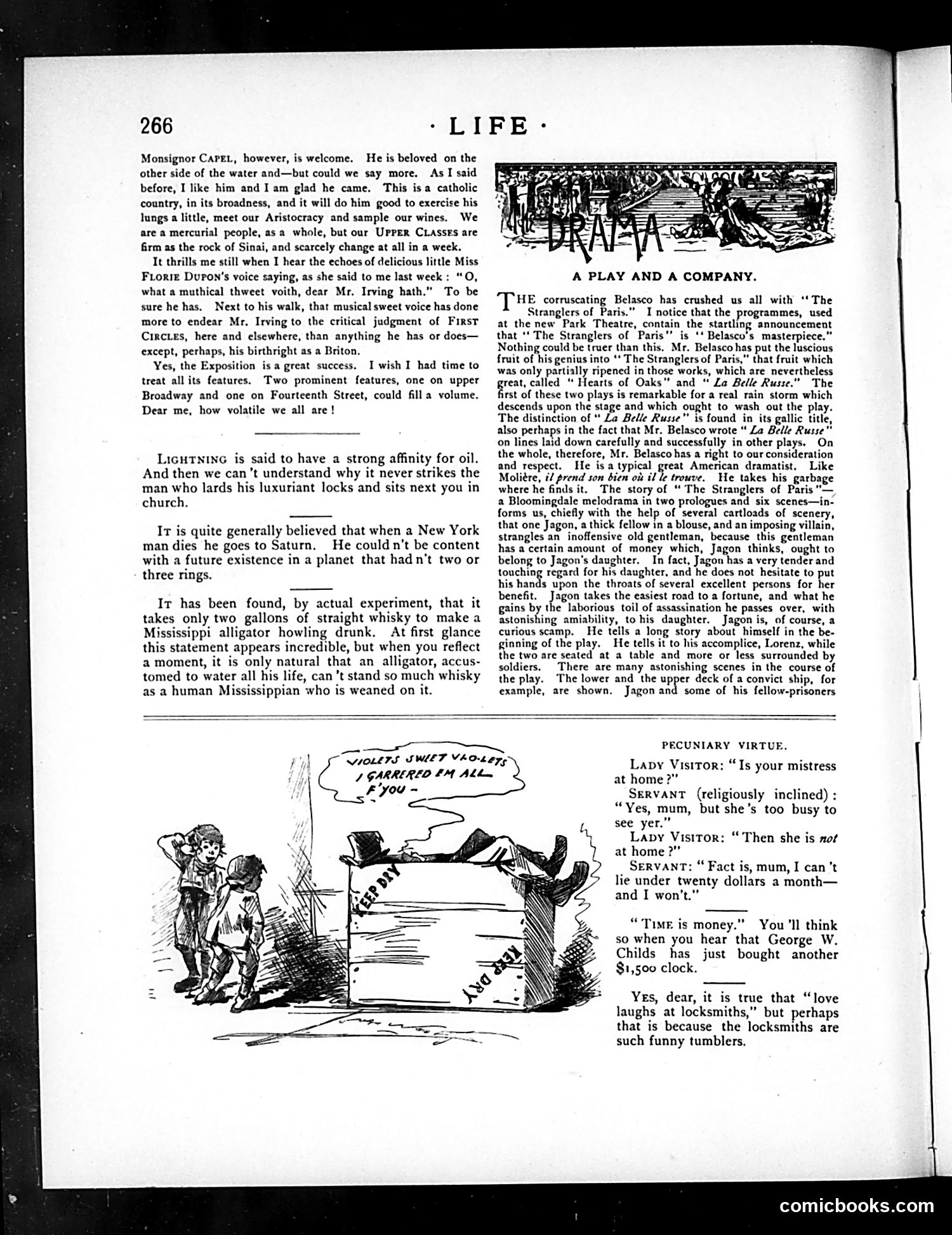
This page contains theater criticism and satirical commentary typical of Life magazine's irreverent style. **Main content:** A lengthy review of David Belasco's play "The Stranglers of Paris" at the Park Theatre. The critic employs biting sarcasm, praising Belasco as a "typical great American dramatist" while mocking his methods—comparing him to Molière but suggesting Belasco simply borrows/steals from existing melodramatic formulas rather than creating original work. The plot involves a villain named Jagon who strangles people to benefit his daughter. **The cartoon** depicts two children discovering what appears to be a vagrant sleeping in a box, with one saying "Violets! Sweet Violets! Hurried in All If You" (possibly garbled OCR). **"Pecuniary Virtue"** section contains a brief comedic dialogue about a servant's employer being "too busy" to receive visitors—social satire about the wealthy's pretensions. The page exemplifies Life's satirical approach: theatrical mockery of popular entertainment and gentle jibes at American social pretension.
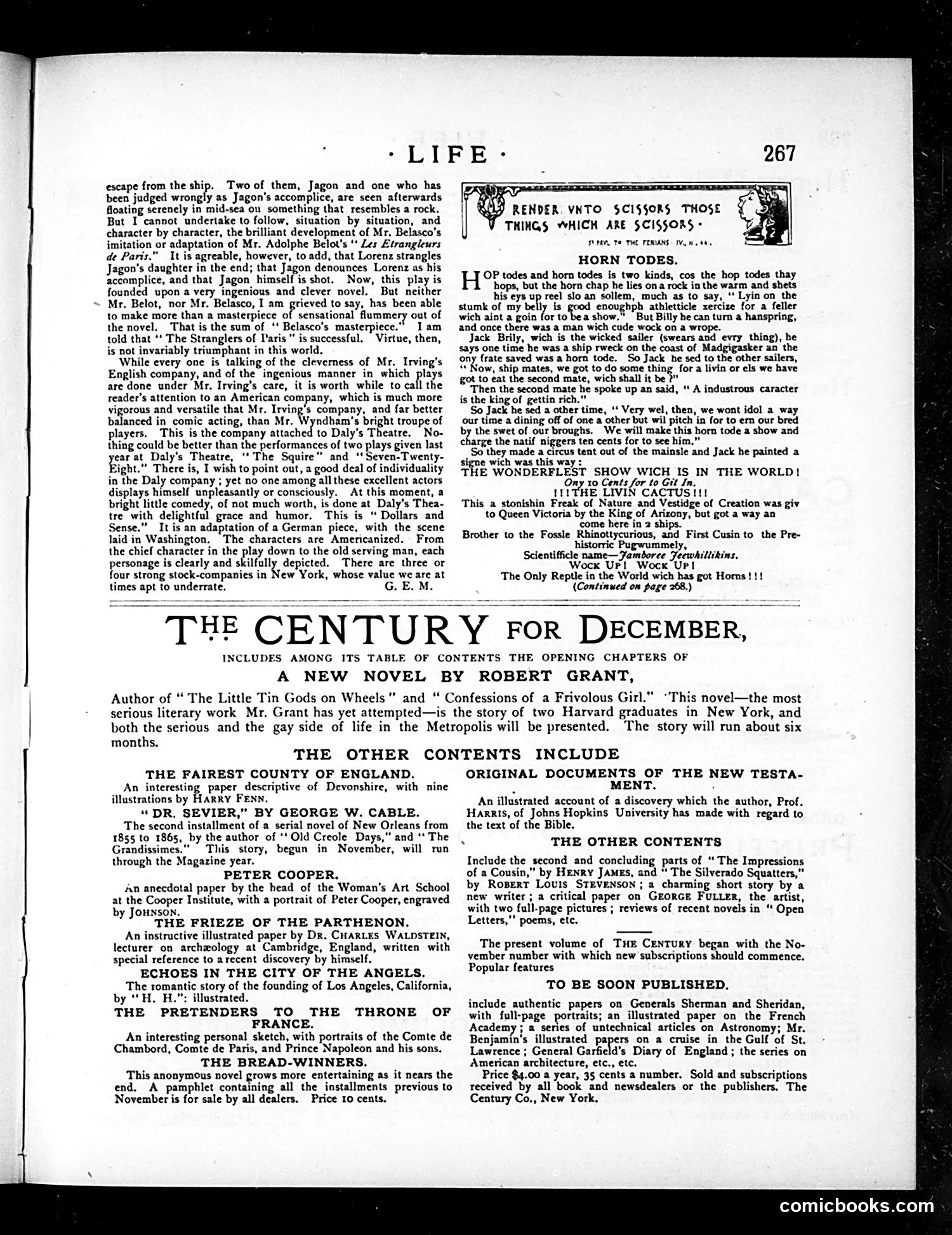
This page is primarily **book and theater reviews**, not political cartoons. The main content critiques theatrical productions, particularly praising Daly's Theatre company over competitors like Henry Irving's English troupe. The only illustrated element visible is a small decorative header reading "RENDER UNTO SCISSORS THOSE THINGS WHICH ARE SCISSORS" — a Biblical pun (referencing "render unto Caesar") with unclear satirical intent. Below that is "HORN TODES," a humorous dialect piece about a sailor's tale featuring a horn toad as a circus attraction. Written in intentionally misspelled, phonetic dialect (a period convention for rural/working-class humor), it mocks credulous audiences and carnival exploitation. The page concludes with announcements for upcoming *Century* magazine content, including works by Robert Grant and papers on historical topics. **For modern readers:** This represents 19th-century literary culture where theater criticism was as important as news, and dialect humor was mainstream entertainment.
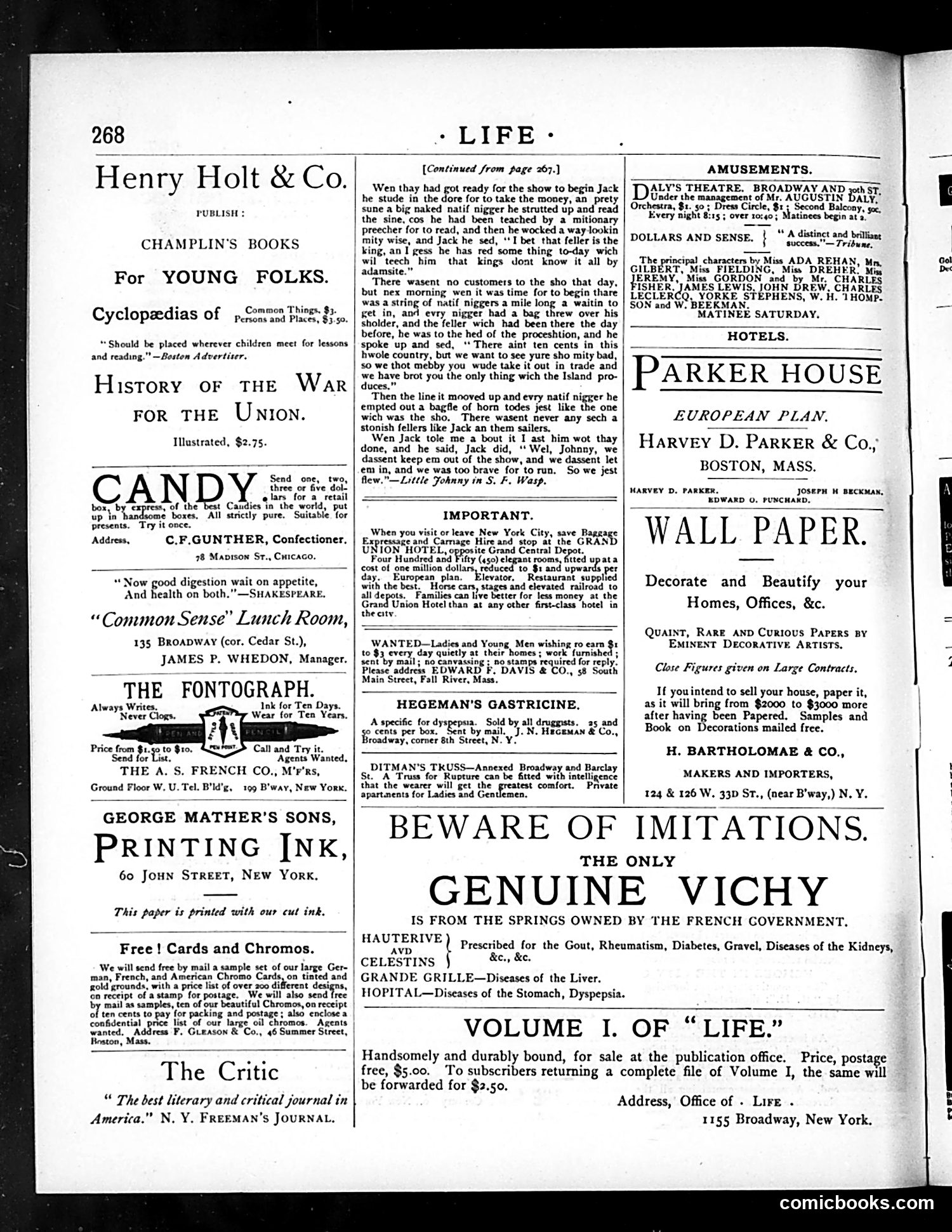
This page is primarily **advertisements and notices**, not satirical content. The main text visible is a serialized story excerpt ("Little Johnny in S.F. Wasp") featuring crude dialect and a deeply offensive racial narrative about Pacific Islanders and a traveling show. The story reflects **19th-century racist attitudes**, depicting Indigenous people using dehumanizing language and stereotypical characterizations. It presents colonialism and cultural exploitation as comedy—a white man's show attracting natives who worship it, with the narrator finding humor in their perceived ignorance. **For modern readers**: This illustrates how casually racist content permeated period publications, even in supposedly sophisticated magazines. The "joke" relies entirely on racial superiority and mocking non-Western peoples. The offensive dialect and caricatures were normalized entertainment then, but today expose the profound prejudices embedded in historical American media. The remainder of the page consists of period advertisements for hotels, printing ink, and patent medicines—typical commercial content from the era.
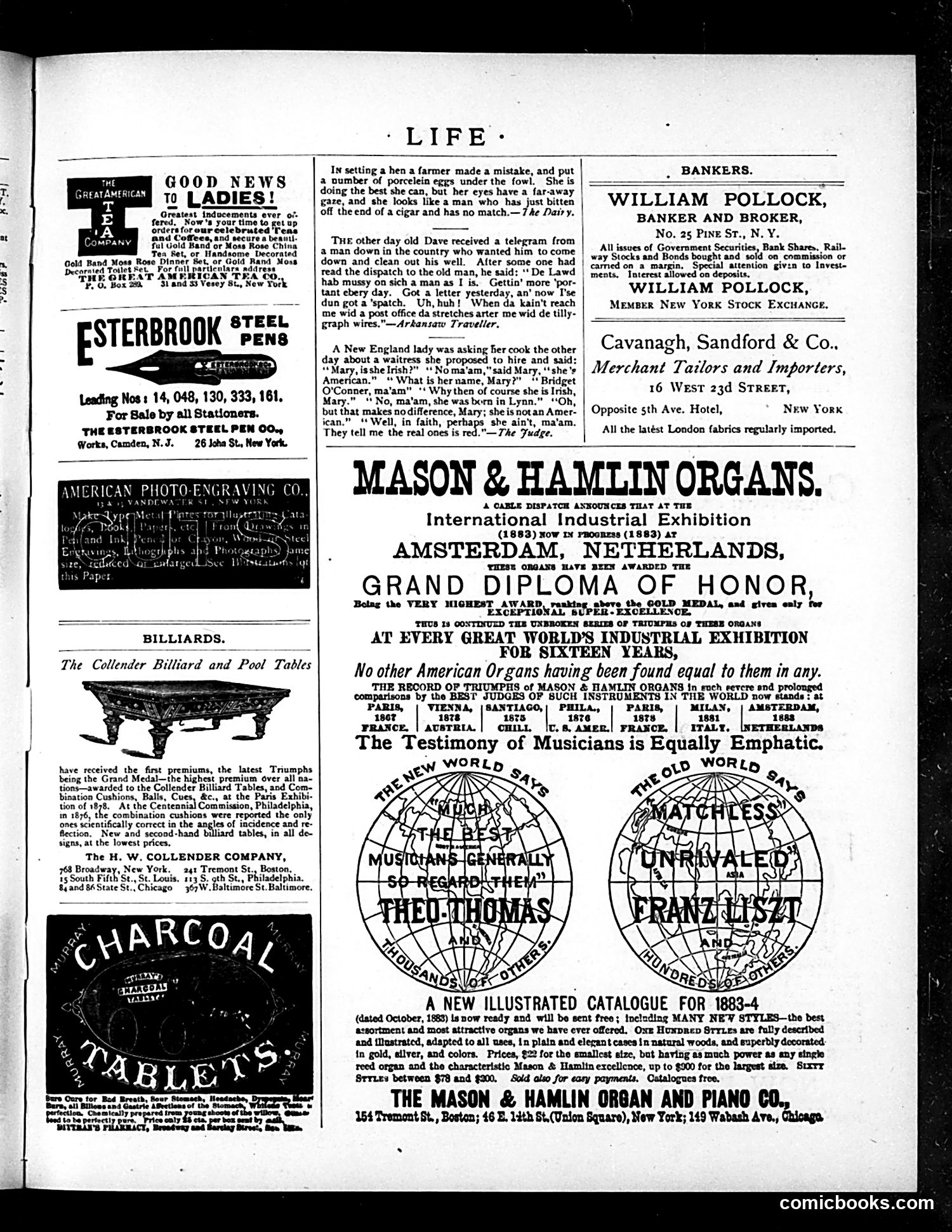
This is primarily an **advertising page** from Life magazine, circa 1883. The small satirical content consists of three brief humorous anecdotes typical of the era: 1. **The hen and porcelain eggs**: A farmer mistakes ceramic eggs for real ones under a brooding hen—a straightforward visual joke about rural naiveté. 2. **Dave and the telegraph**: An African American character (written in dialect) jokes about becoming so important he now receives telegrams, not just mail—likely satirizing pretension or social climbing, though presented through stereotypical characterization common to the period. 3. **The Irish cook**: A New England lady assumes a waitress named "Bridget O'Conner" is Irish despite being born in Lynn, Massachusetts. The punchline—"They tell me the real ones is red"—makes a crude joke about Irish alcoholism. The page's bulk comprises advertisements for **tea sets, steel pens, billiard tables, organs, and banking services**—typical commercial content. The **Mason & Hamlin Organs advertisement** dominates, promoting their international award-winning status.
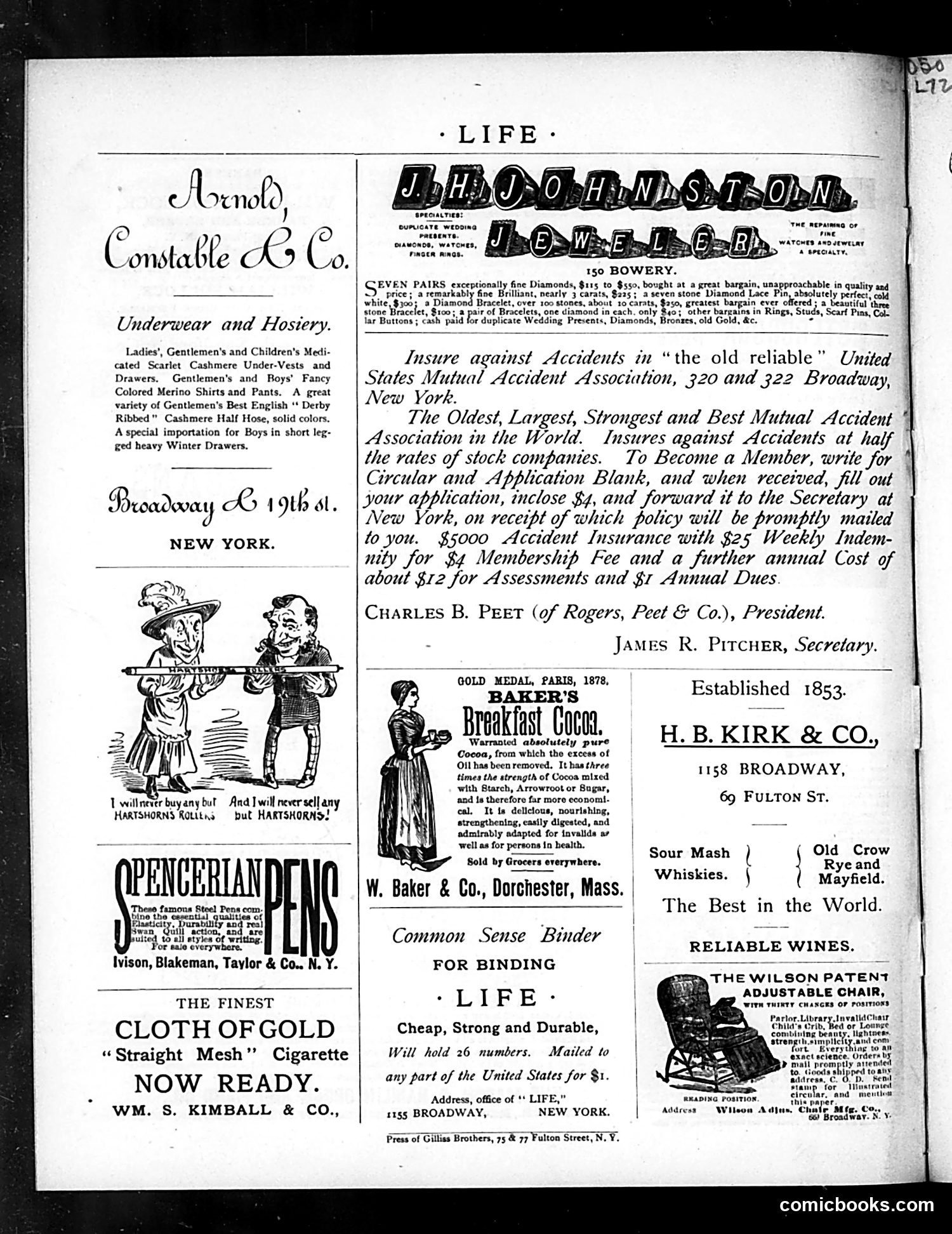
This page is **primarily advertising**, with one notable cartoon. The main visual element is a small comic strip featuring two figures debating Hartshorne's Rotini (a product). One figure declares "I will never buy any but HARTSHORNS Rotini's" while the other counters "And I will never sell any but HARTSHORNS!" The joke appears to be a play on mutual exclusivity and brand loyalty—the two speakers' positions are contradictory yet both adamantly support the same product, creating absurdist humor typical of 19th-century advertising satire. The remainder of the page contains typical period advertisements: undergarments, jewelry, accident insurance, cocoa, whiskey, office furniture, and binding supplies. The ads reflect Gilded Age consumer culture and emerging corporate services like mutual aid insurance associations. The satirical magazine *Life* used such ads both as revenue and satirical commentary on American consumerism.