
Life, 1883-11-22 · page 11 of 16
Life — November 22, 1883 — page 11: what you’re looking at
What you’re looking at
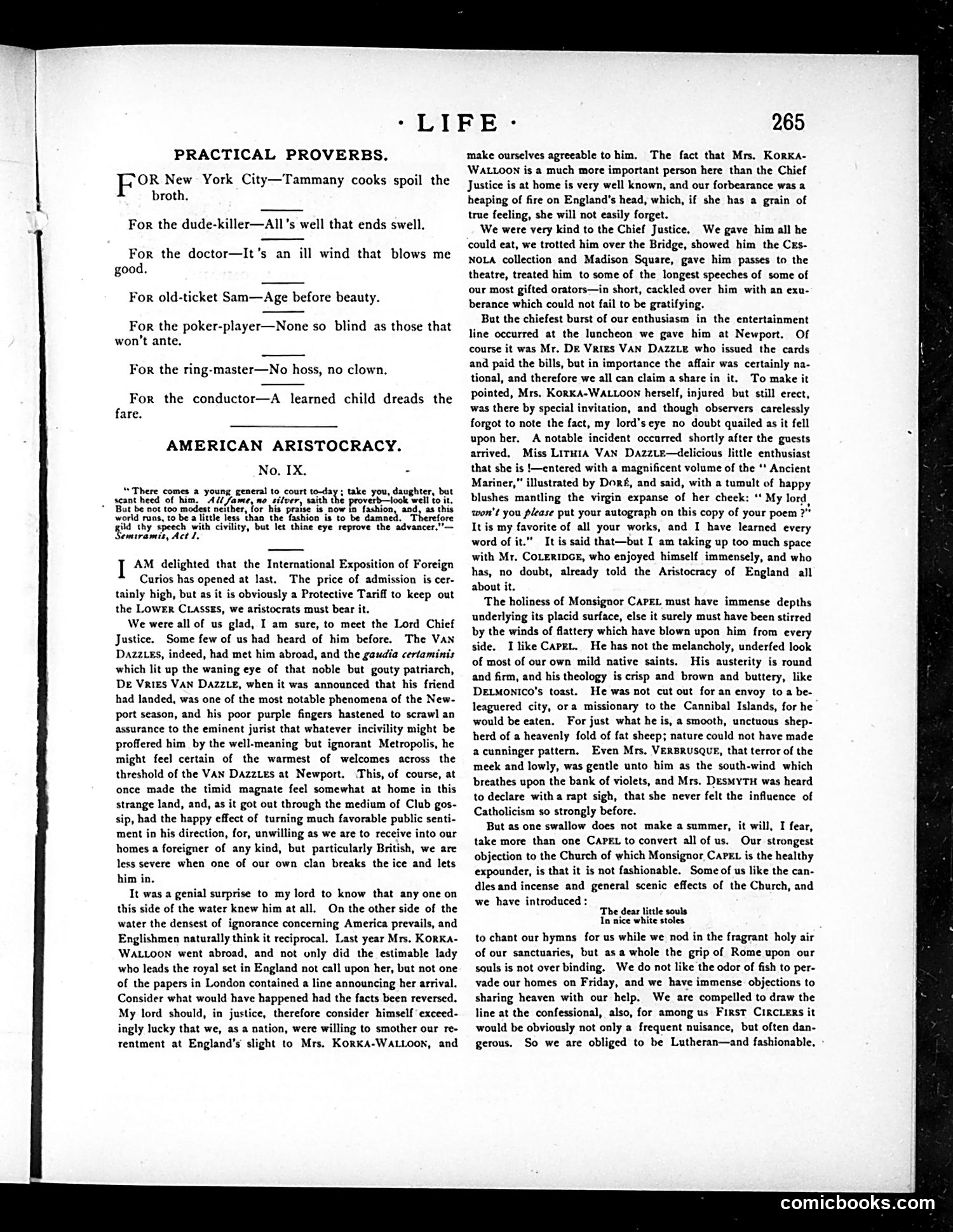
This column mocks New York's wealthy elite and their social pretensions. The "Practical Proverbs" at the top include satirical jabs at contemporary figures: "Tammany cooks spoil the broth" references the corrupt New York political machine; "old-ticket Sam" likely refers to a local political figure; references to "dude-killer," "poker-player," and "ring-master" mock fashionable vices. The main essay ridicules American aristocrats' desperate attempts to impress a visiting British Lord Chief Justice. The satire hinges on the irony that Mrs. Korka-Walloon (a fictional American socialite) is treated as more important than this British dignitary, yet the Americans grovel to impress him anyway. The piece lambastes both American snobbery toward the lower classes (the "Protective Tariff" keeping out the poor from exhibitions) and obsequious deference to British nobility—exposing how American "aristocracy" apes European class structures while claiming independence.
📄 Transcribed text from this page (OCR, searchable)
Machine-transcribed from the original scan — historical spelling and the odd misread are preserved.
- LIFE: PRACTICAL PROVERBS. OR New York City—Tammany cooks spoil the broth. For the dude-killer—All's well that ends swell. For the doctor—It’s an ill wind that blows me good, For old-ticket Sam—Age before beauty. For the poker-player—None so blind as those that won't ante. For the ring-master—No hoss, no clown. For the conductor—A learned child dreads the fare. AMERICAN ARISTOCRACY. No. IX. - “There comes a young general to court to-day ; take you, daughter, but scant heed of him, "Adi Jame, no sifver, saith the proverb—look well to it. * But be not too modest neither, for his praise is now in fashion, and, as this world runs, to be a little less than the fashion is to be damned. Therefore gid thy speech with civility, but let thine eye reprove the advancer,"”"— jemiramis, Act 1, J AM delighted that the International Exposition of Foreign Curios has opened at last. The price of admission is cer- tainly high, but as it is obviously a Protective Tariff to keep out the Lower CLassgs, we aristocrats must bear it. We were all of us glad, I am sure, to meet the Lord Chief Justice. Some few of us had heard of him before. The VAN Dazzes, indeed, had met him abroad, and the gaudia certaminis which lit up the waning eye of that noble but gouty patriarch, De Vries VAN Dazzte, when it was announced that his friend had landed, was one of the most notable phenomena of the New- port season, and his poor purple fingers hastened to scrawl an assurance to the eminent jurist that whatever incivility might be proffered him by the well-meaning but ignorant Metropolis, he might feel certain of the warmest of welcomes across the threshold of the VAN DazzLes at Newport. This, of course, at once made the timid magnate feel somewhat at home in this strange land, and, as it got out through the medium of Club gos- sip, had the happy effect of turning much favorable public senti- ment in his direction, for, unwilling as we are to receive into our homes a foreigner of any kind, but particularly British, we are less severe when one of our own clan breaks the ice and lets him in. It was a genial surprise to my lord to know that any one on this side of the water knew him at all. On the other side of the water the densest of ignorance concerning America prevails, and Englishmen naturally think it reciprocal, Last year Mrs. KoRKA- WALLOON went abroad, and not only did the estimable lady who leads the royal set in England not call upon her, but not one of the papers in London contained a line announcing her arrival. Consider what would have happened had the facts been reversed. My lord should, in justice, therefore consider himself exceed- ingly lucky that we, as a nation, were willing to smother our re- rentment at England’s slight to Mrs. KoRKA-WALLOON, and 265 make ourselves agreeable to him. The fact that Mrs. KorKa- WALttoon is a much more important person here than the Chief Justice is at home is very well known, and our forbearance was a heaping of fire on England’s head, which, if she has a grain of true feeling, she will not easily forget. We were very kind to the Chief Justice, We gave him all he could eat, we trotted him over the Bridge, showed him the Cxs- NOLA collection and Madison Square, gave him passes to the theatre, treated him to some of the longest speeches of some of our most gifted orators—in short, cackled over him with an exu- berance which could not fail to be gratifying. But the chiefest burst of our enthusiasm in the entertainment line occurred at the luncheon we gave him at Newport. Of course it was Mr. De Vries VAN Dazzte who issued the cards and paid the bills, but in importance the affair was certainly na- tional, and therefore we all can claim a share in it. To make it pointed, Mrs, KorKA-WALLOON herself, injured but still erect, was there by special invitation, and though observers carelessly forgot to note the fact, my lord's eye no doubt quailed as it fell upon her. A notable incident occurred shortly after the guests arrived, Miss LirwiA VAN DazzLp—delicious little enthusiast that she is !—entered with a magnificent volume of the ‘* Ancient Mariner,” illustrated by Doré, and said, with a tumult of happy blushes mantling the virgin expanse of her cheek: “' My lord, won't you please put your autograph on this copy of your poem ?”* It is my favorite of all your works, and I have learned every word of it.” It is said that—but I am taking up too much space with Mr, CoLeripGE, who enjoyed himself immensely, and who has, no doubt, already told the Aristocracy of England all about it, The holiness of Monsignor CAPEL must have immense depths underlying its placid surface, else it surely must have been stirred by the winds of flattery which have blown upon him from every side. I like Capet. He has not the melancholy, underfed look of most of our own mild native saints. His austerity is round and firm, and his theology is crisp and brown and buttery, like DELMONICO's toast. He was not cut out for an envoy toa be- leaguered city, ora missionary to the Cannibal Islands, for he would be eaten. For just what he is, a smooth, unctuous shep- herd of a heavenly fold of fat sheep; nature could not have made acunninger pattern, Even Mrs. VERBRUSQUE, that terror of the meek and lowly, was gentle unto him as the south-wind which breathes upon the bank of violets, and Mrs. DesMYTH was heard to declare witha rapt sigh, that she never felt the influence of Catholicism so strongly before. But as one swallow does not make a summer, it will, I fear, take more than one CAPEL to convert all of us. Our strongest objection to the Church of which Monsignor CaPEL is the healthy expounder, is that it is not fashionable. Some of us like the can- dles and incense and general scenic effects of the Church, and we have introduced : The dear little souls In nice white stoles to chant our hymns for us while we nod in the fragrant holy air of our sanctuaries, but as a whole the grip of Rome upon our souls is not over binding. We do not like the odor of fish to per- vade our homes on Friday, and we have immense objections to sharing heaven with our help. We are compelled to draw the line at the confessional, also, for among us First CIRCLERs it would be obviously not only a frequent nuisance, but often dan- gerous. So we are obliged to be Lutheran—and fashionable, comicbooks.com