
Life, 1883-11-22 · page 12 of 16
Life — November 22, 1883 — page 12: what you’re looking at
What you’re looking at
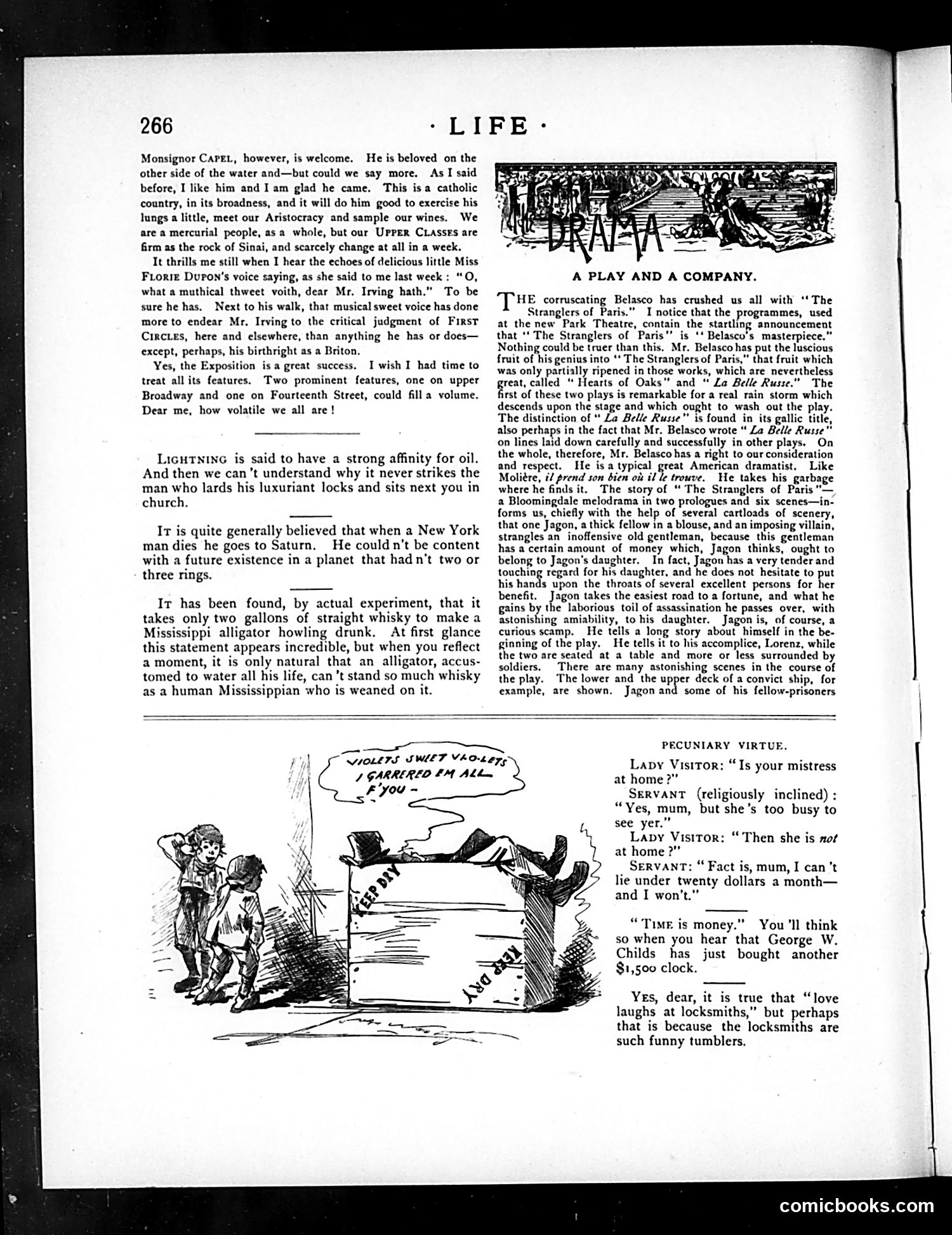
This page contains theater criticism and satirical commentary typical of Life magazine's irreverent style. **Main content:** A lengthy review of David Belasco's play "The Stranglers of Paris" at the Park Theatre. The critic employs biting sarcasm, praising Belasco as a "typical great American dramatist" while mocking his methods—comparing him to Molière but suggesting Belasco simply borrows/steals from existing melodramatic formulas rather than creating original work. The plot involves a villain named Jagon who strangles people to benefit his daughter. **The cartoon** depicts two children discovering what appears to be a vagrant sleeping in a box, with one saying "Violets! Sweet Violets! Hurried in All If You" (possibly garbled OCR). **"Pecuniary Virtue"** section contains a brief comedic dialogue about a servant's employer being "too busy" to receive visitors—social satire about the wealthy's pretensions. The page exemplifies Life's satirical approach: theatrical mockery of popular entertainment and gentle jibes at American social pretension.
📄 Transcribed text from this page (OCR, searchable)
Machine-transcribed from the original scan — historical spelling and the odd misread are preserved.
266 -LI Monsignor CareL, however, is welcome. He is beloved on the other side of the water and—but could we say more. As I said before, I like him and I am glad he came. This isa catholic country, in its broadness, and it will do him good to exercise his lungs a little, meet our Aristocracy and sample our wines. We are a mercurial people, as a whole, but our Upper Ciasses are firm as the rock of Sinai, and scarcely change at all in a week. It thrills me still when I hear the echoes of delicious little Miss Fiorre Duron’s voice saying, as she said to me last week: “O, what a muthical thweet voith, dear Mr. Irving hath.” To be sure he has. Next to his walk, that musical sweet voice has done more to endear Mr. Irving to the critical judgment of First Circtes, here and elsewhere, than anything he has or does— except, perhaps, his birthright as a Briton. Yes, the Exposition is a great success. I wish I had time to treat all its features. Two prominent features, one on upper Broadway and one on Fourteenth Street, could filla volume. Dear me, how volatile we all are! Licutnn is said to have a strong affinity for oil. And then we can’t understand why it never strikes the man who lards his luxuriant locks and sits next you in church, Ir is quite generally believed that when a New York man dies he goes to Saturn. He couldn't be content with a future existence in a planet that hadn't two or three rings. Ir has been found, by actual experiment, that it takes only two gallons of straight whisky to make a Mississippi alligator howling drunk. At first glance this statement appears incredible, but when you reflect a moment, it is only natural that an alligator, accus- tomed to water all his life, can't stand so much whisky as a human Mississippian who is weaned on it. FE: A PLAY AND A COMPANY. THE corruscating Belasco has crushed us all with ‘‘The Stranglers of Paris.” I notice that the programmes, used at the new Park Theatre, contain the startling announcement that ‘The Stranglers of Paris” is ‘‘ Belasco's masterpiece.” Nothing could be truer than this. Mr. Belasco has put the luscious fruit of his genius into ‘* The Stranglers of Paris,” that fruit which was only partially ripened in those works, which are nevertheless great, called “ Hearts of Oaks" and “ La Belle Russe.” The rst of these two plays is remarkable for a real rain storm which descends upon the stage and which ought to wash out the play. The distinction of “ La Belle Russe" is found in its gallic title, also perhaps in the fact that Mr. Belasco wrote “ La Belle Russe" on lines laid down carefully and successfully in other plays. On the whole, therefore, Mr. Belasco has a right to our consideration and respect. He isa typical great American dramatist. Like Moliére, i? prend son bien oi il fe trouve. He takes his garbage where he finds it. The story of “ The Stranglers of Paris” a Bloomingdale melodrama in two prologues and six scenes—in- forms us, chiefly with the help of several cartloads of scenery, that one Jagon, a thick fellow in a blouse, and an imposing villain, strangles an inoffensive old gentleman, because this gentleman has a certain amount of money which, Jagon thinks, ought to belong to Jagon’s daughter. In fact, Jagon has a very tender and touching regard for his daughter, and he does not hesitate to put his hands upon the throats of several excellent persons for her benefit. Jagon takes the easiest road to a fortune, and what he gains by the laborious toil of assassination he passes over, with astonishing amiability, to his daughter. Jagon is, of course, a curious scamp. He tells a long story about himself in the be- ginning of the play. He tells it to his accomplice, Lorenz, while the two are seated at a table and more or less surrounded by soldiers, There are many astonishing scenes in the course of the play. The lower and the upper deck of a conviet ship, for example, are shown. Jagon and some of his fellow-prisoners J GARRERED FM Aken Fiyou -~ ae, VIOLETS SWLET V4O-£ 275 PECUNIARY VIRTUE. Lapy Visitor: “Is your mistress at home?” Servant (religiously inclined) : “Yes, mum, but she’s too busy to see yer.” Lapy Visitor: “Then she is not at home ?” Servant: “ Fact is, mum, I can’t lie under twenty dollars a month— and I won't.” “ny Time is money.” You 'll think so when you hear that George W. Childs has just bought another $1,500 clock. Yes, dear, it is true that “love laughs at locksmiths,” but perhaps that is because the locksmiths are such funny tumblers. comicbooks.com