
Life, 1883-11-22 · page 2 of 16
Life — November 22, 1883 — page 2: what you’re looking at
What you’re looking at
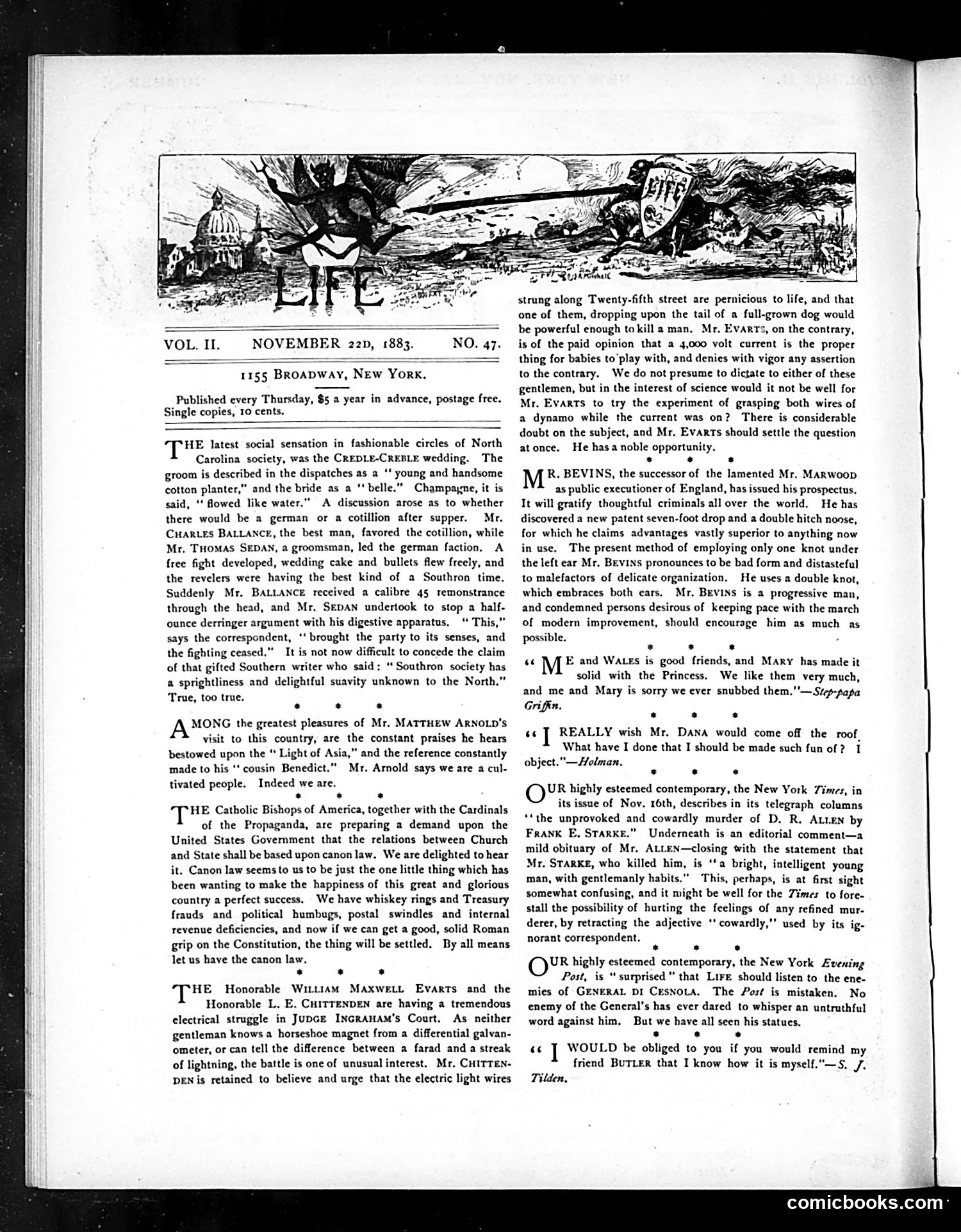
The page consists primarily of satirical commentary and social gossip rather than political cartoons. The masthead illustration shows "LIFE" personified as a classical figure. Content includes commentary on: 1. **The Credle-Creele wedding** in North Carolina—satirizing Southern society's pretensions to refinement while actual violence erupted at the event 2. **Matthew Arnold's visit**—praising the famous British critic as evidence of American cultivation 3. **Church-State relations**—supporting Catholic bishops' calls for stronger connections between Church and State regarding education 4. **William Maxwell Evarts and electrical experiments**—mocking a prominent politician's involvement in dubious electrical demonstrations The tone throughout is gossipy and sardonic, targeting social climbing, pretension, and public figures' questionable endeavors rather than partisan politics.
📄 Transcribed text from this page (OCR, searchable)
Machine-transcribed from the original scan — historical spelling and the odd misread are preserved.
VOL. II. : NOVEMBER 22p, 1883. 1155 BROADWAY, New York. ; Published every Thursday, $5 a year in advance, postage free. Single copies, 10 cents. HE latest social sensation in fashionable circles of North Carolina society, was the CREDLE-CREBLE wedding. The groom is described in the dispatches as a “' young and handsome cotton planter,” and the bride as a ‘‘ belle.” Champayne, it is said, ‘‘ flowed like water.” A discussion arose as to whether there would be a german or a cotillion after supper. Mr. Cares BALLANCE, the best man, favored the cotillion, while Mr. THOMAS SEDAN, a groomsman, led the german faction, A free fight developed, wedding cake and bullets flew freely, and the revelers were having the best kind of a Southron time. Suddenly Mr. BALLANCE received a calibre 45 remonstrance through the head, and Mr, SEDAN undertook to stop a half- ounce derringer argument with his digestive apparatus.“ This,” says the correspondent, ‘‘ brought the party to its senses, and the fighting ceased.” It is not now difficult to concede the claim of that gifted Southern writer who said: “ Southron society has a sprightliness and delightful suavity unknown to the North.” True, too true, * * * AMONG the greatest pleasures of Mr. MATTHEW ARNOLD'S visit to this country, are the constant praises he hears bestowed upon the “ Light of Asia,” and the reference constantly made to his ‘‘ cousin Benedict.” Mr. Arnold says we are a cul- tivated people. Indeed we are. . . . TH Catholic Bishops of America, together with the Cardinals of the Propaganda, are preparing a demand upon the United States Government that the relations between Church and State shall be based upon canon law, We are delighted to hear it. Canon law seems to us to be just the one little thing which has been wanting to make the happiness of this great and glorious country a perfect success, We have whiskey rings and Treasury frauds and political humbugs, postal swindles and internal revenue deficiencies, and now if we can get a good, solid Roman grip on the Constitution, the thing will be settled. By all means let us have the canon law. . *. * HE Honorable Wittiam MAxwett Evarts and the Honorable L. E. CHITTENDEN are having a tremendous electrical struggle in JupGe INGRAHAM's Court. As neither gentleman knows a horseshoe magnet from a differential galvan- ometer, or can tell the difference between a farad and a streak of lightning, the battle is one of unusual interest. Mr. CHITTEN- DEN is retained to believe and urge that the electric light wires aaa Are strung along Twenty-fifth street are pernicious to life, and that one of them, dropping upon the tail of a full-grown dog would be powerful enough to kill a man, Mr, EvARTS, on the contrary, is of the paid opinion that a 4,000 volt current is the proper thing for babies to’play with, and denies with vigor any assertion to the contrary. We do not presume to dictate to either of these gentlemen, but in the interest of science would it not be well for Mr. EvarTS to try the experiment of grasping both wires of a dynamo while the current was on? There is considerable doubt on the subject, and Mr. Evarts should settle the question atonce. He hasa noble opportunity. * . * R. BEVINS, the successor of the lamented Mr. MARWooD as public executioner of England, has issued his prospectus. Tt will gratify thoughtful criminals all over the world. He has discovered a new patent seven-foot drop and a double hitch noose, for which he claims advantages vastly superior to anything now in use. The present method of employing only one knot under the left ear Mr. Bevins pronounces to be bad form and distasteful to malefactors of delicate organization. He uses a double knot, which embraces both cars. Mr. BEVINS is a progressive man, and condemned persons desirous of keeping pace with the march of modern improvement, should encourage him as much as possible. “ MF and WALES is good friends, and Mary has made it solid with the Princess. We like them very much, and me and Mary is sorry we ever snubbed them.”"—Step-papa Griffin, * * * * . * 66 T REALLY wish Mr. Dana would come off the roof What have I done that I should be made such fun of? I object."—Holman, . . . Ov highly esteemed contemporary, the New York Times, in its issue of Nov. r6th, describes in its telegraph columns ‘the unprovoked and cowardly murder of D. R. ALLEN by Frank E, STARKE.” Underneath is an editorial comment—a mild obituary of Mr. Atten—closing with the statement that Mr. STARKE, who killed him, is ‘ta bright, intelligent young man, with gentlemanly habits." This, perhaps, is at first sight somewhat confusing, and it might be well for the Zimes to fore- stall the possibility of hurting the feelings of any refined mur- derer, by retracting the adjective ‘‘ cowardly," used by its ig- norant correspondent. . . Ov highly esteemed contemporary, the New York Evening Post, is “ surprised" that Lire should listen to the ene- mies of GENERAL DI CEsNoLA. The Post is mistaken. No enemy of the General's has ever dared to whisper an untruthful word against him, But we have all seen his statues. . * * “ J WOULD be obliged to you if you would remind my friend BUTLER that I know how it is myself."—S, J, Tilden, comicbooks.com: