
Life, 1883-11-22 · page 4 of 16
Life — November 22, 1883 — page 4: what you’re looking at
What you’re looking at
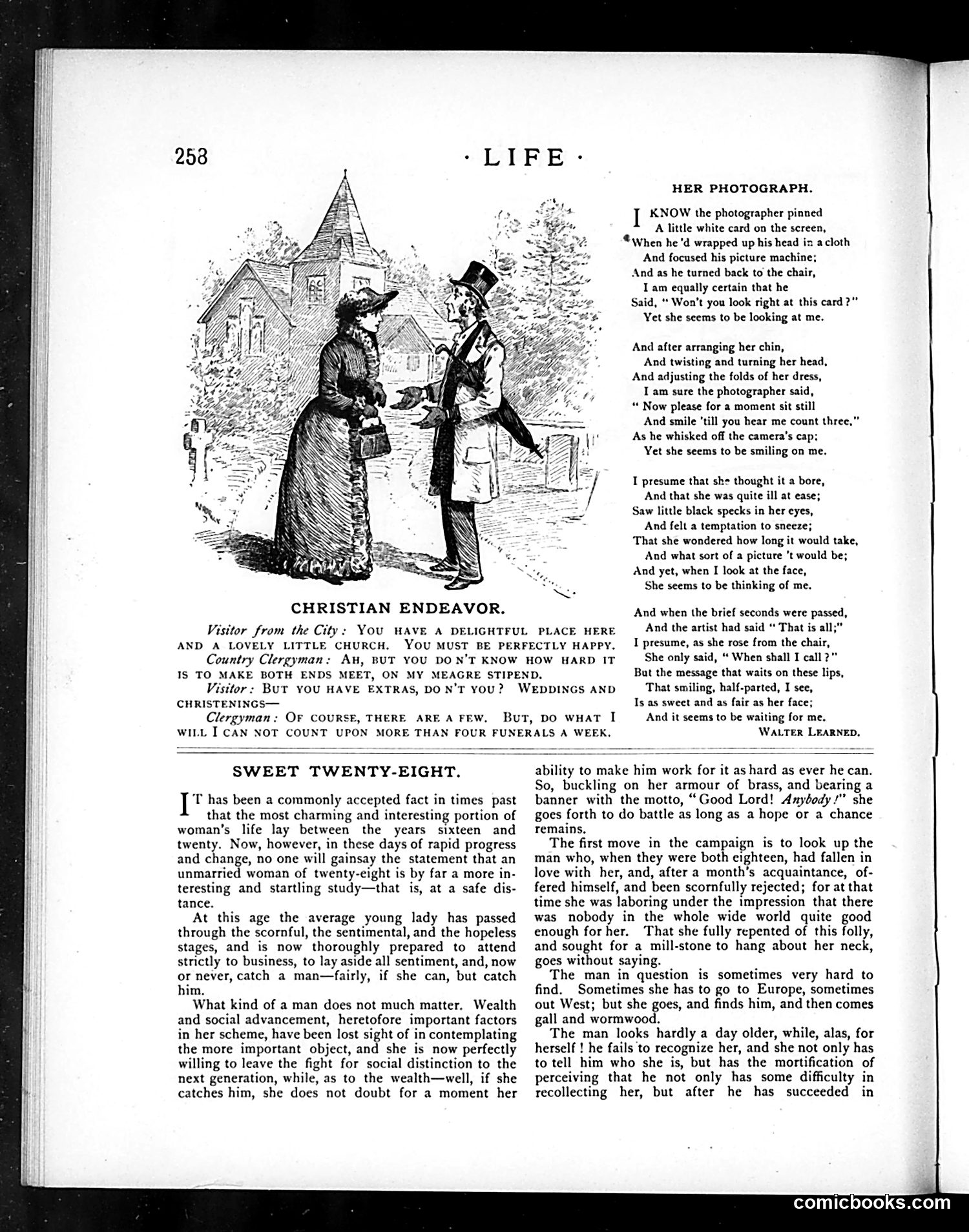
The cartoon depicts a conversation between a well-dressed male visitor and a female church member, labeled "Christian Endeavor." The satire mocks the tension between religious ideology and practical reality: the visitor praises the church as "delightful," while the female character sardonically notes that weddings and funerals are the only activities—she can't count on more than "four funerals a week." The joke critiques the gap between idealized religious community and its actual, grim functionality. The adjoining article "Sweet Twenty-Eight" discusses unmarried women of that age. It satirizes contemporary marriage-market pressures: women must shed sentimentality to "catch" a husband through strategic effort, treating romance as transactional labor rather than genuine connection. The piece reflects Victorian-era anxieties about female independence and the marriage market's commodification of women.
📄 Transcribed text from this page (OCR, searchable)
Machine-transcribed from the original scan — historical spelling and the odd misread are preserved.
CHRISTIAN ENDEAVOR. Visitor from the City: YOU HAVE A DELIGHTFUL PLACE HERE You MUST BE PERFECTLY HAPPY. Country Clergyman: AW, BUT YOU DON’T KNOW HOW HARD IT 1S TO MAKE BOTH ENDS MEET, ON MY MEAGRE STIPEND. WEDDINGS AND AND A LOVELY LITTLE CHURCH. for: BUT YOU HAVE EXTRAS, DON’T you? CHRISTENINGS— Clergyman: OF COURSE, THERE ARE A FEW. But, po wHaTt I WILL I CAN NOT COUNT UPON MORE THAN FOUR FUNERALS A WEEK. HER PHOTOGRAPH. [ KNOW the photographer pinned A little white card on the screen, “When he'd wrapped up his head And focused his picture machine; And as he turned back to the chair, Iam equally certain that he Said, * Won't you look right at this card?” Yet she seems to be looking at me. acloth And after arranging her chin, And twisting and turning her head, And adjusting the folds of her dress, I am sure the photographer said, “ Now please for a moment sit still And smile ‘till you hear me count three,” As he whisked off the camera's cap; Yet she seems to be smiling on me. I presume that sh> thought it a bore, ‘And that she was quite ill at ease; Saw little black specks in her eyes, And felt a temptation to sneeze; ‘That she wondered how long it would take, And what sort of a picture 't would be; And yet, when I look at the face, She seems to be thinking of me. And when the brief seconds were passed, And the artist had said “ That is all;” I presume, as she rose from the chair, She only said, “ When shall I call?" But the message that waits on these lips, That smiling, half-parted, I see, Is as sweet and as fair as her face; And it seems to be waiting for me. WALTER LEARNED. SWEET TWENTY-EIGHT. I" has been a commonly accepted fact in times past that the most charming and interesting portion of woman's life lay between the years sixteen and twenty. Now, however, in these days of rapid progress and change, no one will gainsay the statement that an unmarried woman of twenty-eight is by far a more in- teresting and startling study—that is, at a safe dis- tance. At this age the average young lady has passed through the scornful, the sentimental, and the hopeless stages, and is now thoroughly prepared to attend strictly to business, to lay aside all sentiment, and, now or never, catch a man—fairly, if she can, but catch him. What kind of a man does not much matter. Wealth and social advancement, heretofore important factors in her scheme, have been lost sight of in contemplating the more important object, and she is now perfectly willing to leave the fight for social distinction to the next generation, while, as to the wealth—well, if she catches him, she does not doubt for a moment her ability to make him work for it as hard as ever he can. So, buckling on her armour of brass, and bearing a banner with the motto, “Good Lord! Anybody!” she goes forth to do battle as long as a hope or a chance remains, The first move in the campaign is to look up the man who, when they were both eighteen, had fallen in love with her, and, after a month’s acquaintance, of- fered himself, and been scornfully rejected; for at that time she was laboring under the impression that there was nobody in the whole wide world quite good enough for her. That she fully repented of this folly, and sought for a mill-stone to hang about her neck, goes without saying. The man in question is sometimes very hard to find. Sometimes she has to go to Europe, sometimes out West; but she goes, and finds him, and then comes gall and wormwood. The man looks hardly a day older, while, alas, for herself ! he fails to recognize her, and she not only has to tell him who she is, but has the mortification of perceiving that he not only has some difficulty in recollecting her, but after he has succeeded in comicbooks.com