
Life, 1883-11-22 · page 13 of 16
Life — November 22, 1883 — page 13: what you’re looking at
What you’re looking at
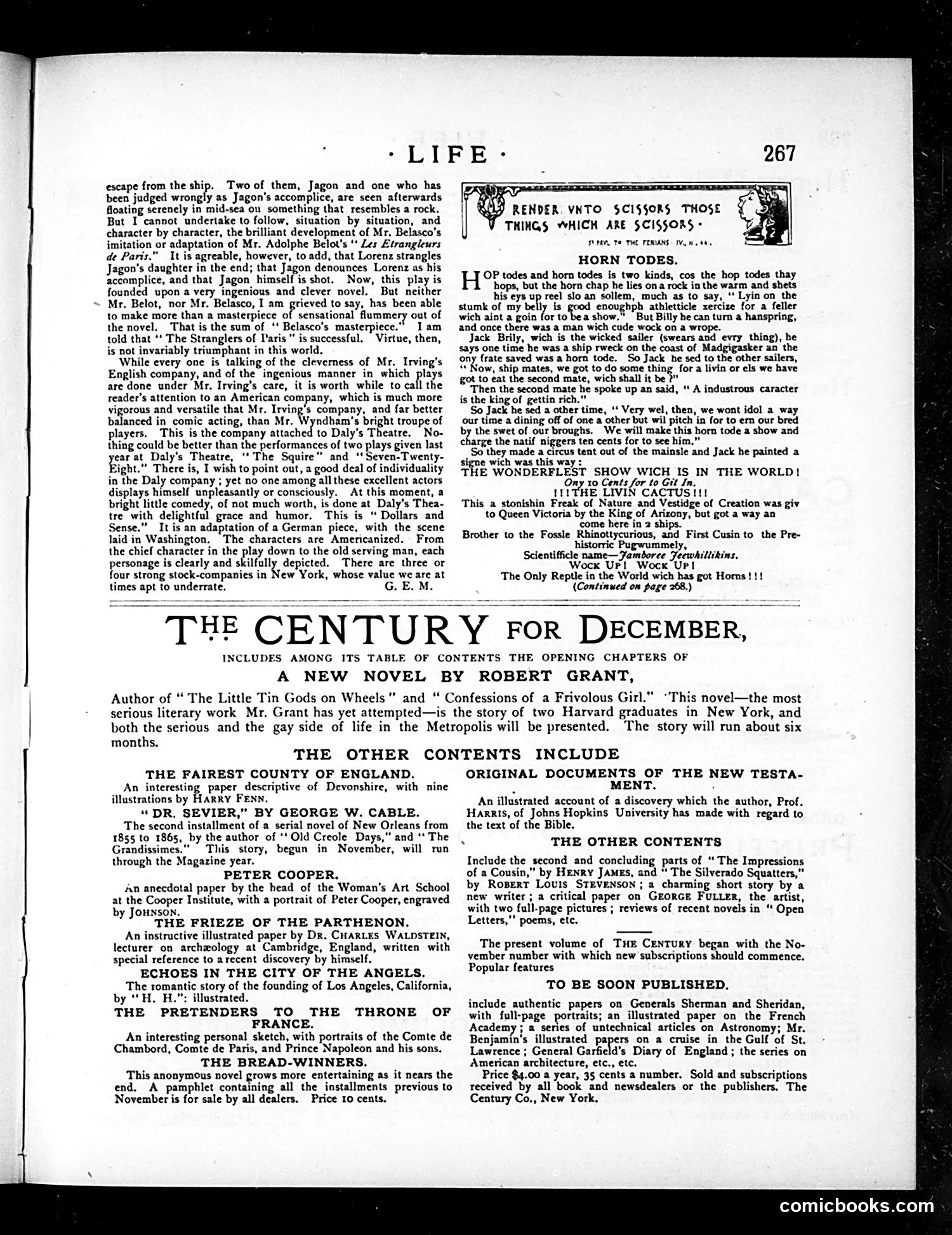
This page is primarily **book and theater reviews**, not political cartoons. The main content critiques theatrical productions, particularly praising Daly's Theatre company over competitors like Henry Irving's English troupe. The only illustrated element visible is a small decorative header reading "RENDER UNTO SCISSORS THOSE THINGS WHICH ARE SCISSORS" — a Biblical pun (referencing "render unto Caesar") with unclear satirical intent. Below that is "HORN TODES," a humorous dialect piece about a sailor's tale featuring a horn toad as a circus attraction. Written in intentionally misspelled, phonetic dialect (a period convention for rural/working-class humor), it mocks credulous audiences and carnival exploitation. The page concludes with announcements for upcoming *Century* magazine content, including works by Robert Grant and papers on historical topics. **For modern readers:** This represents 19th-century literary culture where theater criticism was as important as news, and dialect humor was mainstream entertainment.
📄 Transcribed text from this page (OCR, searchable)
Machine-transcribed from the original scan — historical spelling and the odd misread are preserved.
*- LIFE: escape from the ship, Two of them, Jagon and one who has been judged wrongly as Jagon’s accomplice, are seen afterwards floating serenely in mid-sea on something that resembles a rock. But I cannot undertake to follow, situation by situation, and character by character, the brilliant development of Mr. Belasco's imitation or adaptation of Mr. Adolphe Belot's ‘* Les Etrangleurs de Paris.” It is agreable, however, to add, that Lorenz strangles Jagon’s daughter in the end; that Jagon denounces Lorenz as his accomplice, and that Jagon himself is shot. Now, this play is founded upon a very ‘ingenious and clever novel. But neither Mr. Belot, nor Mr. Belasco, I am grieved to say, has been able to make more than a masterpiece of sensational flummery out of the novel. That is the sum of ‘‘ Belasco’s masterpiece.” I am told that ** The Stranglers of aris” is successful. Virtue, then, is not invariably triumphant in this world. While every one is talking of the cleverness of Mr. Irving’s English company, and of the ingenious manner in which plays are done under Mr, Irving’s care, it is worth while to call the reader's attention to an American company, which is much more vigorous and versatile that Mr. Irving's company, and far better balanced in comic acting, than Mr. Wyndbam's bright troupe of players. This is the company attached to Daly's Theatre. No- thing could be better than the performances of two plays given last ear at Daly's Theatre, ‘* The Squire” and ‘‘Seven-Twenty- Eight.” There is, I wish to point out, a good deal of individuality in the Daly company ; yet no one among all these excellent actors displays himself unpleasantly or consciously. At this moment, a bright little comedy, of not much worth, is done at Daly’s Thea- tre with delightful grace and humor. This is “ Dollars and Sense.” It is an adaptation of a German piece, with the scene laid in Washington. The characters are Americanized. From the chief character in the play down to the old serving man, each personage is clearly and skilfaly depicted. There are three or four strong stock-companies in New York, whose value we are at RENDER. VNTO SCISSORS THOSE THINGS WHICH ARE SCISSORS - Ste. TO THE TERUNS IV, 1.44. HORN TODES. H OP todes and horn todes is two kinds, cos the hop todes thay hops, but the horn chap he lies on a rock in the warm and shets his eys up reel slo an sollem, much as to say, “ Lyin on the stumk of my belly is enoughph athletticle xercize for a feller wich aint a goin for to bea show.” But Billy he can turn a hanspring, and once there was a man wich cude wock on a wrope. Jack Brily, wich is the wicked sailer (swears and evry thing), he says one time he was a ship rweck on the coast of Madgigasker an’ the ony frate saved was a horn tode. So Jack he sed to the other sailers, ** Now, atte mates, we got to do some thing for a livin or els we have ot to eat the second mate, wich shall it be ?” ‘Then the second mate he spoke up an said, “A industrous caracter is the king of gettin rich.” jack he sed a other time, “‘ Very wel, then, we wont idol a way our time a dining off of one a other but wil pitch in for to ern our bred by the swet of our broughs. We will make this horn tode a show and charge the natif niggers ten cents for to see him.” So they made a circus tent out of the mainsle and Jack he painted a signe wich was this way : THE WONDERFLEST SHOW WICH IS IN THE WORLD! ny 10 Cents for to Git In. {!1THE LIVIN CACTUS!!! This a stonishin Freak of Nature and Vestidge of Creation was giv to Queen Victoria by the King of Arizony, but got a way an come here in 2 ships. Brother to the Fossle Rhinottycurious, and First Cusin to the Pre- historic Pugwummely, Scientifficle name— Jamboree Feewhillikins, Wocx UP! Wockx UP! ‘The Only Reptle in the World wich has got Homs !!! times apt to underrate. G. E. M. (Continued on page 268.) ‘THE CENTURY FOR DECEMBER, a A NEW NOVEL BY ROBERT GRANT, Author of “ The Little Tin Gods on Wheels" and “ Confessions of a Frivolous Girl.” “This novel—the most serious literary work Mr. Grant has yet attempted—is the story of two Harvard graduates in New York, and OPENING CHAPTERS OF both the serious and the gay side of life in the Metropolis will be presented. The story will run about six months, THE OTHER CONTENTS INCLUDE THE FAIREST COUNTY OF ENGLAND. An interesting paper descriptive of Devonshire, with nine illustrations by HARRY FENN. “DR, SEVIER,” BY GEORGE W. CABLE. The second installment of a serial novel of New Orleans from 1855 to 1865, by the author of Old Creole Days,” and “ The Grandissimes.” This story, begun in November, will run through the Magazine year. PETER COOPER. An anecdotal paper by the head of the Woman's Art School at the Cooper Institute, with a portrait of Peter Cooper, engraved by Jounson. THE FRIEZE OF THE PARTHENON. An instructive illustrated paper by Dr. CHARLES WALDSTEIN, lecturer on archeology at Cambridge, England, written with special reference to arecent discovery by himself. ECHOES IN THE CITY OF THE ANGELS. The romantic story of the founding of Los Angeles, California, by ‘'H. H.": illustrated. THE PRETENDERS TO THE THRONE OF FRANCE. An interesting personal sketch, with portraits of the Comte de Chambord, Comte de Paris, and Prince Napoleon and his sons. THE BREAD-WINNERS. This anonymous novel grows more entertaining as it nears the end. A pamphlet containing all the installments previous to November is for sale by all dealers. Price 10 cents. ORIGINAL DOCUMENTS OF THE NEW TESTA- MENT. An illustrated account of a discovery which the author, Prof. Hanis, of Johns Hopkins University has made with regard to the text of the Bible. . THE OTHER CONTENTS Include the second and concluding parts of “ The Impressions of a Cousin,” by Henry JAMES, and “ The Silverado Squatters,” by Robert Louis STEVENSON ; a charming short story by a new writer; a critical paper on GEORGE FULLER, the artist, with two full-page pictures ; reviews of recent novels in “ Open Letters,’” poems, etc. The present volume of THE CENTURY began with the No- vember number with which new subscriptions should commence, Popular features TO BE SOON PUBLISHED. include authentic papers on Generals Sherman and Sheridan, with full-page portraits; an illustrated paper on the French Academy ; a series of untechnical articles on Astronomy; Mr. Benjamin's illustrated Papers on a cruise in the Gulf of St. Lawrence ; General Garfield's Diary of England; the series on American architecture, etc., etc. Price $4.00 a year, 35 cents a number. Sold and subscriptions received by all book and newsdealers or the publishers. The Century Co., New York, comicbooks.com