A complete issue · 38 pages · 1932
Judge — December 1932
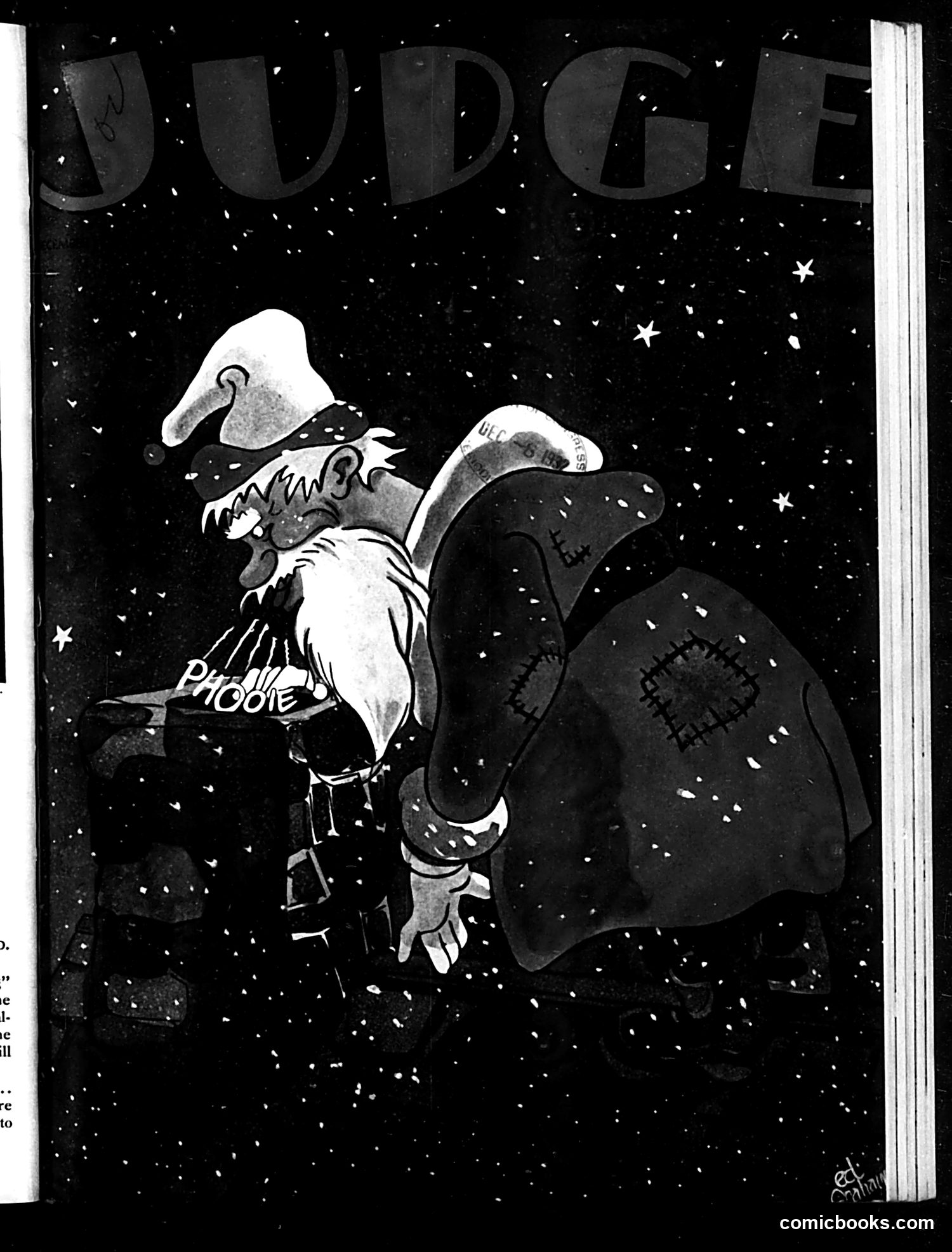
# Analysis This **Judge** magazine cover depicts Santa Claus in a starry night sky, but with a satirical twist. Santa appears disheveled or worn, with a patched coat bearing visible stitching—suggesting hardship or poverty. The exaggerated caricature and tattered appearance likely comment on economic hardship during a specific historical period, possibly the Great Depression or another era of financial struggle. The satire suggests that even Santa—traditionally a symbol of abundance and gift-giving—cannot escape the era's economic difficulties. The starry background frames this commentary as somewhat cosmic or inevitable. Without the full article text, the exact political target remains unclear, but the central joke appears to be that financial crisis affects even mythical figures associated with prosperity and generosity.
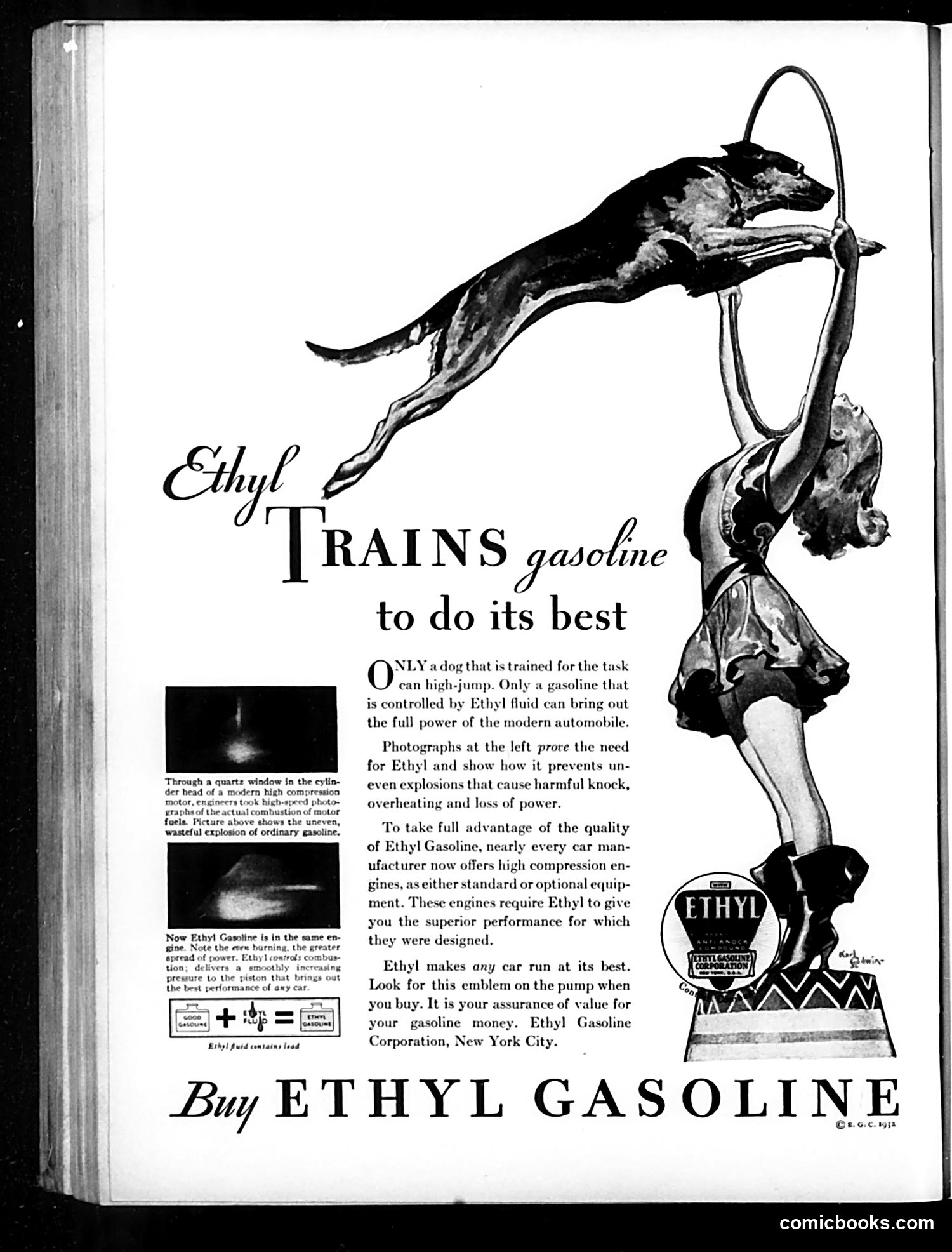
# Analysis This is **not a political cartoon** but rather a **1920s advertisement for Ethyl Gasoline**. The page uses a clever metaphor: just as a dog must be "trained for the task" to high-jump successfully, gasoline requires "Ethyl fluid" (tetraethyl lead) to perform optimally in high-compression engines. The striking illustration shows a trained dog leaping through a hoop, paralleling the "training" of gasoline. Small technical photographs on the left demonstrate combustion differences, showing how Ethyl prevents "knock" and explosions in modern motors. The advertisement emphasizes that most new car manufacturers now offer high-compression engines requiring Ethyl Gasoline. It directs consumers to look for the Ethyl emblem at pumps and closes with the corporate address: Ethyl Gasoline Corporation, New York City. This is pure product advertising, not satire.
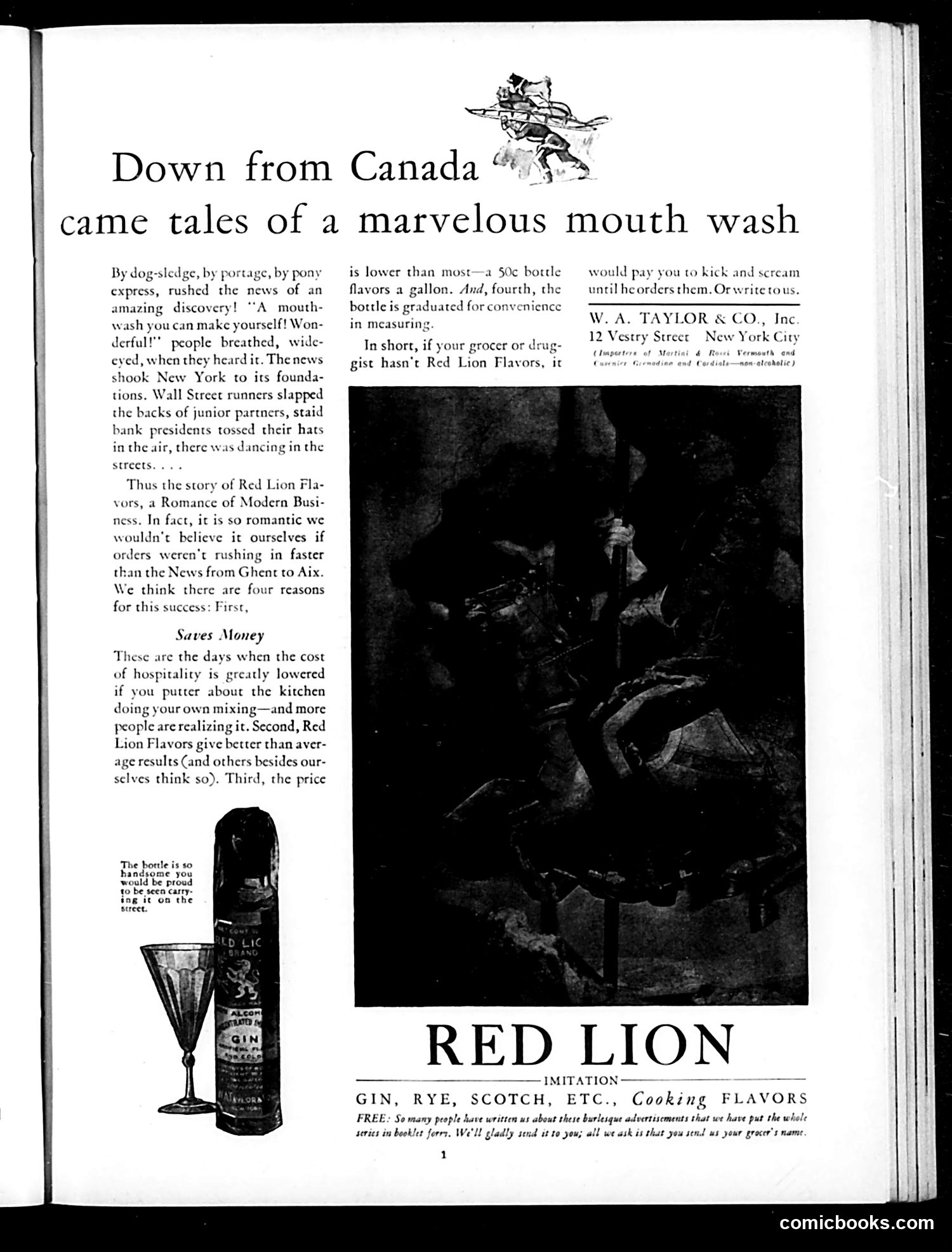
# Red Lion Mouthwash Advertisement This page is primarily a commercial advertisement for Red Lion brand mouthwash and cooking flavorings, not a political cartoon. The ad describes the product's popularity "down from Canada," claiming it caused excitement on Wall Street and in New York's financial district. The advertisement emphasizes four selling points: cost savings (home mixing), superior results, attractive bottle design, and pricing structure (50¢ for a gallon of flavoring). The central image appears to be a dark, atmospheric scene—possibly depicting frontier or outdoor activity—though its relevance to mouthwash is unclear. The accompanying bottle illustration shows the product's packaging. This represents typical early-20th-century *Judge* magazine content: advertisements alongside satire, targeting middle-class urban readers interested in consumer products and business news.
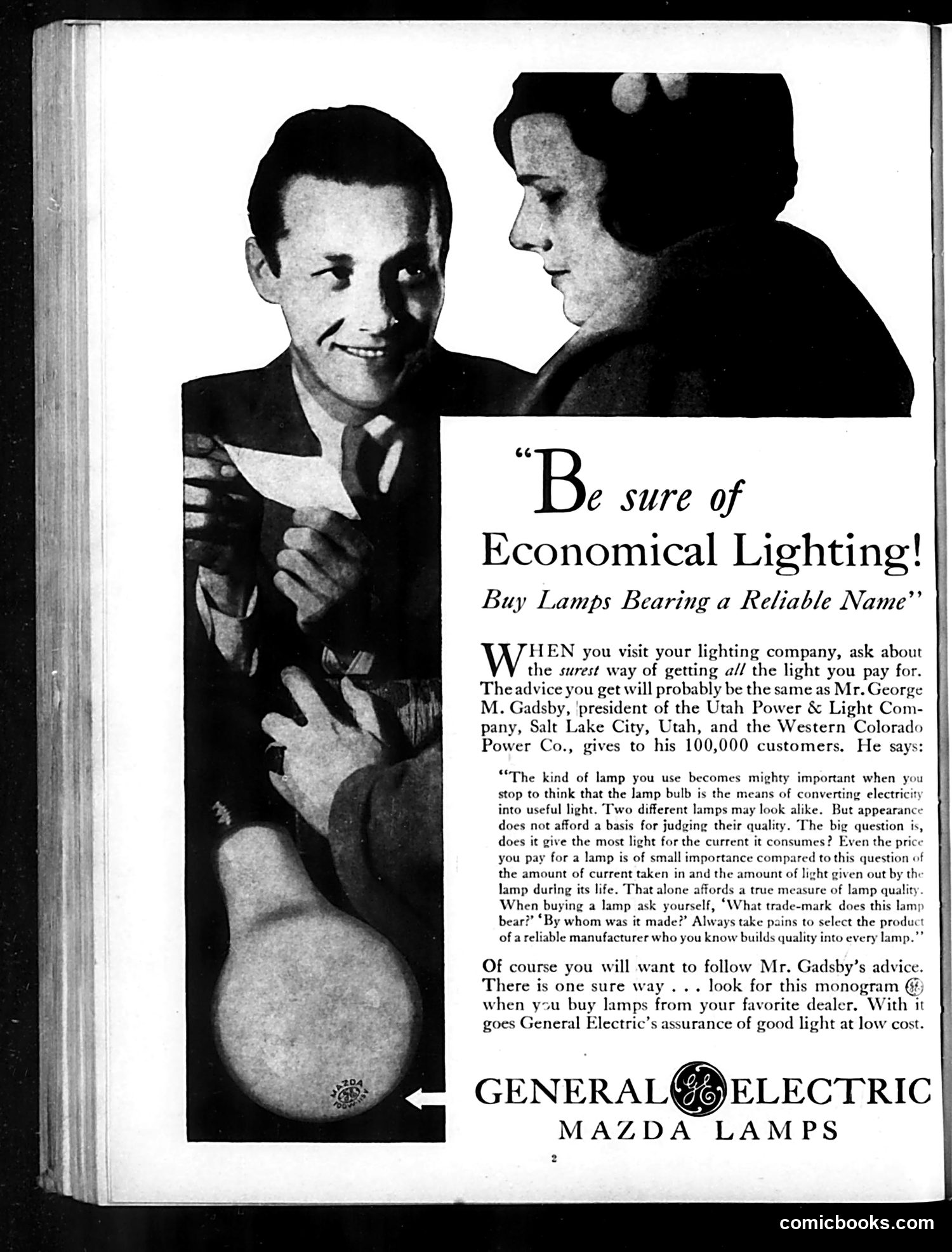
# Analysis This page is **primarily an advertisement**, not satire or political commentary. It features a General Electric Mazda Lamps advertisement disguised as editorial content. The "cartoon" element is minimal—two men in professional dress examining a light bulb. One appears to be identified as George M. Gadsby, president of Utah Power & Light Company, presented as an expert endorsing economical lighting practices. The "satire" (if any exists) is subtle: the ad uses the authority of a real utility executive to promote buying name-brand lamps, framing this as consumer advice. However, this is straightforward advertising copy rather than biting satire. There's no clear political reference or caricature to decode. The page exemplifies how Judge mixed advertisements with editorial content to generate revenue.
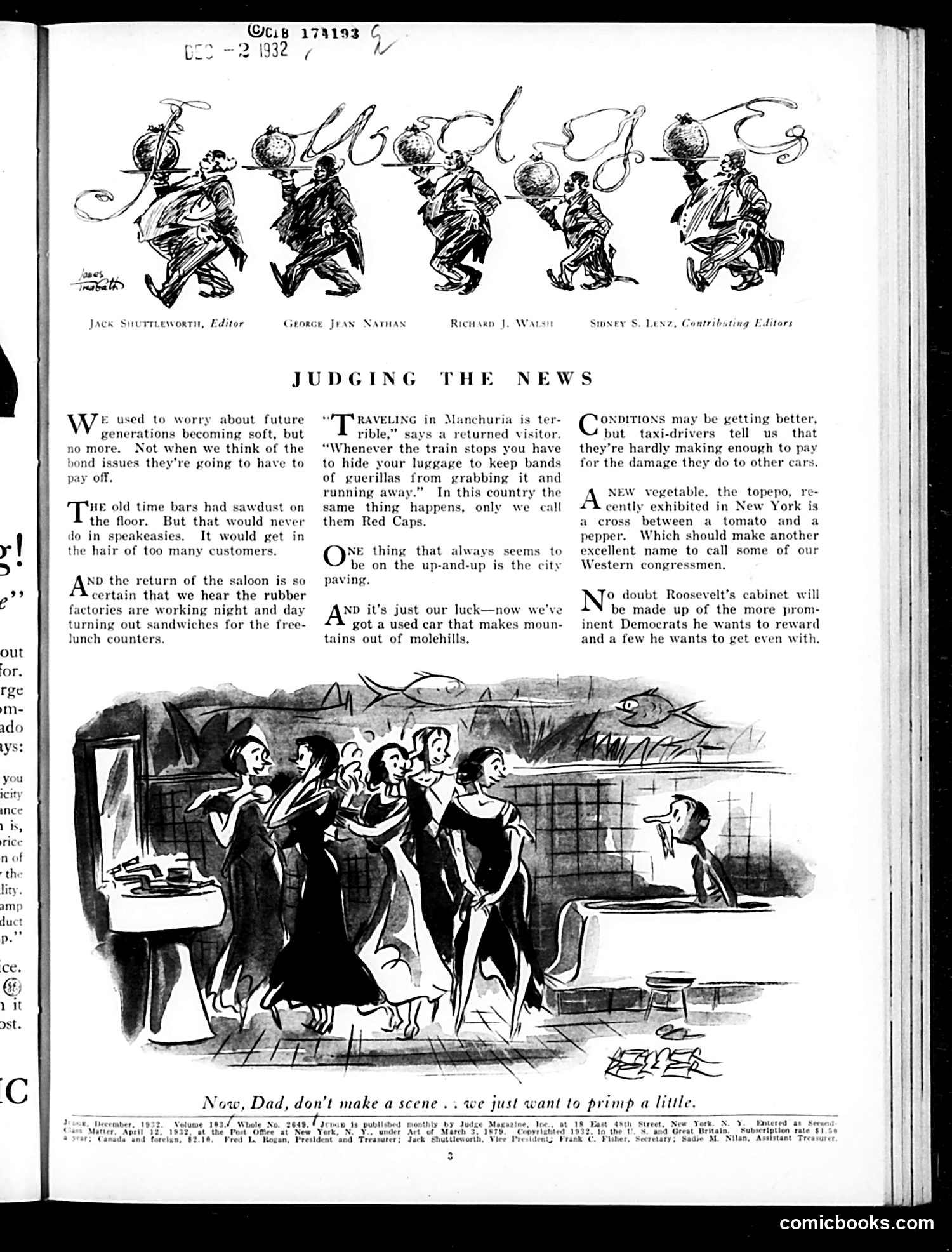
# "Judging the News" - December 1932 This page from **Judge magazine** (dated December 1932) contains satirical commentary on contemporary events during the Great Depression and early New Deal period. The **top cartoon** shows five figures juggling globes—likely representing editors or political commentators attempting to manage multiple international crises simultaneously. The **main cartoon** below depicts a domestic scene where a woman says to a man, "Now, Dad, don't make a scene...I see just want to primp a little." This appears to satirize **Roosevelt's cabinet selections**, referenced in the text: the satire suggests family members (possibly representing Democratic factions) disagreeing over appointments, with implied tension between those wanting immediate action versus those preferring delay. The brief text items mock various 1932 issues: Manchuria troubles, urban conditions, vegetables, and Roosevelt's political balancing act.
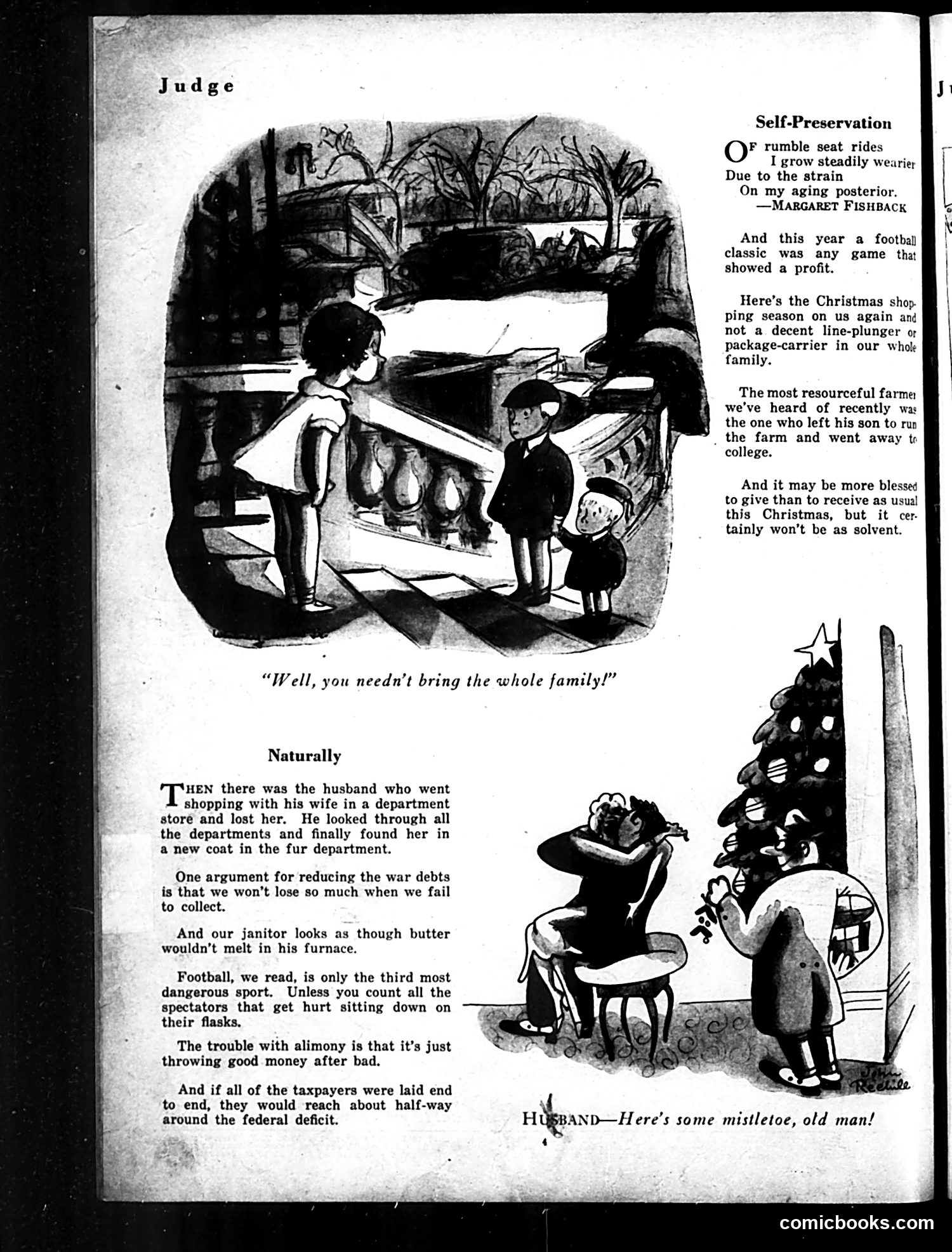
# Analysis of Judge Magazine Page This page contains two satirical pieces commenting on post-WWI economic hardship and Christmas spending. **Top cartoon** ("Self-Preservation"): Shows a family Christmas shopping trip where someone suggests bringing extended relatives along. The satire criticizes economic strain—families can barely afford their own shopping without supporting additional dependents, reflecting Depression-era financial anxiety. **"Naturally" section**: Multiple brief jokes mock post-war difficulties: lost war debts, dangerous football spectators, "alimony throwing good money after bad," and taxpayer burden from federal deficit. **Bottom cartoon**: Shows a husband offering mistletoe to his wife during Christmas, a traditional holiday gesture now treated as cautiously humorous—likely suggesting marital strain from financial pressures. Overall, the page saririzes economic hardship disguised within holiday tradition and family obligation.
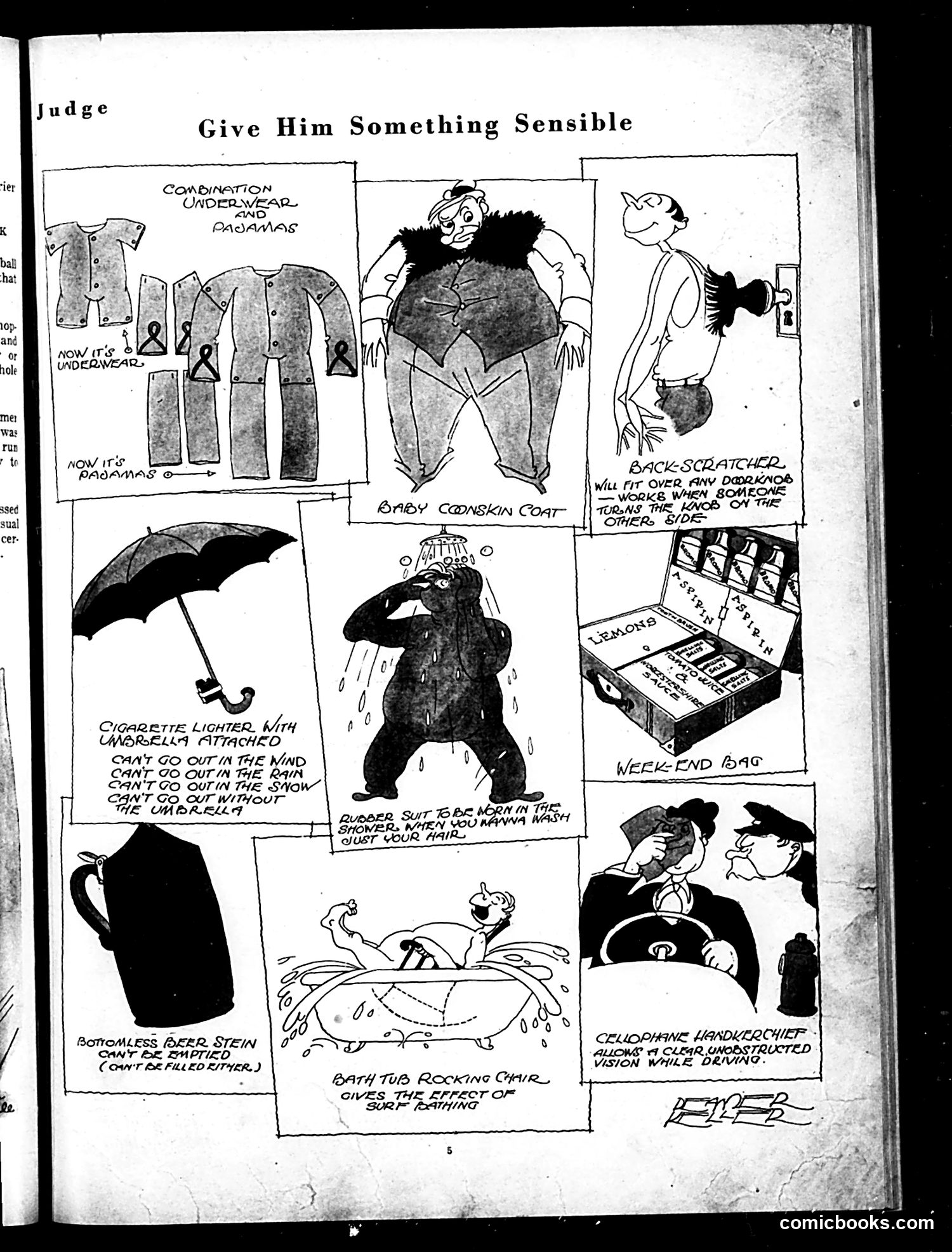
# "Give Him Something Sensible" This page satirizes impractical gift-giving for men. Each panel mocks frivolous or absurd presents: - **Combination underwear/pajamas**: Criticized as pointlessly complicated - **Baby coonskin coat**: Suggests giving a child's fur coat to an adult man - **Back-scratcher**: Described as something to wear over other clothes - **Cigarette lighter with umbrella**: Mocked for being useless in various weather conditions - **Rubber suit for shower**: Impractical bathing attire - **Week-end bag**: Appears to be a travel item - **Bottomless beer stein**: A joke item that cannot function - **Bath tub rocking chair**: Combines bathing with furniture absurdly - **Cellophane handkerchief**: Clear but obstructed vision while driving The headline's irony—"Give Him Something Sensible"—undercuts the page by showing only ridiculous options, satirizing the difficulty of gift selection.
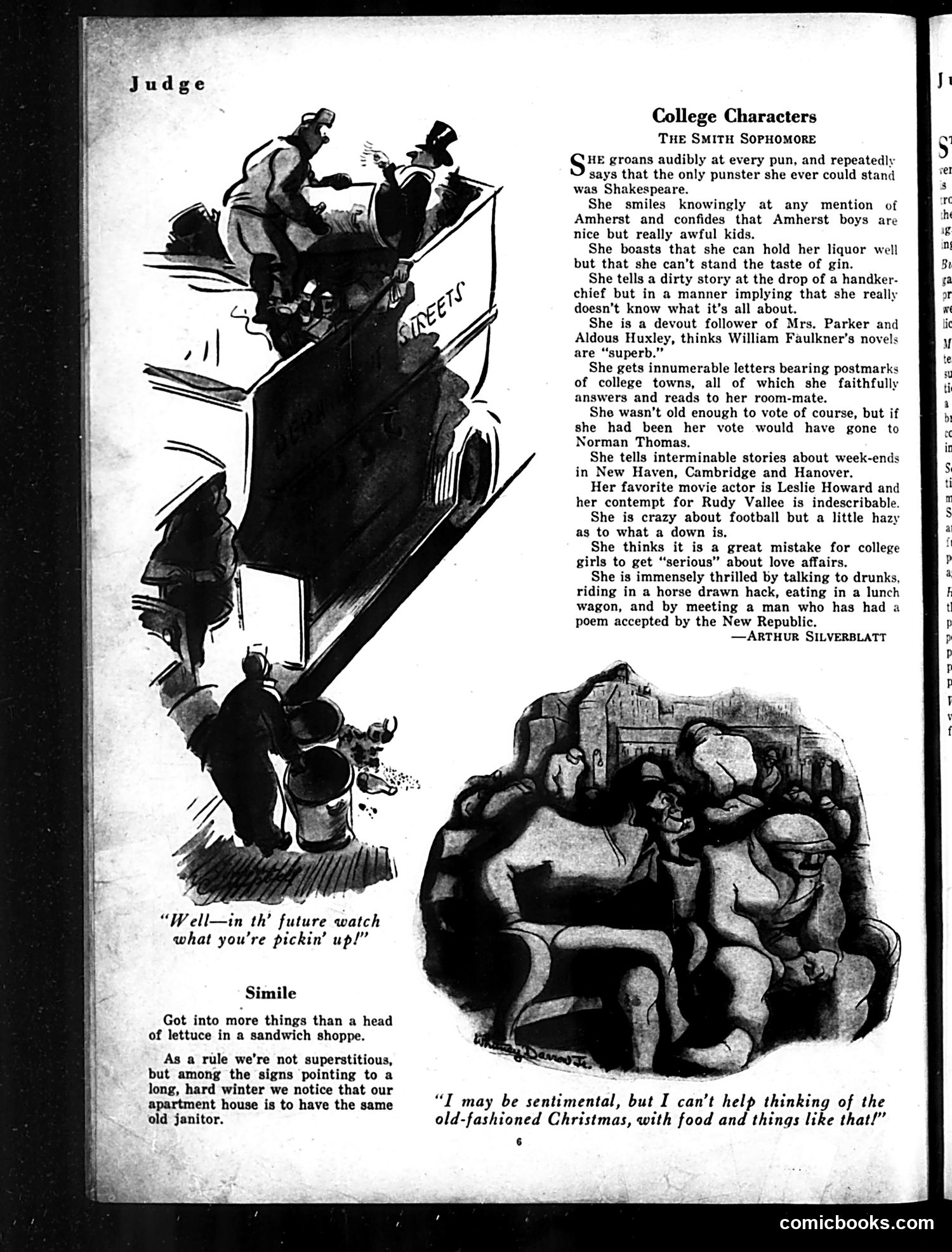
# Analysis of Judge Magazine Page This page contains two distinct satirical pieces about college life: **Top cartoon ("Judge"):** Depicts a chaotic scene of students in a vehicle labeled "KINETIC," with the caption "Well—in th' future watch what you're pickin' up!" The satire appears to mock reckless student behavior and poor judgment. **"College Characters" section:** A character sketch of "The Smith Sophomore"—a female college student who enjoys drinking, tells crude stories, reads modernist literature (Faulkner), and engages in casual socializing. The satire mocks pretentious intellectual affectation mixed with crude behavior. References to Leslie Howard (actor) and "the New Republic" ground this in 1920s-30s college culture. **"Simile" section:** A brief humorous comparison about an apartment janitor, using the metaphor of "lettuce in a sandwich shoppe." The overall tone satirizes youthful excess and affected sophistication among college students of the era.
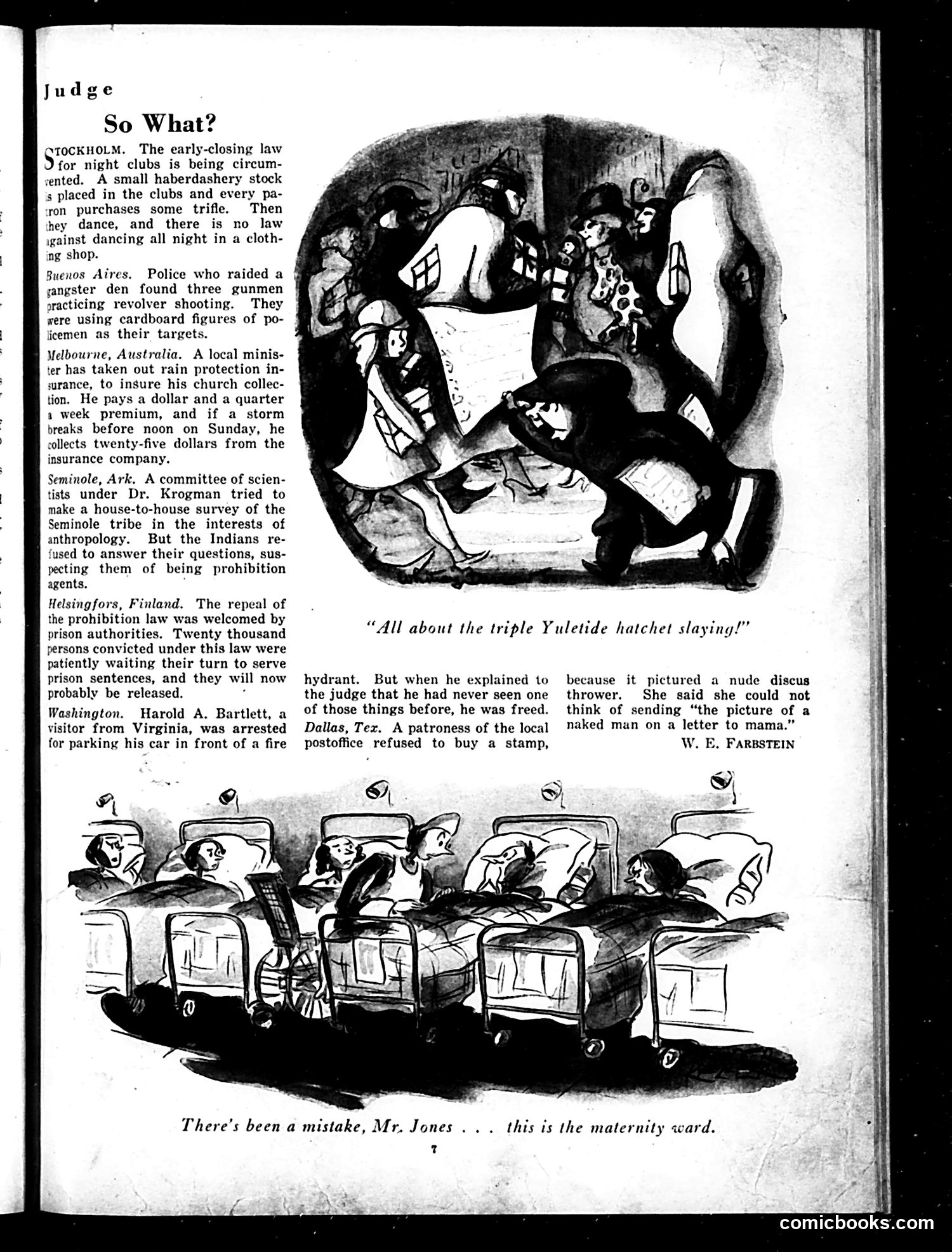
# Judge Magazine Page Analysis This page contains **short satirical news items** ("So What?") mocking absurd real-world situations, plus two unrelated cartoons. The news briefs use exaggeration to critique: - **Legal loopholes** (Stockholm nightclubs selling clothing to circumvent closing laws) - **Irony** (gangsters practicing on cardboard police targets; prohibition conviction backlog released after repeal) - **Absurdity** (Australian minister insuring church donations against rain; Virginia man freed for parking violation because he'd "never seen" a fire hydrant; Texas woman refusing to mail a stamp depicting a classical nude discus thrower as "indecent") The **top cartoon** illustrates the Dallas stamp story, showing shocked reactions to the nude figure. The **bottom cartoon** depicts a hospital maternity ward mix-up, with the caption "There's been a mistake, Mr. Jones...this is the maternity card"—likely meaning someone received the wrong paperwork or newborn. The humor relies on period-specific sensibilities (prudishness about nudity, post-Prohibition attitudes, cultural assumptions) that require historical context for modern readers.
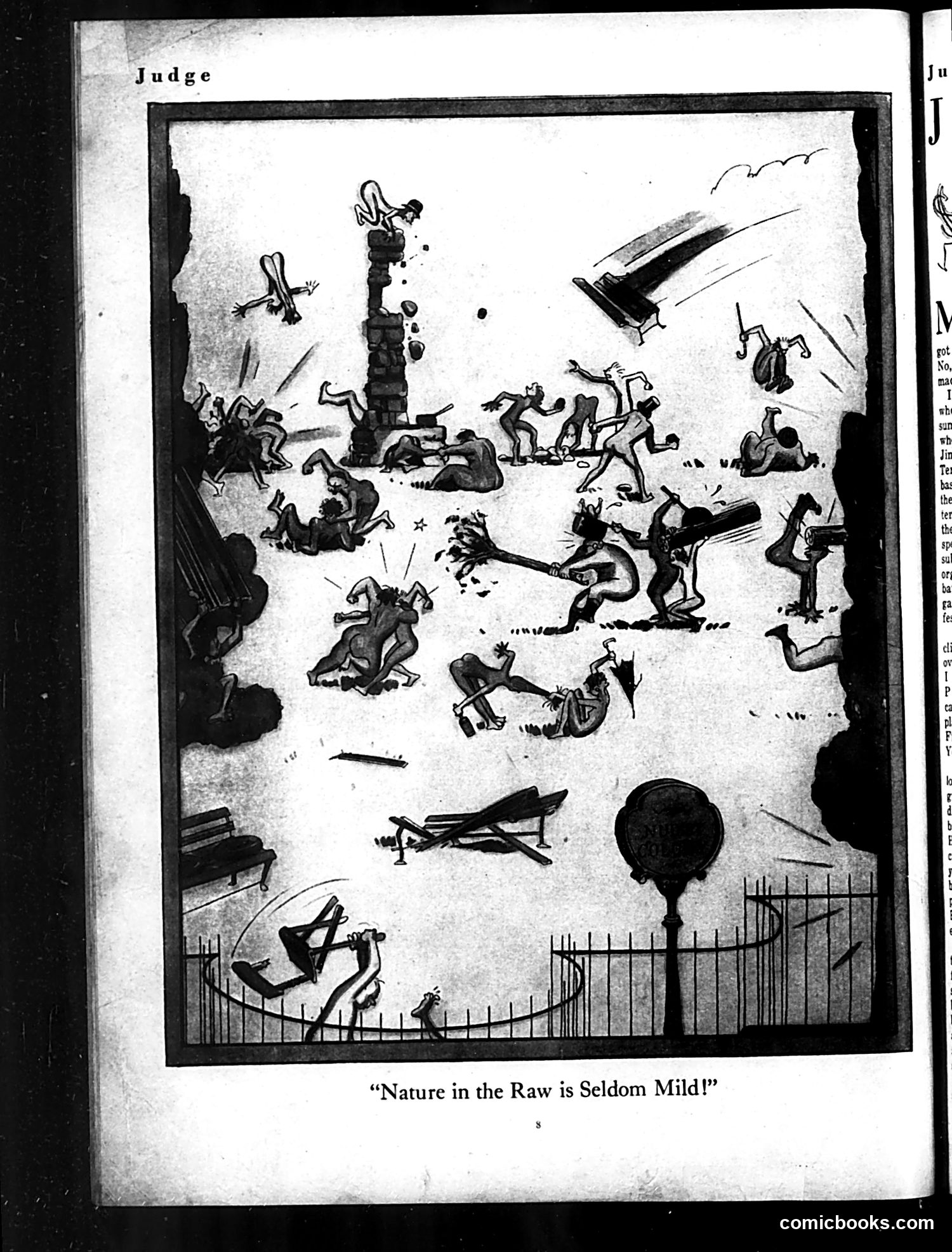
# "Nature in the Raw is Seldom Mild!" This Judge cartoon depicts violent chaos in a park or public space. Figures are shown fighting, fleeing, and being struck by falling objects—including what appears to be an airplane crashing from above. A tall tower or structure collapses at center, while people scatter in panic. The fence and lamp post suggest an urban setting. The caption's phrase "Nature in the Raw" suggests the cartoon satirizes either uncontrolled human nature or actual natural disasters. The chaotic violence, aircraft, and destruction could reference industrial-age anxieties, warfare, or accidents—though without publication date context, the specific event or social commentary remains unclear. The work emphasizes nature or circumstance as fundamentally dangerous and unpredictable.
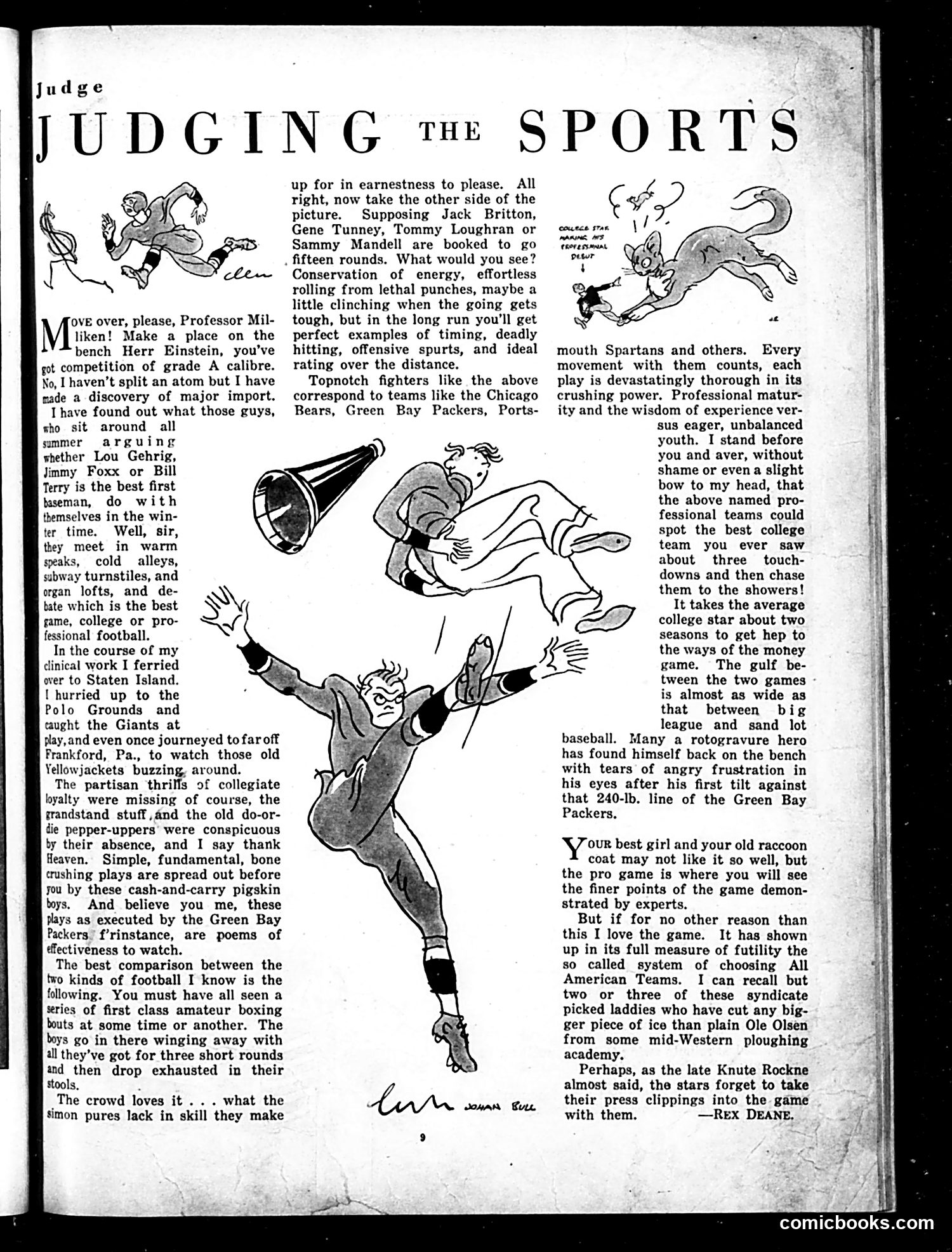
# "Judging the Sports" - Judge Magazine This article argues that **professional football** (specifically teams like the Green Bay Packers, Chicago Bears, and Portsmouth Spartans) is superior to college football. The author, writing as "Professor Miliken," compares the difference to professional vs. amateur boxing: college players are enthusiastic but clumsy; professionals execute plays with precision and maturity. The piece names real athletes from the era—Lou Gehrig, Jimmy Foxx, Bill Terry (baseball stars)—and boxers Jack Britton, Gene Tunney, and others, suggesting these men debate sports endlessly during winter months. The satire targets the reverence for college football and the **"All-American Teams"** selection system, which the author dismisses as meaningless hype. He claims professional players would "spot the best college team...about three touchdowns," and that college stars often fail their first pro game against defensive lines like Green Bay's. The cartoons illustrate these arguments with exaggerated depictions of football players in action. The overall message: ignore the romantic college tradition—pro football shows the true, technical mastery of the game.
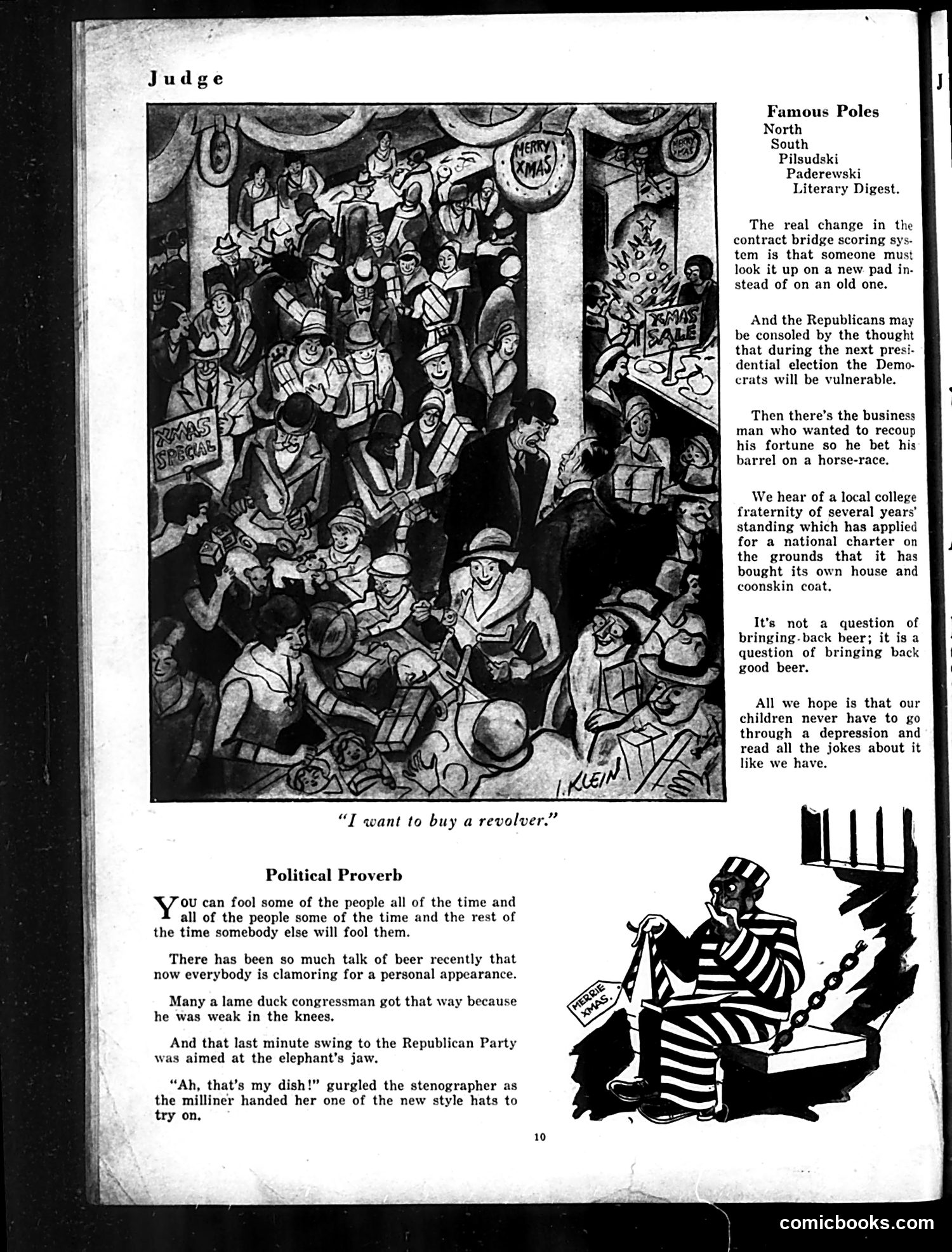
# Analysis of Judge Magazine Page This page contains political humor and satirical commentary circa the Prohibition era and early Depression period. **Main Cartoon**: Depicts a crowded, chaotic Christmas scene with the caption "I want to buy a revolver." The satire mocks Depression-era desperation and holiday stress—someone wanting a weapon as a (darkly humorous) response to seasonal chaos. **"Political Proverb" Section**: A series of brief jokes targeting: - General political deception ("fool some of the people") - Beer/Prohibition nostalgia (recently topical) - Weak Republican politicians ("lame duck congressman") - Last-minute Republican electoral swings - Fashion and stenographers (dated gender humor) **Right Column**: Miscellaneous commentary on bridge scoring, upcoming Democratic electoral vulnerabilities, financial desperation (betting on horse races), college fraternities, beer quality, and Depression-era jokes. The overall tone reflects Judge's satirical approach: mocking politicians, social anxieties, economic hardship, and contemporary fads through quick jokes and visual humor aimed at educated readers.