
Judge, 1932-12 · page 18 of 38
Judge — December 1932 — page 18: what you’re looking at
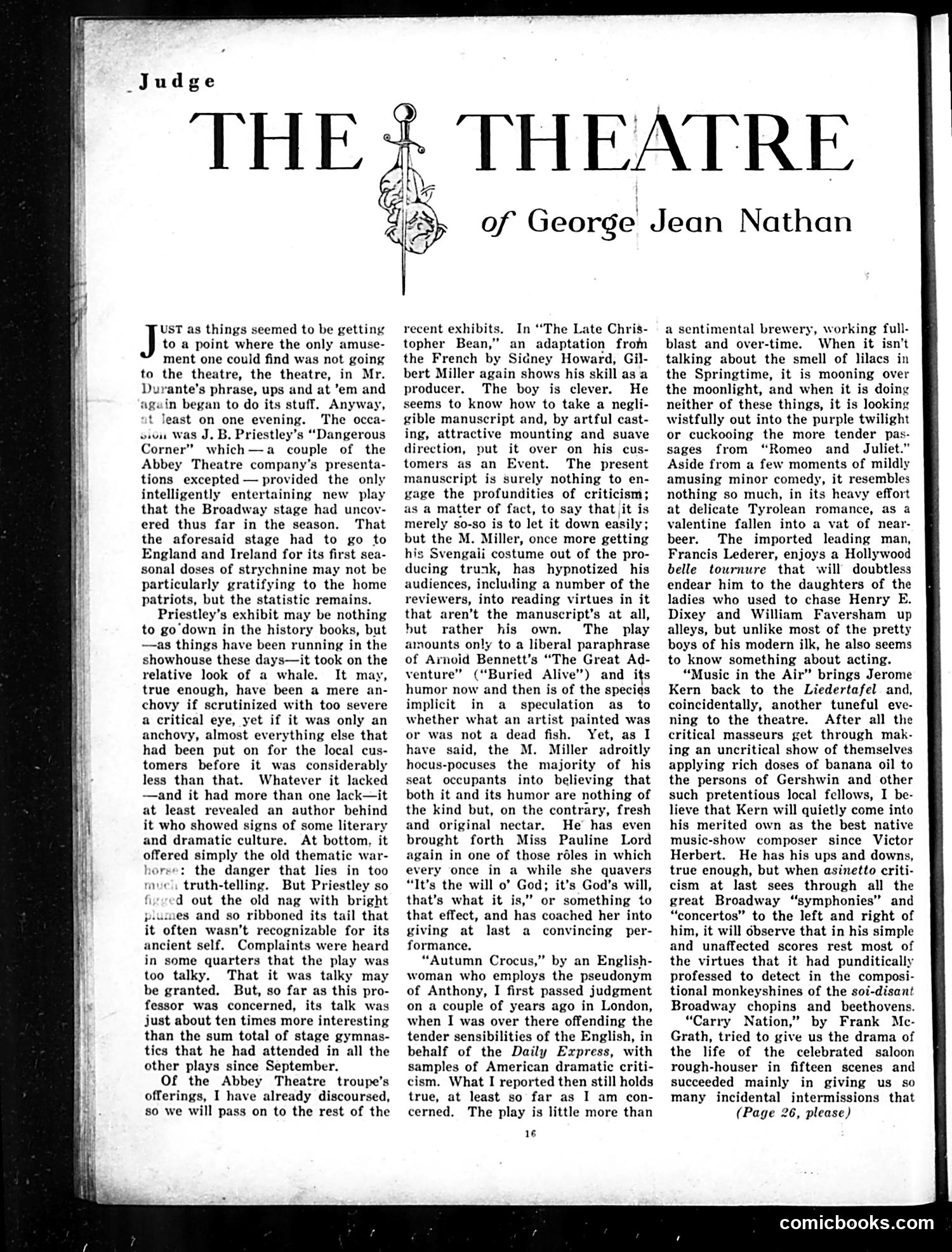
A restored page from Judge, 1932-12. Page through the whole issue in the reader above.
📄 Transcribed text from this page (OCR, searchable)
Machine-transcribed from the original scan — historical spelling and the odd misread are preserved.
THE # THEATRE of George Jean Nathan to a point where the only amuse- ment one could find was not going to the theatre, the theatre, in Mr. Durante’s phrase, ups and at ’em and aguin began to do its stuff. Anyway, at least on one evening. The occa- sion Was J.B. Priestley’s “Dangerous Corne which—a couple of the Abbey Theatre company’s presenta- tions excepted — provided the only intelligently entertaining new play that the Broadway stage had uncov- ered thus far in the season. That the aforesaid stage had to go to England and Ireland for its first sea- sonal doses of strychnine may not be particularly gratifying to the home patriots, but the statistic remains. Priestley’s exhibit may be nothing to go‘down in the history books, but —as things have been running in the showhouse these days—it took on the relative look of a whale. It may, true enough, have been a mere an- chovy if scrutinized with too severe a critical eye, yet if it was only an anchovy, almost everything else that had been put on for the local cus- tomers before it was considerably less than that. Whatever it lacked —and it had more than one lack—it at least revealed an author behind it who showed signs of some literary and dramatic culture. At bottom, it offered simply the old thematic war- } e: the danger that lies in too m truth-telling. But Priestley so f d out the old nag with bright plumes and so ribboned its tail that it often wasn’t recognizable for its ancient self. Complaints were heard in some quarters that the play was too talky. That it was talky may be granted. But, so far as this pro- fessor was concerned, its talk was just about ten times more interesting than the sum total of stage gymnas- tics that he had attended in all the other plays since September. Of the Abbey Theatre troupe’s offerings, I have already discoursed, so we will pass on to the rest of the Je: as things seemed to be getting recent exhibits. In “The Late Chris- topher Bean,” an adaptation from the French by Sidney Howard, Gil- bert Miller again shows his skill as a producer. The boy is clever. He seems to know how to take a negli- gible manuscript and, by artful cast- ing, attractive mounting and suave direction, put it over on his cus- tomers as an Event. The present manuscript is surely nothing to en- gage the profundities of criticism; as a matter of fact, to say that it is merely so-so is to let it down easily; but the M. Miller, once more getting his Svengali costume out of the pro- ducing trunk, has hypnotized his audiences, including a number of the reviewers, into reading virtues in it that aren’t the manuscript’s at all, hut rather his own. The play amounts only to a liberal paraphrase of Arnoid Bennett’s “The Great Ad- venture” (“Buried Alive”) and its humor now and then is of the species implicit in a speculation as_ to whether what an artist painted was or was not a dead fish. Yet, as I have said, the M. Miller adroitly hocus-pocuses the majority of his seat occupants into believing that both it and its humor are nothing of the kind but, on the contrary, fresh and original nectar. He has even brought forth Miss Pauline Lord again in one of those réles in which every once in a while she quavers “It’s the will 0’ God; it’s God’s will, that’s what it is,” or something to that effect, and has coached her into giving at last a convincing per- formance. “Autumn Crocus,” by an English- woman who employs the pseudonym of Anthony, I first passed judgment on a couple of years ago in London, when I was over there offending the tender sensibilities of the English, in behalf of the Daily Express, with samples of American dramatic criti- cism. What I reported then still holds true, at least so far as I am con- cerned. The play is little more than 16 a sentimental brewery, working full- blast and over-time. When it isn’t talking about the smell of lilacs in the Springtime, it is mooning over the moonlight, and when it is doing neither of these things, it is looking wistfully out into the purple twilight or cuckooing the more tender pas- sages from “Romeo and Juliet.” Aside from a few moments of mildly amusing minor comedy, it resembles nothing so much, in its heavy effort at delicate Tyrolean romance, as a valentine fallen into a vat of near- beer. The imported leading man, Francis Lederer, enjoys a Hollywood belle tournure that will doubtless endear him to the daughters of the ladies who used to chase Henry E. Dixey and William Faversham up alleys, but unlike most of the pretty boys of his modern ilk, he also seems to know something about acting. “Music in the Air” brings Jerome Kern back to the Liedertafel and, coincidentally, another tuneful eve- ning to the theatre. After all the critical masseurs get through mak- ing an uncritical show of themselves applying rich doses of banana oil to the persons of Gershwin and other such pretentious local fellows, I be- lieve that Kern will quietly come into his merited own as the best native music-show composer since Victor Herbert. He has his ups and downs, true enough, but when asinetto criti- cism at last sees through all the great Broadway “symphonies” and “concertos” to the left and right of him, it will observe that in his simple and unaffected scores rest most of the virtues that it had punditically professed to detect in the composi- tional monkeyshines of the soi-disant Broadway chopins and _ beethovens. “Carry Nation,” by Frank Mc- Grath, tried to give us the drama of the life of the celebrated saloon rough-houser in fifteen scenes and succeeded mainly in giving us so many incidental intermissions that (Page 26, please) comicbooks.com