
Judge, 1932-12 · page 20 of 38
Judge — December 1932 — page 20: what you’re looking at
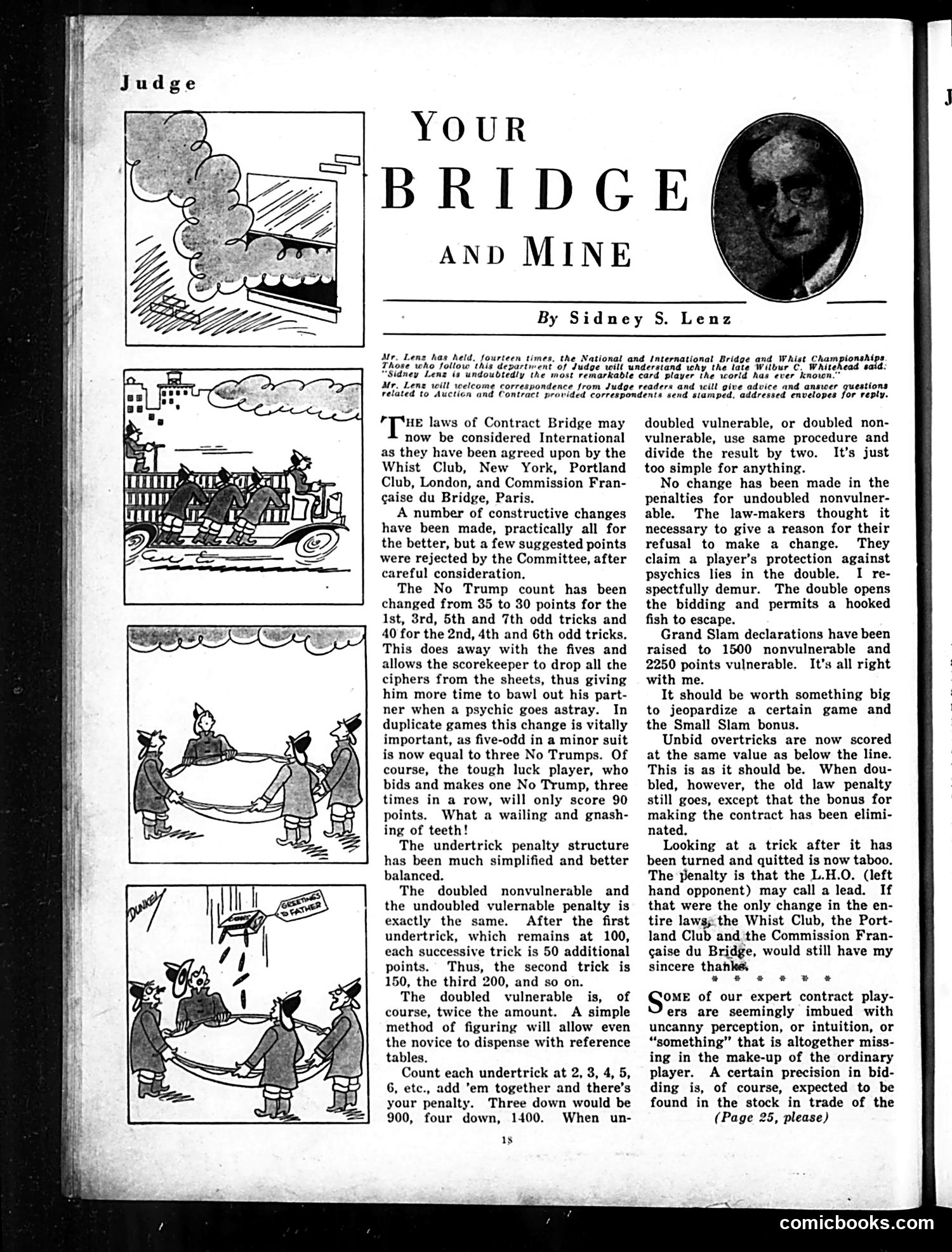
A restored page from Judge, 1932-12. Page through the whole issue in the reader above.
📄 Transcribed text from this page (OCR, searchable)
Machine-transcribed from the original scan — historical spelling and the odd misread are preserved.
YOUR BRIDGE AND MINE By Sidney S. Lenz Mr. Lenz has held, fourteen times. the National and International Bridge and Whist Championsh(; Those who follow this departivent of Judge ritl understand why the tae Wilbur C. WAitehead said: ‘Sidney Lenz is undoubtedly the most remarkable card player the world has ever known.” Air. Lenz will welcome correspondence from Judge readers and will give advice and answer questions related to Auction and Contract provided correspondents send stamped, addressed envelopes for reply. Te laws of Contract Bridge may now be considered International as they have been agreed upon by the Whist Club, New York, Portland Club, London, and Commission Fran- gaise du Bridge, Paris. A number of constructive changes have been made, practically all for the better, but a few suggested points were rejected by the Committee, after careful consideration, The No Trump count has been changed from 35 to 30 points for the Ist, 3rd, 5th and 7th odd tricks and 40 for the 2nd, 4th and 6th odd tricks. This does away with the fives and allows the scorekeeper to drop all the ciphers from the sheets, thus giving him more time to bawl out his part- ner when a psychic goes astray. In duplicate games this change is vitally important, as five-odd in a minor suit is now equal to three No Trumps. Of course, the tough luck player, who bids and makes one No Trump, three times in a row, will only score 90 points. What a wailing and gnash- ing of teeth! The undertrick penalty structure has been much simplified and better balanced. The doubled nonvulnerable and the undoubled vulernable penalty is exactly the same. After the first undertrick, which remains at 100, each successive trick is 50 additional points. Thus, the second trick is 150, the third 200, and so on. The doubled vulnerable is, of course, twice the amount. A simple method of figuring will allow even the novice to dispense with reference tables, Count each undertrick at 2, 3, 4, 5, 6, etc., add ’em together and there’s your penalty. Three down would be 900, four down, 1400. When un- 1s doubled vulnerable, or doubled non- vulnerable, use same procedure and divide the result by two. It’s just too simple for anything. No change has been made in the penalties for undoubled nonvulner- able. The law-makers thought it necessary to give a reason for their refusal to make a change. They claim a player’s protection against psychics lies in the double. I re- spectfully demur. The double opens the bidding and permits a hooked fish to escape. Grand Slam declarations have been raised to 1500 nonvulnerable and 2250 points vulnerable. It’s all right with me. It should be worth something big to jeopardize a certain game and the Small Slam bonus. Unbid overtricks are now scored at the same value as below the line. This is as it should be. When dou- bled, however, the old law penalty still goes, except that the bonus for making the contract has been elimi- nated. Looking at a trick after it has been turned and quitted is now taboo. The penalty is that the L.H.O. (left hand opponent) may call a lead. If that were the only change in the en- tire laws; the Whist Club, the Port- land Club and the Commission Fran- gaise du Bridge, would still have my sincere thahke, * 8 © ee Some of our expert contract play- ers are seemingly imbued with uncanny perception, or intuition, or “something” that is altogether miss- ing in the make-up of the ordinary player. A certain precision in bid- ding is, of course, expected to be found in the stock in trade of the (Page 25, please) comicbooks.com