
Judge, 1932-12 · page 21 of 38
Judge — December 1932 — page 21: what you’re looking at
A restored page from Judge, 1932-12. Page through the whole issue in the reader above.
📄 Transcribed text from this page (OCR, searchable)
Machine-transcribed from the original scan — historical spelling and the odd misread are preserved.
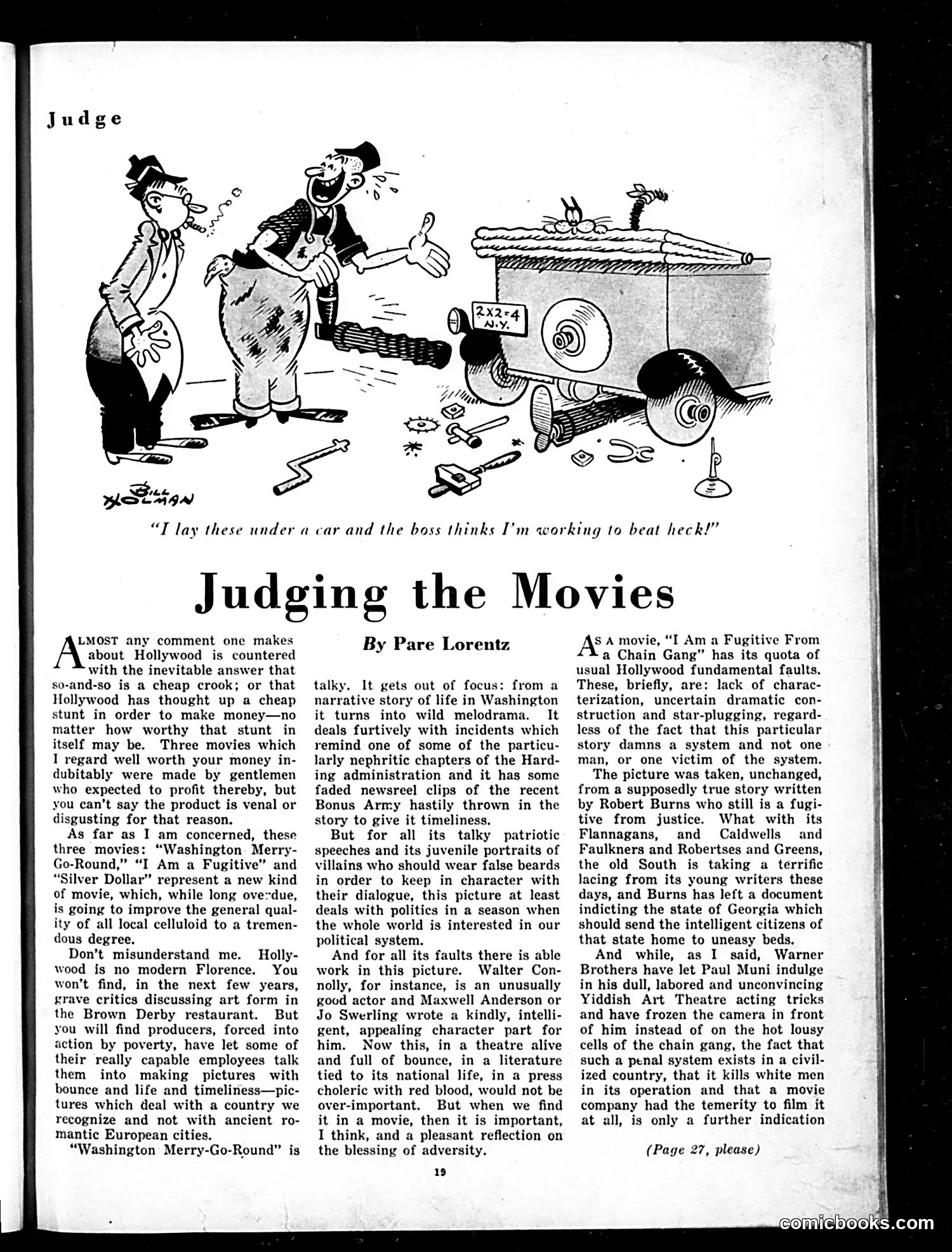
LLL “T lay these under a car and the boss thinks I’m working to beat heck!” Judging the Movies LMOST any comment one makes Aittout Hollywood is countered with the inevitable answer that so-and-so is a cheap crook; or that Hollywood has thought up a cheap stunt in order to make money—no matter how worthy that stunt in itself may be. Three movies which I regard well worth your money in- dubitably were made by gentlemen who expected to profit thereby, but you can’t say the product is venal or disgusting for that reason. As far as I am concerned, these three movies: “Washington Merry- Go-Round,” “I Am a Fugitive” and “Silver Dollar” represent a new kind of movie, which, while long ove-due, is going to improve the general qual- ity of all local celluloid to a tremen- dous degree. Don’t misunderstand me. Holly- wood is no modern Florence. You won't find, in the next few years, grave critics discussing art form in the Brown Derby restaurant. But you will find producers, forced into action by poverty, have let some of their really capable employees talk them into making pictures with bounce and life and timeliness—pic- tures which deal with a country we recognize and not with ancient ro- mantic European cities. “Washington Merry-Go-Round” is By Pare Lorentz talky. It gets out of focus: from a narrative story of life in Washington it turns into wild melodrama. It deals furtively with incidents which remind one of some of the particu- larly nephritic chapters of the Hard- ing administration and it has some faded newsreel clips of the recent Bonus Army hastily thrown in the story to give it timeliness. But for all its talky patriotic speeches and its juvenile portraits of villains who should wear false beards in order to keep in character with their dialogue, this picture at least deals with politics in a season when the whole world is interested in our political system. And for all its faults there is able work in this picture. Walter Con- nolly, for instance, is an unusually good actor and Maxwell Anderson or Jo Swerling wrote a kindly, intelli- gent, appealing character part for him. Now this, in a theatre alive and full of bounce, in a literature tied to its national life, in a press choleric with red blood, would not be over-important. But when we find it in a movie, then it is important, I think, and a pleasant reflection on the blessing of adversity. 19 s a movie, “I Am a Fugitive From a Chain Gang” has its quota of usual Hollywood fundamental faults. These, briefly, are: lack of charac- terization, uncertain dramatic con- struction and star-plugging, regard- less of the fact that this particular story damns a system and not one man, or one victim of the system. The picture was taken, unchanged, from a supposedly true story written by Robert Burns who still is a fugi- tive from justice. What with its Flannagans, and Caldwells and Faulkners and Robertses and Greens, the old South is taking a terrific lacing from its young writers these days, and Burns has left a document indicting the state of Georgia which should send the intelligent citizens of that state home to uneasy beds. And while, as I said, Warner Brothers have let Paul Muni indulge in his dull, labored and unconvincing Yiddish Art Theatre acting tricks and have frozen the camera in front of him instead of on the hot lousy cells of the chain gang, the fact that such a penal system exists in a civil- ized country, that it kills white men in its operation and that a movie company had the temerity to film it at all, is only a further indication (Page 27, please)