A complete issue · 36 pages · 1931
Judge — August 29, 1931
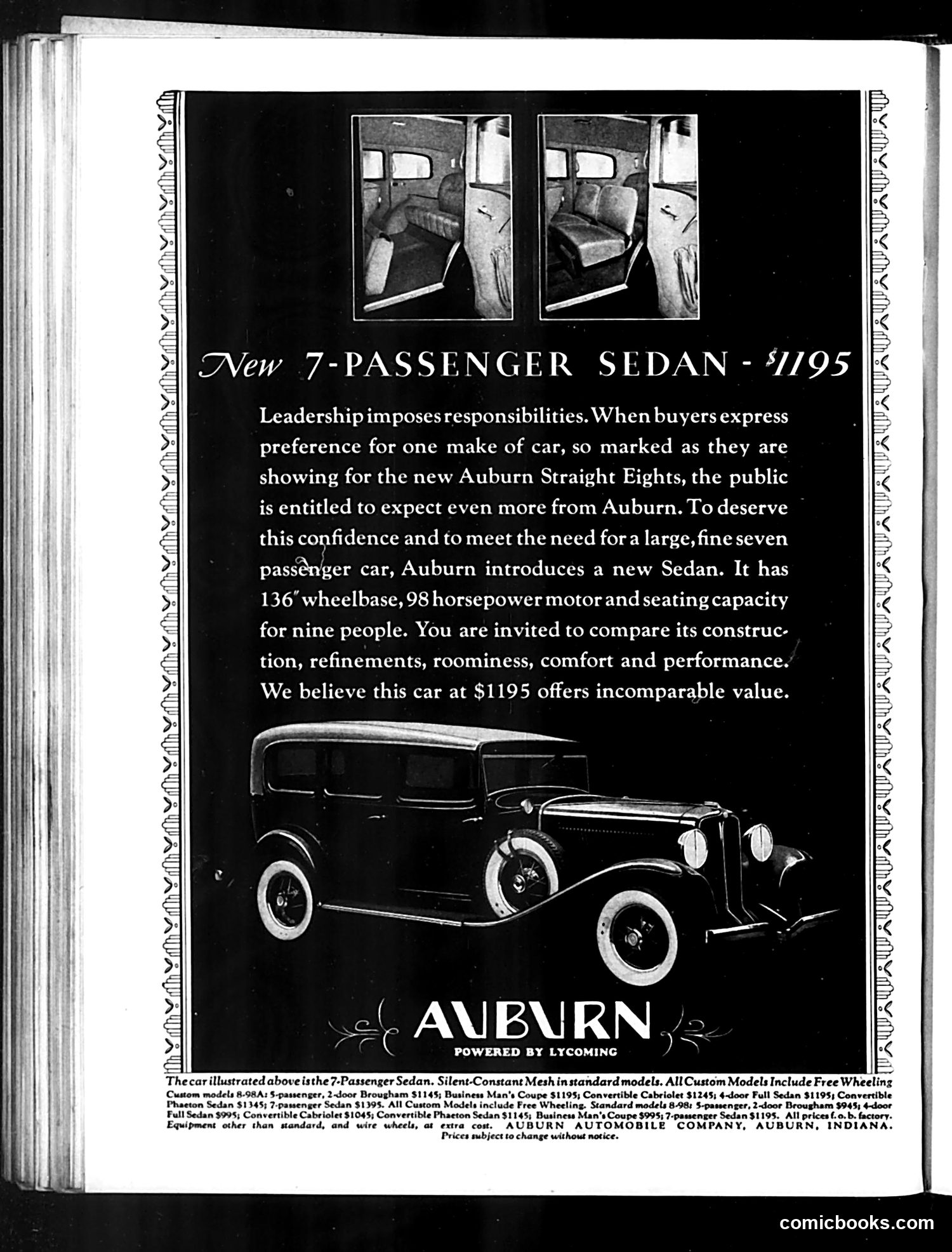
# Analysis This page is **not a cartoon or satirical content** — it's a straightforward automobile advertisement, not a satirical piece. Judge magazine frequently included paid advertisements alongside humor content. The ad promotes Auburn's new 7-passenger sedan priced at $1,195. The copy emphasizes Auburn's market leadership ("leadership imposes responsibilities") and positions the car as a quality competitor to other popular makes. It highlights specifications: 136-inch wheelbase, 98 horsepower, and capacity for nine people. The two interior photos at top show the car's spacious seating. The lower illustration displays the sedan's sleek profile. This appears to be from the late 1920s or early 1930s based on the car's design and price point. The advertisement simply aims to convince Judge readers that Auburn offers superior value in the luxury sedan market.
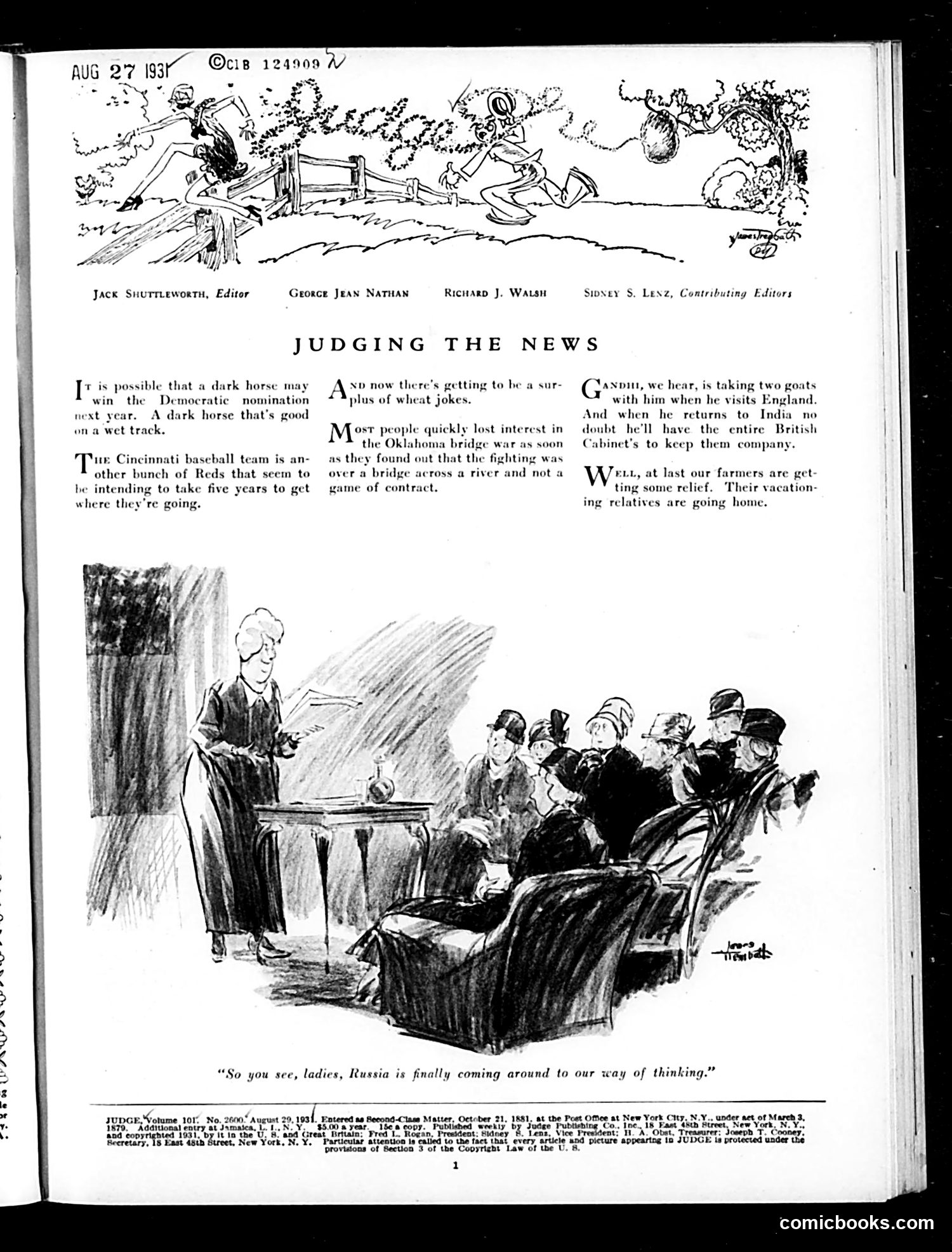
# "Judging the News" - August 27, 1931 This page presents satirical commentary on current events. The main cartoon shows a woman lecturer addressing an audience of well-dressed attendees, with the caption: "So you see, ladies, Russia is finally coming around to our way of thinking." The joke appears to satirize Western assumptions about Soviet policy shifts. During the early 1930s, the USSR was undergoing significant ideological and economic changes. The cartoon mocks the notion that Russia was adopting Western capitalist or democratic values—suggesting naive Western wishful thinking about Soviet intentions. The brief text snippets above the cartoon offer lighter satirical items: comments on Democratic politics, the Oklahoma bridge controversy, and the Cincinnati Reds baseball team—typical Judge magazine fare mixing political and social humor.
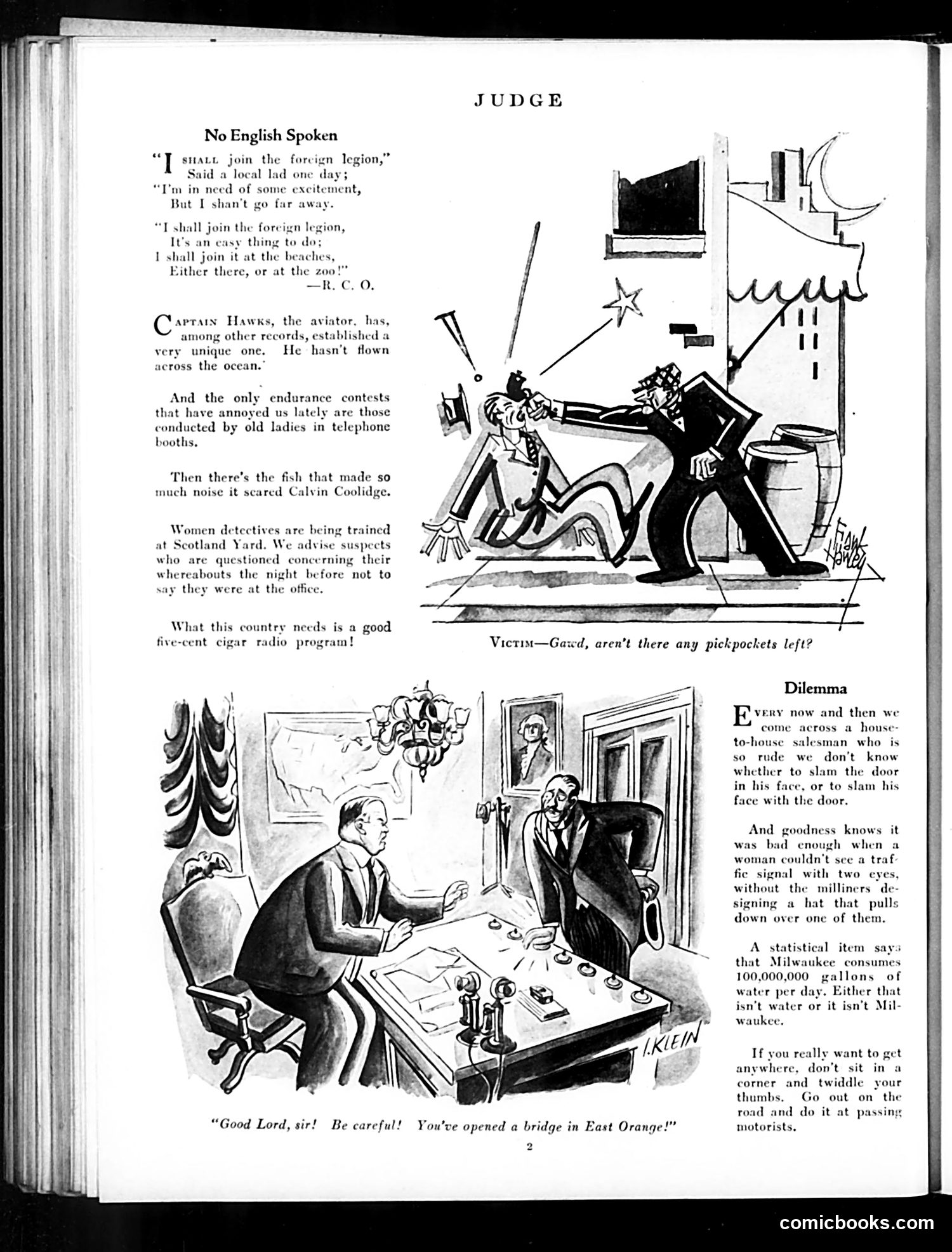
# Analysis of Judge Magazine Page This page contains three separate satirical pieces: 1. **"No English Spoken"**: A poem mocking young men's desire for excitement, referencing the Foreign Legion as an adventure fantasy. 2. **Top cartoon**: Shows a chaotic street scene where a disheveled man confronts a well-dressed gentleman, asking about pickpockets. The satire targets petty crime and urban disorder. 3. **Bottom cartoon titled "Dilemma"**: A house-to-house salesman awkwardly confronts a homeowner at his door. The accompanying text humorously discusses the etiquette problem of whether to slam the door in a salesman's face—satirizing the nuisance of aggressive door-to-door sales, a common 1920s-era complaint. The page's miscellaneous items mock contemporary annoyances: water consumption statistics about Milwaukee, and advice about reckless motorists.
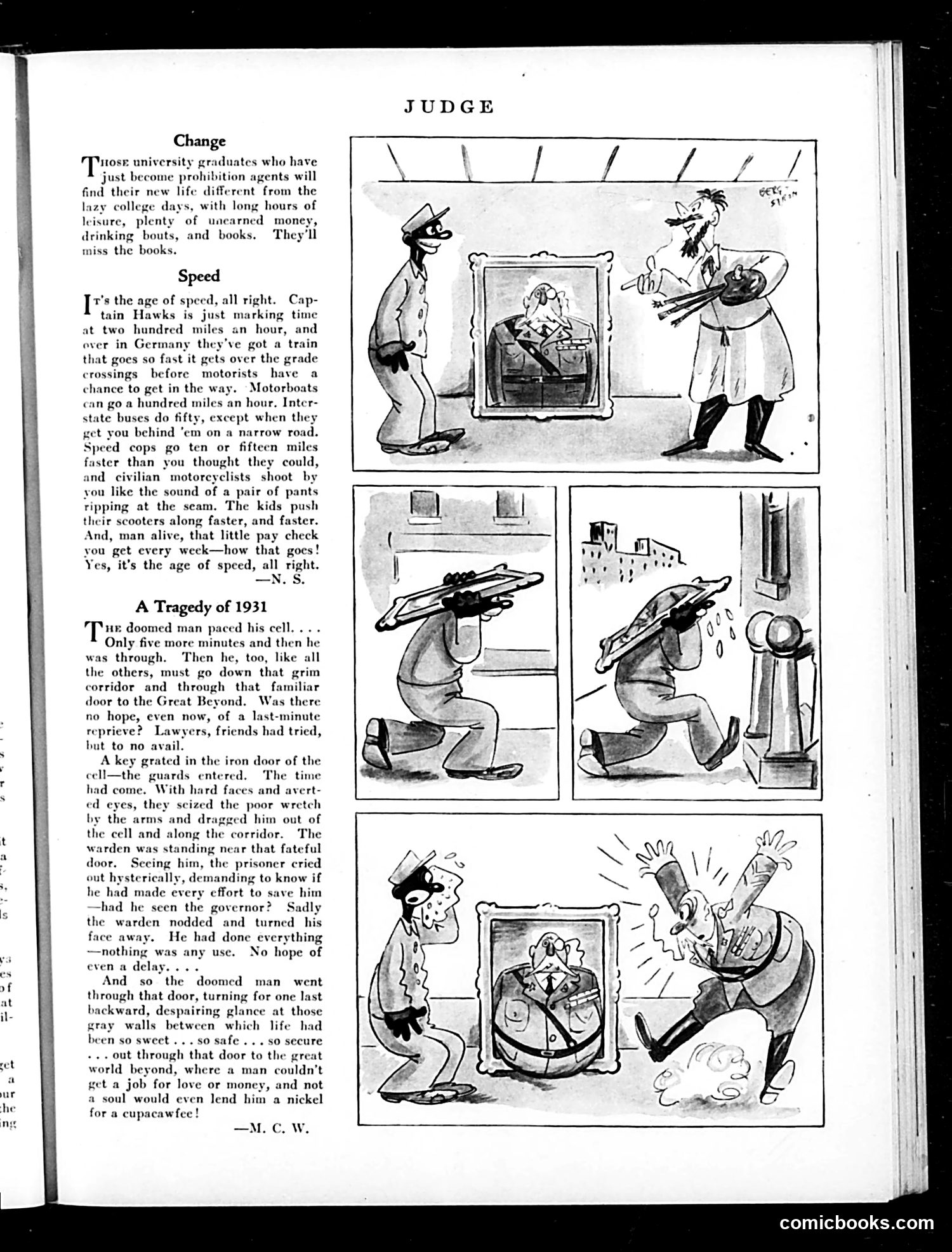
# Judge Magazine Page Analysis This page contains three distinct satirical pieces: **"Change"** mocks newly-appointed prohibition agents, suggesting they'll miss the leisure of college life. **"Speed"** critiques dangerous driving trends of the era. It references Captain Hawks setting speed records in Germany and complains about motorists driving recklessly at 100+ mph on American highways. The satire highlights how speed competitions inspired civilian drivers to drive dangerously, killing pedestrians and children. **"A Tragedy of 1931"** is a darker comic strip depicting an execution. It shows a condemned prisoner's final moments—dragged from his cell, greeted by the warden, and ultimately executed—ending with commentary on the prisoner's despair about finding employment or money, suggesting economic hardship (likely referencing the Great Depression) drove him to crime.
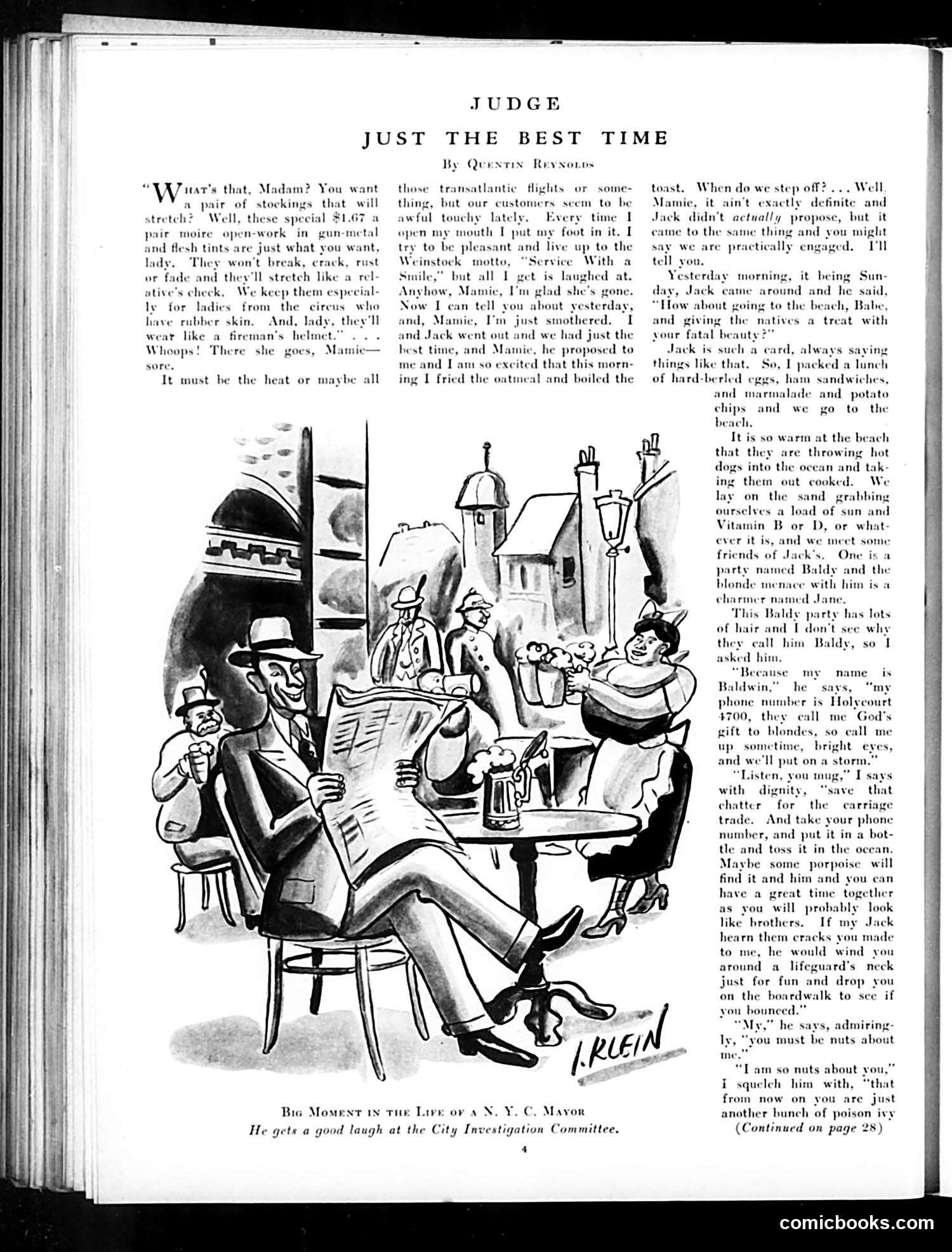
# "Judge: Just the Best Time" This page features a humorous story about a NYC mayor's casual beach outing. The illustration shows a well-dressed man lounging at the beach with companions, labeled "Big Moment in the Life of a N.Y.C. Mayor—He gets a good laugh at the City Investigation Committee." The satire targets the mayor's apparent indifference to civic duties. While he relaxes at the beach eating hot dogs and socializing, the City Investigation Committee—presumably investigating municipal corruption or mismanagement—continues its work. The joke suggests the mayor treats serious governance with levity, prioritizing leisure and socializing with friends (including someone named Baldy) over addressing the committee's concerns. The cartoon mocks official negligence and the casual attitude of public servants toward accountability.
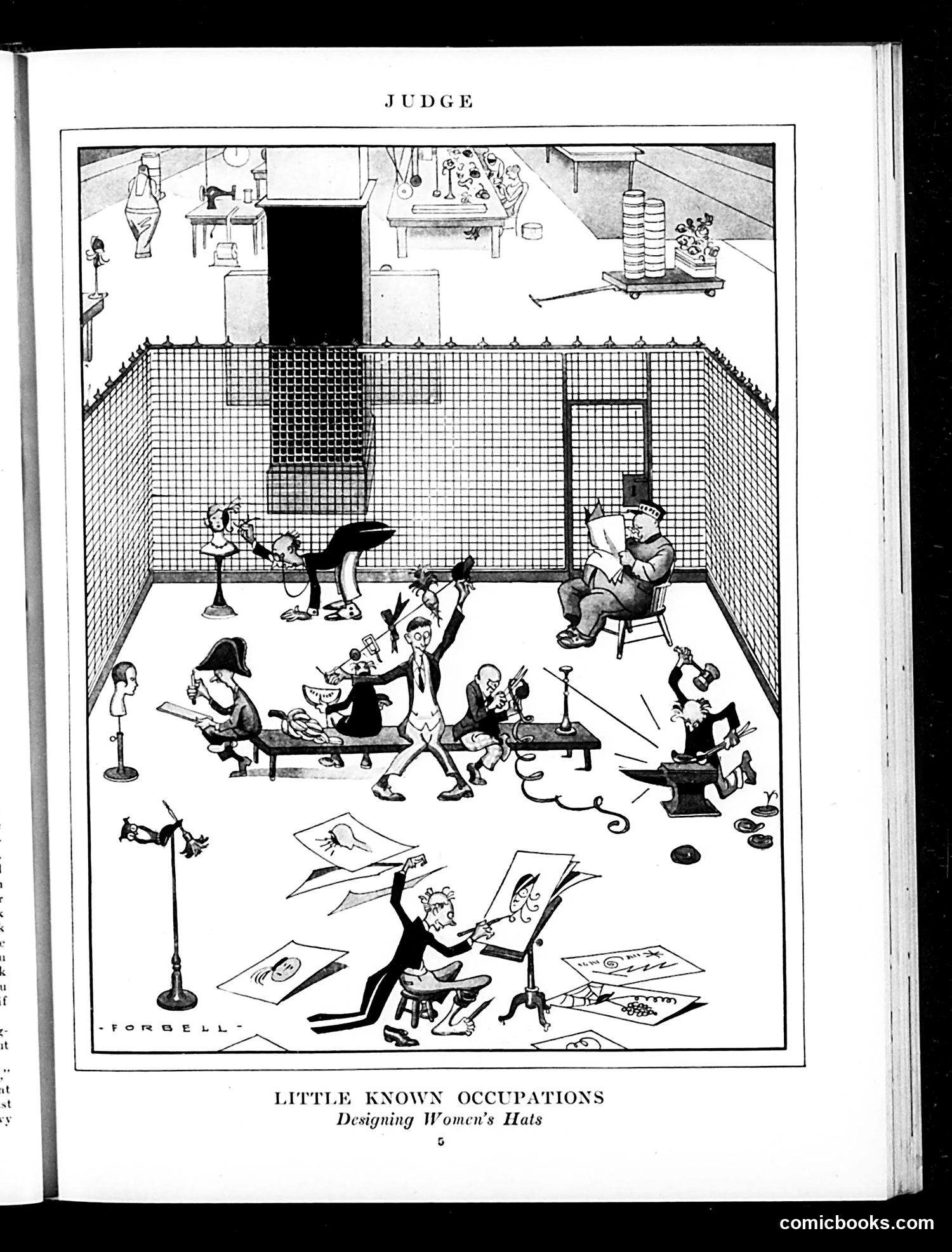
# Analysis This Judge magazine cartoon satirizes the profession of women's hat design. The image depicts a chaotic workshop where designers work frantically on women's hats, surrounded by sketches, materials, and design tools. The satire targets the seemingly absurd nature of hat fashions—the elaborate, impractical creations women were expected to wear. The frenetic activity and exaggerated poses suggest designers treated hat-making as serious, intense work despite the frivolous end product. The scattered sketches and frantic energy mock both the fashion industry's pretensions and women's supposed obsession with elaborate headwear. This reflects early 20th-century skepticism toward women's fashion trends, portraying hat design as comically overwrought labor producing unnecessary luxury items—a common satirical target of the era.
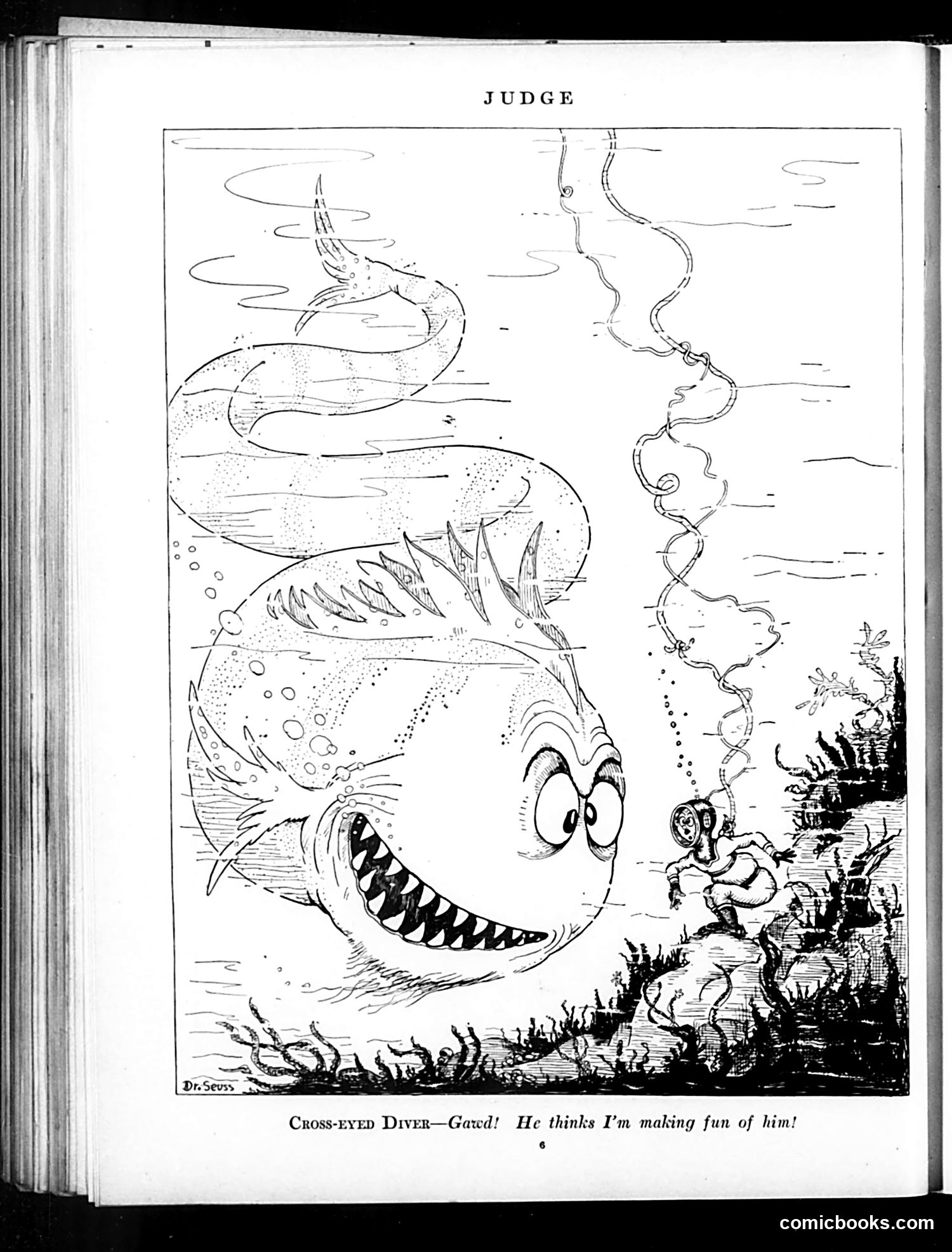
# Political Cartoon Analysis: "Cross-eyed Diver" This Dr. Seuss illustration depicts an underwater scene with a grotesque, menacing fish confronting a small human diver. The fish has an exaggerated grin with prominent teeth, cross-eyes, and a serpentine body—characteristic of Seuss's surreal style. The caption reads: "CROSS-EYED DIVER—Gawl! He thinks I'm making fun of him!" The joke appears to rely on the absurdity of the situation: the fish's paranoid interpretation of the diver's presence. The "cross-eyed" detail suggests the fish misperceives the diver's intentions. This is likely satirizing paranoia, misunderstanding, or perhaps a contemporary political figure or situation where someone interprets neutral actions as mockery or offense—though the specific reference is unclear without additional context from Judge magazine's publication date.
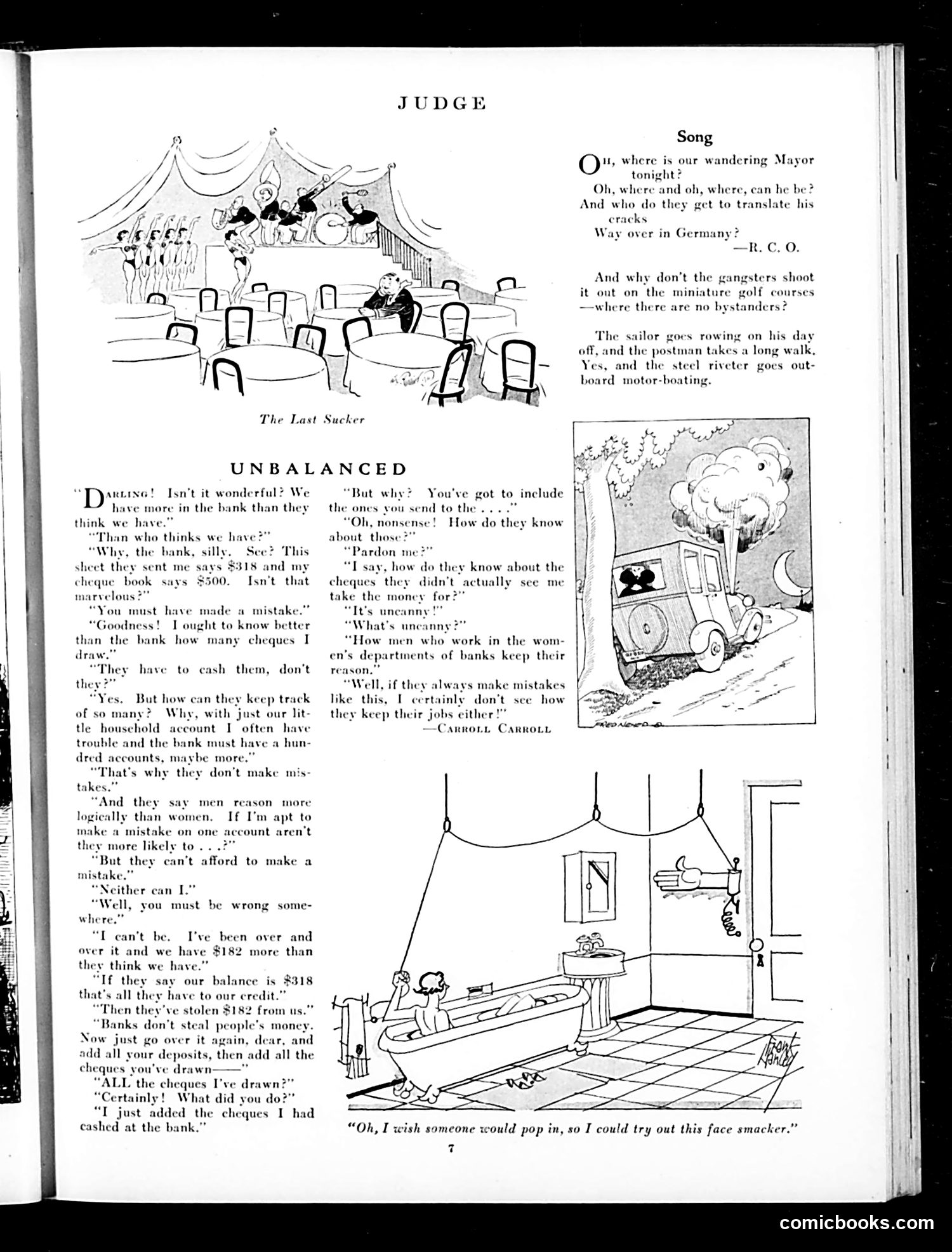
# Explanation of Judge Page Content **"Unbalanced"** satirizes gender stereotypes about logic and financial competence. A woman discovers her bank account shows $182 more than the bank's records, but when her husband instructs her to recount, she realizes she only tallied checks she *cashed*, not all checks written. Rather than admitting error, she questions the bank's competence—suggesting women are illogical with money. The irony is deliberate: the joke proves the opposite of its premise, showing her reasoning failure while she claims men think *more* logically. **"The Last Sucker"** appears to mock a nightclub or entertainment venue patron surrounded by diners. **The "Song"** humorously questions where the Mayor is nightly and jokes about gangsters shooting on a miniature golf course instead of real locations. **The bottom cartoon** depicts someone in an unusual suspended contraption, captioning their desire to test a "face smasher"—likely absurdist humor about an impractical device. All reflect 1920s-era Judge humor: domestic comedy, urban observations, and physical slapstick.
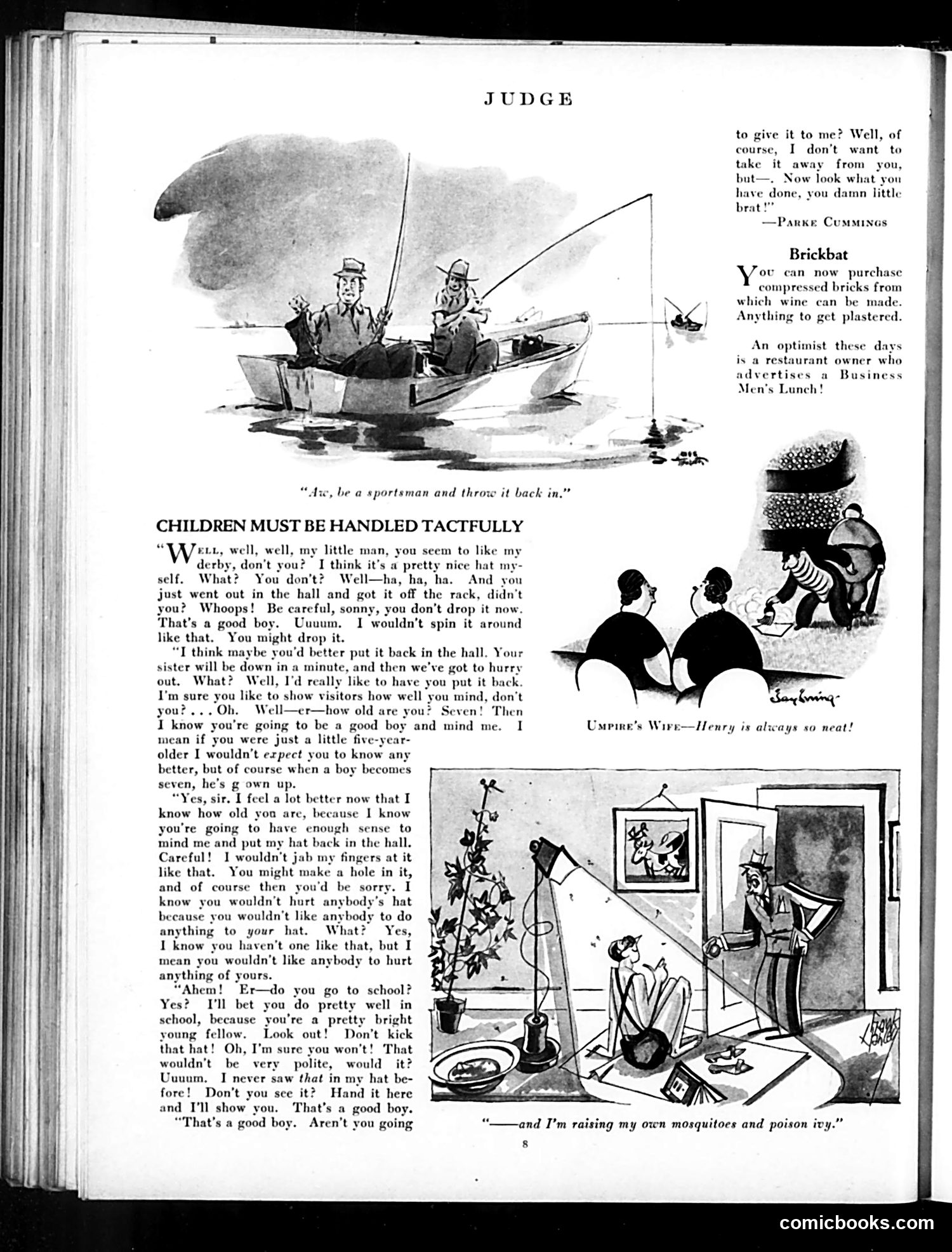
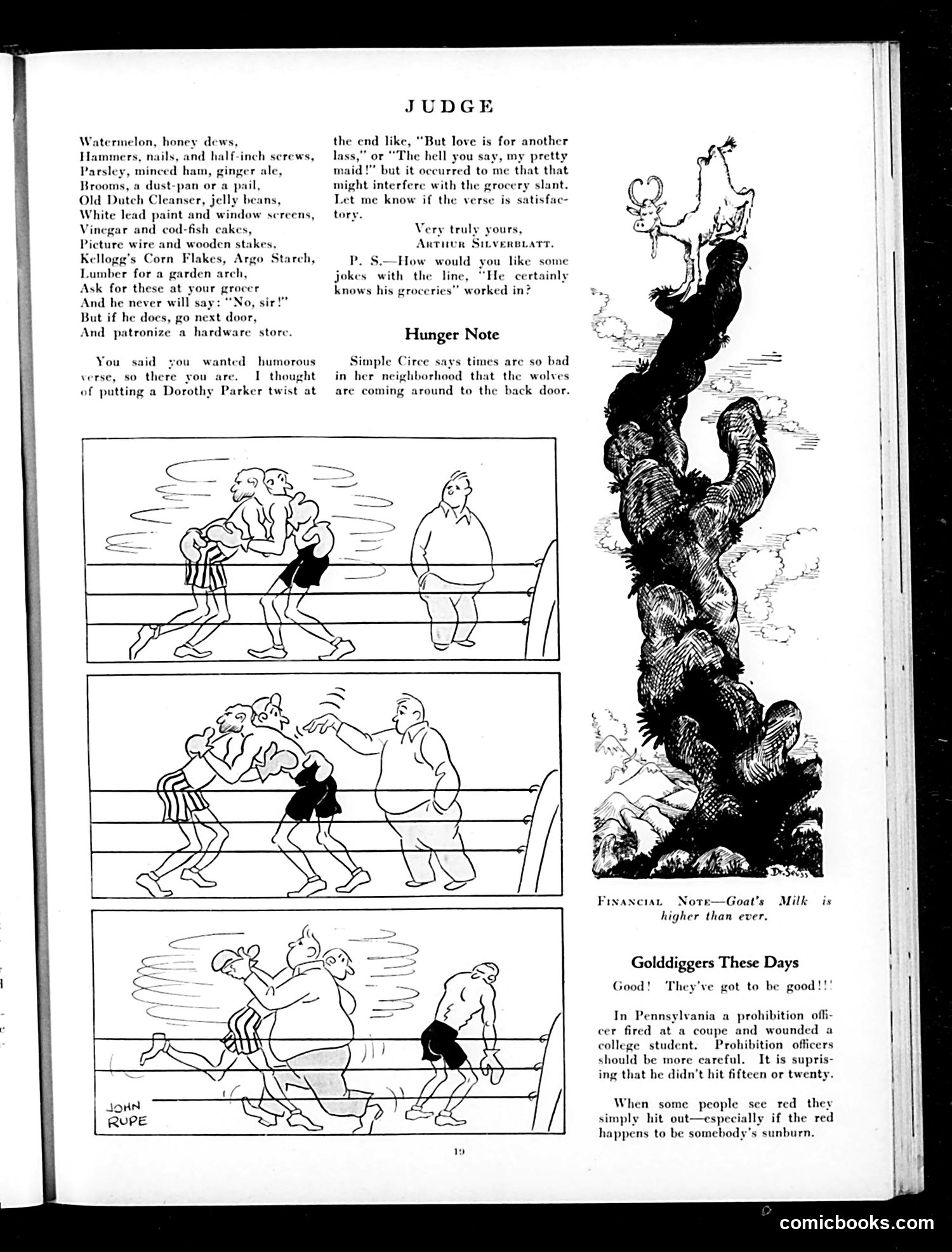
# Judge Magazine Page Analysis This page contains two satirical pieces reflecting early-20th-century American concerns: **"Children Must Be Handled Tactfully"** presents an adult's exhausting attempt to manipulate a child into returning a stolen derby hat through excessive flattery and psychological appeals. The satire mocks adults who employ complicated reasoning and false praise rather than simple discipline—suggesting modern parenting overcomplicated "psychology" was already seen as ridiculous. **The "Brickbat" section** includes three brief jokes: - A reference to Prohibition-era ingenuity (making wine from compressed bricks to get "plastered") - Commentary on Depression-era optimism (restaurant owners advertising business lunches despite economic hardship) - A cartoon captioned "and I'm raising my own mosquitoes and poison ivy," satirizing someone's misguided attempts at self-sufficiency or complaint-making The fishing cartoon at top appears to satirize sportsmanship or fair play principles. Overall, the page ridicules pretentious parenting methods, Prohibition-era desperation, and false optimism during economic hardship.
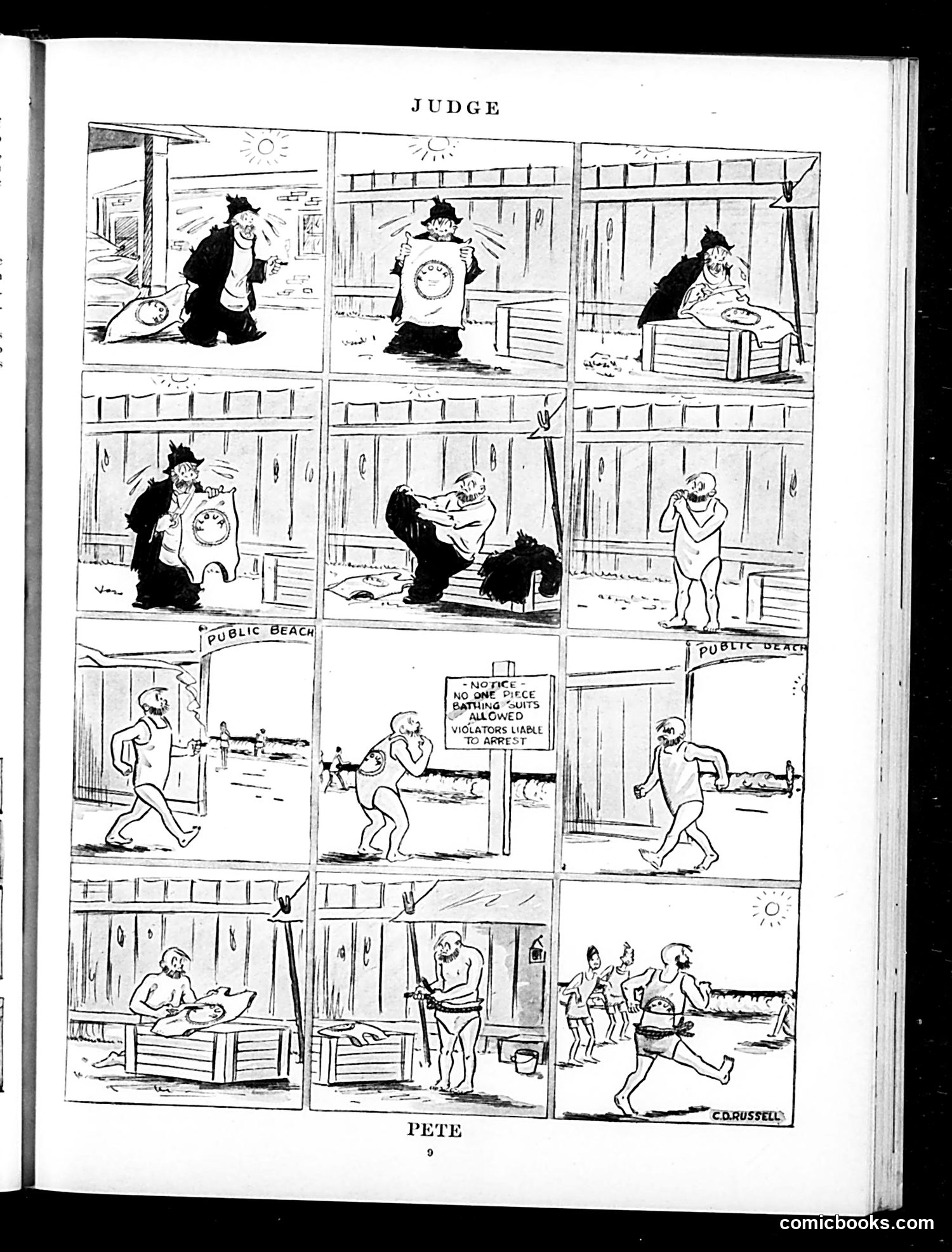
# "Judge" Comic: "Judge" and "Pete" at the Beach This two-part satirical comic contrasts a stern authority figure ("Judge") enforcing bathing suit regulations with an ordinary man ("Pete") enjoying beach freedom. The top panels show a judgmental official inspecting beachgoers' swimming attire, appearing scandalized by exposure. The sign reads "No one piece bathing suits allowed—violators liable to arrest," establishing absurd authority. The bottom panels depict "Pete" happily swimming and playing at the beach without concern for such rules. The satire targets rigid social enforcement of modesty standards and government overreach in regulating private behavior. The contrast between the uptight "Judge" and carefree "Pete" mocks Puritanical attitudes toward the human body, suggesting such prudish regulations are ridiculous and unenforceable. This likely reflects early-to-mid 20th century debates over beach attire and bodily freedom.
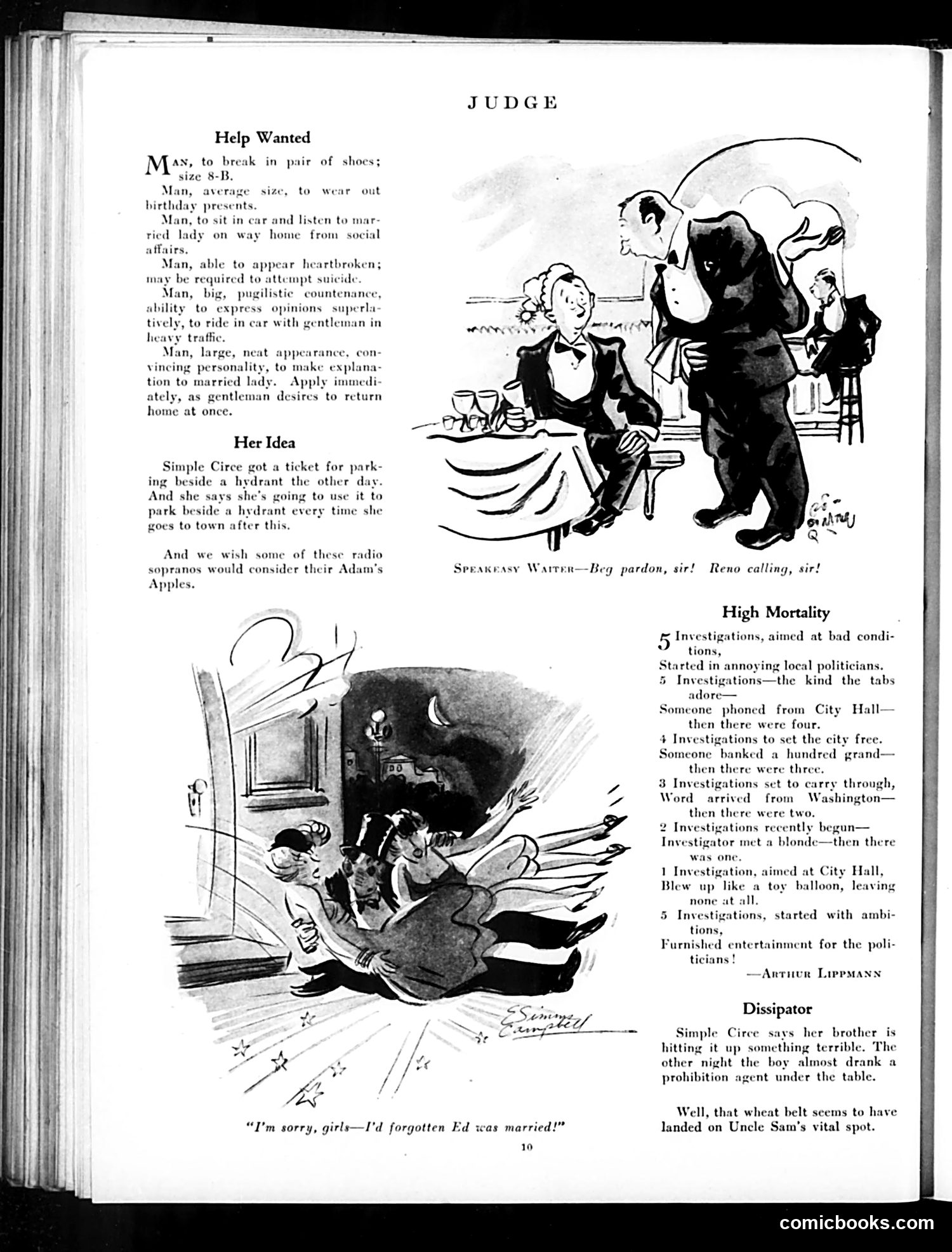
# Judge Magazine Page Analysis This page contains satirical humor typical of Judge's 1920s-era content: **"Help Wanted"** mocks relationship dynamics of the era—listing absurd job requirements for men to serve women's romantic needs, including breaking in shoes, appearing heartbroken, even attempting suicide. The satire targets both gender relations and the frivolous demands placed on suitors. **"Her Idea"** jokes about a woman (Circe, a classical seductress reference) who received a parking ticket and now intentionally parks illegally repeatedly—satirizing petty rule-breaking and spite. **"High Mortality"** by Arthur Lippmann uses dark humor about government investigations into corruption. Each investigation spawns scandals that reduce subsequent ones—one investigator was distracted by "a blonde," another investigation "left none at all." The satire mocks the cyclical, ineffectual nature of corruption probes in city/federal politics. **"Speakeasy Waiter"** and **"Dissipator"** reference Prohibition-era bootlegging and drinking culture—the waiter deflects suspicion; a man drinks a prohibition agent "under the table." The cartoons satirize 1920s social issues: gender relations, government corruption, and Prohibition enforcement.