
Judge, 1931-08-29 · page 15 of 36
Judge — August 29, 1931 — page 15: what you’re looking at
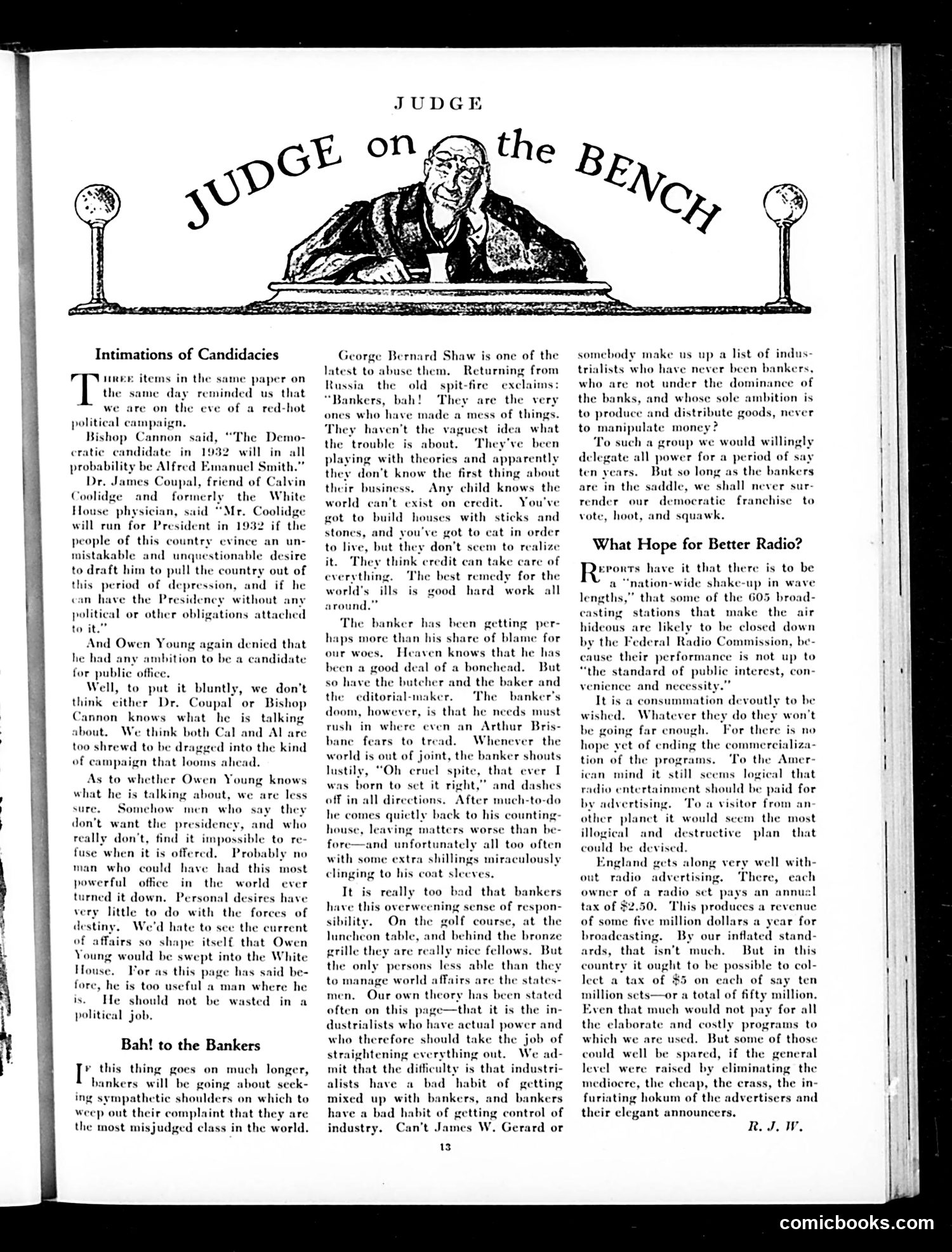
A restored page from Judge, 1931-08-29. Page through the whole issue in the reader above.
📄 Transcribed text from this page (OCR, searchable)
Machine-transcribed from the original scan — historical spelling and the odd misread are preserved.
Intimations of Candidacies T Hiner items in the same paper on the same day reminded us that ~~ we are on the eve of a red-hot political campaign, Bishop Cannon said cratic candidate in 19: will in all probability be Alfred Emanuel Smith.” Dr. James Coupal, friend of Calvin Coolidge and formerly the White House physician, said “Mr. Coolidge will run for President in if the people of this country evince an un- mistakable and unquestionable desire to draft him to pull the country out of this period of depression, and if. he “The Demo- can have the Presidency without any al or other obligations attached again denied that nbition to be a candidate office. And Owen Youn he had any for publ Well, to put it bluntly, we don’t think either Dr. Coupal or Bishop Cannon knows what he is talking bout. We think both Cal and Al are too shrewd to be dragged into the kind of campaign that looms ahead. As to whether Owen Young knows what he is talking about, we are less sure. Somehow men who say they don’t want the presidency, and who really don’t, find it impossib fuse when it is offered, man who could have had this most powerful office in the world ever turned it down, Personal desires have very little to do with the forces of destiny, We'd hate to see the current of affairs so shape itself that Owen Young would be swept into the White House. For as this page has said be- fore, he is too useful a man where he is. He should not be wasted in a political job. to re- Probably no Bah! to the Bankers » this thing goes on much lon: bankers will be going about s ing sympathetic shoulders on which to weep out their complaint that they are the most misjudged class in the world. JUDGE George Bernard Shaw is one of the latest to abuse them. Returning from Russia the old. spit-fire exel: “Bankers, bah! ‘They are the ones who have made a’ mess of th They haven't the vaguest ides the trouble is about. They've they don’t know the first thing Any child knows the world can’t exist on credit. You've got to build houses with sticks and stones, and you've got to eat in order to live, but they don’t seem to reali it. They think credit can take care of everything. The best remedy for the world's ills is good hard work all around.” The banker has b haps more than his sh our woes. Heaven ows that he has been a good deal ¢ bonehead. But so have the butcher and the baker and the editorial-maker. The banker's doom, how » is that he needs must rush in where even an Arthur Bris- bane fears to tread. Whenever the world is out of joint, the banker shouts lustily, “Oh cruel spite, that ever I was born to set it right,” and dashes off in all directions. After much-to-do he comes quietly back to his counting- house, leaving matters worse than be- fore—and unfortunately all too often with some extra shillings miraculously clinging to his coat sleeves. It is really too bad that bankers > this overweening sense of respon- ‘olf course, at the luncheon table, and behind the bronze grille they are really nice fellows. But the only persons less able than they the states- en stated their business. on getting per- re of blame for to manage world affairs ar: Our own theory often on this ps t it is the in- dustrialists who etual power and who therefore should take the job of straightening everything out. We ad- mit that the ditliculty is that industri- alists have a bad habit of getting mixed up with bankers, and bankers have a bad habit of getting control of industry. Can't James W. Gerard or 13 men. somebody make us up a list of indus- trialists who have never been bankers, who are not under the dominance of the banks, and whose sole ambition is to produce and distribute goods, never to manipulate moncy? To such a group we would willin delegate all power for a period of ten years. But so long as the bankers are in the saddle, we shall never sur- render our democratic franchise to vote, hoot, and squawk, What Hope for Better Radio? Rerort have it that there is to be nation-wide shake-up in wave lengths,” that some of the 605 broad- casting s! that make the air hideous are likely to be closed down by the Federal Radio Commission, be- cause their performanc “the standard of public venience and necessity.” It is a consummation devoutly to be wished. Whatever they do they won't be going far cnough. For there is no hope yet of ending the commercializa- tion of the programs. ‘To the Amer- ican mind it still seems logical that radio entertainment should be paid for by advertising. ‘T tions is not up to nterest, con- a visitor from an other planet it would seem the most iMogical and destructive plan’ that could be devised. England gets along very well with- out radio advertising. There, each owner of a radio set pays an annual tax of $2.50. This produces a revenue of some five million dollars a year for broadcasting. By our inflated stand- ards, that isn’t much. But in this country it ought to be possible to col- lect a tax of $5 on each of say ten million sets—or a total of fifty million. Even that much would not pay for all the elaborate and costly programs to which we are used. But some of those could well be spared, if the general level were raised by eliminating the mediocre, the cheap, the ¢ the in- furiating hokum of the advertisers and their elegant announcers. RdILW, comicbooks.com