
Judge, 1931-08-29 · page 10 of 36
Judge — August 29, 1931 — page 10: what you’re looking at
What you’re looking at
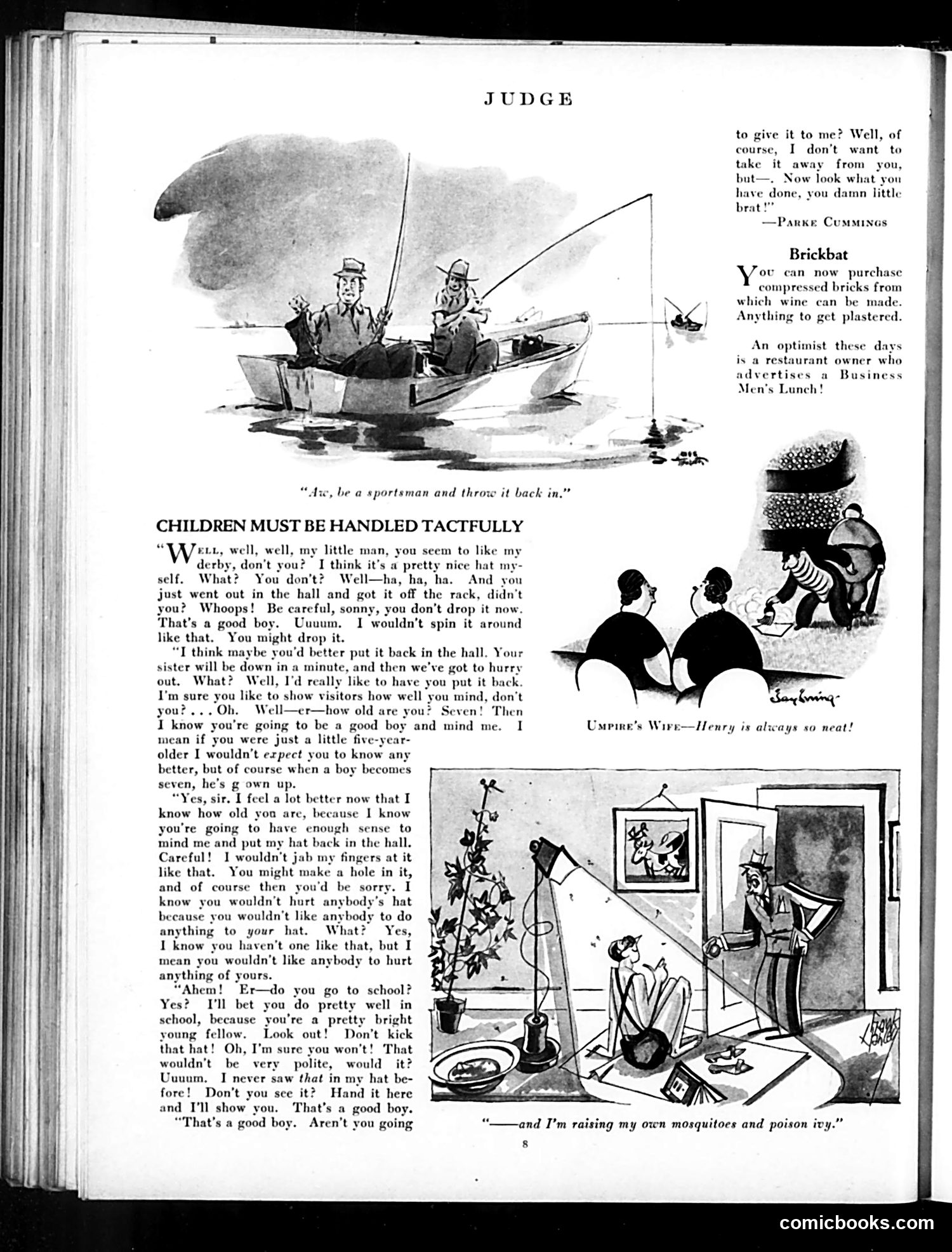
# Judge Magazine Page Analysis This page contains two satirical pieces reflecting early-20th-century American concerns: **"Children Must Be Handled Tactfully"** presents an adult's exhausting attempt to manipulate a child into returning a stolen derby hat through excessive flattery and psychological appeals. The satire mocks adults who employ complicated reasoning and false praise rather than simple discipline—suggesting modern parenting overcomplicated "psychology" was already seen as ridiculous. **The "Brickbat" section** includes three brief jokes: - A reference to Prohibition-era ingenuity (making wine from compressed bricks to get "plastered") - Commentary on Depression-era optimism (restaurant owners advertising business lunches despite economic hardship) - A cartoon captioned "and I'm raising my own mosquitoes and poison ivy," satirizing someone's misguided attempts at self-sufficiency or complaint-making The fishing cartoon at top appears to satirize sportsmanship or fair play principles. Overall, the page ridicules pretentious parenting methods, Prohibition-era desperation, and false optimism during economic hardship.
📄 Transcribed text from this page (OCR, searchable)
Machine-transcribed from the original scan — historical spelling and the odd misread are preserved.
JUDGE to give it to me? Well, of course, I don’t want to c it away from you, but—. Now jook what you © done, you damn little —Parke Cummines Brickbat Yor can now purchase compressed bricks from which wine can be made. Anything to get plastered. An optimist these days is a restaurant owner who advertises a Business Men's Lunch! “Aw, be a sportsman and throw it back in.” CHILDREN MUST BE HANDLED TACTFULLY “VV ret, well, well, my Tittle man, you seem to like my derby, don’t you? I think it’s a pretty nice hat my- self. What? You don’t? Well—ha, ha, ha. And you just went out in the hall and got it off the rack, didn't you? Whoops! Be careful, sonny, you don’t drop it now. That's a good boy. Uuuum. I wouldn't spin it around like that. You might drop it. “I think maybe you'd better put it back in the hall. Your sister will be down in a mi d then we've got to hurry out. What? Well, I'd really like you put it back. I'm sure you like to show $ y well you mind, don’t yor Oh, Well—er—how old are you? Seven! Then I know you're going to be a good boy and mind me. I mean if you were just a little five-year- older I wouldn't expect you to know any better, but of course when a boy becomes seven, he’s g own up. “Yes, sir. I feel a lot better now that I know how old yon are, because I know you're going to have enough sense to mind me and put m b: in the hall. Careful! I wouldn't jab my fingers at it like that. You might make a hole in it, and of course then you'd be sorry. I know you wouldn't hurt anybody's hat because you wouldn't like anybody to do anything to your hat. What? Yes, I know you haven't one like that, but I mean you wouldn't like anybody to hurt anything of yours. “Ahem! Er—do you go to school? Yes? I'll bet you do pretty well in school, because you're a pretty bright young fellow. Look out! Don’t kick that hat! Oh, I’m sure you won't! That wouldn't be very polite, would it? Uuuum. I never saw that in my hat be- fore! Don’t you sce it? Hand it here and I'll show you. That's a good boy. “That's a good boy. Aren't you going and I’m raising my own mosquitoes and poison ivy.” 8 comicbooks.com