
Judge, 1931-08-29 · page 26 of 36
Judge — August 29, 1931 — page 26: what you’re looking at
A restored page from Judge, 1931-08-29. Page through the whole issue in the reader above.
📄 Transcribed text from this page (OCR, searchable)
Machine-transcribed from the original scan — historical spelling and the odd misread are preserved.
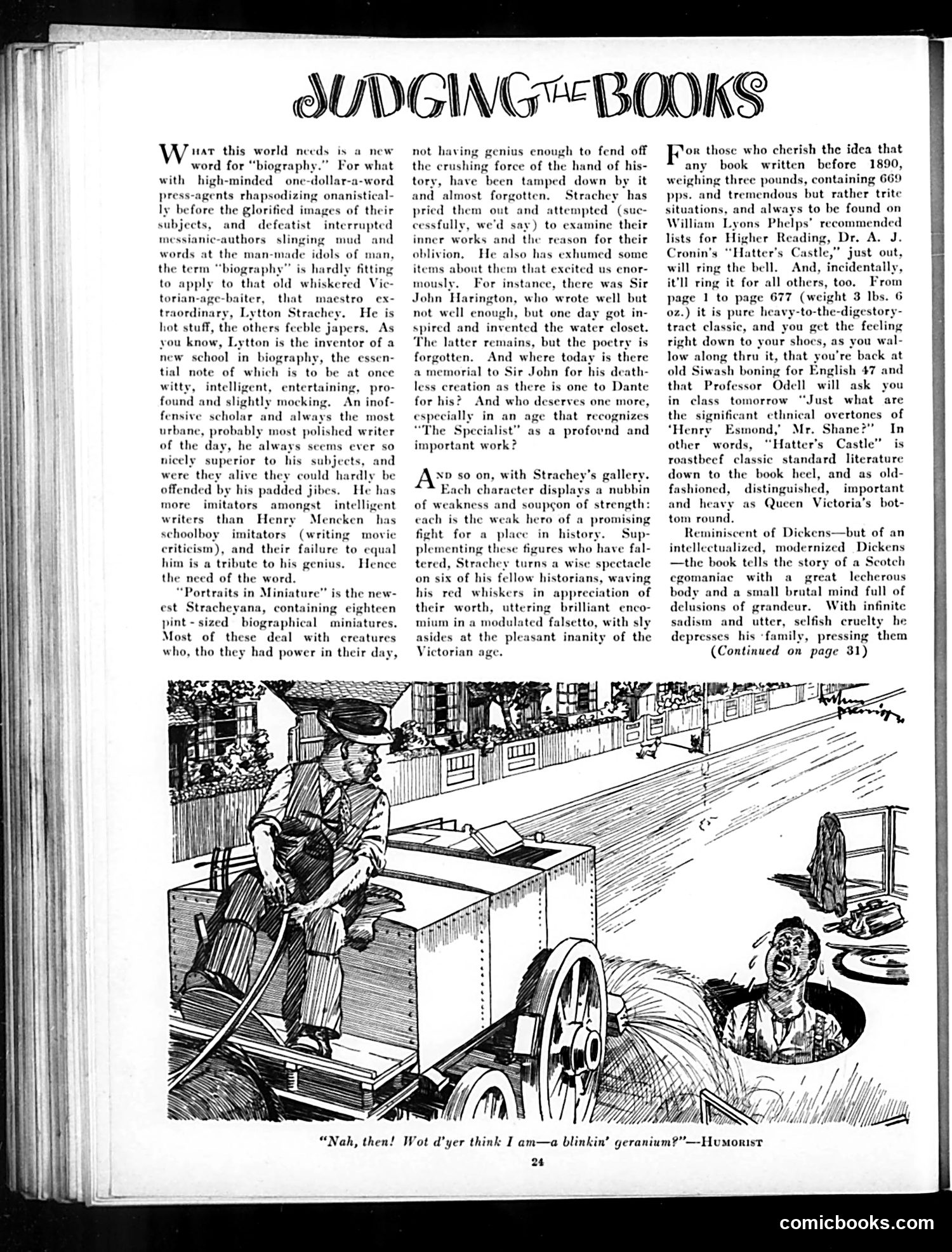
AUDGING“ BOOKS uat this world need word for “biography.”” For what minded one-dollar-a-word gents rhapsodizing onanist ly before the glorified ima subjects, and defeatist interrupted messianic-authors slinging mud and words at the man-made idols of man, the term “biography” is hardly fitting to apply to that old whiskered Vic- torian-age-baiter, that maestro ex- traordinary, Lytton St y. He is hot stuff, the others feeble japers, As you know, Lytton is the inventor of a new school in biog the essen- tial note of which is to be at once witty, intelligent, entertaining, pro- found and slightly mocking. An inof- fensive scholar and always the most urbane, probably most polished writer of the day, he always seems ever so nicely superior to his subjects, and were they alive they could hardly be offended by his padded jibes. He has more ors amongst intelligent writers than Henry Mencken schoolboy imitators (writing movie criticism), and their failure to equal him is a tribute to his genius. Hence the need of the word. “Portraits in Miniature” is the new- est Stracheyana, containing eighteen pint-sized biograph Most of these deal with creatures who, tho they had power in their d is a new has not having genius en to fend off the crushing force of the hand of his- tory, have been tamped down by it and almost forgotten. Strachey has pried them out and attempted (suc- cessfully, we'd say) to examine their inner works and the ason for their oblivion, He also has exhumed some items about them that excited us enor- mously. For instance, there was Sir John Har on, who wrote well but not well enough, but one day got in- spired and invented the water closet. The latter remains, but the poetry forgot And where today is there a memorial to Sir John for his death- less creation as there is one to Dante for his? And who deserves one more, especially in an age that recognizes “The Specialist” as a profovnd and important work? ey'’s gallery. a nubbin d soupgon of strength: rach is the weak hero of a promising fight for a place in history. Sup- plementing these figures who have tered, Strachey turns a wise spectacle on six of his fellow historians, waving his red whiskers in appreciation of their worth, uttering brillia mium in a modulated falsetto, y asides at the pleasant inanity of the Victorian age. q’onr those who cherish the idea that any book written before 1890, weighing three pounds, containing 669 pps. and tremendous but rather trite situations, and always to be found on William Lyons Phelps’ recommended lists for Higher Reading, Dr. A. J. Cronin’s “Hatter’s Castle,” just out, will ring the bell. And, incidentally, it'll ring it for all others, too. From page 1 to page 677 (weight 3 Ibs. 6 0z.) it is pure heavy-to-the-digestory- tract classic, and you get the feeling right down to your shoes, as you wal- low along thru it, that you're back at old Siwash boning for English $7 and that Professor Odell will ask you in class tomorrow “Just what are the significant ethnical overtones of ‘Henry Esmond,’ Mr. Shan other words, “Hatter’s roastbeef classic standard literature down to the book heel, and as old- fashioned, distinguished, important and heavy as Queen Victoria’s bot- tom round, Reminiscent of Dickens—but of an intellectua d, modernized Dickens —the book tells the story of a Scotch egomaniac with a great lecherous body and a small brutal mind full of delusions of grandeur. With infinite sadisin and utter, selfish cruelty he depresses his ‘family, pressing them (Continued on page 31) Y THs WH, “Nah, then! Wot d’yer think I am—a blinkin’ geranium?”—Humorist 24 comicbooks.com