
Judge, 1931-08-29 · page 24 of 36
Judge — August 29, 1931 — page 24: what you’re looking at
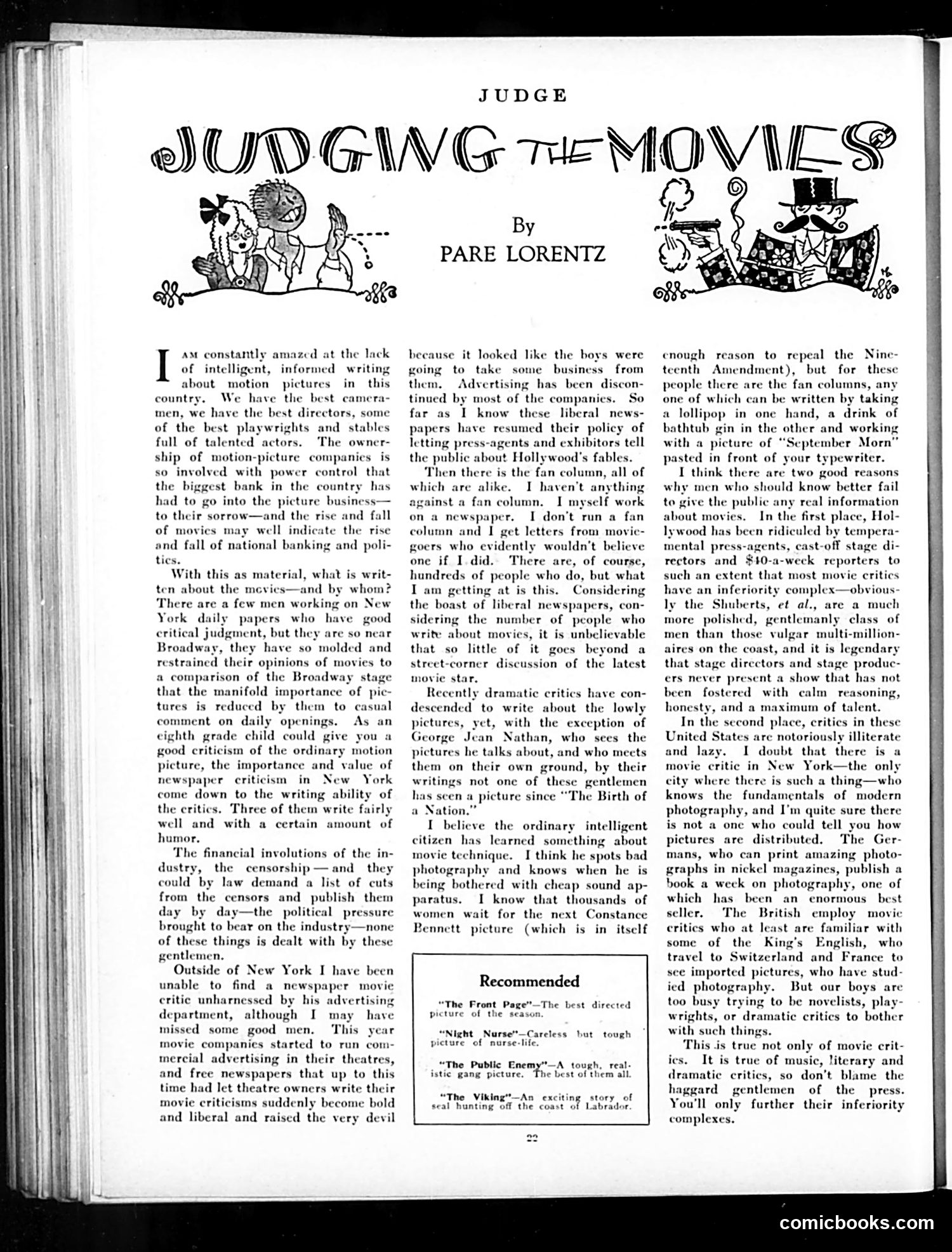
A restored page from Judge, 1931-08-29. Page through the whole issue in the reader above.
📄 Transcribed text from this page (OCR, searchable)
Machine-transcribed from the original scan — historical spelling and the odd misread are preserved.
aM constantly nzed at the lack of intelligent, informed writing about motion pictures in this country. We have the best camera- men, we have the best directors, some of the best playwrights and stables full of talented actors. The owner- ship of motion-picture companies is so involved with power control that the biggest bank in the country has had to go into the picture business— to their sorrow—and the rise and fall of movics may well indicate the rise and fall of national banking and poli- tics. With this as material, what is writ- ten about the mevies—and by whom? There are a few men working on New York daily papers who have good critical judgment, but they are so near Broadway, they have so molded and restrained their opinions of movies to a comparison of the Broadway stage that the manifold importance of pic- tures is reduced by them to casual comment on daily openings. As an eighth grade child could give you a good criticism of the ordinary motion picture, the importance and value of newspaper criticism in York come down to the writing the critics. Three of them write fairly well and with a certain amount of humor. The financial involutions of the in- dustry, the censorship — and they could by law demand a list of cuts from the censors and publish them day by day—the political pressure brought to bear on the industry—none of these things is dealt with by these gentlemen. Outside of New York I have been unable to find a newspaper movie critic unharnessed by his advertising spartment, although I may missed some good men. This mercial advertising in their theatres, and free newspapers that up to this time had let theatre owners write their movie criticisms suddenly become bold and liberal and raised the very devil JUDGE because it looked like the boys were going to take business from them. Advertising has been discon- tinued by most of the companies. So far as I know these liber: papers have resumed their po letting press-agents and exhibitors tell the public about Hollywood's fables. Then there is the fan column, all of which are alike. I haven't anything inst a fan column. I myself work on a newspaper. I don’t run a fan column and I get letters from movie- goers who evidently wouldn't believe one if I did. There are, of course, hundreds of people who do, but what I am getting at is this. Considering the boast of liberal newspapers, con- sidering the number of people who write about movies, it is unbelievable that so little of it gocs beyond a street-corner discussion of the latest movie star, Recently dramatic critics have con- descended to write about the low pictures, yet, with the exception o George Jean Nathan, who sees the pictures he talks about, and who meets 1 on their own ground, by. their gs not one of these gentlemen as seen a picture s The Birth of some ion.” I believe the ordinary intelligent citizen has learned something about movie technique. I think he spots bad photography and knows when he is being bothered with cheap sound ap- paratus. I know that thousands of women wait for the next Constance Bennett picture (which is in itself Recommended “The Front Page"—The best directed picture of the seas “Night Nurse”’—Careless but tough picture of nurse-life. “The Public Enemy —A tough, real- istic gang picture. best of them all. “The Viking"—An excitini story, of seal hunting off the coast Labrador enough reason to repeal the Nine- teenth Amendment), but for these people there are the fan columns, any one of which can be written by taking a lollipop in one hand, a drink of bathtub gin in the other and working with a picture of “September Morn” pasted in front of your typewriter. I think there are two good reasons why men who should know better fail to give the public real information about movies. In the first place, Hol- lywood has been ridiculed by tempera mental press-agents, cast-off stage di- rectors and $40-a-weck reporters to such an extent that most movie critics have an inferiority complex—obvious- ly the Shuberts, et al., are a much more polished, gentlemanly class of men than those vulgar multi-million- aires on the it is legendary and stage produc ers never present a show that has not been fostered with calm reasoning, honesty, and a maximum of talent. In the second place, critics in these United States are notoriously illiterate and lazy. I doubt that there is a movie critic in New York—the only city where there is such a thing—who knows the fundamentals of modern photography, and I'm quite sure there is not a one who could tell you how pictures are distributed. The Ger- mans, who can print amazing photo- graphs in nickel magazines, publish a book a week on photography, one of which has been an enormous best seller. The British employ movie critics who at © familiar with some of the King glish, who travel to Switzerland and France to sce imported pictures, who have stud- ied photography. But our boys are too busy trying to be novelists, play- wrights, or dramatic critics to bother with such things. This is true not only of movie crit- ics. It is true of music, literary and dramatic critics, so don’t blame the haggard gentlemen of the pri You'll only further their inferiority complexes. comicbooks.com