
Judge, 1931-08-29 · page 18 of 36
Judge — August 29, 1931 — page 18: what you’re looking at
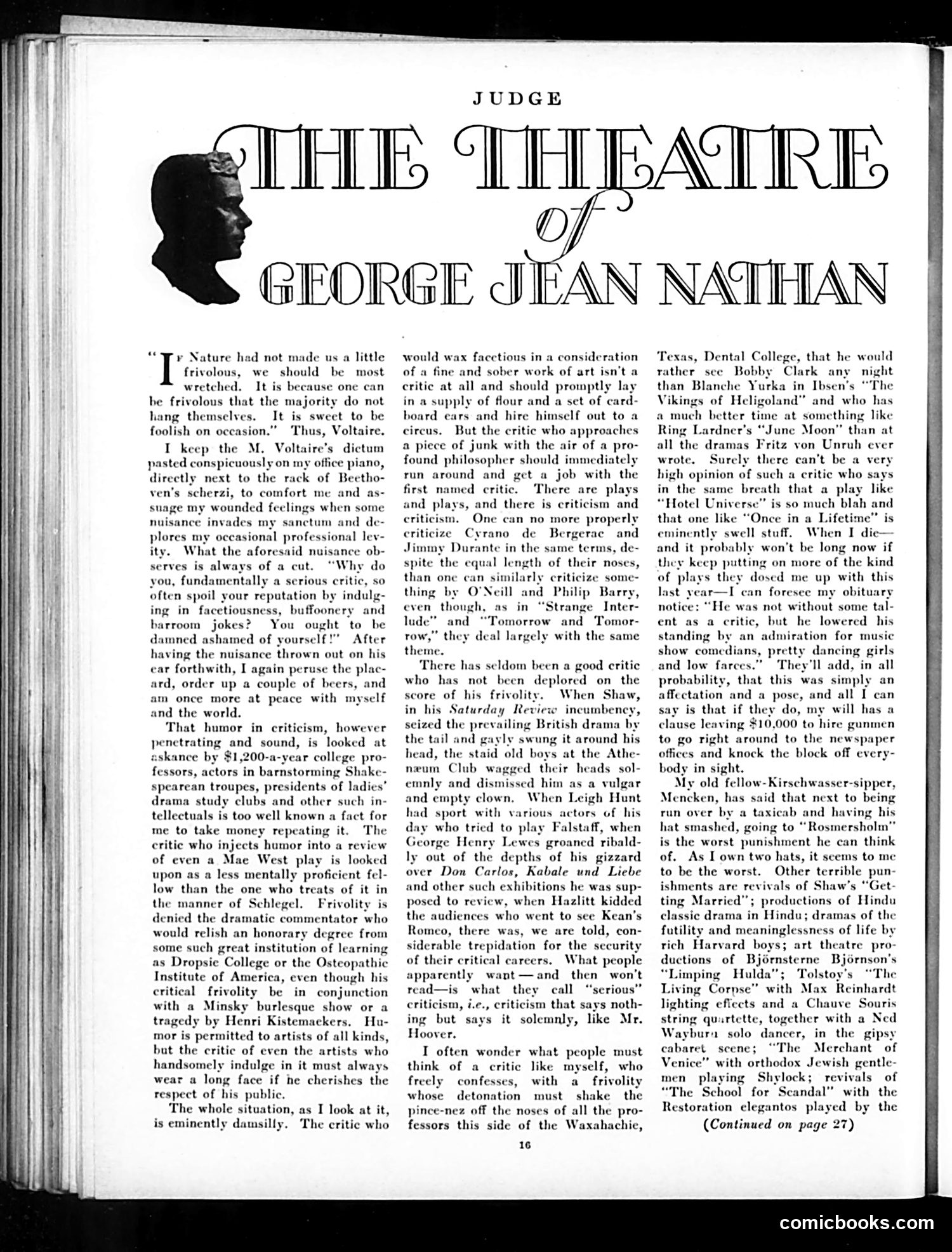
A restored page from Judge, 1931-08-29. Page through the whole issue in the reader above.
📄 Transcribed text from this page (OCR, searchable)
Machine-transcribed from the original scan — historical spelling and the odd misread are preserved.
I GEORGE J y Nature had not made us a little frivolous, we should be most wretched. It is because one can he frivolous that the majority do not hang themselves. It is sweet to be foolish on o Thus, Voltaire. I keep the M. Voltaire’s dictum pasted conspicuously on my office piano, directly next to the rack of Beetho- ven's scherzi, to comfort me and as- suage my wounded feelings when some nuisance invades my sanctum and de- plores my occasional professional lev- i What the aforesaid nu serves is always of a cut. you, fundamentally a serious critic often spoil your reputation t ing in facetiousness, buffoonery and barroom jokes? You ought to be damned ashamed of yourself!" After having the nuisance thrown out on his car forthwith, I again peruse the plac- ard, order up a couple of beers, and am once more at peace with myself and the world. That humor in er m, however etrating and sound, is looked at kance by $1,200-a-year college pro- fessors, actors in barnstorming Shake- spearean troupes, presidents of ladies’ drama study clubs and other such in- tellectuals is too well known a fact for me to take money repeating it. The critic who injects humor into a review of even a Mae West play is looked upon as a less mentally proficient fel- low than the one who treats of it in the manner of Schlegel. Frivolity is denied the dramatic commentator who would relish an honorary degree from some such great institution of learning as Dropsie College or the Osteopathic Institute of America, even though his critical frivolity be in conjunction with a Minsky burlesque show or a tragedy by Henri Kistemackers. Hu- mor is permitted to artists of all kinds, but the critic of even the artists who handsomely indulge in it must alw wear a long face if he cherishes the respect of his pul The whole situation, as I look at it, is eminently damsilly. The critic who sion.” indulg- would wax facetious in a consideration of a fine and sober work of art isn’t a critic at all and should promptly lay in a supply of flour and a set of card- hoard ears and hire himself out to a circus. But the critic who approaches a piece of junk with the air of a pro- found philosopher should immediately run around and get a job with the first named critic. There are plays and plays, and there is criticism and One can no more properly criticize Cyrano de Bergerac and Jimmy Durante in the same terms, de- spite the equal length of their noses, than one can similarly criticize some- thing by O'Neill and Philip Barry, even though, as in “Strange Inter- lude” and “Tomorrow and Tomor- row,” they deal largely with the same theme. There has seldom been a good critic who not been deplored on the score of his frivolity. When Shaw, in his Saturday Review incumbency, seized the prevailing British drama by the tail and gayly swung it around his head, the staid old boys at the Athe- neum Club wagged their heads sol- emnly and dismissed him as a vulgar and empty clown. When Leigh Hunt had sport with various ay who tried to play Falstaff, when eorge Henry Lewes groaned ribald- ly out of the depths of his gizzard over Don Carlos, Kabale und Liebe and other such exhibitions he was sup- posed to review, when Hazlitt kidded the audiences who went to see Kean's Romeo, there was, we are told, con- siderable trepidation for the security of their critical careers. What people apparently then won't i “serious” cism, i.e., criticism that says noth- ing but says it solemnly, like Mr. Hoover. ‘ors of his I often wonder what people must think of a critic like myself, who freely confesses, with a frivolity whose detonation must shake the pince-nez off the noses of all the pro- fessors this side of the Waxahachie, 16 AXE NATHAN | Texas, Dental College, that he would rather see Bobby Clark any night than Blanche Yurka in Ibsen's “The Vikings of Heligoland” and who has a much better time at something like Ring Lardner’s “June Moon” than at all the dramas Fritz von Unruh ever wrote. Surely there can’t be a very high opinion of such a critic who s in the same breath that a play 1 “Hotel Universe” is so much blah and that one like “Once in a Lifetime” is eminently swell stuff. When I die— and it probably won't be long now if on more of the kind ned me up with this ee my obituary s not without some ent as a critic, but he lowered his standing by an admiration for music show comedians, pretty dancing girls and low farces.” They'll add, in all probability, that this simply an affectation and a pose, and all I can is that if they do, my will has a clause leaving $10,000 to hire gunmen to go right around to the newspaper offices and knock the block off every- body in sight. My old fellow-Kirschwasser-sipper, Mencken, has said that next to being run over by a taxicab and having his hat smashed, going to “Rosmersholm” is the worst punishment he can think of. As I own two hats, it seems to me to be the worst. Other terrible pun- ishments are revivals of Shaw's “Get- ting Married”; productions of Hindu classic drama in Hindu; dramas of the futility and meaninglessness of life by rich Harvard boys; art theatre pro- ductions of Bjérnsterne Bjérnson’s “Limping Huld Tolstoy's “The Living Corpse” with Max Reinhardt nting eflects and a C i string quurtette, together with a Ned Waybura solo dancer, in the gipsy cabaret scene; “The Merchant of Venice” with orthodox Jewish gentle- men playing Shylock; revivals of “The School for Scandal” with the Restoration clegantos played by the (Continued on page 27) comicbooks.com