A complete issue · 36 pages · 1931
Judge — March 28, 1931
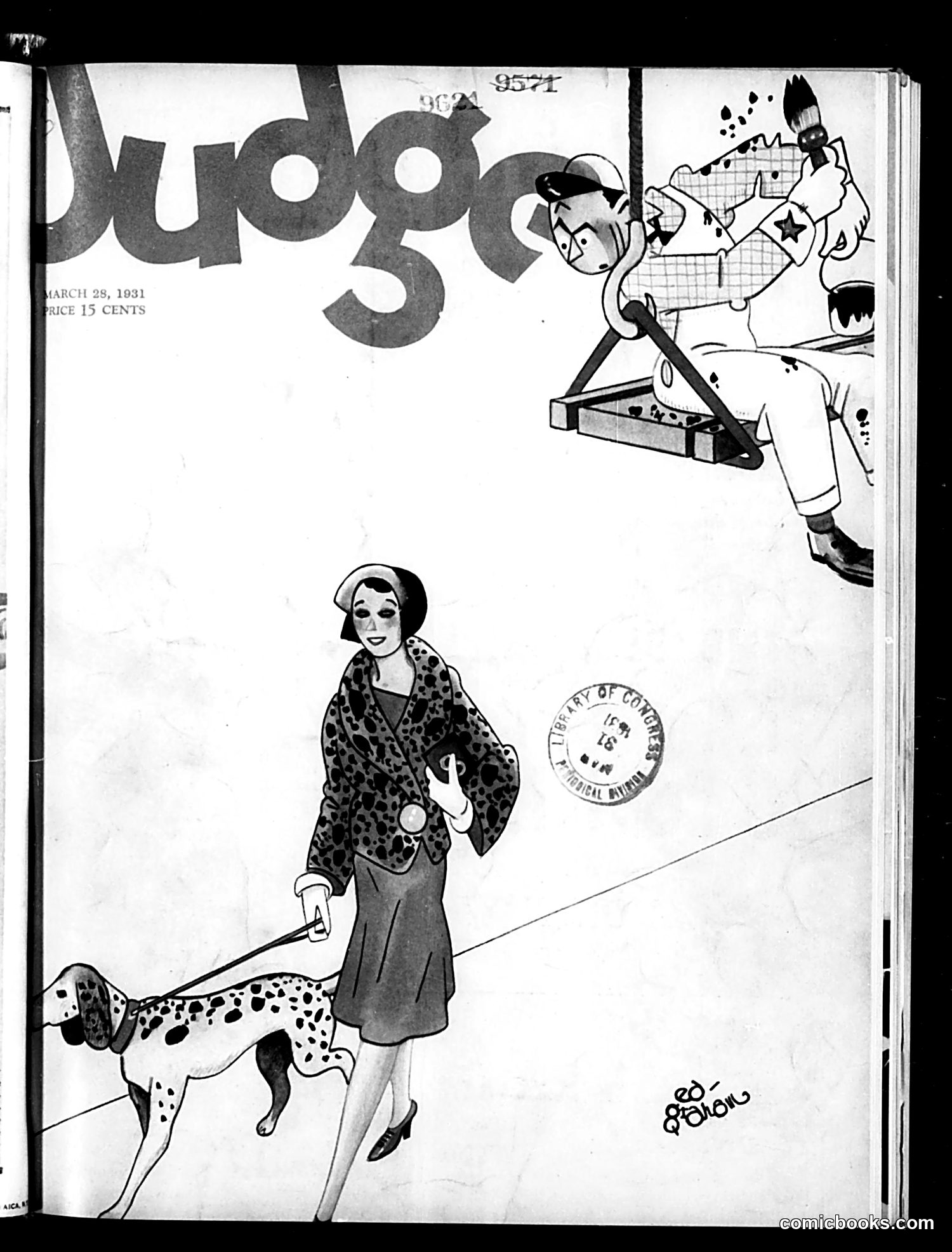
# Judge Magazine Cover Analysis — March 28, 1931 This cover satirizes **1930s fashion and gender roles**. The lower illustration shows a stylish woman in a patterned coat walking a spotted dog—a familiar leisure activity for affluent women of the era. The upper cartoon depicts a man in casual attire operating what appears to be **a surveying or construction tool**, suggesting manual labor or outdoor work. The juxtaposition appears to mock the **contrast between idle leisure (represented by the fashionable woman) and productive work (the laboring man)**. Given the 1931 date, this likely reflects **Great Depression-era anxieties about class, gender roles, and economic productivity**—satirizing the perceived frivolity of wealthy women's pursuits against the backdrop of widespread male unemployment and economic hardship.
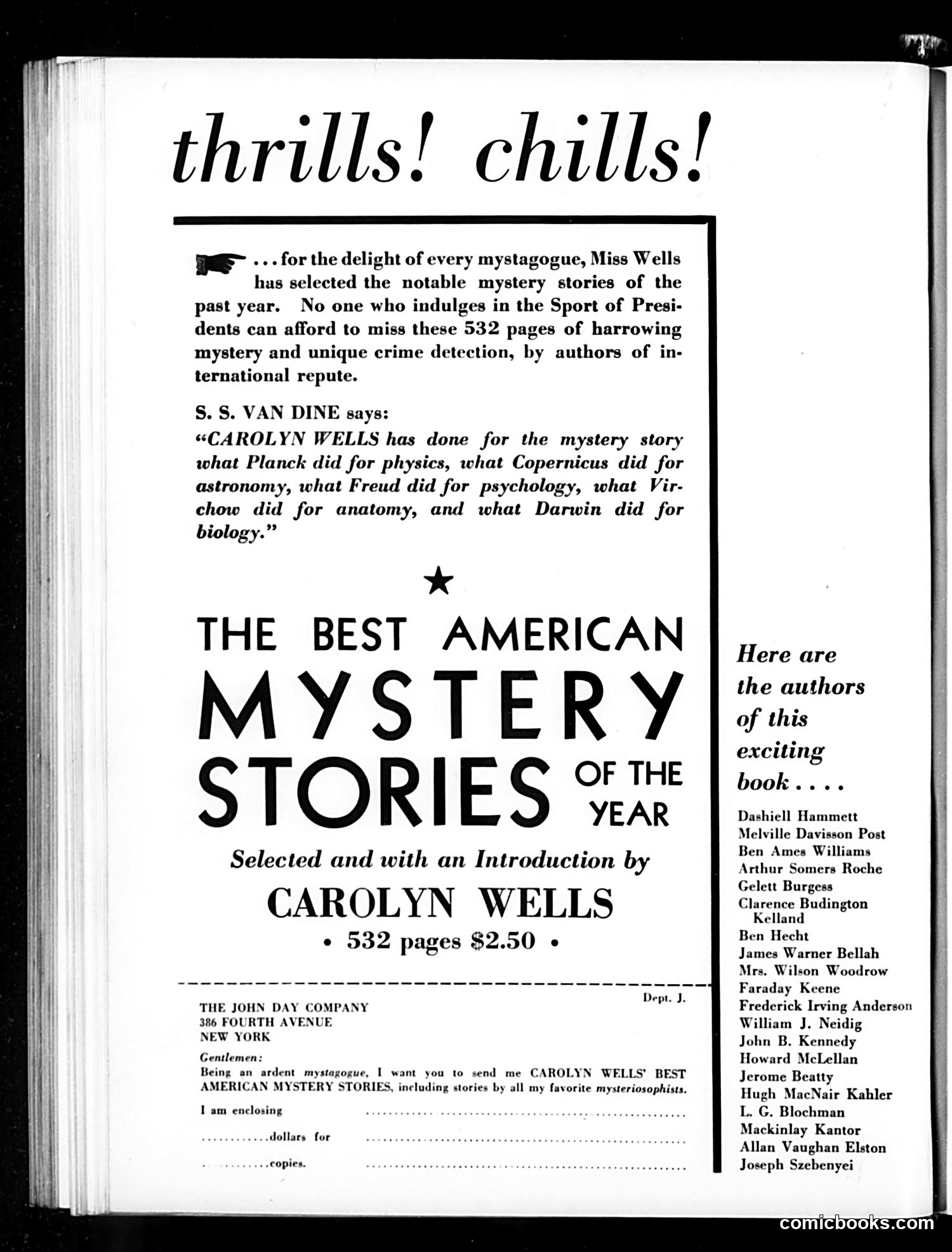
# Analysis This page is **primarily advertising**, not satire or political content. It's a book advertisement for "The Best American Mystery Stories of the Year," selected by Carolyn Wells, published by The John Day Company in New York. The page uses promotional techniques typical of the era: - **Endorsement quote** from S.S. Van Dine comparing Wells's contributions to mystery fiction with major scientific figures (Planck, Darwin, etc.) - **List of contributing authors** including well-known names like Ben Hecht and Jerome Beatty - **Mail-order coupon** for customers to purchase the 532-page book for $2.50 There are no political cartoons or satirical elements visible. This is straightforward commercial advertising using credibility-building quotes and famous authors' names to market an anthology to mystery enthusiasts.
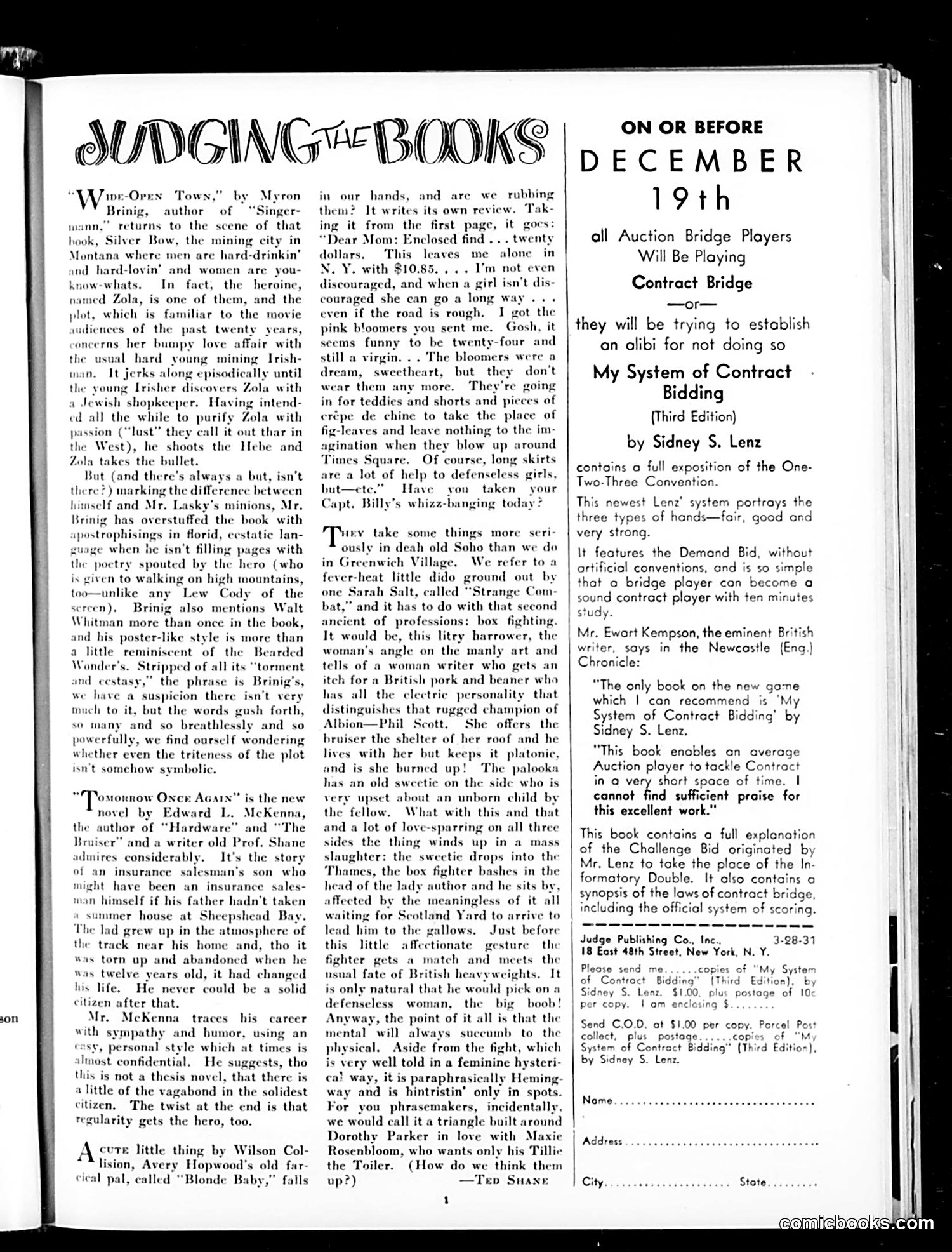
# Analysis of Judge Magazine Page This page is primarily **book reviews** rather than political satire or cartoons. The "Judging the Books" section reviews recent novels including: - "Wide Open Town" by Myron Brinig (about hard-drinking men and women in Montana) - "Tomorrow Once Again" by Edward L. McKenna (an insurance salesman's son in Shepherd's Bush, London) - "Blonde Baby" by Wilson Collison (a farce set in Greenwich Village) The right column contains **advertisements** for contract bridge instruction books, promoting Sidney S. Lenz's bidding system ahead of an Auction Bridge Players event on December 19th. This appears to be a standard magazine issue mixing literary criticism with instructional advertisements—no political commentary or satirical cartoons are evident on this particular page.
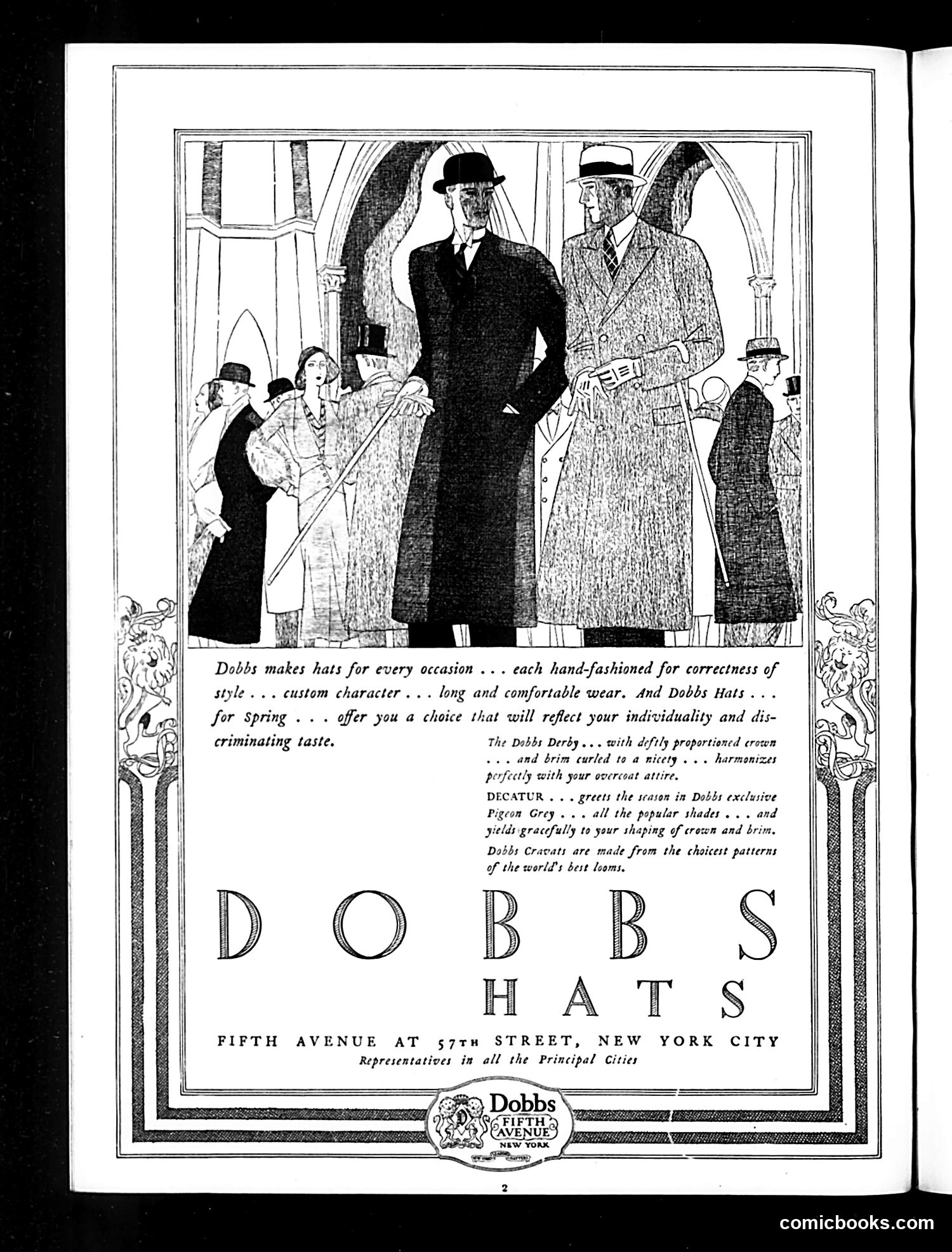
# Analysis This is primarily a **fashion advertisement**, not a political cartoon. The image shows well-dressed men and women in 1920s attire examining hats at what appears to be an elegant interior space. The ad copy emphasizes that Dobbs hats are "hand-fashioned for correctness of style" and offers variety for "every occasion." It highlights specific models: the "Dobbs Derby" (with proportioned crown and brim), "Decatur," and "Pigeon Grey" (in various shades). The satirical element, if present, is subtle—perhaps mocking the pretension of high-fashion hat-buying culture or the notion that hats reflect "individuality and discriminating taste." However, the page functions primarily as a luxe advertisement for Dobbs Hats, located at Fifth Avenue and 57th Street in New York City, with representatives in major cities.
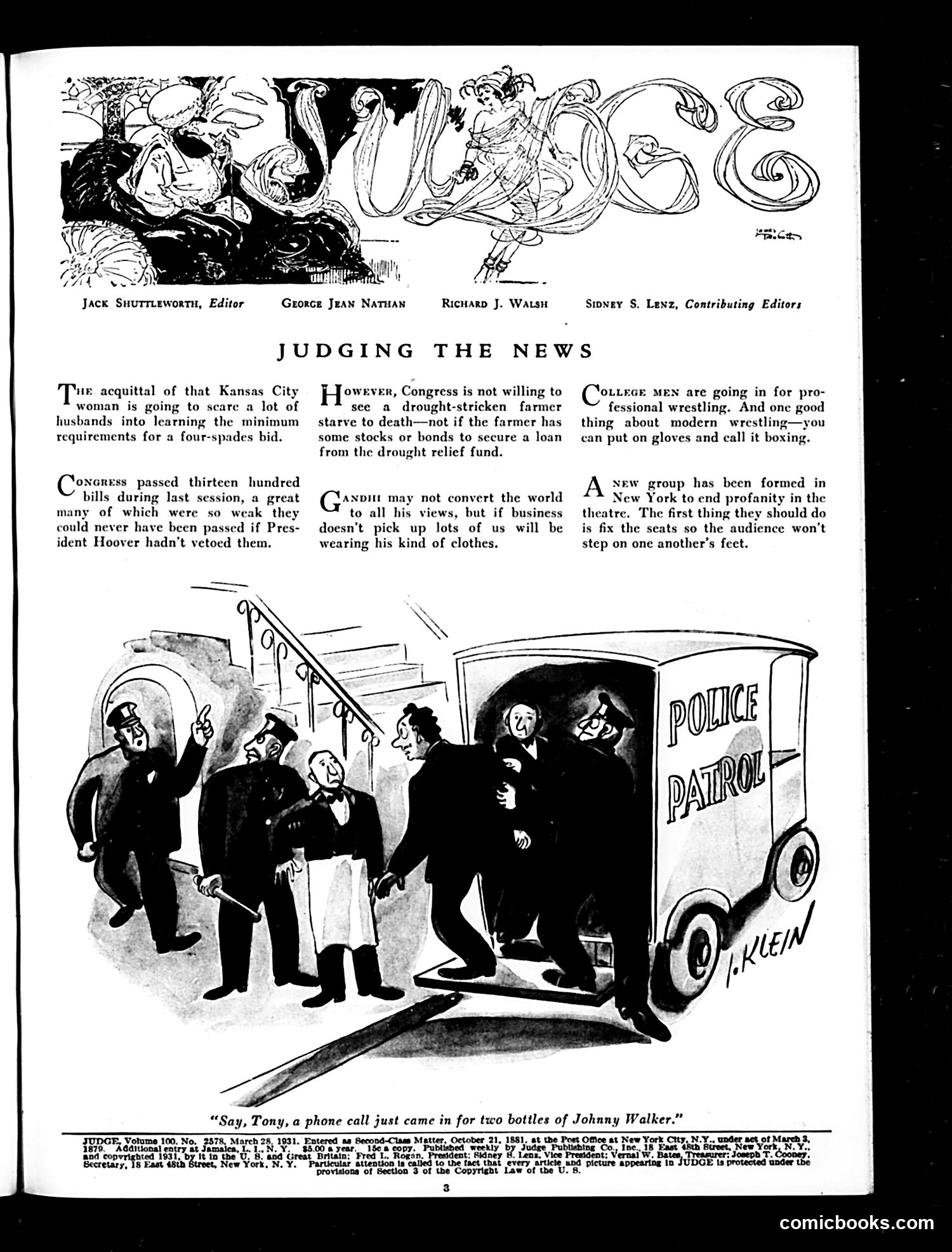
# "Judge" Page Analysis - October 31, 1931 This satirical page critiques contemporary issues through brief commentary and a cartoon. The main cartoon depicts police bundling two men into a "Police Patrol" wagon while officers outside discuss "a phone call just came in for two bottles of Johnny Walker"—referencing Prohibition-era bootlegging. The surrounding commentary touches on: - A Kansas City woman suing her husband over inadequate financial support - Congress's weakness in passing legislation President Hoover might veto - Drought relief funds and farm loans - Gandhi's non-cooperation with Western business practices - A new anti-profanity theater group in New York The cartoon's humor centers on police hypocrisy: authorities arrest citizens while themselves engaged in the illegal alcohol trade they're supposedly enforcing against.
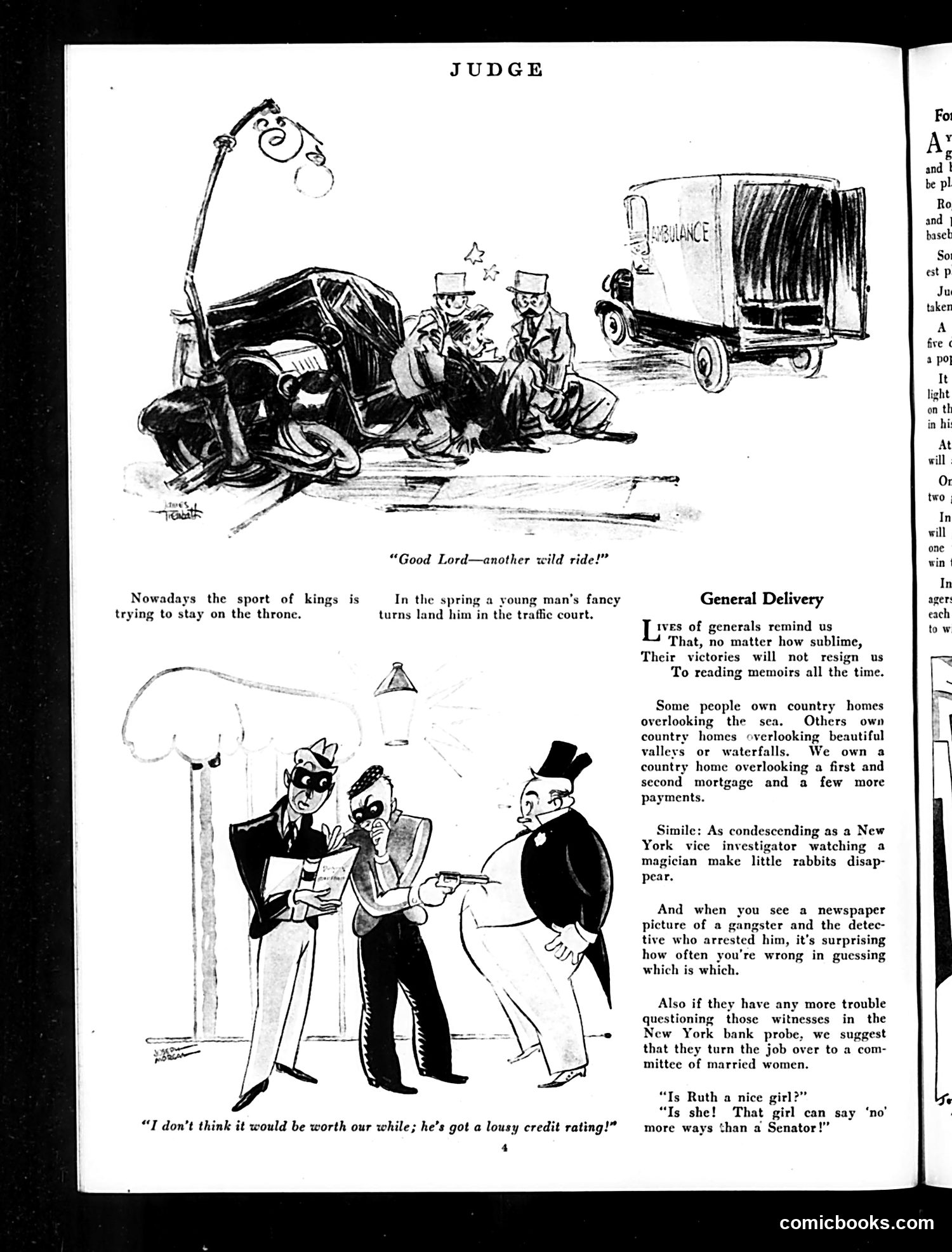
# Analysis of Judge Magazine Page **Top Cartoon ("Good Lord—another wild ride!"):** This depicts a car accident with an ambulance arriving. The satire mocks reckless driving as "the sport of kings"—wealthy elites treating dangerous driving like aristocratic entertainment. The joke references spring as "a young man's fancy turns [him] in the traffic court," suggesting wealthy men face traffic violations rather than serious consequences. **Bottom Cartoon ("I don't think it would be worth our while..."):** Three men in formal dress discuss credit. One appears to be a creditor or banker rejecting a loan applicant, saying he has "a lousy credit rating." The satire comments on financial desperation or fraud during economically uncertain times. **"General Delivery" section:** Humorous commentary on human vanity and self-deception, comparing people's inflated self-images to actual reality.
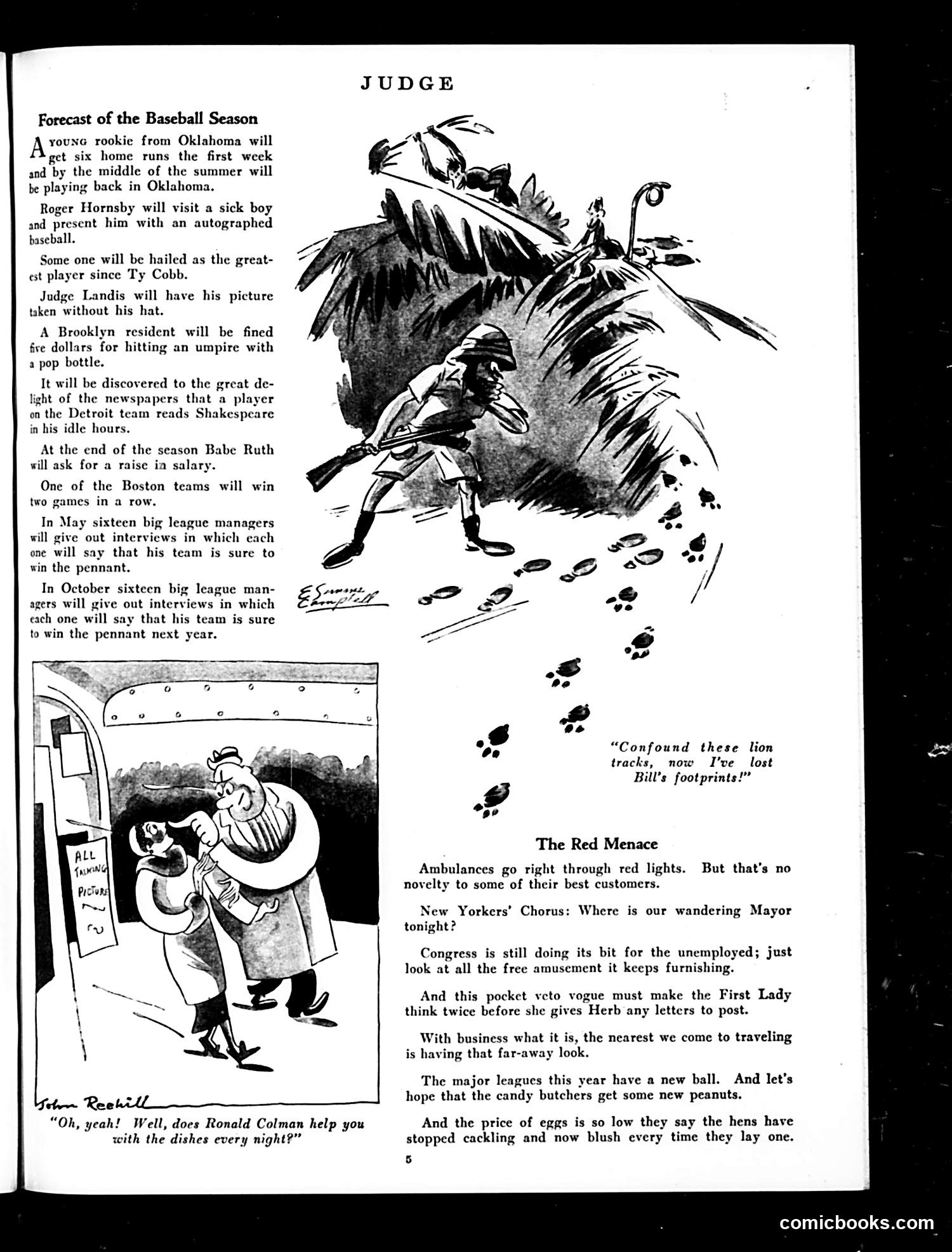
# Analysis of Judge Magazine Page This page contains two satirical pieces: **"Forecast of the Baseball Season"** lists humorous predictions about 1920s baseball, including jokes about rookies, famous players like Babe Ruth and Judge Landis, and umpire behavior. **"The Red Menace"** section critiques contemporary politics with biting commentary. It references the "wandering Mayor" (likely Mayor Jimmy Walker of New York), Congress's unemployment relief efforts, presidential veto power ("pocket veto vogue"), and economic issues like egg prices and hen productivity. The cartoons are lighter—one depicts someone asking "Ronald Colman" (a silent film star) for dishwashing help, likely mocking celebrity culture or labor shortages of the era. The satire targets government incompetence, economic anxiety, and celebrity obsession typical of post-WWI American society.
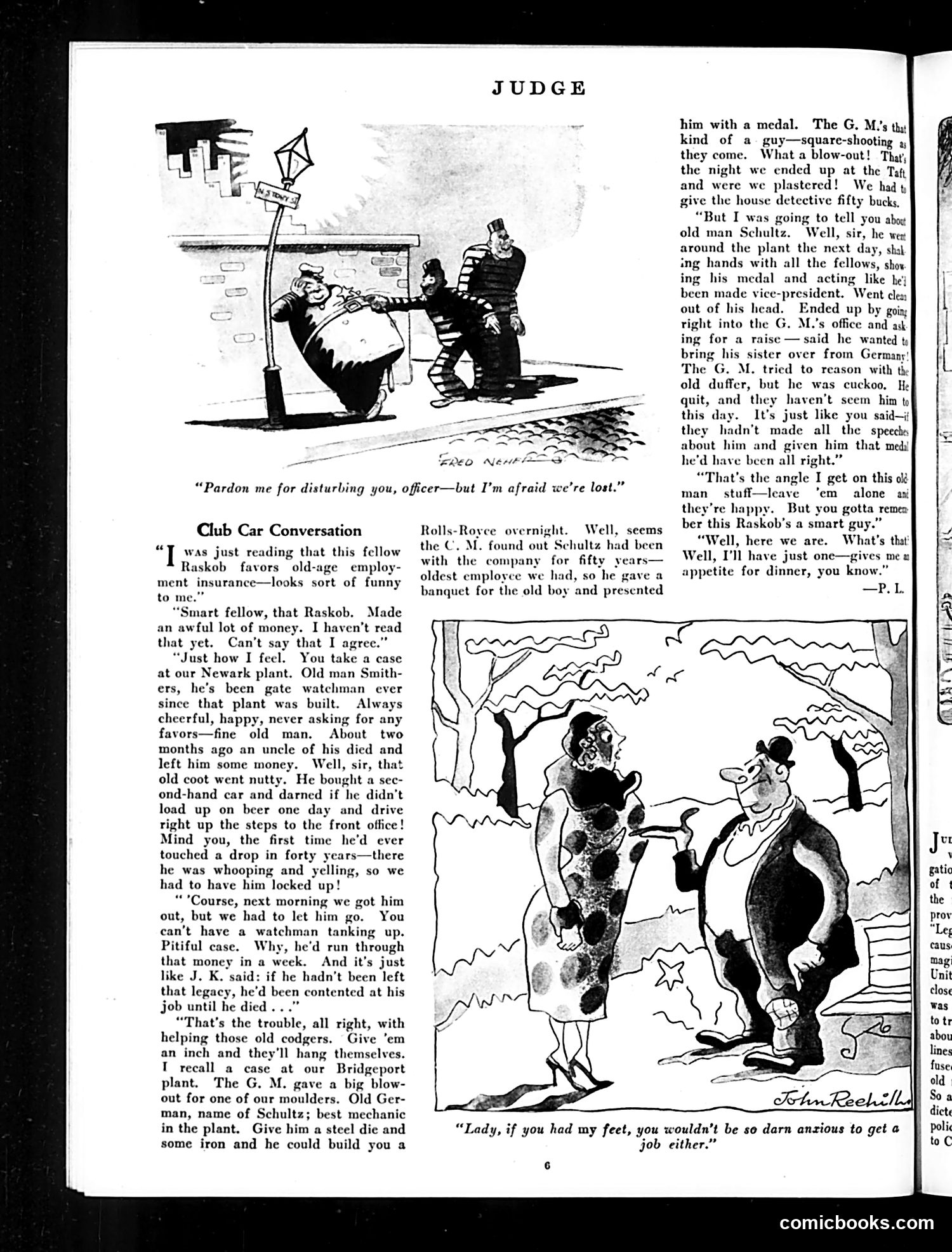
# Analysis of Judge Magazine Page This page contains two separate items: **Top Cartoon:** A street scene where a disheveled police officer addresses two men near a street lamp, saying "Pardon me for disturbing you, officer—but I'm afraid we're lost." The humor appears to be visual—the officer looks more disoriented or drunk than the civilians asking directions. **"Club Car Conversation":** A multi-paragraph anecdote about an old employee named Raskok at a Newark plant who unexpectedly received money from a deceased uncle's will. The story humorously contrasts his sudden wealth with his lifelong modest circumstances—he bought a car, drove recklessly, and ultimately had to be locked up. The satire targets nouveau riche behavior and the chaos that sudden wealth can cause. **Bottom Cartoon:** Two figures in winter, one saying "Lady, if you had my feet, you wouldn't be so darn anxious to get a job either."
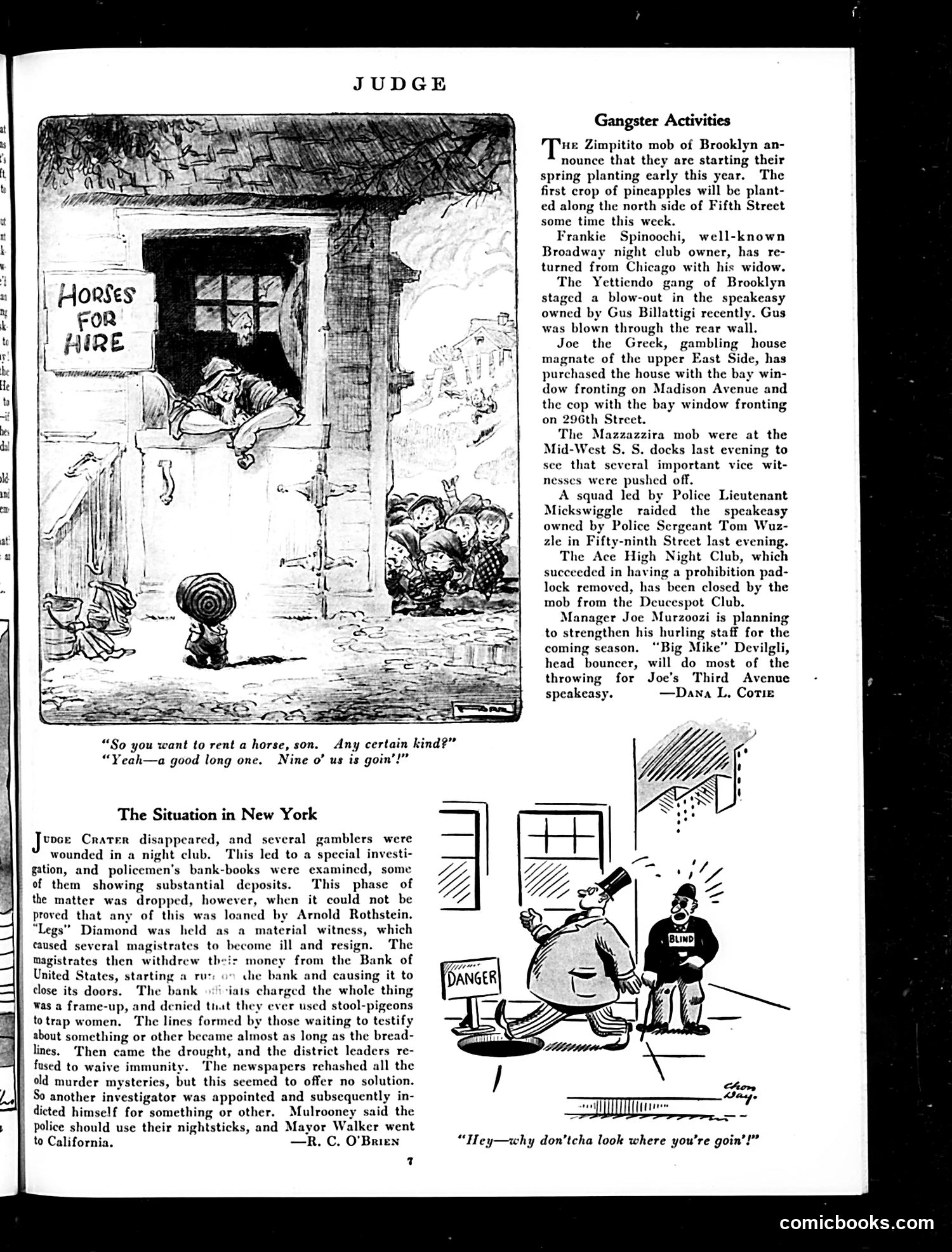
# Judge Magazine Satire: Prohibition-Era Corruption This page satirizes 1920s organized crime and judicial corruption during Prohibition. The "Gangster Activities" section uses mock-serious reporting on Brooklyn mob violence—murders disguised as euphemisms ("pineapples" for bombs, witnesses "pushed off" docks)—to mock both gangster brutality and police indifference. The main cartoon shows a horse-rental shop where someone needs "a good long one. Nine o' us is goin'"—dark humor about gang executions or violence requiring multiple conspirators. "The Situation in New York" recounts real scandals: Judge Crater's disappearance, "Legs" Diamond's involvement in organized crime, and widespread police corruption (bank deposits from bribes). It satirizes the system's failure—investigations collapse, magistrates resign rather than prosecute, and even new investigators get indicted. Mayor Jimmy Walker's retreat to California caps the absurdist portrait of civic breakdown under Prohibition. The satire's point: law enforcement and judiciary are wholly compromised by organized crime.
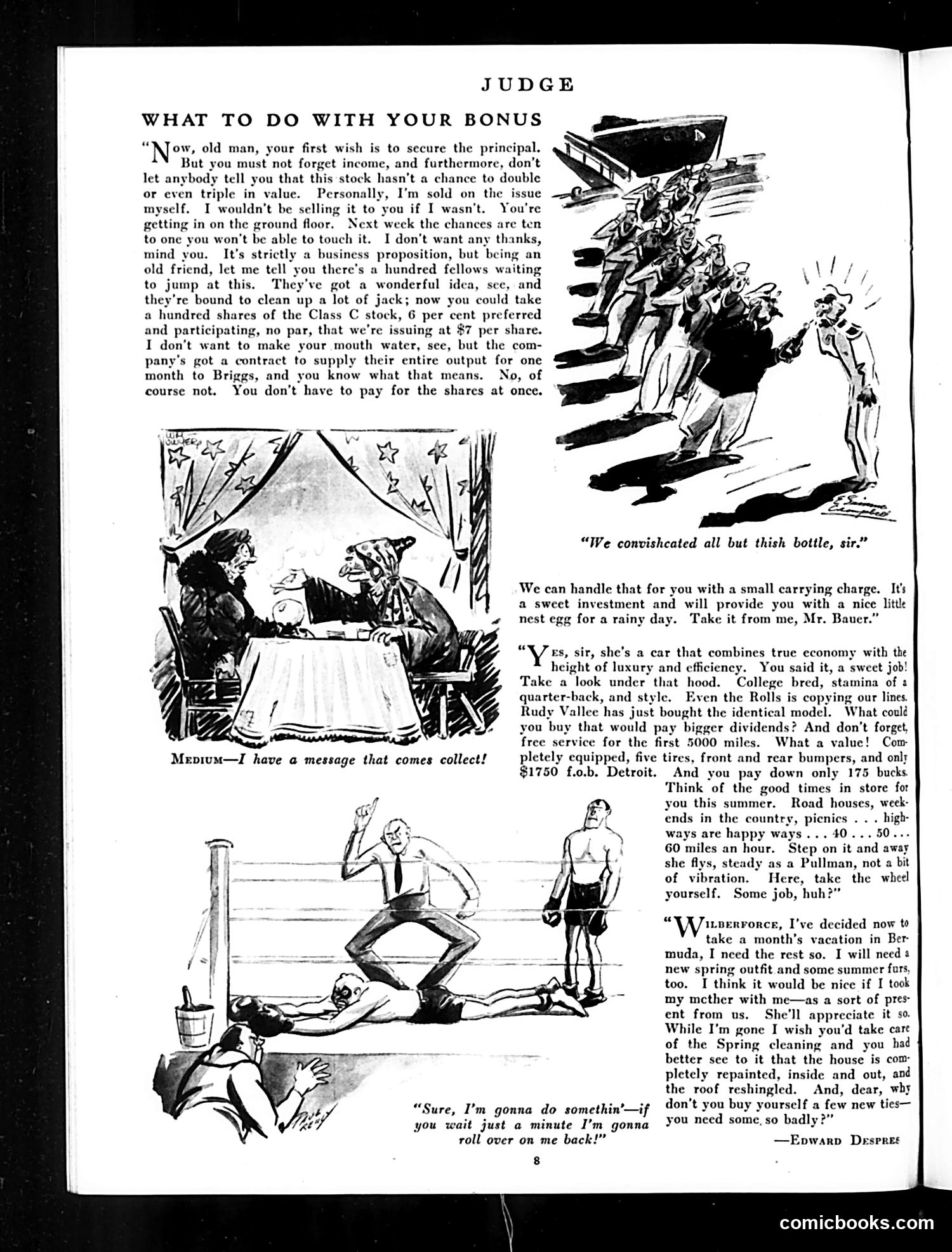
# Analysis: "What to Do With Your Bonus" This Judge page satirizes the get-rich-quick schemes and aggressive sales pitches that proliferated after workers received bonuses (likely post-WWI or during the 1920s boom). The main cartoon depicts a slick salesman convincing an older man to invest his bonus in dubious stock. The salesman uses classic high-pressure tactics: claiming the stock will "double or triple," insisting others are waiting to buy it, and offering payment plans so the buyer won't feel the cost immediately. The humor lies in recognizing this as obviously predatory—the salesman admits he's "sold on the issue" while simultaneously selling it away. The accompanying vignettes mock similar overconfidence: an overpriced car advertised with unrealistic promises, and a wife's frivolous spending plans (Bermuda vacation, furs, home renovations). Together, these satirize the era's rampant consumerism and naive financial decisions among newly prosperous ordinary people—the satirical point being that bonuses were being squandered on inflated investments and luxury purchases rather than prudently saved.
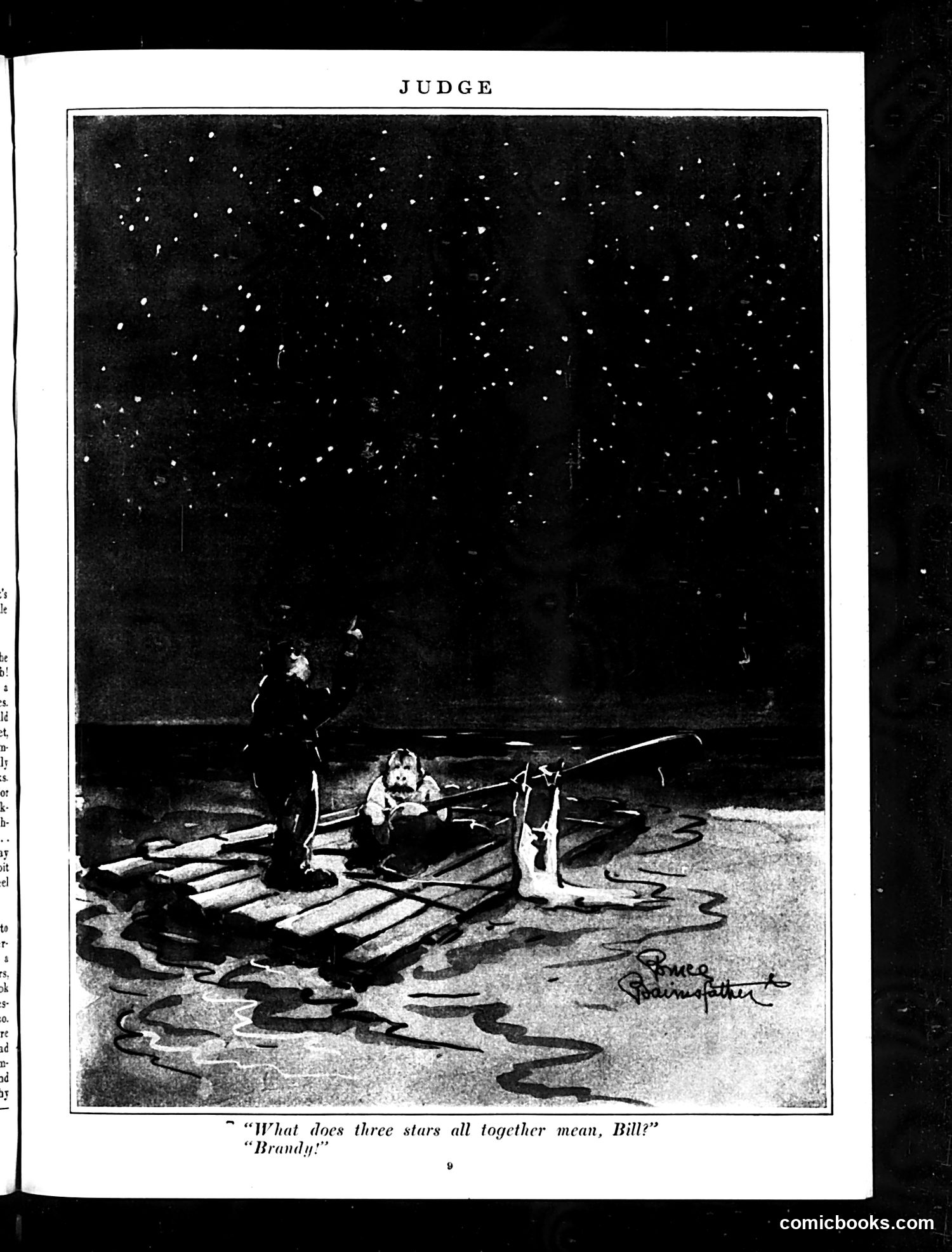
# Judge Cartoon Analysis This cartoon depicts two figures examining logs under a starry night sky. The dialogue joke plays on a double meaning: one character asks what "three stars all together" signify, and the other responds "Brandy!" The humor appears to reference brandy grading systems, where stars (★★★) indicate quality levels—three stars typically denoting high-quality brandy. The rural setting with logs suggests woodsmen or laborers who would recognize this commercial designation. The cartoon satirizes either working-class unfamiliarity with luxury goods, or conversely, the unexpected knowledge of alcohol ratings among ordinary people. The starlit backdrop emphasizes the "stars" pun. Without additional context, the specific satirical target remains unclear, though it likely comments on class, consumption, or Prohibition-era attitudes toward alcohol.
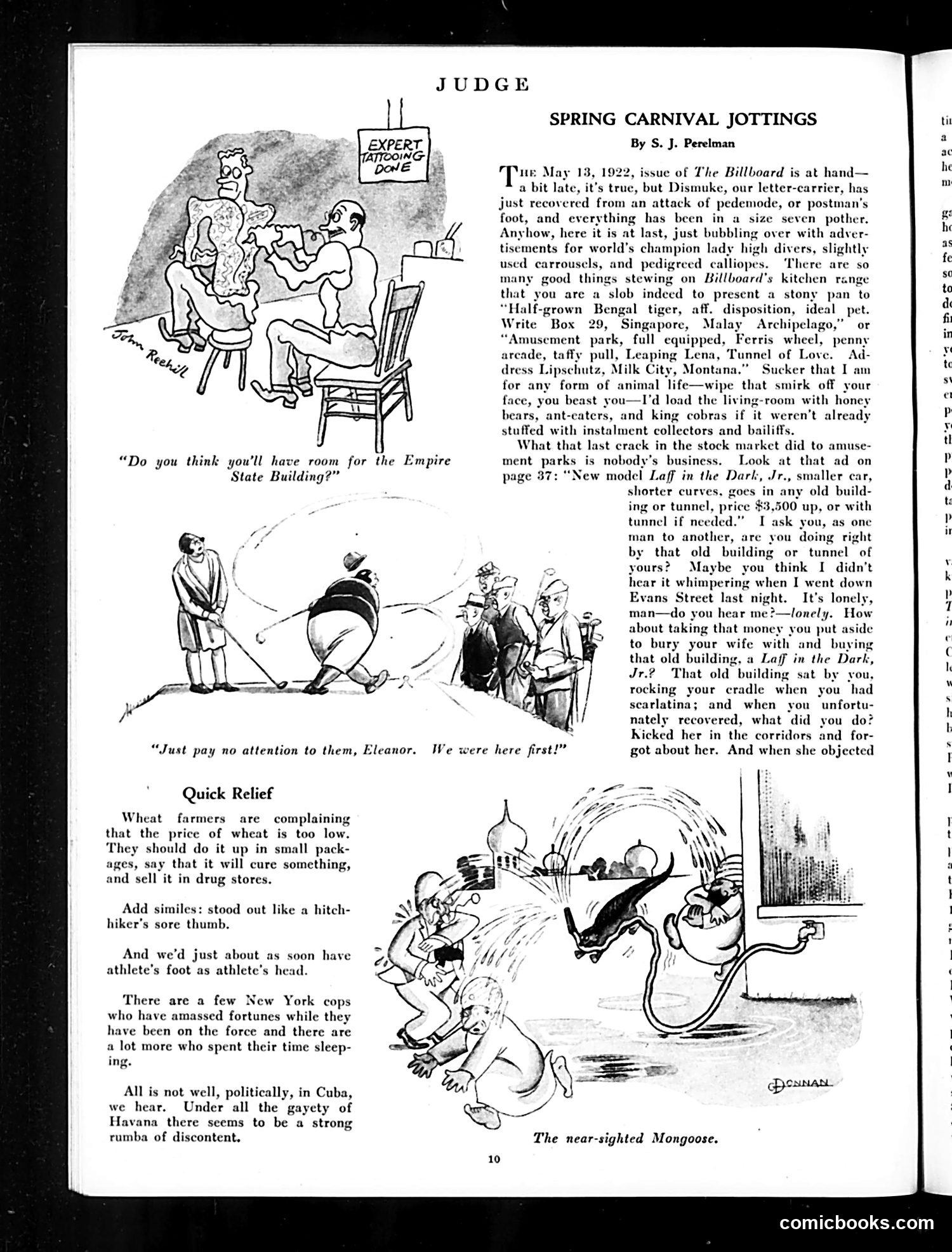
# Spring Carnival Jottings Analysis This page features **satirical commentary by S.J. Perelman** (humorist and future screenwriter) on the May 13, 1922 *Billboard* magazine and broader 1920s economic/social issues. ## Main Cartoons: **Top cartoon**: Two figures discuss the "Empire State Building"—likely satirizing New York's real-estate boom and speculation during the 1920s construction era. **Bottom cartoon**: "The near-sighted Mongoose"—appears to be social satire, though the specific reference is unclear without additional context. ## Textual Satire: Perelman mocks *Billboard's* classified ads for amusement park equipment and exotic animals, using absurdist humor to critique post-war consumer culture and stock market volatility ("What that last crack in the stock market did to amusement parks"). The "Quick Relief" section satirizes contemporary problems: wheat price complaints, police corruption in New York, and Cuban political unrest—typical 1922 news topics treated with tongue-in-cheek commentary. The humor depends on readers' familiarity with current events and period anxieties about commerce and urban development.